Cost & Savings Articles
Tile cutter rental vs buying: count charged periods
Compare invented purchase and rental costs by charged period, distinguish returned deposits from spending and keep actual cutter eligibility and order terms unresolved.
A tile cutter rental vs buying comparison needs a time boundary. One purchase price and one rental charge answer different questions until you know how many charged periods the planned work would require. A few separate jobs may mean several hires, while several tasks within one valid hire period may attract one charge. Use the actual terms before assigning either pattern to a real order.
The amounts in these worked examples are invented. No rental provider, available tool or current quote is identified. The two actual Unbranded manual cutters supply product details to investigate if purchasing. Before comparing any prices, establish that the tool available by either route is appropriate for the actual work and comes under terms you can meet.
Start with an eligible tool for the actual job
The Unbranded 31.5-inch manual tile cutter identifies SKU 18783906538. Its description gives a 31.5-inch cutting length and a literal 1.4-inch thickness capacity. Keep that thickness statement as written while seeking the applicable model information; do not silently change it into a different unit or a more familiar-looking figure.
The same account names an infrared laser guide, an all-steel frame, a titanium-coated tungsten-carbide cutting wheel and a spare wheel. It lists ceramic, porcelain and granite among the materials it handles. Those are retail claims, without a demonstrated cut on the particular tile you intend to use. Obtain the applicable requirements for the actual model and material before treating the tool as eligible for the project.
The Unbranded 48-inch manual tile cutter identifies SKU 18783906957. Its description pairs a maximum length of 48 inches with 1200mm and gives a tile-thickness range of 6–15mm. Preserve those paired source statements without pretending that the length pair is an exact unit conversion.
This second offer names an infrared laser guiding straight and angled cuts up to 45 degrees, a titanium-coated tungsten-carbide wheel and an all-steel frame. Its wheel wording claims less frequent replacement, but supplies no replacement interval or verified operating cost. The description also calls the design portable without giving its complete transport measurements or weight here. A longer stated cutting length does not settle every part of the job or carrying question.
Count charged periods before calculating tile cutter break-even cost
For tile cutter break-even cost, define the comparison first. In the initial fictional model, purchasing costs 120 currency units once. Renting an independently confirmed comparable, eligible tool costs 30 currency units for each charged period. Assume no other charges in this deliberately simplified example. These are mathematical inputs, not current prices for either selected offer.
After one charged period the rental total is 30; after three it is 90. At four charged periods, 4 multiplied by 30 equals 120, matching the invented purchase amount. After five periods, the rental total is 150. Under these assumptions alone, buying has the lower counted outlay after the equality point. Those inputs establish only the example's counted outlay.
The four-period threshold is not a promise about four tiles, four working hours or four projects. It counts the periods charged under the assumed agreement. Identify what an actual agreement treats as one period, when that period begins and which return condition ends it. A remembered day rate does not establish those boundaries for the tool currently being considered.
Someone planning three short jobs might imagine three separate hires. Someone else might hope to complete all three during one permitted hire. Those are different rental plans, even if the physical work sounds similar. Confirm the actual availability and terms before using either plan as a calculation input. This article establishes no right to keep a rented tool between jobs.
Add actual charges to the route they belong to
Change the fictional example by adding 15 currency units of purchase delivery. The purchase total becomes 135. Suppose each rental period instead has a separate five-unit collection or delivery charge, making its assumed total 35 per period. At three periods, rental totals 105; at four, it totals 140. The first whole period at which that rental total exceeds the purchase total is now four.
The arithmetic is 135 divided by 35, about 3.86 periods. Since this model charges complete periods, the comparison must consider the next whole charged period. That does not authorize rounding a real agreement's duration up or down from memory. A supplier might use different periods or extra charges, so the actual contract remains the source for that part of a real decision.
Keep each charge attached to the route that incurs it. A purchase-delivery amount belongs to the purchased order. A fee incurred on each separate hire belongs in each of those hires. A one-time charge should not be multiplied merely because several jobs are planned. Equally, a recurring charge should not disappear after the first line of the comparison.
Rental deposit and total spending answer different questions
For rental deposit and total spending, separate an amount temporarily required from an amount ultimately retained under the actual terms. In an additional fictional example, a 50-unit refundable deposit is returned in full after an agreed hire. That returned amount does not become a permanent cost in the simplified spending total. It still matters to the cash needed while the hire is active.
With the initial 30-unit rental charge and that fictional 50-unit deposit, the immediate amount needed would be 80 before any other charges. If the deposit is fully returned, the counted rental spending remains 30. Record the initial cash requirement separately from the spending after the assumed deposit return.
Actual deposit conditions may leave that outcome uncertain. Read the current agreement rather than assuming that refundable means every possible deduction is excluded. Keep an unresolved return or damage condition visible. The example supplies no actual deposit policy, refund permission or prediction about a tool's condition after a particular project.
Do not invent a future-use count to justify ownership
Check the future hire count before relying on the break-even calculation. Begin with the jobs and timing you actually expect. A project you may never undertake should remain uncertain instead of becoming a definite rental period avoided. You can compare a smaller confirmed plan with a larger hypothetical one while keeping their different certainty clear.
Storage and transport also remain real questions after the initial purchase. The selected 48-inch offer calls its design portable, while the 31.5-inch offer names support feet and a nonslip handle. Neither account provides a complete arrangement for the place you intend to store it or the route over which you would carry it. This article assigns no invented storage fee or handling result.
The tower-fan purchase budget guide begins with the function a household needs, using actual CuYeHt and 01 offers with different feature accounts. Its useful relationship here is deciding whether a proposed purchase addresses the real task before calculating its budget. Those fan features supply no cutting capacity, rental term or compatibility evidence for a tile cutter.
Suppose the initial fictional plan called for three separate 30-unit hires, but one of those jobs is cancelled before any agreement is made. Two remaining hires would total 60 under the unchanged simplified assumptions. Keep the cancelled job out of the confirmed total. Buying a tool does not make that abandoned job a definite future rental charge avoided.
If you expect to sell an owned tool later, the eventual amount remains another uncertain input. Do not subtract an unsupported resale credit from the cash needed to buy it now. A separate hypothetical sale calculation can be useful if its assumptions are named, while the initial purchase still requires its actual full amount.
Keep supplies and condition with the exact offer
The 31.5-inch description explicitly names a spare wheel. The 48-inch account does not provide the same spare inventory. Its silence does not establish that no spare is supplied, and the first offer's inventory cannot complete the second. Ask about the actual package if a supplied spare affects the purchase comparison.
A spare wheel is not a stated replacement schedule. Nor does the second offer's reduced-replacement wording establish a number of jobs between replacements. Keep any actual consumable quote and relevant requirements with the model they concern. This guide gives no wheel-changing, cutting, laser-adjustment or repair procedure.
The yarn unit-cost guide uses actual Sensy Candy and CAKE package lengths to distinguish a common-length price from whole-pack outlay. Keep that per-length comparison separate from a charged hire period. Its fictional per-yard example does not supply a rental period, tool-use count or current tile-cutter price. Keep the quantity denominator in that example distinct from this comparison's charged time periods.
Keep the payment question with the actual purchase
If purchasing on republeq.com and considering USDT, confirm the payment methods presented for the selected order. A general cryptocurrency reference does not establish that a particular asset is offered for every transaction. The rental model above supplies no checkout option for any provider. Keep a proposed purchase and any separately obtained rental terms attached to their own actual transactions. A preferred payment method cannot establish whether the tool is appropriate for the work. Retain the selected model and its unresolved capacity or material questions before comparing actual spending. The 31.5-inch offer's literal thickness claim and the other offer's separate range still need their own applicable information. Paying by an available method does not turn either retail statement into a verified project result. Review current delivery, return and warranty terms for a purchase without importing conditions from an imagined hire. Likewise, an actual rental agreement would need its own availability, collection, return and charge information. This article provides no actual provider quote, promised arrival date, refund outcome or confirmation that either purchase can be tried under a rental-style arrangement. If another person helps arrange the equipment, share the exact offer and the questions still open. Keep any eventual confirmation with the transaction it concerns. A remembered cryptocurrency purchase supplies no current payment confirmation. This discussion gives no wallet instructions, token-transfer sequence, network selection or assurance about transaction security. If the selected offer changes, check its own current checkout information rather than carrying forward a payment answer about the previous item. The arithmetic can remain a planning example while the actual equipment and transaction choices are unresolved.
End with the threshold and its assumptions together
Before relying on a comparison, read its purchase amount, charged-period definition and included costs together. In the first invented model, four 30-unit hires equal a 120-unit purchase. In the modified model, four 35-unit periods exceed a 135-unit delivered purchase. Neither result survives unchanged if the actual inputs differ.
Use a tile cutter rental vs buying calculation after establishing comparable eligible equipment and actual terms. Preserve uncertain future use as uncertain, keep returned deposits distinct from retained spending and leave unsupported resale credits out. The result can then answer a specific cost question without claiming that the project or a real rental arrangement has already been verified.
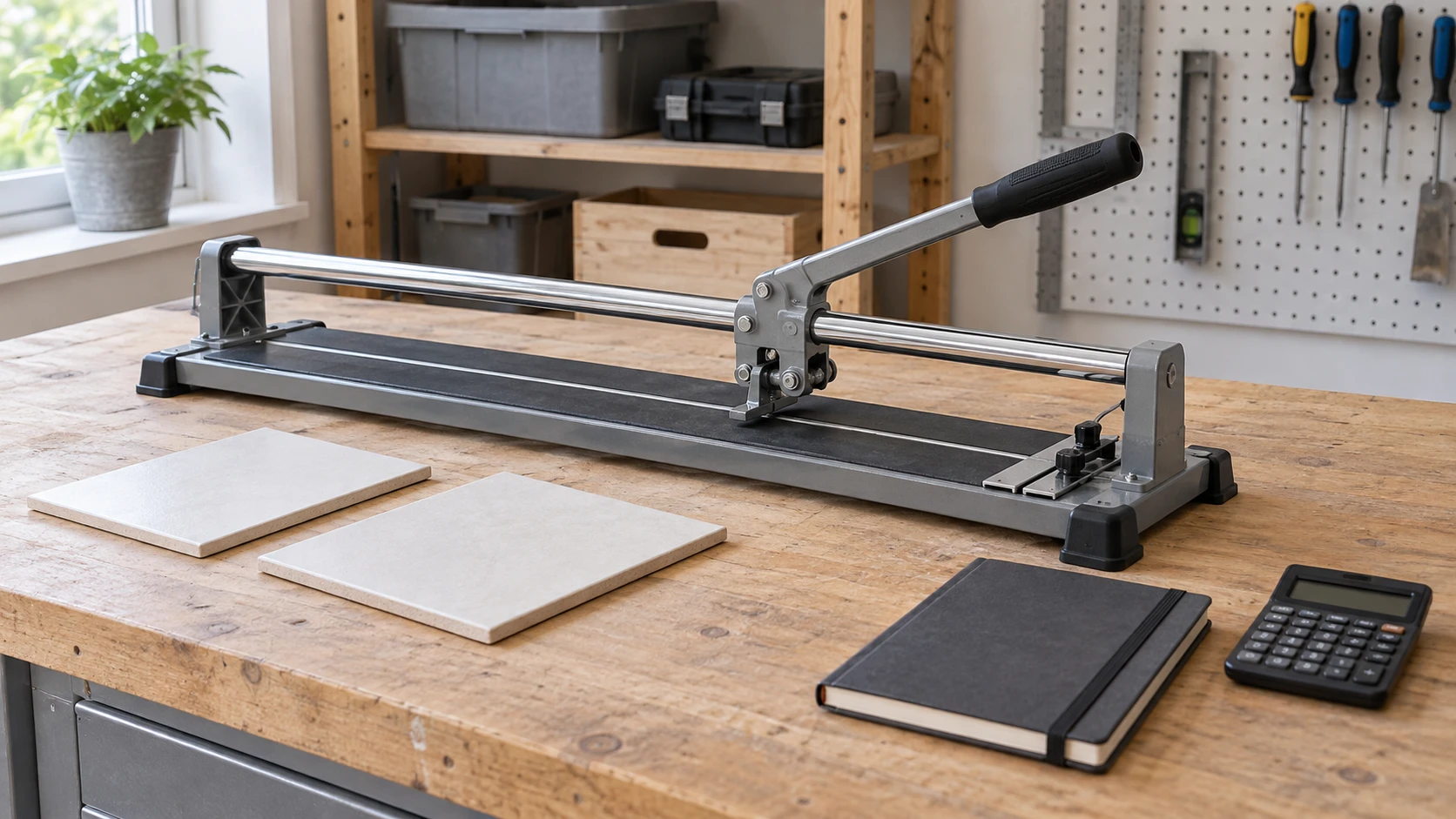
Conceptual tile cutter rental vs buying decision with one whole generic unused manual cutter and planning materials; no exact retail model, rental offer, capacity or cutting method is demonstrated.