Cooking & Food Prep
Thanksgiving leftover container handoff: lend pairs guests can return
Decide who wants Thanksgiving leftovers, which complete host-owned container pairs to lend, and how guests will return both pieces.
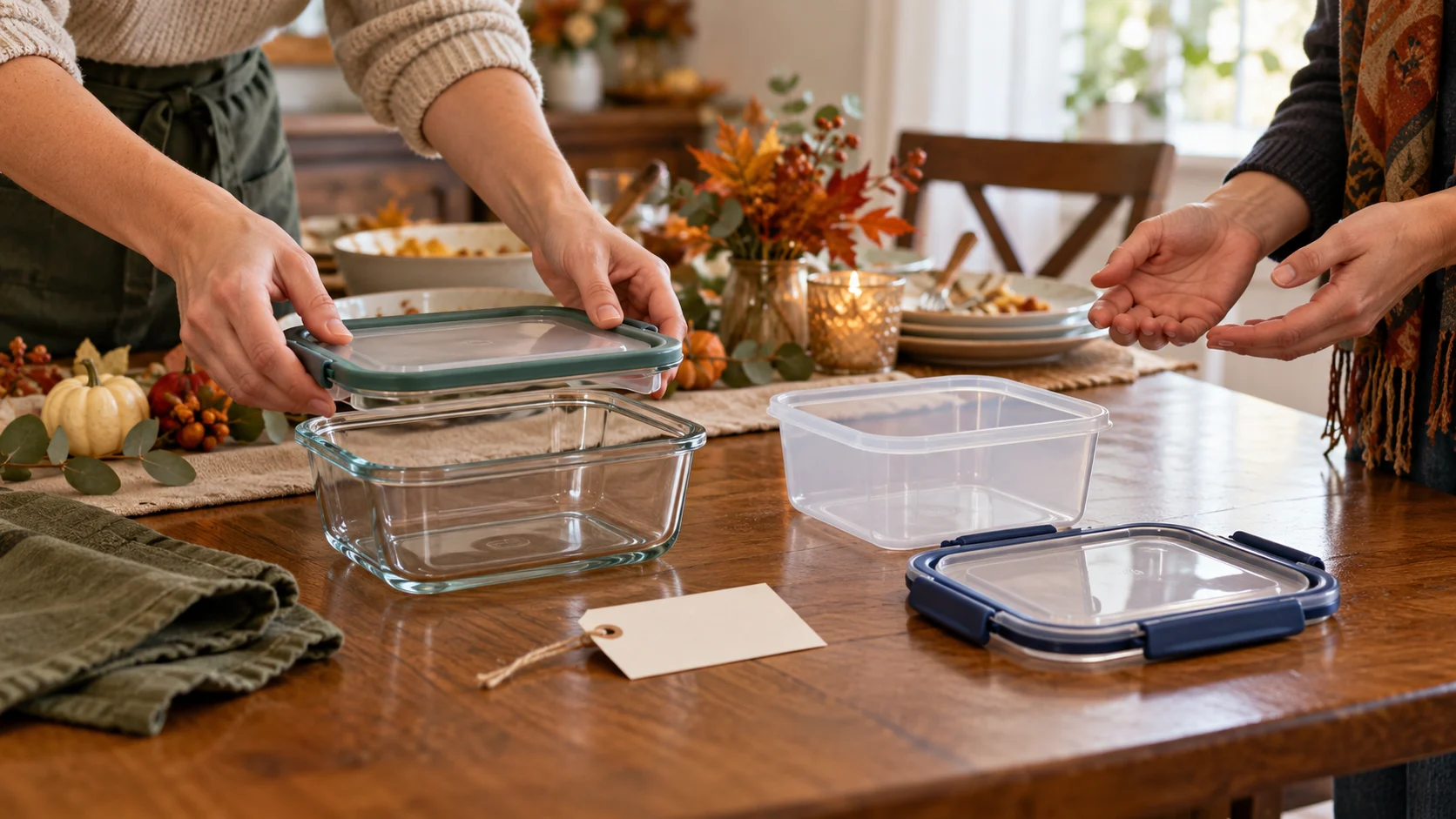
A Thanksgiving guest may be glad to take a portion home, but a host's reusable container can disappear into another kitchen. Decide who wants leftovers, whether you are willing to lend a container, and how that container will come back before anyone fills it. A complete base and matching lid are the unit to track. A box of unmatched pieces does little for a guest heading out the door.
The glass meal prep container listing describes a mixed-size set of ten containers with lids. The Brilliance food storage listing describes five clear plastic containers with lids. Use these complete sets as examples to inspect; the number of guests and containers already available determine whether another set is useful. Check the current listing and each piece you already own before deciding what to send away.
Ask guests before setting out containers
Some guests will want a small portion; others have a long journey, little bag space, or no interest in taking food. Ask quietly while clearing the meal, rather than filling a row of containers and asking people to carry them. A guest who brought a suitable container can use that instead of borrowing yours. You can also choose to keep all host-owned pieces at home.
Start with the people who have actually said yes. Then look at the portions available and the containers you can spare until the next visit. Choose from the requests made at this dinner and the complete pairs you can spare. A ten-container box does not mean ten guests need a container, and a five-container box does not tell you how many portions to prepare.
Keep the question specific when several dishes are on the table. “Would you like some vegetables to take home?” is easier to answer than a general offer of leftovers. A guest might want one dish and decline another. That answer lets you choose a suitable base instead of filling a large container by default. If two people in the same household both want food, ask whether they prefer separate portions or will share one. The host can then count actual containers leaving the table, while each guest knows what they accepted.
A host can also make a small no-lending boundary without turning dinner into a negotiation. If the only matching containers are needed for tomorrow's meals, say you cannot send those pieces away. If you have a spare pair, offer it with a clear return request. Guests can decline either the food or the loan. That choice matters because a container given as a gift and a container expected back call for different conversations. Decide which arrangement you mean before the food is packed.
Choose complete pairs you can lend
Lay out the bases and lids you might use. Match each lid to its own base before food is packed. Similar-looking lids from different sets can be easy to confuse, especially when several people help clear the table. If a lid is missing or will not close as the product instructions describe, keep that base out of the take-home group. Do not rely on a photograph to establish that pieces from different products fit together.
The glass listing offers multiple sizes; that may be useful when guests want different amounts. The Brilliance listing describes five 3.2-cup containers, which gives a more uniform set on the page. Treat those descriptions as a way to ask what is included in the current variant. The gallery can show shape and closure details, but it cannot tell you whether a particular piece in your cupboard has its matching lid. Count the pairs in hand.
Keep one or two host containers back if you will need them after the guests leave. Lending is easiest when you know exactly which pieces are leaving and which remain. If your available pairs are fewer than the people who want leftovers, ask whether anyone has their own container or is willing to take a portion another way. Do not promise more containers than you own.
With several sets in one cupboard, make a short departure group on a clear counter. Put each base next to its matching lid, and move any unmatched piece back to storage. If a guest chooses a smaller portion, use a smaller complete pair you already have rather than trying to make a large base appear full. The useful count is the number of matching pairs that the host is comfortable lending today. A set's advertised total can be checked against its listing, but it does not replace that count in your kitchen.
If guests help themselves, keep the lendable pairs in one place so they do not pull a lid from a different set. A brief explanation of which pieces are available can prevent accidental mixing without assigning someone to supervise every serving. When a pair leaves, note the guest's name and a plain description of the base and lid. You can do this on paper or on a phone; the method matters less than making the note before the last person walks out.
Fit the handoff to the trip home
Ask how a guest will carry the food. A rigid glass container may be a poor match for someone with a crowded bag; a plastic set may be easier for another guest to handle. The particular trip and the container in hand determine whether the guest is comfortable carrying it. Check the actual container, its closure, and the maker's instructions. Neither a product title nor a closed-lid gallery image proves that a filled container will remain leakproof in transit.
Leave room for the lid to sit as intended. An overfilled base can interfere with closure. Pack each portion only after you have selected a matching pair and a guest has agreed to take it. Keep the guest's carrying space in mind when choosing between a larger and a smaller base. If you are unsure that a piece suits the trip, let the guest decide whether to take that portion and container.
The guest may be carrying a coat, another dish, and a bag from the visit. Offer a container only after the guest has a workable way to carry it. If the base would need to ride sideways in a crowded tote, ask whether the guest would rather take a different portion or use a different container they brought. Keep the closure check separate from a promise about transport. A lid that appears seated at the table still needs careful handling on the way home, and the listing cannot guarantee what happens in someone else's bag.
Think about who will unpack the food. A guest sharing a ride may need to keep the container with them rather than leave it on a seat. Another may have little space in a refrigerator when they get home. These are questions for that guest, not facts a product page can answer. If any part of the handoff feels awkward, the host can keep the food or offer a smaller portion. A practical handoff should suit the person leaving, as well as the host's desire to clear the table.
Mark the host's pieces before they leave
A removable label on the outside can identify the host and the matching lid. A short note such as “Avery's glass base and blue lid” is more useful later than a label that only says “Thanksgiving.” Put any label where it will not obstruct the lid or closure. If you prefer not to label the container itself, make a quick note of the set and the guest taking it.
Do this before the kitchen becomes busy with departures. A guest should know whether the container is theirs to keep or one you would like back. If you are lending it, say so plainly. A friendly return request is easier to remember than an unspoken assumption.
Use a description that will still make sense after the holiday. “My glass base with the square lid” may identify a pair better than a brand name if several similar pieces are in circulation. If two guests take identical pieces, record which guest took each pair. A removable note on the outside can travel with the container, while the host keeps a separate note at home. Make the mark easy to remove and check the product's instructions before attaching anything to a surface that might be damaged.
A note should explain ownership without becoming a handling instruction. Keep it away from food-contact surfaces, closures, and places where it can fall into the food. If a label would be hard to remove, use the separate host note instead. The point is to connect the guest to a recognizable base and lid, not to make the container look like a shipping package. When guests know which pieces belong to the host, they have an easier time bringing back the complete pair.
Agree on a return route
Choose a return plan that fits how you actually see the guest. They might bring the empty base and lid to the next visit, or contact you to arrange a handoff. If a return would be inconvenient, offer a different take-home option or decide that lending is not worthwhile. The plan should cover both pieces; getting back a lid without its base still leaves an incomplete pair.
Later, check the pairs that come back against your note. Wash and store them according to the product's instructions. For one dinner, a brief note can spare you from wondering which guest has a missing lid weeks afterward.
Put the return agreement into ordinary words: “Please bring the base and lid next time we meet.” If there is no likely next visit, decide whether arranging a pickup is realistic before lending the set. Some hosts may be happy to give away a spare container; others want a favorite piece back. Neither choice needs to be hidden. If a guest later loses a lid, the host's short record will show which pair is incomplete. That helps the host decide what to use at home without guessing which similar lid belongs where.
After the holiday, wait for a natural time to follow up rather than sending a reminder as people travel. A simple message with the same container description can help the guest recognize it in their kitchen. When it returns, check that the lid still belongs to the base. If it does not, ask about the other piece before mixing it into your cupboard. This is the final step of the lending decision, not a recurring meal-prep station routine.
Read the listings for what they actually establish
Use a seller page to confirm the current set composition, material description, stated dimensions, and shown closures. Inspect all gallery views because a main image may hide the lid profile or differences among sizes. If the page leaves an important detail unclear, ask the seller before buying. Descriptive words such as “airtight” or “BPA free” in a product title are seller claims; they do not establish how the container will perform in your guest's bag or under a particular heating method.
Do not infer oven, microwave, freezer, dishwasher, or reheating suitability from a material name alone. Check instructions for the exact base and lid separately. The host-owned set in your kitchen may also differ from the currently displayed listing, even if the brand and shape seem familiar. Check each actual pair and settle the return plan with the guest before handing it over.
A current product page is most useful when it answers a concrete question. Does this variant include matching lids for every base? Are the sizes mixed or uniform? Is the material description clear? Can you see the lid shape in more than the hero photograph? If the listing does not answer one of those questions, keep it open rather than filling the gap with a guess. The two sets here show why a host might want to inspect different configurations, but the host's own available pairs still determine the Thanksgiving handoff.
Record any seller detail that genuinely affects your choice, then leave unrelated claims aside. A heating or leakproof promise would need evidence for the exact item and use; a title phrase alone does not provide it. Gallery photographs can help identify what is pictured, while a specification or seller answer is needed for details not visible there. If you already own a set, check the piece and its original instructions because a current listing may describe a later variant. The reader decision remains narrow: lend a complete, suitable pair and know how it returns.
Keep food handling a separate check
A container choice does not determine how long leftovers can sit out, how they should be cooled, or when they should be eaten. Follow applicable food-handling guidance for the dish and your situation. This guide makes no time or temperature promise. Make the food decision before the container handoff, and do not use an attractive product page as evidence about food safety.
If your main project is organizing containers for recurring meals, the meal-prep container station guide covers the home storage routine. For a purchase based on weekly portions and shelf space, see the meal-prep container pack-count guide. Thanksgiving guest handoff has a shorter path: ask who wants food, match the pairs you can lend, mark ownership, and agree how both pieces return.