Crypto Commerce
10-tray commercial food dehydrator — Ten trays or twelve: compare drying area before counting shelves
Compare 10-tray commercial food dehydrator by tray area, timer range, controls, accessories, and conflicting temperature specifications.
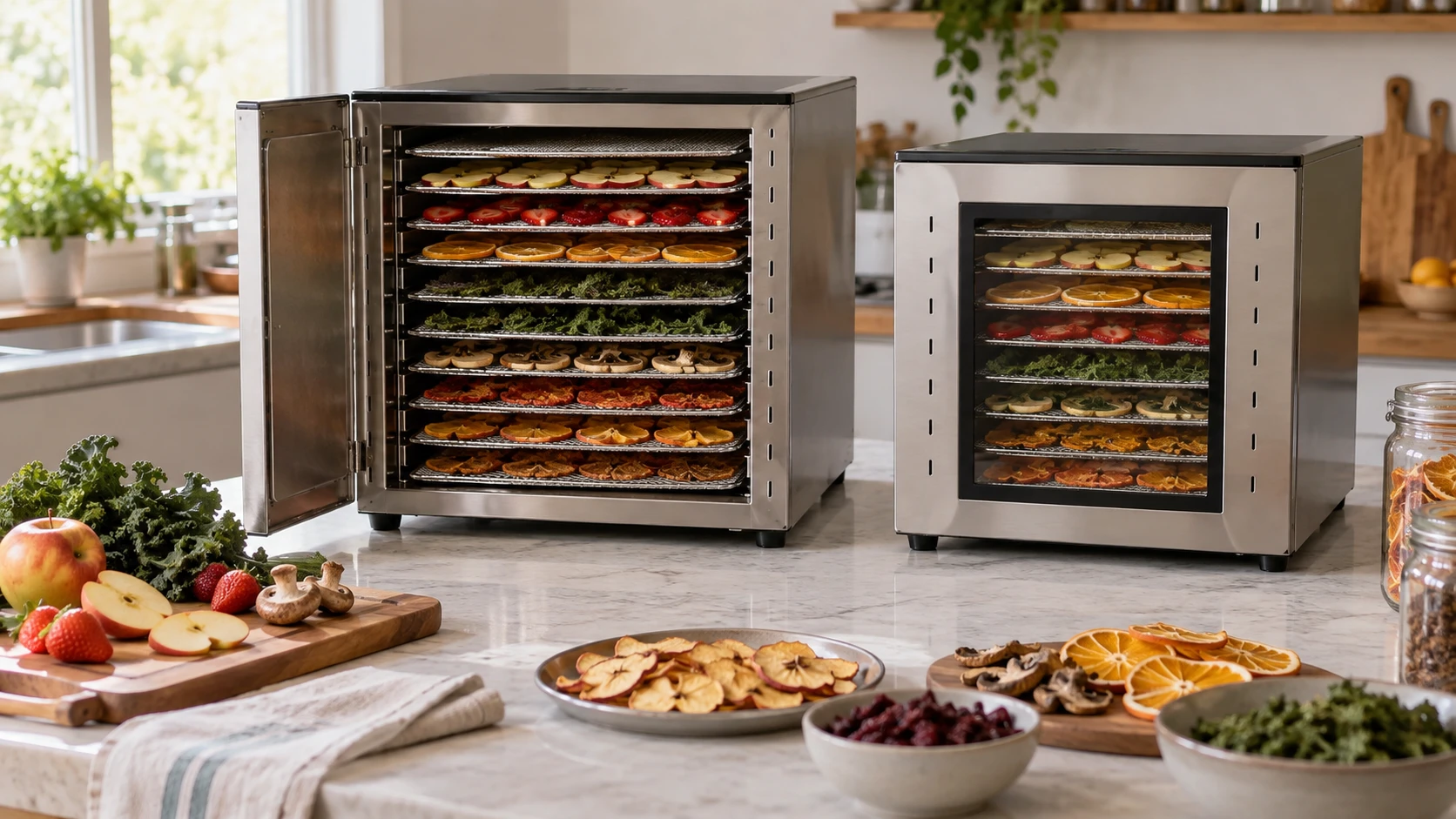
The 10-tray commercial food dehydrator lists large 15.6-by-15.6-inch trays, a 24-hour timer, and a temperature control described as reaching 190°F in its body text. This guide to dehydrator tray rotation addresses a related question: whether food needs to be moved while drying. The 12-tray 850W food dehydrator lists smaller 11.42-by-11.42-inch trays, a 48-hour timer, and a lit viewing window. The guide discusses a different machine; the claims in this comparison come from the two exact listings.
Tray count alone makes the second unit sound larger. The listed tray dimensions tell a more useful story. Ten 15.6-inch-square trays add up to roughly 16.9 square feet of nominal tray surface. Twelve 11.42-inch-square trays add up to roughly 10.9 square feet. That calculation uses the outer tray dimensions as if every part could hold food, so it is an estimate rather than a measured usable area. The first model's “up to 17 square feet” claim is consistent with that arithmetic. Ask for the true food-loading area and cabinet dimensions before deciding which unit can handle your batch.
Count the pieces that actually fit on a tray — 12-tray 850W food dehydrator
The 10-tray listing describes stainless-steel trays measuring 15.6 by 15.6 inches. A broad tray may hold longer fruit strips or more jerky pieces with fewer cuts. The listing also says the machine includes two nonstick silicone sheets and a drip tray. Silicone sheets can help with foods that would otherwise stick or drip through a grid, subject to the manual's placement instructions. They may reduce airflow through the covered part of the tray. Republeq's product description does not give the mesh spacing, shelf clearance, or maximum load weight.
The 12-tray unit lists stainless-steel trays measuring 11.42 by 11.42 inches, plus one mesh screen and a drip tray. Its narrower trays may be easier to wash in a small sink or move around a compact kitchen, but the actual cabinet dimensions are missing from the saved excerpt. Twelve levels could help separate different food types or recipes, provided there is enough height between trays for the cut thickness you need. Do not assume every level can take a thick slice or a tall container just because it accepts a metal tray.
For a realistic comparison, draw one tray at each stated size on paper and arrange the food you usually prepare. A pound of thin apple slices occupies a different surface than large mushroom halves. Leave space between pieces as the recipe and machine instructions require. If the food overhangs the tray or blocks the fan path, the arithmetic surface area will overstate useful capacity. Make the same test for both tray sizes before planning a large batch around either model's headline number.
The first machine's listing names 17 square feet of drying area and calls it commercial. Those are catalog descriptions, not a certification for any particular business use. The second description presents its machine for jerky, fruit, vegetables, herbs, and pet treats. Food type affects preparation and safe drying conditions. Follow a tested recipe and the actual manual for the chosen ingredients; neither catalog entry supplies a full food-safety procedure.
Check the temperature discrepancy on both product pages — 12-tray 850W food dehydrator
The 10-tray product title says its temperature reaches 195°F. The body says the adjustable thermostat runs from 70°F to 190°F in 5°F steps and supports Fahrenheit only. The upper limits conflict. A shopper who needs a specific setting cannot choose between 190°F and 195°F from this listing alone. Ask for the control-panel photo, manual, and rating label of the exact shipped model. The body also says the timer runs up to 24 hours in 30-minute increments and shuts the machine off when it ends.
The 12-tray title says 165°F temperature control, while the body says 95°F to 167°F. That is another mismatch, smaller in degrees but still relevant if a recipe calls for a specific setting. The body lists time adjustment from one to 48 hours. It does not state time increments or how accurately the cabinet holds a set temperature. A food thermometer used as the manual permits can help confirm actual conditions, but it cannot repair contradictory pre-purchase specifications. Confirm with Republeq which range applies to the model in the current offer.
The lower ends also differ in the saved descriptions: 70°F for the 10-tray machine and 95°F for the 12-tray. A low listed setpoint may be useful for delicate herbs or a particular recipe, but the excerpt gives no measured chamber temperature under load. Room conditions and food moisture can affect drying time. Treat the control range as an available setting, not a guarantee that all trays have that exact temperature at the same moment. The published tray-rotation guide is helpful here because it directs attention to distribution across levels.
Decide whether presets or direct control suit your routine — 12-tray 850W food dehydrator
The 12-tray listing advertises ten one-touch presets, naming apples, kiwis, bananas, mushrooms, chicken, and fish among the examples. It also offers manual time and temperature adjustment. A preset can reduce menu work for a familiar food, but the listing does not reveal the preset temperatures, slice thickness assumptions, or whether food must be pretreated. Check the current manual before following a preset for meat or fish. A button labeled for an ingredient is a starting instruction, not an independent test of the finished food.
The 10-tray entry emphasizes direct adjustment: temperature in 5°F steps and time in 30-minute steps. That may appeal to someone using their own tested recipes and recording which settings work in this cabinet. Its saved text does not mention ingredient presets. If an overnight run is routine, the 24-hour maximum may be enough; if a tested recipe genuinely needs longer, a 48-hour timer can avoid a manual restart. Neither maximum tells you how long a specific batch will take. Slice thickness, loading, humidity, and desired final texture change the result.
Both listings claim automatic shutoff when a timer finishes. The 10-tray product also mentions overheat protection. The 12-tray excerpt does not describe an overheat-protection system, which is an information gap rather than proof that none exists. Read the electrical and unattended-use instructions before scheduling a long run. A timer controls a machine; it does not judge whether each piece is dried safely or evenly. Check the food and follow a tested storage procedure after the cycle.
Look at airflow and visibility, then ask about rotation — guide to dehydrator tray rotation
The 10-tray description says a rear-mounted fan circulates air and double-row vents release water vapor. It has a glass front door for watching progress. Claims in Republeq's catalog this arrangement promotes even drying, but the excerpt contains no tray-by-tray measurements. The 12-tray listing describes a glass door with an interior light. That should make it easier to inspect the trays without opening the door, although visual inspection alone cannot establish moisture inside a piece of food. Ask how the fan is positioned and whether the manual requires rotating trays during a long cycle.
A simple first batch can reveal more than broad airflow claims. Use similarly cut pieces of one ingredient across several trays, following a tested recipe. Note which levels finish first and whether edges and centers differ. Record the settings and rotation schedule. If the cabinet needs frequent tray exchanges, consider whether its trays can be handled safely and where you will set them while moving food. The two Republeq's product descriptions do not provide matched tests, so do not rank their drying uniformity from fan descriptions alone.
The 10-tray model's Republeq listing reports 45 to 50 dB noise, while the 12-tray model's Republeq listing states under 55 dB. Neither listing gives the measurement distance or test method. Those numbers do not prove one unit will sound quieter in a kitchen. Fan tone and vibration can also matter during a 24- or 48-hour run. Check whether a machine can sit on a stable surface with its vents clear and without disturbing another room. Neither saved excerpt provides a full cabinet footprint for that placement check.
Plan washing and storage after a batch — 12-tray 850W food dehydrator
The 10-tray package list includes ten stainless-steel trays, two silicone sheets, one drip tray, silicone gloves, two storage containers, a manual, and a recipe book. The Republeq's listing says the electric back box can be separated and describes washing the front portion with a garden hose; it also calls the trays and drip tray dishwasher-safe. Do not rinse any electrical part or use a hose until the exact manual confirms which components can be detached and washed that way. The listing's short cleaning claim is not a complete safety instruction.
The 12-tray package list includes twelve stainless-steel trays, a mesh screen, a drip tray, a recipe book, and a manual. It calls the design dishwasher-safe without clearly naming each safe component. Ask whether the trays, mesh screen, and drip tray can all go in a dishwasher and whether the cabinet must be wiped by hand. Small food fragments can lodge in tray openings, so access to both sides of each tray matters. Count how many pieces have to dry after washing and where they will be stored between batches.
Neither catalog excerpt describes a verified method for storing finished jerky, dried fruit, or pet treats. Drying and safe storage depend on the food and the process. Use tested guidance for preparation, final dryness, cooling, packaging, and shelf life. A recipe book in the box may give useful starting instructions, but its presence does not certify every recipe in it. For foods with stricter safety needs, check the manual and an authoritative food-safety source before making a batch for long storage.
The saved minimum prices are $312 for the 10-tray machine and $362 for the 12-tray unit. Current offers can differ. The larger nominal tray area and lower saved price favor inspecting the 10-tray model first for wide, repeated batches; the 12-tray unit provides a longer stated timer, presets, and a lit window. Before checkout, resolve both temperature-range conflicts, obtain external cabinet dimensions and usable tray measurements, and check each manual's rotation, cleaning, and electrical instructions. Those facts will tell you far more than whether the product title says ten or twelve trays.