Troubleshooting & Repairs
Tape dispenser will not feed: locate the stopped stage
Separate a tape roll that will not feed from tape that will not cut, then identify the actual dispenser, refill requirements and matching instructions.
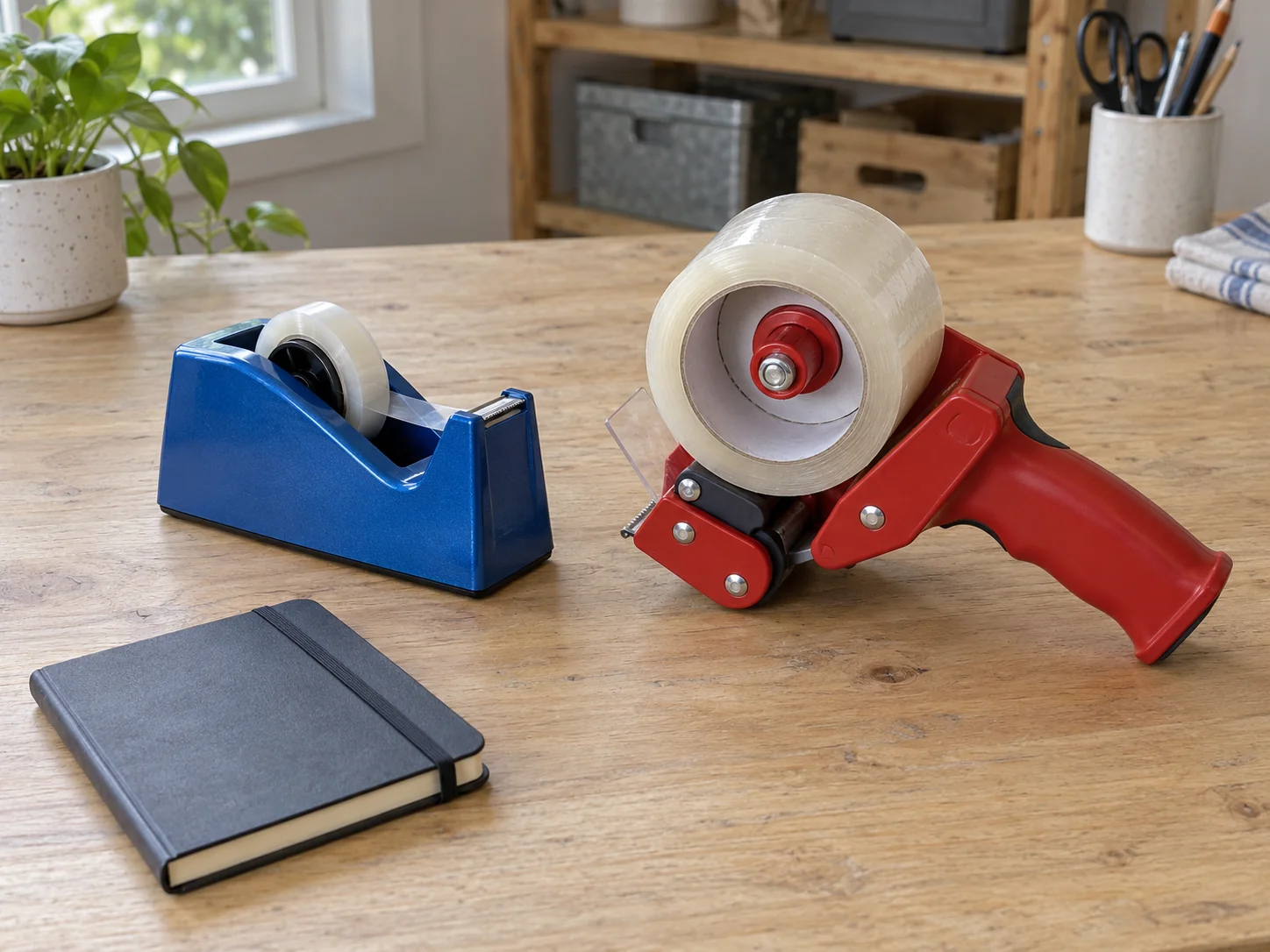
When a tape dispenser will not feed, describe what stopped before deciding that its cutting edge needs attention. A roll that supplies no length of tape presents a different problem from tape that comes forward but will not separate into a piece. Calling both situations a broken dispenser can send a support enquiry toward the wrong part.
The Scotch Wave desktop offer and Business Source pistol-grip offer below describe different roll requirements and features. This guide uses those descriptions to organise a troubleshooting enquiry. It reports no operating trial, successful repair or interchangeable replacement part, and supplies no blade-removal or tension-adjustment procedure.
Separate unwinding and cutting in the observation
Begin with the last ordinary use you actually observed under the tool's applicable instructions. Did any tape come away from the roll? Did it reach the point where the user normally takes a piece? Did the difficulty occur only when separating that piece? Record the stage you can identify, without repeatedly operating the tool to demonstrate the fault.
For unwinding and cutting, the distinction is between supplying material and separating it. If no usable length has come forward, the cutting stage has not yet had material to work on. That does not prove the edge is sound. It means that changing the cutting component would leave the recorded feeding question unanswered.
Conversely, a length that comes forward but fails to separate leaves a cutting question to investigate using the actual model's instructions. Keep the observation specific. Torn tape, an inaccessible end and a roll that does not turn are different descriptions, even if each prevents someone finishing the same wrapping task.
Set the affected dispenser aside while its condition or applicable instructions remain unclear. Keep hands away from its cutting edge and avoid forcing an unestablished movement. Another suitable dispenser can let the task continue under its own instructions, without being described as a repair to the first one.
Read tape roll dimensions as separate requirements
The Scotch Wave desktop dispenser offer identifies a metallic blue plastic body and a refillable arrangement for a one-inch core. It states tape widths of one-half or three-quarters of an inch and a fifteen-hundred-inch length capacity. Those are separate size requirements for this offer.
Core diameter describes the roll's central opening. Tape width describes the strip across its face, while tape length describes how much material the roll contains. A familiar width does not establish the required core. Nor does a longer roll automatically satisfy the capacity stated for the dispenser you are trying to refill.
Record the tape roll dimensions from the actual refill packaging and compare them with the dispenser's matching instructions. Leave an unknown field open. The fact that a roll is clear or bears a familiar brand does not supply its core designation, and an old empty wrapper may belong to another dispenser.
Scotch's current FAQ says that most of its desktop dispensers use one-inch cores, while identifying C-24 as an example accepting both one- and three-inch cores. That distinction shows why a general brand name cannot establish universal fit. C-24's different capability is not supplied as a feature of the selected Wave offer.
The pistol-grip description adds a brake feature
The Business Source pistol-grip dispenser offer explicitly names a three-inch core and an adjustable tension mechanism. Its description also calls that feature a tension brake. The feature belongs to this offered arrangement; the Scotch Wave description above supplies no equivalent brake-adjustment statement.
The Business Source width wording needs clarification. It says packaging tape “up to 2 wide” but omits the unit beside that number. This article does not silently supply inches. Obtain the applicable maximum width for the exact offer before choosing a refill on that basis, even when another similar-looking dispenser gives a clearer specification.
An adjustable brake statement does not give the direction, amount or procedure for an adjustment. Use the matching instructions before treating a control as the remedy for a roll that will not feed. The description supplies no measured setting or troubleshooting sequence, and this article has not tested the mechanism.
A pistol grip also identifies a different handling arrangement from a weighted desktop body. The Wave offer describes a weighted, nonskid base for one-handed use. Those are stated design features, without a handling comparison performed here. Neither description authorises holding or modifying the other tool in the same way.
Keep the roll and its supporting parts identifiable
If the problem appeared immediately after a refill, retain both the affected dispenser and the refill's packaging. Note who changed it and what information they used. A new roll arriving just before the problem gives the enquiry an event to investigate; it does not establish that the tape is defective.
Compare the refill's printed size with the actual dispenser's requirement before considering a mechanical repair. A roll that fails a stated requirement has not become suitable because someone managed to place it near the holder. Do not trim a roll or improvise a support to make an unresolved combination appear to fit.
Scotch's FAQ separately addresses a lost desktop spool and says replacement spools are commonly carried by office suppliers. It supplies no specific replacement identity for the selected Wave offer. If a supporting piece appears missing, ask for the exact applicable part rather than treating any spare spool as interchangeable.
Photograph the complete inactive dispenser if support needs to identify a missing component. Keep its product reference with the image. A close-up of one loose piece can hide which arrangement it belonged to, especially when a shared cupboard contains desktop dispensers and packaging tools together.
Keep the refill wrappers with their own rolls when checking supplies for several dispensers. Two rolls of similar clear tape can carry different core or length information. A wrapper loose in a shared drawer should be associated with its actual roll before its printed dimensions enter a service request.
Visible tape remaining on a roll establishes that material is present. It does not establish that an accessible end has been found or that the roll meets the holder's requirements. Describe each of those observations separately. This lets support distinguish a supply-identification question from a later operating or component question without guessing what “still full” meant.
An invented handover records which stage stopped
Imagine Ellis is preparing ordinary paper parcels at a shared worktable. One person reports that a dispenser is broken after changing the roll. Another says the tape came forward but would not separate. This is a fictional troubleshooting example, not a trial of the two offers or a completed shipment.
Ellis asks which dispenser each person used and when. The first account concerns a blue desktop tool after a refill; the second concerns a separate handheld packaging tool used earlier. Combining those accounts would make the history contradictory. Identifying the two tools gives each observation its own starting point.
For the desktop tool, Ellis retains the refill wrapper and compares the printed core designation with the actual tool's requirement. The record can state whether they agree or whether the wrapper leaves the designation unknown. It need not invent a damaged cutting edge to explain why the refill question is still open.
For the handheld tool, Ellis records that tape came forward and that separation was the reported difficulty. That account supports asking about the cutting stage under its matching instructions. It does not identify a dull blade or justify dismantling the tool. The two enquiries can remain separate while the table uses an identified suitable alternative.
If one account changes after the people involved compare notes, retain the correction. Perhaps the roll did turn, but the tape end remained inaccessible. The corrected account gives support a more precise starting point. Changing the description is not the same as observing a repair, so keep the tool's condition unresolved until the applicable answer and result establish more.
Match instructions before following a loading route
Scotch's FAQ gives a loading route for its packaging and moving dispensers and notes that some have a spring-loaded bar. Those differences affect which instructions apply. A generic route for one arrangement does not identify the components or loading sequence of every desktop or pistol-grip dispenser, including the selected Business Source offer.
Find the instructions for the actual tool in hand before rethreading, adjusting or replacing anything. This article gives no sticky-side orientation or roller sequence to transplant between models. Retain the guide that actually identifies the equipment, so another person can follow the same applicable reference rather than a remembered demonstration of a different tool.
The EPS10HC troubleshooting guide keeps an electric sharpener's operating instructions attached to its identified model. Its thermal-switch and shavings-tray guidance belongs to that equipment. Here, the relevant connection is finding matching instructions; none of its electrical actions applies to a manual tape dispenser.
If the applicable instructions cannot be found from the retained product reference, ask for them before trying another tool's method. Include the whole product name and any identification on the actual equipment. A seller's reply linking a superficially similar dispenser leaves the instruction question open unless it explains why that reference applies.
Save the reply with the tool's information, including any limits or unanswered questions. This is useful when the person ordering supplies differs from the person who reports the fault. They can check the proposed refill against the established requirement without reconstructing a conversation from an unlabeled spare roll.
A refill enquiry differs from a replacement purchase
The Miele GN and KK replacement-bag guide establishes the existing cleaner's supply requirement before comparing pack quantities. The tape question has the same purchasing order: establish what the owned dispenser accepts before ordering a large refill pack. The bag designations remain specific to those vacuum supplies.
Keep quantities with the selected offer. The Scotch Wave account states a bundle of ten, with one dispenser in each unit. The Business Source title combines “1 Each” with “Bundle of 10 Each.” Confirm the current order unit and included contents before buying, rather than reading the first quantity alone as the whole order.
A replacement dispenser can meet the immediate need for a usable tool without identifying the old one's fault. If that becomes the chosen outcome, record it as a purchase decision. The old roll, holder or cutting edge has not acquired a diagnosis merely because another dispenser works under its own instructions.
Give support the remaining question
If the tape dispenser will not feed after the applicable checks, report the tool's exact identity, the refill information and the last observed behaviour. Include actions already taken and their results. A reply about a different core size or another model leaves the present enquiry unanswered.
Finish with an account of unwinding and cutting that another person can follow. State whether material came forward and which step remained unsuccessful. Keep an unknown cause unknown, and retain any model-specific instruction or service answer with the actual dispenser before returning it to the shared task.