Educational & Explainer Articles
Surge protector joules and USB charging labels explained
Read surge protector joules, shared USB current, charging wattage and circuit-breaker labels using two actual power-strip offers and NIST unit definitions.
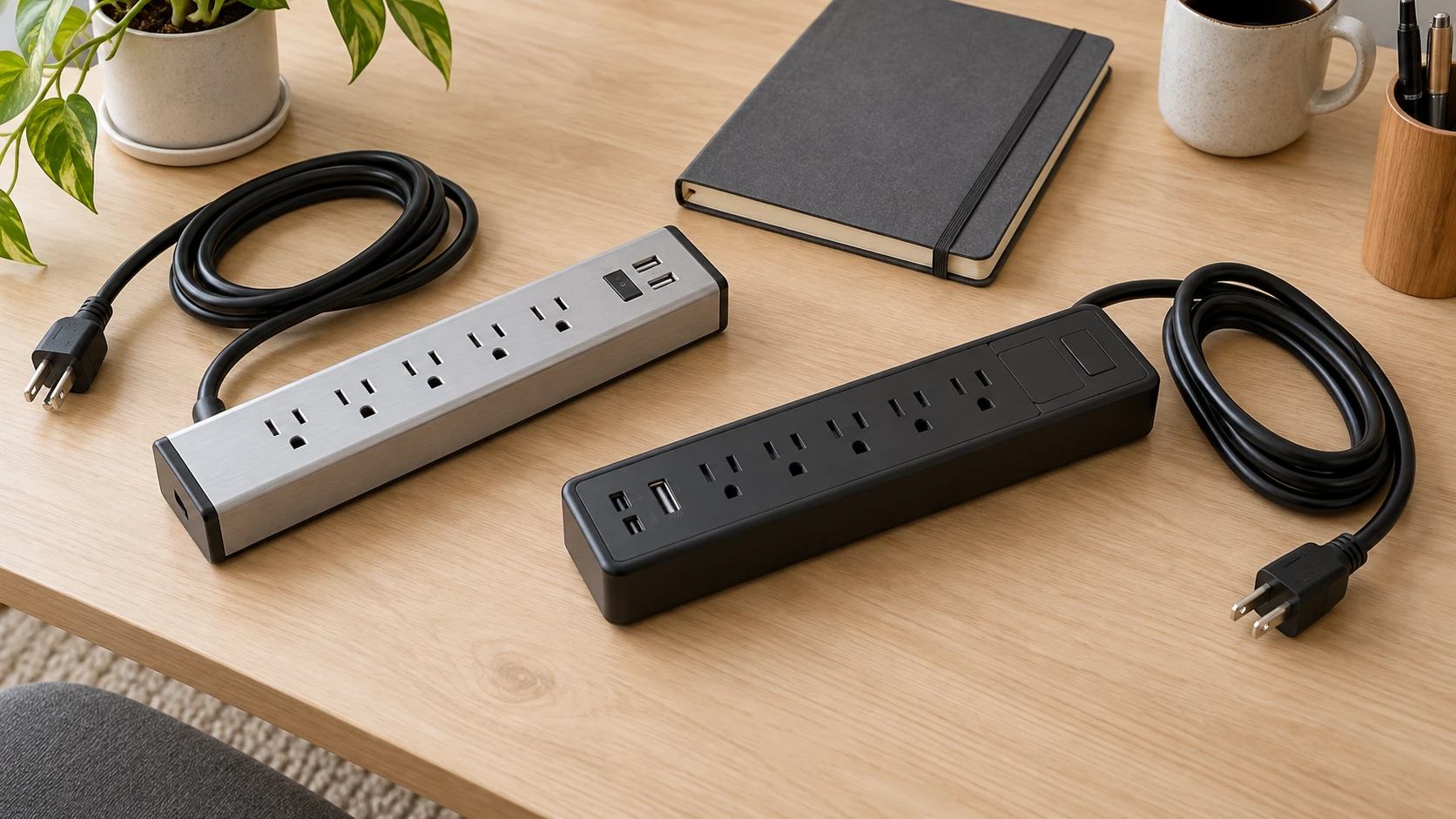
Surge protector joules, USB charging figures and circuit-breaker labels describe different features of a power strip. A large joule number is not a USB charging wattage. An outlet count does not give an electrical allowance for each socket. Before comparing offers, read which feature the number describes and the condition attached to it.
Two actual power-strip descriptions illustrate the distinction. An Unbranded Computer Accessories offer describes an Eaton metal strip with eight AC outlets, a 2,100-joule surge rating and two USB ports sharing 3.9A. A NOBRAND Extension Cords offer names thirteen AC outlets, 5,000-joule protection and four USB ports with an up-to-20W charging claim. These are different disclosures within each product, not a common performance test.
Start with the actual strip and its named connections
The eight-outlet metal surge-strip offer is titled Unbranded Computer Accessories Surge Strip, SKU 18632066609 and UPC 746364314925. Its description uses Eaton wording while its catalog brand is Unbranded. Keep that identity distinction visible when identifying the order rather than silently changing the recorded brand.
The thirteen-outlet NOBRAND power-strip offer appears in Extension Cords as SKU 18585609989 and UPC 746309024803. Its description names a black strip, thirteen AC outlets, two USB-C ports and two USB-A ports. Those counts identify different connection types on the selected item.
AC outlets and USB charging ports should remain separate entries in the explanation. Adding them produces a total number of physical connections but loses their roles. A person looking for a USB-C charging connection still needs the stated USB-C inventory; a larger AC-outlet count does not answer that question.
What a surge protector joule figure is describing
Both descriptions attach their joule figures to surge protection. The eight-outlet account gives 2,100 joules, while the thirteen-outlet account gives 5,000 joules. Read the number as the stated surge-protection rating. It is separate from the USB charging output and the number of outlets on the strip.
A joule is an energy unit, whereas the USB figures here are stated in amperes or watts. Those labels cannot be substituted for one another. A 5,000-joule claim does not mean 5,000 watts of ongoing output, and the 2,100-joule number is not a charging-speed measurement. The product description's own category for the number helps prevent that mistake.
The sources provide no matched surge test, event conditions or service-life comparison between the selected units. They also do not turn either joule number into a count of events the strip will withstand. A larger listed number can be reported accurately without declaring a complete protection or longevity winner for a particular household arrangement.
Energy, current and power are different quantities
NIST's Guide to the SI, Chapter 4, lists joule for energy, ampere for electric current and watt for power. It expresses a watt as a joule per second. These definitions explain why the three unit names have different jobs in the descriptions. They do not turn the product labels into interchangeable measures of overall capability.
In particular, neither source describes its surge joule figure as stored energy available from a rechargeable battery. Dividing that figure by a USB wattage would combine ratings assigned to different functions. The result would not be a playback or charging-runtime claim supplied by either listing.
Keep the quantity and the feature together when comparing an offer: surge-protection energy rating, shared USB current, or qualified USB charging power. The unit definition helps interpret the statement; it cannot supply the product-specific conditions missing from that statement.
Shared USB current and per-port output
For shared USB current and per-port output, the eight-outlet source is explicit about the shared condition: its one USB-A and one USB-C port share 3.9A. The word share limits what the figure says about the two ports together. It does not state 3.9A independently available from each port at the same time.
That description does not provide a complete per-port allocation table, the associated voltage account or a tested result for every connected-device combination. Keep those omissions separate from the stated shared figure. Without the missing conditions, this explanation does not convert the 3.9A statement into a wattage or promise an allocation to a particular phone and tablet.
The USB-C charger pack-and-port guide gives a concrete shared-output example: its Belkin description distinguishes up-to-45W single-port use from a stated 25W-plus-20W two-device split. That illustrates why an output condition belongs with the number. The Belkin split is not the eight-outlet strip's missing table and cannot be assigned to either strip here.
An up-to-20W claim needs its own conditions
The thirteen-outlet description says its two USB-C and two USB-A ports support PD and QC fast charging at up to 20W. Keep the up-to qualifier and the USB charging context. The text does not specify a twenty-watt result from every port simultaneously or identify a full allocation for four attached devices.
PD and QC are named charging features in that account. Their presence is different from a list of tested devices and complete output profiles. A phone or tablet needs its own applicable compatibility information. This article does not infer a result simply because a device's cable can reach a matching-shaped port.
The 20W and shared-3.9A statements also use different quantities and supply different detail. One is a qualified power claim, while the other explicitly names shared current. The descriptions do not provide enough common conditions to rank charging speed between the strips. Compare the exact requirement only after the relevant voltage, allocation and device information is established.
Circuit breaker and surge rating
For circuit breaker and surge rating, the eight-outlet source names a 15A circuit breaker separately from its 2,100-joule surge protection. Those entries have different subjects. The circuit-breaker label is not the USB ports' shared output, and it does not assign fifteen amperes to each of the eight AC outlets.
The description does not provide a complete operating-load or installation account here. This guide supplies no permission to connect a particular group of appliances, no wiring method and no reset procedure. The actual product's applicable instructions and ratings must address an intended arrangement; an outlet inventory alone cannot approve it.
The thirteen-outlet description does not provide a corresponding circuit-breaker figure in its short account. That omission does not establish the absence of a protective feature, nor can the other offer's 15A statement fill the gap. Keep each strip's actual disclosures together instead of building a third specification from the two descriptions.
Cord and plug descriptions answer physical questions
The eight-outlet account names a braided eight-foot cord. That is a stated reach dimension for the offer. It does not provide every plug, routing or placement requirement, and the eight-foot figure is unrelated to the USB current allocation. A person investigating where the strip would sit has a length to consider alongside the actual product information.
The thirteen-outlet description instead names a heavy-duty 14AWG/3C cord without giving its length here. Preserve that designation as cord information, not a missing length measurement or an approval for a chosen electrical load. The phrase heavy-duty supplies no common durability test against the braided cord in the other offer.
Its source also describes a 45-degree flat plug intended to fit behind furniture while leaving the lower outlet usable. That is the description's physical-layout claim. It does not measure the reader's receptacle, surrounding plugs or furniture clearance. The plug description and the electrical or USB requirements remain separate parts of understanding the product.
Outlet spacing and mounting features are additional entries
The eight-outlet source says three outlets are spaced for bulky transformer plugs. That identifies the spacing feature without giving a complete dimension drawing. It does not establish that every large adapter fits beside every other plug or that the eight-outlet inventory remains accessible in every proposed arrangement.
The same description names rear keyhole slots for wall or under-desk mounting. The thirteen-outlet source names supplied screws and a drill template for wall mounting. Keep a mounting feature separate from included hardware. Neither short account provides a complete method or approval for an arbitrary wall, support or orientation.
A mount option is not another output port or a higher surge rating. Likewise, included screws do not establish the correct support for the reader's location. These physical disclosures can matter to a purchase while still leaving their applicable instructions to determine the actual installation. This article gives no drilling or mounting sequence.
Indicators and support claims need their stated scope
The eight-outlet description names diagnostic LEDs that indicate whether connected equipment is protected. The thirteen-outlet source names LED status indicators without giving their complete meanings. Keep those actual statements distinct. A light's color, trigger or required response needs the selected model's own explanation; the other product's indicator wording cannot supply it.
The eight-outlet source also calls the strip UL Certified and UL Listed and names a limited manufacturer's warranty and connected-equipment insurance. These are claims and support entries in the retail account. They do not reproduce a certification record, all policy conditions or a tested result for the reader's proposed use. This guide has not independently certified either item.
Support, protection claims and supplied parts can all matter to an order, but they answer different questions. A warranty statement cannot fill a USB allocation table, and a status LED cannot establish that a cable meets an attached device's requirement. Use each entry to answer the question it actually addresses.
Keep the cable requirement beside the charging task
The charger-accessory planning guide separates an Anker offer's excluded cable from the specific 5A cable requirement attached to one advertised charging feature. That is a useful distinction when considering a strip's USB ports: included inventory and required capability are separate questions. Its 5A requirement belongs to that charger claim, not to either strip in this article.
Neither selected strip description supplies a complete inventory and capability account for USB charging cables. Keep that information open for the exact order and intended device. An existing cable's ownership does not establish its suitability, while an omitted cable list does not prove that every order excludes cables. This explanation gives no connection procedure.
Read one complete statement instead of combining unrelated labels
A useful restatement of the eight-outlet offer keeps its eight AC outlets, 2,100-joule surge rating, two USB ports sharing 3.9A and separately named 15A circuit breaker together. The thirteen-outlet restatement keeps its thirteen AC outlets, 5,000-joule surge claim and four USB ports with qualified up-to-20W wording together. Neither restatement silently supplies the missing conditions.
Use surge protector joules for the surge-protection question, shared current and power claims for their stated USB conditions, and the actual physical descriptions for the placement questions they address. Understanding the label is the first result. Confirming an intended arrangement still requires the selected product's complete applicable information.