Crypto Commerce
Sunpentown UF-304SSA upright freezer or Whynter CUF-301BK for freezer overflow
Compare Sunpentown UF-304SSA upright freezer by basket access, shelf layout, cabinet measurements, locks, defrost, and installation needs.
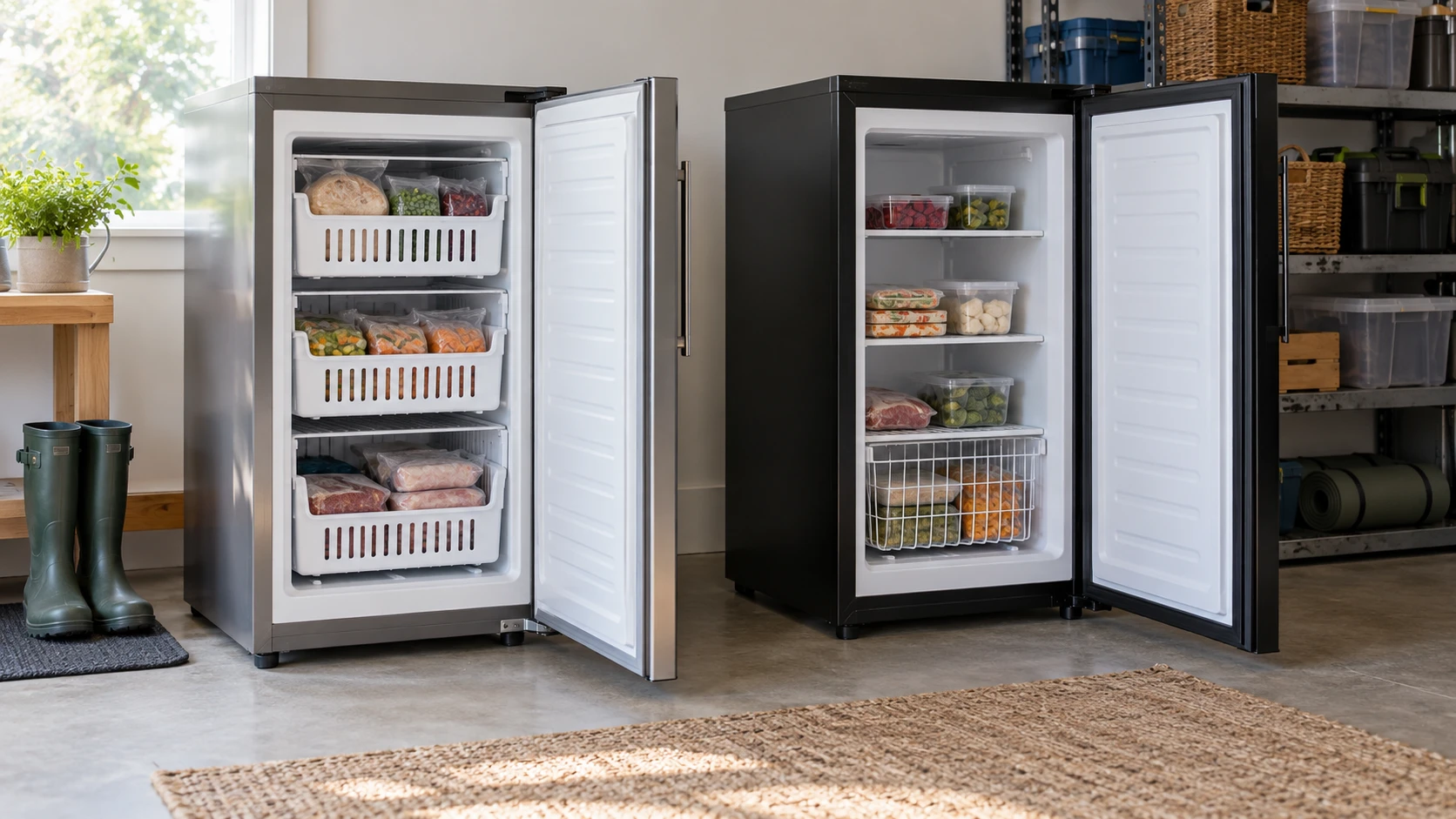
The Sunpentown UF-304SSA upright freezer has three pull-out baskets and a stated net capacity of 3.0 cubic feet. A published guide on small freezer usable-capacity checks examines different appliances, but its central question applies here: how much of a rated cabinet can hold the food you actually buy? The Whynter CUF-301BK upright freezer also lists 3.0 cubic feet, arranged with fixed cooling shelves and a removable slide-out basket shelf. The number on each listing is similar. Access to packages, usable dimensions, and the available floor space can still favor one layout.
Start with a week's worth of the items that will move out of the main refrigerator-freezer. Count flat boxes, lumpy bags, containers with rigid lids, and any food that must remain upright. A basket may keep small packages from slipping behind others. A fixed shelf may support a broad container more predictably, provided it fits through the doorway and clears the shelf above. Measure the widest and tallest packages before comparing any cubic-foot figure. Stated capacity says little about an awkward pizza box or a bulky bag that consumes most of a compartment.
Compare basket access with shelf access — small freezer usable-capacity checks
Sunpentown lists three pull-out baskets. Its saved row gives 14.25 inches of width and 13.5 inches of depth for each. The upper two baskets are listed at 8.5 inches high, while the bottom one is 7.75 inches high. Those dimensions are useful for a loading sketch, although the row does not explain whether they describe the basket interior or the outer frame. Leave a margin until you can check the exact manual or measure a display unit. A bag may fit in the basket body yet catch on the rail or the opening as you pull it out.
Baskets encourage a different sorting routine from open shelves. Put the foods used most often near the front of an easy-to-reach basket. Keep a category in each basket so a person can pull one out instead of searching behind a wall of packages. Check whether a loaded basket moves smoothly and whether its stop prevents an accidental drop. The saved product row does not give a load rating, removal procedure, or replacement-part number. Ask for those details if heavy packages or frequent basket removal are part of the plan.
Whynter lists three fixed cooling shelves and one removable slide-out basket shelf. The fixed levels may make it easier to stack flat containers without pulling out a full basket. They also constrain the height of packages that can be placed between them. The single basket can hold small loose items, but it does not provide the same three separate pull-out zones as Sunpentown's layout. Check where Whynter's removable basket sits and whether it can be taken out for cleaning without leaving unsupported packages behind. A photograph with the door fully open is more useful than a closed-cabinet beauty shot.
Try a dry run with measured package outlines drawn on paper. Put bulky items on a shelf or in a basket using the listed dimensions, then account for the hand space needed to lift or pull them out. A basket with room for food but no room to reach it will quickly become the place where old items disappear. Mark dates on packages and keep an inventory on the door or nearby. Neither listing claims a built-in inventory system. Simple placement habits will do more for everyday access than the shared 3.0-cubic-foot label.
Fit the cabinet and its door — Whynter CUF-301BK upright freezer
Whynter gives exterior dimensions of 33.5 inches high, 19.5 inches wide, and 21 inches deep. It also lists interior dimensions of 14.25 inches wide, 26.25 inches high, and 15.25 inches deep. A compressor step interrupts the lower portion; the row describes it as 13 and five-eighths inches wide, 7 and seven-eighths inches high, and 5 and three-quarters inches deep. Draw that obstruction into the loading sketch instead of treating the entire interior as an empty box. The saved Sunpentown row gives basket dimensions but not a comparable exterior diagram, so ask for one before deciding that it fits a specific alcove.
Both rows mention a reversible door and a recessed handle. A hinge change may solve a conflict with a nearby wall, but it still requires the clearance and procedure in the current manual. Tape the proposed footprint on the floor and swing a cardboard template through the doorway arc. Allow space for a person to stand or kneel while loading lower compartments. A door that technically opens a few inches is not enough if a basket cannot slide out or a wide box cannot turn through the opening.
Sunpentown's description names a flush back and front leveling legs. The flush back may simplify positioning, but it does not establish that the cabinet can be pushed against a wall without ventilation clearance. Leveling legs help with a floor that is slightly uneven; they do not make an unsuitable surface safe. Whynter calls for clearance around its freestanding cabinet. Obtain both installation guides for the actual model labels and follow their requirements for airflow, power access, and a level surface. Check the delivery path, including stairs and the carton, before arranging a tight final location.
Read the temperature details carefully — Whynter CUF-301BK upright freezer
Sunpentown lists a mechanical adjustable thermostat but gives no numerical control range in the saved row. Whynter states a range from minus 11 to 10.4 degrees Fahrenheit. Neither figure demonstrates what a delivered freezer will hold after it is filled, opened during meal preparation, and placed in a warm room. Follow the maker's setup instructions, put an independent freezer thermometer inside, and observe it after a typical load has stabilized. Record the setting that works in the actual location. Recheck after moving the appliance or changing the load substantially.
The Whynter listing gives a compressor noise figure below 42 dB, R600a refrigerant, 115V/60Hz supply, a 100-watt rating, 1.1 amps, and estimated use of 240 kWh per year. The Sunpentown row does not provide matching figures for noise or annual energy use. Confirm Whynter's specifications against its current label and request comparable data for Sunpentown if operating cost or room noise will influence the purchase. A stated noise level can depend on the measurement method and room. Neither row gives a direct comparison recorded under the same conditions.
Think about where an outage would be noticed. Neither saved row promises a temperature alarm, remote alert, or a measured holdover time. Keep the door closed during a power cut and follow current food-safety guidance for deciding what to keep afterward. If the freezer will sit in a basement, garage, or other space away from daily traffic, decide who will check that the outlet remains powered. Whynter's listing mentions those locations as possible uses, but the actual ambient-temperature requirements still need confirmation in the manual. Do not assume a garage is suitable in every season.
Plan for manual defrost and shared access — Whynter CUF-301BK upright freezer
Both models are described as manual-defrost freezers. Set aside time to transfer food to safe temporary storage, let ice thaw under the maker's instructions, collect water, dry the cabinet, and allow it to return to the needed temperature before reloading. Do not use a sharp tool to chip ice. Ask where the meltwater goes and how to reach the areas behind baskets or shelves. Sunpentown's three baskets may come out for cleaning, but the saved row does not spell out the removal sequence. Whynter's fixed shelves may require a different reach and wiping routine.
Each row also mentions a lock. Sunpentown lists a lock and key; Whynter specifies a cylinder lock and two keys. Check the delivered box for the keys and decide who will hold a spare. The lock can be useful in a shared workspace, yet it should not make routine defrost or a spill hard to address. If several people use the freezer, assign someone to date packages and clear old food. A locked cabinet full of unidentified bags is still difficult to manage.
Sunpentown identifies a stainless-steel door and black cabinet, while Whynter's saved listing describes a black door and cabinet. Finish may matter if the freezer sits in view, but measure door swing and cleanability first. If the door faces a busy work area, consider how often its finish will need wiping. Follow the installation instructions when placing either cabinet near another appliance or heat source. Check the current warranty and service path for each exact SKU. The saved Sunpentown row establishes UL listing and Energy Star certification; Whynter states those certifications as well. The brief listings may not cover a later delivered variant, so verify current labels and terms.
Make the 3.0-cubic-foot decision — Whynter CUF-301BK upright freezer
Choose the layout that fits a measured load. Sunpentown's three baskets give each food category a pull-out home, and its basket dimensions help test a few packages before purchase. Whynter gives more cabinet and interior dimensions, fixed shelves for flat items, and one removable basket. Its published electrical and annual-use figures also offer a starting point for an operating-cost estimate. The missing Sunpentown exterior measurements and missing matched energy figure are questions to resolve with current documentation, not performance verdicts.
Before ordering, confirm the full installation dimensions, door reversal procedure, clearance, and actual shelf or basket openings. Compare the measured packages with those openings, and decide where food will go during manual defrost. Inspect the delivered model label, seal, and accessories before loading it. Let the freezer reach a verified temperature in its intended room before adding food.