Crypto Commerce
Summit DW245NTADA panel-ready dishwasher — A built-in dishwasher changes the cabinet face
Compare Summit DW245NTADA panel-ready dishwasher by cabinet finish, ADA claims, rack flexibility, wash programs, controls, and installation evidence.
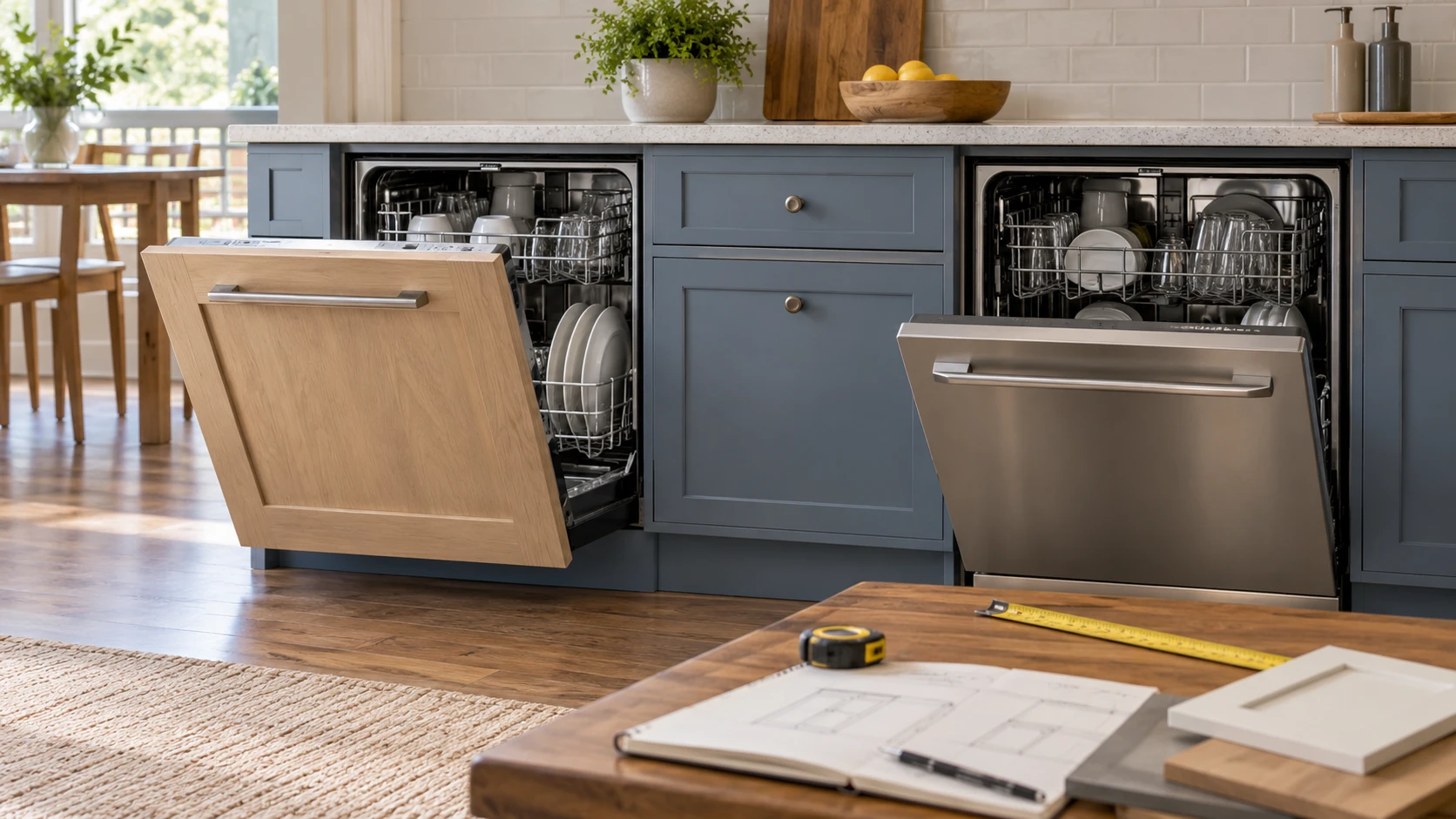
Two dishwashers can share a 24-inch label and still require different work around the opening. The Summit DW245NTADA panel-ready dishwasher is described with an unfinished door that accepts a custom panel and handle. The GE Appliances model is described as a 24-inch built-in unit with a stainless-steel interior and fully integrated controls. Its saved listing does not say that its exterior door accepts a custom cabinet panel. A matching cabinet front is therefore an explicit Summit project and an unanswered GE question, not a feature to infer from the shared width.
Start with the cabinet opening rather than the appliance brochure. Measure width, height, depth, floor level, and the clearance needed for the door to swing. Summit gives a 32.25-inch height and says its three leveling legs can raise it to a standard 34-inch counter height, with a taller kickplate covering the gap. That does not make it a fit for every 34-inch space: flooring, countertop underside, and the manufacturer’s required clearances still matter. The short GE description gives no exact height or installation drawing. Get the current dimension sheets for both exact models before ordering either.
If the surrounding cabinets will be replaced, decide how the dishwasher should look with the doors closed. Summit's panel-ready front could help it blend with the new cabinetry, but the saved source says the panel and handle are custom items. Confirm their allowable size, thickness, weight, attachment method, and swing clearance from Summit's current instructions. A cabinetmaker needs those details before fabricating the face. The published guide on panel-ready dishwasher cabinet planning is useful for framing the design questions; the model-specific installation manual remains the authority for this unit.
The GE listing describes a sleek built-in appearance with fully integrated controls. It does not identify a supplied exterior finish in the saved excerpt, even though the title mentions a stainless-steel interior. Interior tub material and exterior door treatment are separate. Check Republeq's product page for the exact model number, current product photo, and door-finish specification before trying to match it to cabinetry. If the kitchen design requires a custom front, do not assume the GE can take one without written manufacturer support.
Treat accessibility as a measured requirement — GE 24-inch built-in dishwasher
Both saved descriptions make ADA compliance claims. Summit's description pairs that claim with its lower stated height. GE's description calls its model ADA compliant without giving the exact installed height in the excerpt. Compliance of the appliance does not prove that every finished kitchen layout will be usable by every person. Counter height, door clearance, control reach, circulation space, and the installer’s chosen placement affect real access. Identify the person’s actual reach and loading needs, then have the design checked against applicable requirements and current manufacturer documents.
Consider where the controls sit while the door is open. Summit puts touch controls and a digital display along the top edge. GE calls its controls fully integrated, but the saved text does not show their positions or describe whether status is visible when the door is closed. If someone needs to start a cycle from a seated position or read progress without opening the door, inspect both exact control layouts. A brochure phrase such as "integrated" cannot answer reach or visibility questions.
Summit specifies two slide-out nylon-coated wire racks, adjustable upper-rack arms for tall glasses or smaller cups, fold-down lower tines, and a removable cutlery basket. Those details offer several ways to arrange a load. The GE excerpt says only that the machine has multiple wash cycles; it gives no rack diagram or loading capacity. That omission is a reason to obtain its rack specifications, not a reason to conclude it has fewer adjustments. Compare both racks using your widest dinner plate, a tall glass, a mixing bowl, and the utensils that regularly pile up after meals.
A removable basket is useful only if its alternate position leaves room for the rest of the load. Check where Summit allows it to sit and whether the upper rack can move with your taller items in place. For GE, ask for the same rack and basket information. Consider what must be hand washed if a large pan occupies the lower rack. A nominal place-setting number, if later provided, should be tested against your actual cookware rather than treated as the whole capacity story.
Read the program tables, not the cycle count — GE 24-inch built-in dishwasher
Summit lists eight wash programs: Regular, Auto, Intensive, Intensive Plus, Daily, Delicate, Super, and Rinse. It also lists Sanitize, Extra Fast, Extra Dry, Hi-Temp, and Half Load functions. The description says Half Load works with any program and that Sanitize raises the final-rinse temperature. Those names make the controls sound flexible, but the excerpt does not provide cycle lengths, energy or water use for each program, or the exact sanitizing test conditions. GE's source mentions multiple wash cycles and a sanitize cycle without naming or describing the rest. Get both current program tables and compare the two or three cycles you would use each week.
Do not treat a sanitize label alone as a guarantee for medical equipment, infant items, or every material placed in a rack. Check the cycle’s documented temperature and certification, the dishware manufacturer's care instructions, and loading guidance. GE's listing says its sanitize cycle eliminates bacteria, but it supplies no test organism or percentage in the saved excerpt. Summit's higher final-rinse temperature also needs its own context. For hygiene-sensitive items, ask for the evidence behind the specific model and program instead of comparing two brief marketing phrases.
Summit's Extra Dry function may be worth examining if plastic containers often remain wet, but its source does not describe the drying mechanism or outcomes. GE's excerpt gives no drying detail. Ask whether either unit relies on heated drying, residual heat, ventilation, or a combination, and what maintenance those systems need. Try to find comparable independent tests with similar loads. Even a useful program cannot overcome a rack loaded so densely that water cannot reach or drain from the items.
The Summit description includes a door-mounted detergent dispenser with push-button release and a display that indicates when rinse aid needs adjustment. It also says the unit adjusts for detergent type, though the saved text does not explain which types or how. GE gives no dispenser detail. Confirm permitted detergent forms and maintenance steps in each manual. A cycle that works well with one detergent may require a different dose or rinse-aid setting when household water conditions change.
Check the installation and daily sound — panel-ready dishwasher cabinet planning
Summit lists a pre-installed cord with a three-pronged plug. That identifies the supplied connection style in the saved source, but it does not tell you whether the existing outlet is in an approved location or on a suitable circuit. The GE excerpt supplies no electrical connection detail. Ask installers to check both manuals for power, water-supply, drain, and access requirements. A dishwasher is an installed appliance: a convenient plug or a matching cabinet width does not settle the rest of the job.
Summit's description names water-supply and overflow warnings, and says washing stops when a water-supply issue is detected. These features may help identify a problem, but their presence does not replace correct plumbing or periodic checks under the sink. GE's short listing does not describe comparable warnings. Ask how either machine reports faults, where the filter sits, and how to clear an ordinary blockage safely. Summit says its bottom filter is removable for cleaning; the GE excerpt does not discuss filter service.
Summit lists an operating level of 47 dB. GE's source says quiet operation but gives no number or test condition. A number can help frame the question, yet room acoustics and what is happening in a cycle will affect how the machine sounds at home. Find a model-specific GE rating tested under a comparable method before claiming one is quieter. If the kitchen opens to a living room, a demonstration or credible independent test may be especially useful.
Both descriptions mention ENERGY STAR certification. That is more concrete than a generic efficiency adjective, but it does not tell you each household's annual water or energy cost. Check the current EnergyGuide or equivalent model-specific data for the same usage assumptions. Summit's source says its unit uses less energy and water than national standards require; the saved GE text gives no comparative amounts. Do not rank them by efficiency until the labels or measured figures can be compared on the same basis.
The GE 24-inch built-in dishwasher may suit a kitchen where a custom cabinet front is unnecessary, provided its exact exterior, installation drawing, racks, and program details meet the plan. Summit offers a documented panel-ready route, lower listed height, detailed rack adjustments, and a fuller program list. Its custom front and handle require their own specifications and installation work. Ask for both manuals and dimension sheets, place your typical dishes against the rack drawings, and settle the cabinet face before comparing optional cycles. That order reduces the chance of choosing a machine whose controls look appealing but whose door cannot fit the kitchen you are building.