Writing & Documents
Fill a story-only submission field without the cover note
Separate a prepared cover-letter entry into a complete unchanged story and its requested author details, using an original fictional two-field brief.
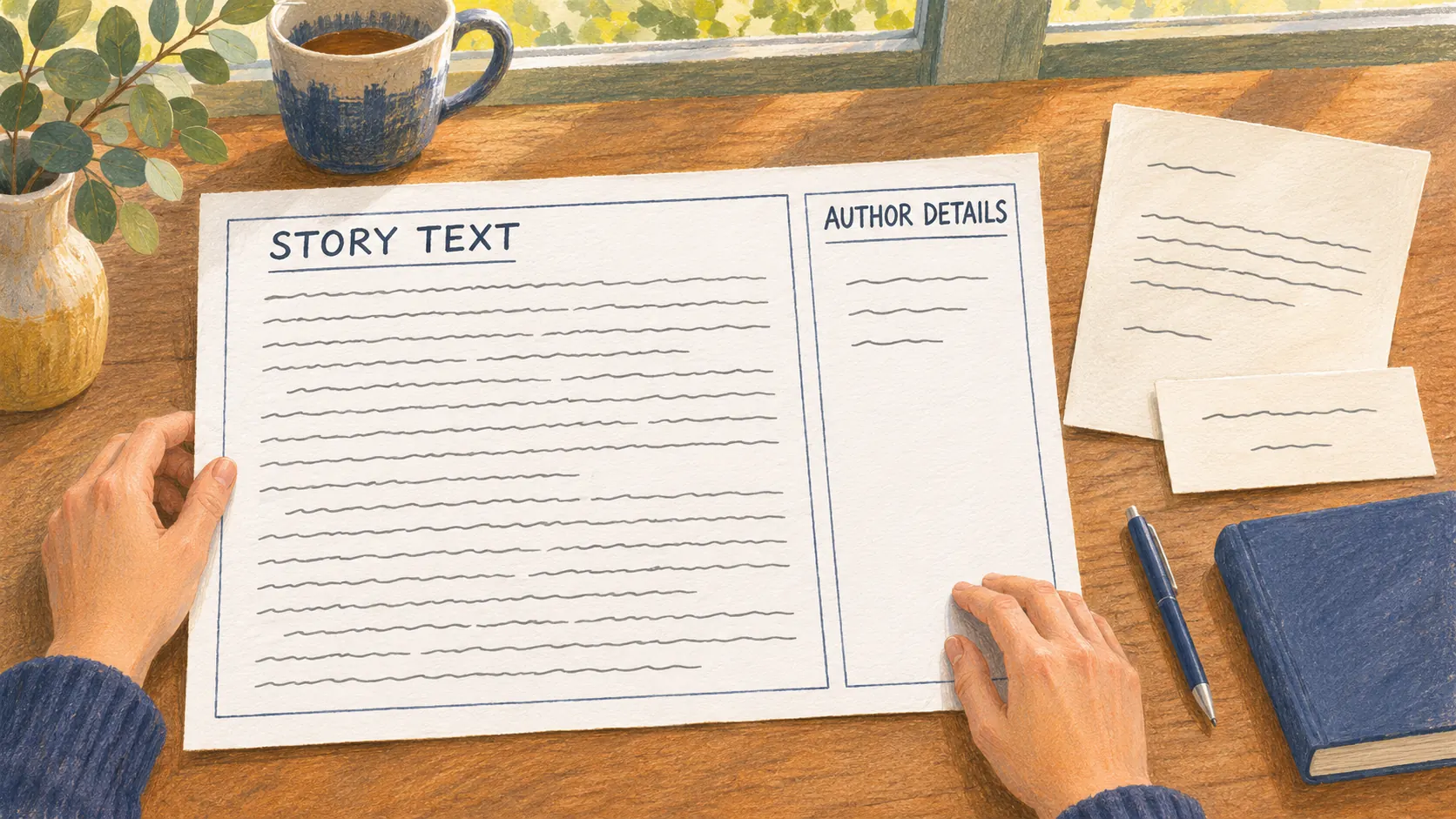
A story-only submission field asks for a particular part of a prepared entry. A greeting, a title and a finished story may all be present in the same document, while belonging in different places under the receiving brief. This original two-field example separates those parts without changing the story. The form, request, writer and fiction below are invented for the exercise. They are not the requirements of a named publisher or a report of an actual submission.
Read the complete two-field request
The fictional request says: “Put the complete story, and only the story, in Story text. Put its title, the writer’s byline and a short cover note in Author details. A greeting or sign-off may be part of that cover note. Keep the story’s words unchanged while preparing these fields.” This is the whole request for the example. It supplies two destinations and names the material assigned to each.
The request does not ask the writer to improve the story, shorten its ending or invent an editorial introduction. It also gives no character limit. If a real form had another requirement, that actual requirement would need to be considered before using the same arrangement. Here, work with the stated brief rather than adding a missing rule and then treating the addition as something the fictional form required.
Mina Park has already prepared a complete entry with a greeting and a cover note surrounding her story, The Plain Side. She wants to offer that same story. Her immediate task is to prepare the two fields. The example leaves any decision to send the entry outside the exercise, and it gives no result from a reader or an editor.
Preserve the complete prepared entry
Keep Mina’s source draft available while making a working copy. Its greeting and sign-off are useful evidence of where the cover note ends and the story begins. Removing them from one destination does not require erasing them from the retained entry. The working copy can be labelled for this fictional two-field brief so that it is distinguishable from Mina’s original combined version.
Before moving text, identify the complete story Mina selected. In this example it begins “At six, Nia found the painted sign behind the flour tin” and ends “then carried it upstairs.” Those endpoints locate a complete authored passage in the entry below. They are not a general instruction to find every manuscript’s boundaries by its first and last sentence. Another document might need clarification from its writer.
Read the passage between those endpoints as well. Finding the opening and closing words would not reveal an omitted middle sentence. Mina’s selected story has one paragraph in this example, and the complete version remains visible during preparation. That gives the later comparison actual text to work from instead of an impression that the destination looks about the right length.
Inspect Mina’s original combined entry
Dear editor,
Please consider The Plain Side, a story by Mina Park.
At six, Nia found the painted sign behind the flour tin. Her father had used it every morning, setting OPEN against the front window. The shop had been shut for a month. She wiped a white crescent from the glass and put the sign in place. Outside, a man slowed, saw her coat still buttoned and pointed at the word. Nia shook her head, smiling at her mistake. She turned the sign around. On its plain wooden back she wrote the date she had come to collect it, then carried it upstairs.
Thank you for reading,
Mina Park
The entry contains the entire selected story, but the whole entry would exceed the content role assigned to Story text. Its opening greeting addresses an editor, and its final thanks and signature belong to the surrounding message. The sentence introducing the title also addresses the proposed recipient. Those words do not become part of Nia’s story simply because they share a document with it.
No correction to Nia’s actions has been requested. Keep the sign, the passer-by, the mistaken display and the final trip upstairs exactly as Mina wrote them. Adding a final explanation about what the sign means would create a revised story. This preparation task can be completed while leaving that creative decision with the writer and preserving the selected passage in full.
Place the complete story in Story text
At six, Nia found the painted sign behind the flour tin. Her father had used it every morning, setting OPEN against the front window. The shop had been shut for a month. She wiped a white crescent from the glass and put the sign in place. Outside, a man slowed, saw her coat still buttoned and pointed at the word. Nia shook her head, smiling at her mistake. She turned the sign around. On its plain wooden back she wrote the date she had come to collect it, then carried it upstairs.
That is the complete Story text entry for this brief. It contains the selected paragraph without the greeting, introductory cover sentence, thanks or signature. The title has a destination in Author details, so it is not added above this paragraph. These placements follow the original request shown here. They do not establish that another publisher wants an untitled text field or uses the same labels.
Check the actual prepared text after moving it. A selection can stop before a sentence ends, or include an adjacent sign-off. Looking at what is now in the field gives you a chance to notice either mistake before treating the working copy as ready. This example reports no paste test in a real service and assumes no automatic preservation of formatting by an unnamed interface.
Keep the requested details together
The separate details box is labelled Author details in Mina’s fictional form. Its prepared content follows. The repetition of the name comes from keeping Mina’s short note alongside the separately requested byline.
Title: The Plain Side.
Byline: Mina Park.
Cover note:
Dear editor,
Please consider The Plain Side, a story by Mina Park.
Thank you for reading,
Mina Park
Mina could choose a differently worded cover note if she wanted to revise that message. No such revision is needed to demonstrate the field separation. Keeping the existing note makes this worked example easier to inspect: the story remains intact, and the surrounding message has an appropriate destination under the declared brief. Neither field is being asked to carry the other field’s assigned material.
Compare two incomplete preparations
Imagine that the Story text field still begins “Dear editor” and then continues with the complete story. The story itself may be present, but the greeting remains in a destination defined as story only. The necessary correction concerns the greeting’s placement. There is no need to replace Nia’s opening sentence or rewrite the scene merely to remove that extra material.
Now imagine a field that begins with the correct opening but stops after “She turned the sign around.” The wrapper is gone, yet the selected story is incomplete. Its final sentence has been left behind. Restore the actual missing sentence from the retained version instead of composing a new ending that sounds similar. The two mistakes concern different parts of the brief.
A third check concerns the cover note’s destination. Clearing the Story text field does not show that Author details has been prepared. Read that area against its own request for title, byline and note. If it is still empty, leave that work visible as unfinished. A correct story paragraph cannot supply information absent from the other field.
Finish the preparation before deciding what happens next
Read both prepared entries beside the complete request once the moves are finished. Check the story’s whole paragraph, then the separate title, byline and note. Keep the original combined entry identifiable if you retain it. This comparison concerns the selected text and its assigned destinations; it does not assess the literary quality of The Plain Side.
The exercise supplies no anonymity requirement and makes no privacy or hidden-metadata guarantee. It also supplies no actual account, uploaded file, application state or acceptance receipt. A prepared entry can remain local. If someone later uses a real service, that service’s actual instructions and the person’s decision to submit remain relevant to what happens there.
For Mina’s example, the finished result is specific: one complete unchanged story in Story text, with its title, byline and existing cover note in Author details. The retained entry shows how those pieces were previously combined. Keeping both arrangements distinguishable lets the writer examine the preparation without pretending that the original document had always been separated this way.
Two optional desk-lamp accounts
The Data Accessories DTA21646 account is an optional workspace reference. Its native desk-lamp listing shows a tall stem, a short curved upper neck, a wide horizontal bar joined near its center and a screw clamp. The description’s reference to placing it behind a laptop does not make a laptop part of the pictured fixture. Native model DTA21646 and UPC 061754216468 remain catalog identifiers, without a readable on-product identity label.
The Adesso Home Gordon native account shows a different assembly: a circular head on articulated angular arms, an external strut and a flat base with a USB-shaped side port. That port is a visible fixture feature, not a charging test or evidence of a separately supplied hub. Native model Gordon and UPC 798919601318 have no readable on-product label authenticating them in the sole original image.
Both desk-lamp accounts stay separate from the fictional form preparation. Neither establishes delivered quantity, material, brightness, colour performance, eye-health benefit, energy use, adjustment range, clamp fit, charging compatibility or electrical safety. Dedicated fixture parts do not establish another supplied computer or phone. Mina’s example can use an existing suitable workspace; neither retail lamp determines what belongs in a text field.
Keep neighbouring writing tasks distinct
The manuscript packet labels guide separates a paper draft’s version, contents and requested review task on a cover sheet. Mina is preparing two declared text-field roles, with the story’s words unchanged. She is not identifying a paper packet’s version or asking its next reader for a particular kind of manuscript review.
The cue card revision guide clarifies which of two matching lines should change and preserves the other card’s wording. This example changes no occurrence inside the story. It separates the surrounding message from the complete selected fiction according to the receiving brief, leaving the authored passage intact.
Keep an optional purchase outside the submission exercise
If you browse republeq.com for a workspace furnishing, begin with the actual item and the questions its listing leaves unanswered. Preparing Mina’s fictional form creates no reason to buy a lamp and supplies no checkout result. Payment is another decision. If a cryptocurrency option is offered for an order you actually want, read the current instructions for that transaction before authorizing it. In particular, if USDT is available, check the supported network, requested recipient, amount, fees and any displayed timing conditions. A familiar token name cannot establish that a transfer using another network will be accepted. This article has not tested a payment route or verified an address. Do not carry a destination or network from an earlier order into a new one without checking the actual request. Where information is missing or inconsistent, pause and seek clarification through the seller’s available support route. Review the applicable delivery, return and refund terms as well, including the process described for the payment method you choose. A completed transfer does not answer a lamp-fit question, authenticate a manufacturer or establish dispatch. If you do make a purchase, retain the order details and payment record you actually receive, then check the merchant’s order status rather than assuming the goods have been sent. Another available payment method, waiting for an answer and leaving the item unpurchased remain options. None of those choices alters which text belongs in Story text or Author details in this invented brief. The prepared story can remain complete and unchanged while a separate purchasing question stays unresolved.