Gift Wrap & Party Supplies
A stocking diagonal measurement does not establish width and height
Two stipulated rectangles share a diagonal while their sides differ. The paper comparison supplies no actual stocking shape, opening, usable capacity or load claim.
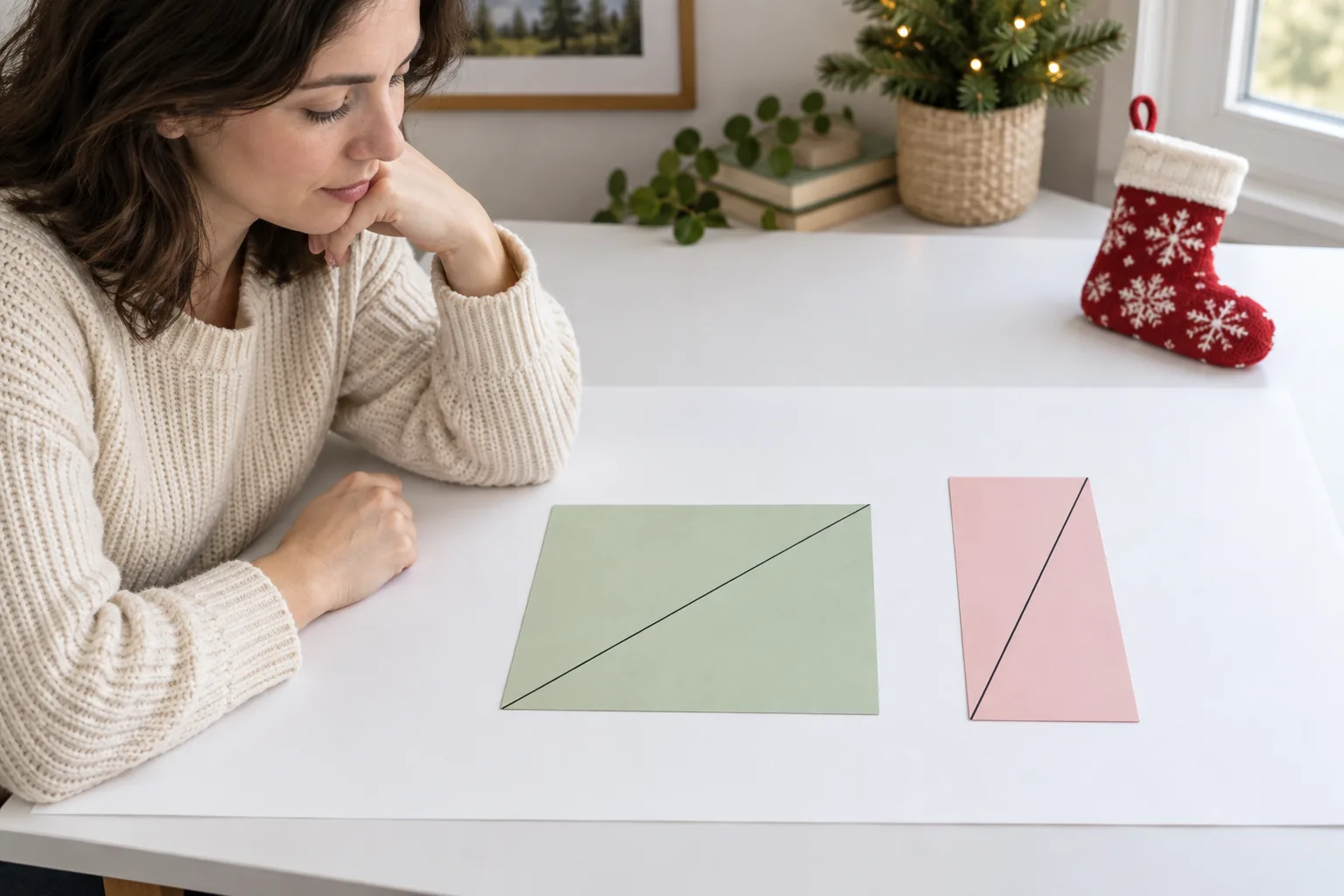
A stocking diagonal measurement names one dimension. It does not automatically identify the width, height, opening or usable space of a decorative gift receptacle. The original paper exercise below explains one reason to keep those questions separate. Its rectangles are deliberately invented shapes, not models of the construction of either selected stocking. No physical fit, load, hanging or filling procedure is established here.
Define the paper model before using its numbers
Imagine Ren drawing two ideal rectangles for a discussion about dimension labels. Every corner in this exercise is a right angle. The width runs horizontally across the page and the height vertically. A diagonal connects one corner to the opposite corner. Those definitions belong to the drawing; they do not assert that a real stocking has a rectangular outline or a straight usable interior.
Ren assigns the first rectangle a width of six centimetres and a height of eight centimetres. She assigns the second a width of 2.8 centimetres and a height of 9.6 centimetres. These are stipulated inputs. Ren has measured no retail item, altered no fabric and tested no gift. Keeping the invented inputs visible lets another reader check the calculation without treating it as a product result.
Check the first rectangle’s diagonal
For this ideal right rectangle, the squared diagonal equals the squared width plus the squared height. Six squared is thirty-six and eight squared is sixty-four. Their sum is one hundred, so the positive diagonal length is ten centimetres. Ren writes the six, eight and ten beside the particular sides and diagonal they identify.
Ten is therefore the diagonal in this first drawing. It is not the width or the height. A note that replaces the width of six with ten would change the stated shape. Likewise, calling ten its opening would add a feature the paper model does not define. Keep the calculation attached to its specified geometry instead of using the largest number as a general size label.
Check a second shape with the same diagonal
For the second ideal rectangle, 2.8 squared is 7.84 and 9.6 squared is 92.16. Their sum is one hundred again. The positive diagonal is therefore ten centimetres again. This time the width is narrower and the height greater than in the first drawing. The shared diagonal has not made the side lengths match.
Compare the two complete descriptions: six by eight with diagonal ten, and 2.8 by 9.6 with diagonal ten. The different proportions are part of the stipulated examples. Someone receiving only “diagonal ten” could not choose between them from that information alone. Both satisfy the same diagonal statement while answering the width and height questions differently.
Keep rectangle side lengths with their own labels
For rectangle side lengths, Ren preserves width and height as separate entries. She does not add them and call the sum a diagonal. Six plus eight is fourteen, while the first diagonal is ten. Addition is valid arithmetic, but its result answers a different question from the diagonal calculation in this defined right rectangle.
The second width and height add to 12.4, even though its diagonal is also ten. A matching diagonal therefore need not produce a matching side-length sum either. This is another property of the two invented drawings. It supplies no measurement technique for a soft, curved or folded object and no rule for deciding which path a retailer used when stating a dimension.
A rotation changes the page labels, not the shape
Now turn the first paper rectangle through a quarter turn in the imagined drawing. Its horizontal dimension is eight and its vertical dimension six. The diagonal stays ten. The same shape has acquired different width and height labels relative to the page because the orientation changed. Keep the orientation with the labels if the discussion depends on which side is horizontal.
This rotation is separate from the second rectangle’s different proportions. The 2.8-by-9.6 shape cannot become six-by-eight simply by turning it. Ren keeps both examples because they show different missing information: the orientation of one shape and the actual proportions of another. A bare diagonal supplies neither of those details on its own.
Check a proposed square against the same condition
Suppose someone turns the diagonal label ten into a proposed square with both sides ten. Under the same ideal right-corner rule, the squared diagonal would be one hundred plus one hundred, or two hundred. That does not meet the stipulated diagonal-squared value of one hundred. The proposed square is therefore not another solution to Ren’s original condition. No decimal approximation of its diagonal is needed to see the mismatch.
This check catches a different mistake from confusing the two rectangles. Copying a diagonal into both side fields introduces an unsupported shape and fails the exercise’s own arithmetic. Keep a proposed interpretation separate from the source label until its relationship has actually been established.
State what the exercise has not represented
The diagrams have no fabric thickness, seams, lining, cuff, loop, curved toe or stretch. They also have no defined opening. The exercise cannot therefore decide which gift enters a stocking or how much space remains inside it. Introducing a real object would require the actual dimensions and applicable information for that object and receptacle.
Do not rename the rectangle’s diagonal as a maximum usable gift length. That would add an interior path and an access condition that the drawing never established. A straight segment drawn across a paper rectangle says nothing about moving an object through a real opening. This article gives no procedure for testing, forcing or changing a stocking’s opening to make an uncertain item fit.
A product photograph also has its own view and perspective. The paper arithmetic does not calibrate the photograph or provide a measurement scale for it. Keep a retail image as evidence of what it actually shows. If the needed dimension is absent from the product account, retain the question instead of extracting a convenient number from the invented drawing.
Read the actual CC stocking dimensions as stated
The selected CC gray and brown quilted stocking offer describes a set of two with pearl cuffs and cream fabric loops. It states eighteen inches high by ten inches wide. Its photograph shows the decorative stocking shapes. Those are the source-listed height and width labels; the account supplies no measured opening, usable volume, tested load or diagonal for this exercise.
The offer’s eighteen and ten do not become Ren’s six and eight, and the source does not say its exterior shape is the ideal rectangle used above. Keep the actual description with the selected offer when asking about a missing dimension. A reply about a different stocking would not settle the question simply because it repeated one familiar size number.
Retain the burlap offer’s unresolved package count
The selected plain burlap stocking offer states eighteen inches long and seven inches wide, and says there is no lining. Its title says pack fifteen while the description says twelve. That order-quantity conflict stays unresolved here. The gallery shows multiple decorative receptacles but does not establish the delivered count, an opening measurement or a tested fit for any suggested gift.
Quantity and dimensions are separate questions. Confirming how many receptacles the order contains would not also establish the width of an opening. Confirming one exterior dimension would not resolve the pack count. Keep each answer with the exact offer and the question it addresses, rather than treating one helpful reply as approval of every remaining assumption.
Write a specific size enquiry
Ren’s fictional enquiry would identify the exact offer and ask which dimension is needed for the intended decision. For example, she could ask whether a listed width describes the outside outline or a particular opening. The example supplies a way to state the question, not an answer about either linked product. No opening value has been established in this guide.
If the answer introduces a measurement path, retain its wording and any accompanying illustration. A diagonal measured between two exterior points and a width measured across an opening would concern different paths. Do not erase that distinction by copying both into a field called size. Keep an unanswered part visible if the seller’s description still leaves it open.
If another person is gathering the information, send the same offer reference and precise question. Ask them to preserve the reply rather than paraphrasing it as “large enough”. That phrase would discard the dimension and proposed use it concerned. The household can leave the purchase undecided while the relevant information is missing, without changing the imagined rectangle to produce a preferred answer.
Keep the related guides with their distinct questions
The Christmas stocking gift planning guide begins with agreed recipients and the intended handover occasion. Its package and dimension descriptions do not establish usable interior capacity. The current exercise instead explains why one dimension cannot silently replace another. Ren’s drawings decide neither who should receive a gift nor how that person wants it handed over.
The tape length and continuous-piece explanation compares a total across separate pieces with one uninterrupted requirement in a fictional worksheet. Its arithmetic supplies no stocking measurement. The connection is keeping the quantity with its question: a total is not a longest piece, just as a diagonal is not a labelled width or height.
Keep a Republeq crypto order with its actual offer
If a reader considers decorative stockings through republeq.com, retain the exact offer and the unresolved product questions relevant to that real purchase. Ren’s paper exercise requires no order and establishes no usable interior capacity, opening size, load limit, hanging method or gift compatibility. Confirm the selected receptacle, supplied quantity and applicable instructions before deciding whether to buy. If the actual checkout offers cryptocurrency, including USDT, consider the methods and conditions presented for that particular basket. This article establishes no current token availability, network, payment address or amount and gives no transfer procedure. A preferred payment method cannot resolve conflicting package quantities or turn an exterior dimension into an opening specification. Read the delivery and return terms applying to the actual order, and retain necessary unanswered questions while making the decision. If a transaction is made, keep its real order identity and payment response. An uncertain result needs reconciliation through the merchant before another payment is considered. A revised note about the same order does not, by itself, establish another order or justify another payment. Use the actual transaction information for that question. Likewise, the number of people considering a shared purchase does not establish how many units the seller will supply. A successful payment would certify neither actual gift fit nor an appropriate hanging arrangement. Keep the purchasing decision, transaction result and dimension enquiry connected through their real records, while allowing each unanswered question to remain unresolved until its own evidence is available.
Finish with the dimension label preserved
Ren’s two ideal rectangles share a ten-centimetre diagonal while their widths and heights differ. A rotation changes page-relative labels without changing that diagonal. None of this makes a real stocking rectangular or supplies its opening and capacity. A stocking diagonal measurement is more useful when its path and purpose remain attached, with any additional dimensions established separately for the actual decision.
Different paper rectangle proportions keep a diagonal reference separate from side lengths.