Crypto Commerce
Plan stand mixer attachment selection around the recipe
When a recipe names an action instead of an attachment, read the ingredient state and intended result before choosing a candidate tool. For stand mixer attachment selection , distinguish what the recipe explicitly requests from what you infer. Then compare that reading with the instructions for the exact mixer. A plausible interpretation can help you prepare a question, but it does not establish that an attachment suits the recipe.
When a recipe names an action instead of an attachment, read the ingredient state and intended result before choosing a candidate tool. For stand mixer attachment selection, distinguish what the recipe explicitly requests from what you infer. Then compare that reading with the instructions for the exact mixer. A plausible interpretation can help you prepare a question, but it does not establish that an attachment suits the recipe.
The useful result is a recipe-stage map: a short annotation beside each mixing instruction showing the proposed attachment, the reason for considering it, and anything unresolved. You can prepare this map before handling ingredients or fitting accessories. It lets you see where the recipe gives a direct answer and where a familiar word such as "beat" leaves too much open.
Read The Recipe Before Reviewing The Geek Chef Stand Mixer
Start with the full stage, including the sentence before and after the action. Identify what the recipe says is already in the bowl. Does it describe separate ingredients, a combined mixture, or a dough? Preserve the actual description instead of filling in a texture from memory. If the starting state is missing, record that gap; it may affect how you understand the next instruction.
Next, isolate the requested action and its object. "Mix the ingredients" gives different information from "knead the dough," even though neither names a particular accessory. Look for an intended result in the same passage. The recipe may describe a change in texture or simply ask for ingredients to become combined. Those details help explain the task without yet deciding which tool can perform it.
Keep these observations separate in your annotation. An ingredient name answers what is involved; the action answers what the writer wants done; the result describes where that stage is meant to end. Combining them too quickly into an attachment name hides the reasoning. You should be able to point back to the words that support each part of your proposed choice.
Named Tools And Implied Tools For The Geek Chef Stand Mixer
An explicit instruction such as "use the whisk attachment" identifies the recipe writer's intended tool. Record it as a named attachment, while leaving exact-model suitability for a separate check. That wording is stronger evidence of recipe intent than "whip," which describes an action, or "beat," which may need more surrounding explanation before you can identify a candidate.
Read any equipment note that belongs to the recipe, too. A tool named at the beginning may apply to a specific stage rather than every later instruction. When the recipe uses a term that differs from the mixer instructions, do not silently treat the names as equivalent. Preserve both terms and identify the question they create. Similar wording alone does not establish compatibility.
A helpful annotation separates recipe certainty from equipment certainty. You might write, "The recipe explicitly names a whisk; suitability for this model remains unchecked." That is a more precise conclusion than either declaring the stage settled or treating the entire instruction as unknown. It preserves the answer you have while keeping the remaining question visible.
Attachment Roles To Compare With The Geek Chef Stand Mixer
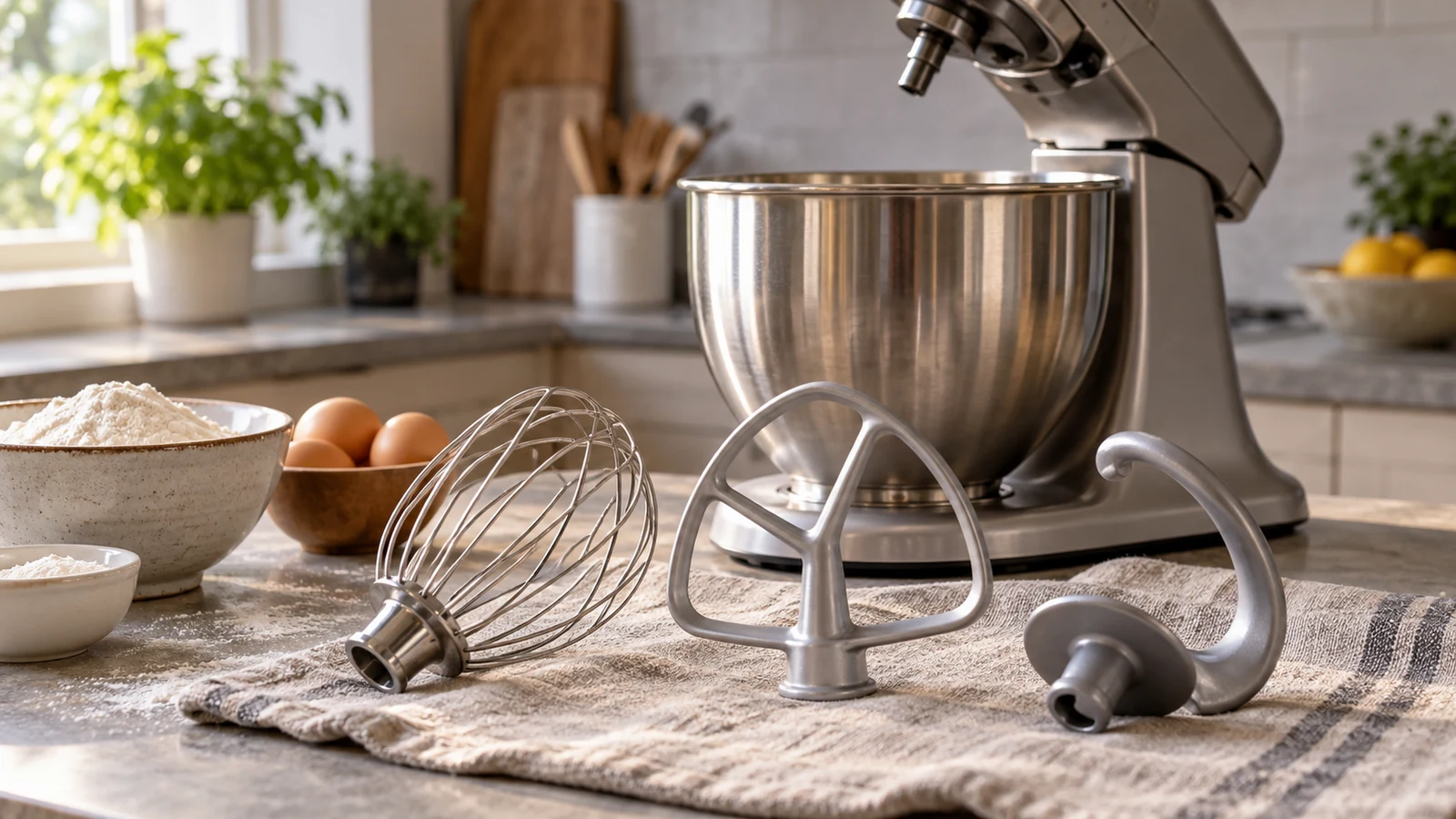
The SKYSHALO listing provides a concrete example for stand mixer attachment selection: its description associates the dough hook with kneading, the flat beater with mixing, and the whisk with whipping. These are the listing's stated roles. They offer a starting vocabulary for comparing a recipe action with a named accessory, rather than instructions for a particular preparation.
Use the associations in that direction. If your recipe calls for kneading, the description gives you a reason to investigate the dough hook. If it calls for whipping, the whisk becomes a candidate to check. Neither association tells you whether the exact recipe, ingredient condition, or quantity is suitable for that mixer. Those questions require the applicable recipe and model instructions.
The broad word "mixing" needs particular care. The listing's association between mixing and a flat beater does not resolve every sentence containing "mix." Read what the recipe wants changed and whether it specifies a method elsewhere. Avoid turning a short product description into a universal translation rule in which every action word automatically produces an attachment choice.
Keep the product name beside any listing-derived note. An annotation that says "SKYSHALO description: hook associated with kneading" identifies where the association came from. A note saying only "kneading means hook" drops that boundary. The first remains useful when you later consult the exact-model instructions; the second can sound more conclusive than its supporting information warrants.
What The Geek Chef Stand Mixer Inventory Establishes
The description for the Geek Chef stand mixer names a whisk, beater, dough hook, and pouring shield. That establishes the accessories named in the description. It does not assign an attachment to your chosen recipe stage or show that every listed item serves the same purpose. Keep the inventory beside your recipe notes without treating it as a completed selection.
This distinction matters when a recipe names a tool that appears in the bundle description. You have found a match in terminology, which is useful. You still need to establish whether the exact-model instructions support that tool for the intended task and quantity. A matching name should move the question forward, not erase conditions you have not checked.
Nor does the shared presence of a hook, beater, or whisk establish interchangeability between the two mixers. Keep each product's accessories and instructions attached to that product in your notes. The SKYSHALO role descriptions can illustrate how a listing expresses intended uses; they cannot supply missing instructions for the other model or justify transferring an accessory between them.
Reconsider Each Stage For The Geek Chef Stand Mixer
Give a later recipe stage its own annotation whenever the action or intended result changes. An earlier attachment choice belongs to the task that supported it. If the recipe later introduces another mixture, names a different action, or requests a different texture, read that passage again rather than automatically carrying the first candidate forward.
For example, imagine an incomplete, fictional sequence that first requests combining ingredients and later requests whipping a separately described mixture. The second instruction deserves a fresh interpretation because its object and action differ. This observation does not prescribe an attachment change or explain how to make one. It identifies a separate decision that the recipe and model instructions need to resolve.
The same principle applies when a recipe becomes less explicit. A clearly named tool in an early stage cannot settle an ambiguous later instruction merely because no replacement is mentioned. Check whether the wording actually carries the earlier tool forward. If it does not, write the uncertainty at the later stage instead of inventing continuity.
Fictional Recipe Excerpts For The Geek Chef Stand Mixer Review
The following excerpts are invented reading exercises, not recipes or operating instructions. They deliberately omit quantities, settings, and preparation details. Each demonstrates a different conclusion you might reach while annotating a real recipe: a tool explicitly named, a candidate supported by context, or an instruction that remains unresolved.
An Explicit Attachment In The Geek Chef Stand Mixer Notes
Consider the fictional wording, "For this whipping stage, use the whisk attachment." Your map can record the action as whipping and the named tool as a whisk. The reason for the selection is direct: the sentence identifies the accessory. There is no need to present that part as an inference or seek a different attachment based on a broad listing label.
The annotation should still retain what the excerpt leaves open. It does not identify the ingredients or establish suitability for either mixer. A complete note could read, "Recipe names whisk; ingredient context and exact-model guidance still required." This preserves the explicit instruction without turning a fictional excerpt into permission to operate a machine.
A Candidate Attachment In The Geek Chef Stand Mixer Notes
Now consider a separate fictional excerpt: "The dough is combined. Knead it to the texture described in the recipe." The starting state is combined dough, and the requested action is kneading. The SKYSHALO description's hook-for-kneading association supports investigating that attachment for that product. The excerpt itself does not name a tool, so the selection remains a candidate.
Write the support accurately: "Hook candidate based on the stated kneading action and SKYSHALO listing role; check the complete recipe and that model's instructions." If you are considering the Geek Chef model instead, its inventory establishes that a dough hook is named, but the other product's role description does not establish recipe suitability for it. Keep that equipment question separate.
An Unresolved Instruction In The Geek Chef Stand Mixer Notes
A final fictional excerpt says only, "Beat the mixture." It supplies neither a named tool nor enough context to identify the intended result. Assigning a beater because its name resembles the verb would add information the excerpt does not contain. Leave the candidate field unresolved and look for the missing description in the complete recipe.
The useful question is specific: "What mixture is being beaten, what change is intended, and does the recipe identify an attachment elsewhere?" If the full recipe answers those points, update the interpretation and then compare it with model guidance. If the recipe and equipment instructions conflict, preserve the conflict and seek clarification rather than choosing whichever wording seems easier to follow.
Complete The Attachment Map Before Appliance Installation Readiness
For your own recipe, put the annotations in recipe order so each proposed tool stays beside the stage it belongs to. The map should let you retrace a choice without rereading unrelated product features. Keep the recipe wording recognizable, and avoid compressing a qualified candidate into a definite instruction when you shorten your notes.
- Record the stage wording, including any explicitly named attachment.
- Describe the starting ingredient state, requested action, and intended result using the recipe's information.
- Mark the tool as explicitly named, a context-supported candidate, or unresolved.
- Identify the supporting recipe passage, product description, or exact-model instruction.
- Write the remaining question beside the affected stage.
Keep placement and connection concerns outside this attachment map. The separate guide to appliance installation readiness addresses that planning area; it does not decide which accessory a recipe requires. If cryptocurrency is offered for a prospective purchase, that payment option likewise does not answer the attachment question or establish suitability for your intended preparation.
Before fitting accessories or preparing food, finish your proposed stand mixer attachment selection map for one complete recipe. Read each attachment name beside its supporting wording. Where the recipe is explicit, retain that instruction; where your reading is tentative, label it; where information is missing, write the question. Use the completed map to identify exactly what you still need to resolve with the recipe and exact-model instructions.