Educational & Explainer Articles
Spring shoe trees and their role between wears
Read the storage purpose of spring forms without assuming a change in shoe fit.
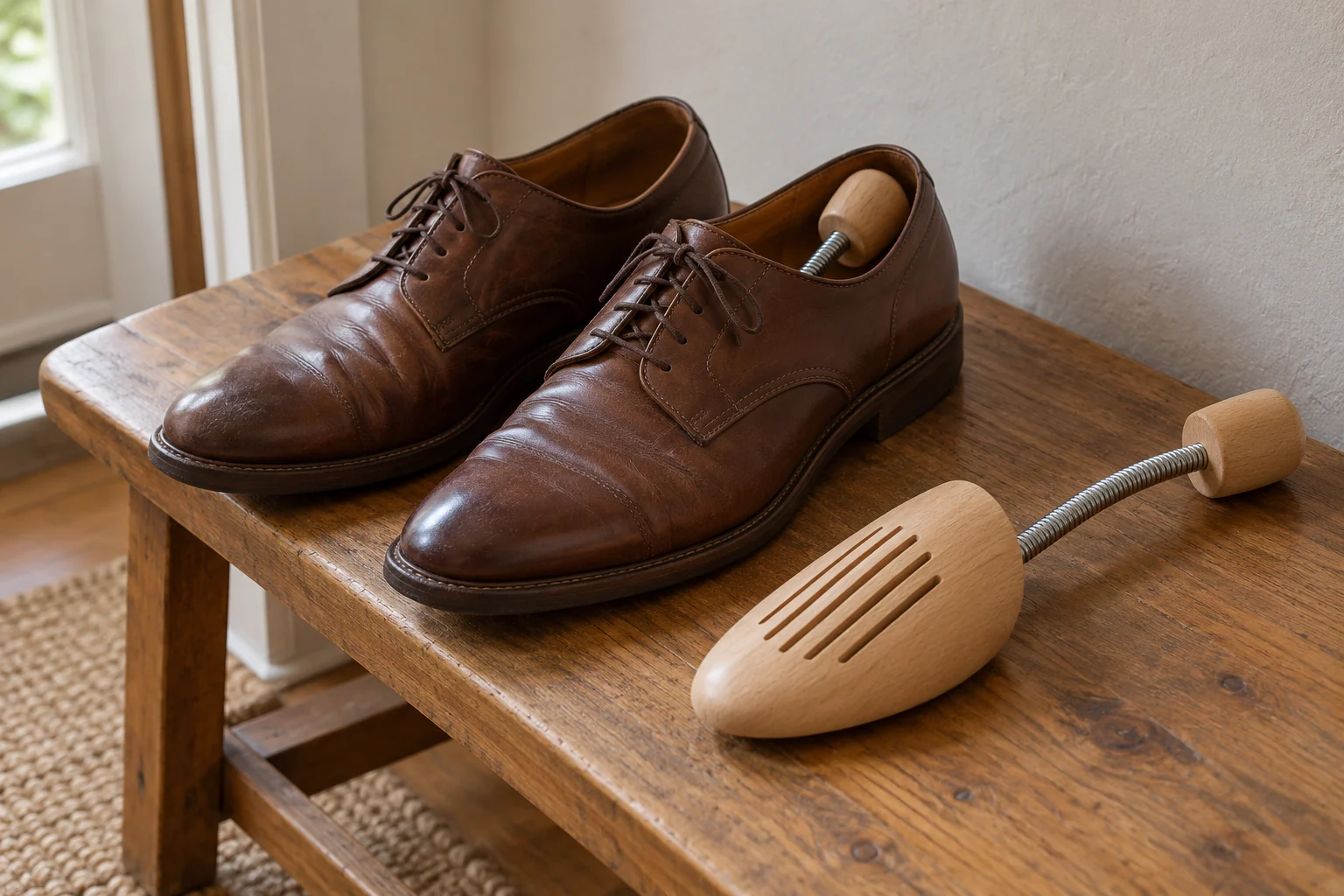
Spring shoe trees belong to a question about the footwear you already own: what does the form inside an unworn shoe do? A product name containing stretcher can make that question harder to read. This article looks at ordinary spring-connected forms offered by COOPHYA and GOOHOCHY, then separates their storage description from a request to change how a shoe fits. It does not report a fitting trial or recommend altering footwear.
Take a storage purchase as a working example: the wearer already likes the fit of a particular pair and is considering an accessory for the time between wears. That is the task followed here. It is a hypothetical example, with no fitting trial behind it. A second wearer asking for extra room would bring a different request. Knowing which request you are trying to answer helps keep a vague retail title from doing the deciding.
Storage shape is the subject
Cheaney describes the primary purpose of a shoe tree as holding a shoe’s shape during storage. The maker also explains that normal walking produces creases and that shoes cannot be kept completely crease-free through use. Its discussion gives the storage role a useful boundary. A form described for that role does not become a promise that an already worn shoe will look new, or that every visible crease will disappear.
The storage question can be settled in ordinary language before a purchase is chosen. You might ask whether the accessory is intended to sit inside the footwear between wears, then seek guidance about the particular item and pair involved. You have not asked for an alteration simply by asking that question. If changing how a shoe fits is your real concern, say so when seeking help; this article does not diagnose discomfort or decide whether footwear should be modified.
Read the spring form as a complete object
The COOPHYA gallery shows a slotted wooden forefoot piece, a flexible coil connection and a small wooden heel end. That observation identifies the photographed form; it measures neither force nor range. The staged shoes are not identified here as supplied items. There was no use test in a reader’s footwear.
Saphir’s instructions for its own Black Pointed Shoe Trees describe placing the front into the shoe and positioning the back with pressure on the spring. That is an example of a maker identifying the parts of its particular storage form. Saphir also gives a size recommendation for that product. Neither its insertion directions nor its sizing advice is an operating instruction for the two other offers discussed here.
A photograph may let you point to an object’s parts without answering everything you would need before use. Here it helps distinguish the forefoot, connection and heel end. It supplies no tested limit, universal size conversion or permission to press harder when something does not suit your footwear. Keep an unanswered use question unanswered until the actual product guidance can address it. This guide does not supply a substitute fitting procedure.
shoe tree offer details
The COOPHYA five-pair offer describes a spring design and a purpose of preserving shoe shape during home storage. Its native brand field and title both identify COOPHYA. The description gives a package quantity of five pairs. The corresponding photographs show the forefoot-and-spring forms discussed above. Those facts describe this offer; they do not independently establish its broad promotional claim of being a perfect fit for most shoes.
The GOOHOCHY five-pair offer also identifies a spring design and shape-preserving purpose. Its title names wood and metal and gives EU size 39–40, while its description uses broad language about most shoes. Keep the stated size attached to this offer. The broader wording does not provide a verified conversion for another sizing system or establish that every shoe carrying a particular label has the same internal shape.
Reading shoe tree offer details also means recognising what the images do not establish. GOOHOCHY’s gallery repeats several photographs used in the other offer. That overlap supplies no measured comparison or proof of an identical manufacturing model. No side-by-side use test was conducted for this article.
Suppose the imagined owner finds a familiar-looking image while shopping and assumes it is the item a friend previously bought. The useful next question is which exact offer the friend meant. A shared photograph leaves that identity unresolved. The owner can choose to postpone the purchase until the intended item is clear, rather than turning visual familiarity into a fit assurance. This is a hypothetical decision, not a reported customer experience.
shoe tree storage role
Understanding the shoe tree storage role starts with the intended outcome. A storage description and a resizing request begin with different intended outcomes. In the first, the imagined owner is already content with the footwear and is considering an accessory between wears. In the second, someone wants the footwear to become different. This distinction explains why the word stretcher in a title deserves context. It does not prove what a tool can accomplish or determine whether changing a shoe is appropriate.
The guide to shoe stretcher controls explains tools with separately described width, length, instep or local-contact functions. It identifies the working areas and limitations of actual FootFitter offers. That is the relevant further reading when a product’s advertised adjustment functions are the question. The present article stays with spring-form storage descriptions; it supplies no turns, dwell times, stretching preparation or promised increase in room.
In the working example, there is no reason to rank a storage accessory by the amount of extra room it might create. That would answer a question the wearer has not asked. If someone helping with the purchase brings a different aim, establish which footwear decision they are trying to make before choosing goods together. A shared order can contain separate requests. It does not make the intended outcome of each request identical.
Size words need their own evidence
Cheaney warns that an incorrectly shaped or incorrectly sized shoe tree can distort a shoe. Its own collection includes forms intended for different shoe shapes. That warning does not establish which size of either selected retail offer suits an individual reader. It does explain why a general label such as wooden shoe tree is insufficient on its own. The appropriate product-specific fit information still needs to concern the footwear and form actually involved.
Saphir recommends selecting a size slightly smaller than the wearer’s own for its Black Pointed Shoe Trees. The recommendation belongs to that named Saphir product, with its own stated size options and pointed form. It is not a conversion rule for an accessory from another manufacturer. A size recommendation can therefore be genuine and still be the wrong answer to a question about a different offer. Seek the relevant product’s guidance instead of extending another maker’s rule.
A household can also own several pairs under the same broad footwear label while wanting different things from them. A pair selected for a particular occasion and a pair used regularly need not become interchangeable examples in a product enquiry. The imagined owner can name the intended pair when asking for guidance. This is a way to make the question specific, not a claim that this article has established the internal dimensions or suitability of those shoes.
Quantity does not settle suitability
A bundle quantity does not answer a household’s suitability question. The arithmetic of dividing a purchase can be straightforward while its intended use remains unresolved. If only one identified pair is under consideration, a larger package does not supply the missing fit information. An unused part of a bundle is still a product to account for, rather than evidence of a better result.
A bundle can also be considered as a shared purchase. Before dividing it, the people involved can agree which exact goods they mean and what each person expects to use. One person’s enthusiasm does not resolve another’s unanswered product question. If the requests differ, separate decisions remain possible even when buying together would be convenient. This is a purchasing consideration, without any claim that the selected forms have been fitted to either person’s footwear.
Where the shoes go is another question
The shoe-rack fit guide examines actual footwear, shelf openings and furniture access. It keeps a rack’s external measurements apart from the openings a particular pair must use. That is a separate storage-space question from the role of a form inside a shoe. Knowing where footwear will be put away does not establish the correct internal accessory, and choosing an accessory does not establish that the footwear will fit a cabinet.
For the imagined owner, it may be enough to settle one question before taking on another. They can understand the intended role of a spring form without redesigning an entryway or buying new furniture. Conversely, someone whose immediate concern is a crowded cabinet may need the furniture question answered first. This article does not turn either preference into a universal order of work. It helps the reader recognise which decision they are actually making.
Keep the claim within the job
Loake’s shoe-care guidance places shoe trees within a larger care routine for its footwear. It calls for rest between wears, describes its own cedar trees, and says wet shoes should dry naturally away from direct heat. Those are Loake’s instructions and product claims. They do not establish a drying result for the two retail accessories here. They do show why an accessory’s description should be read alongside the footwear maker’s applicable care guidance.
The same Loake guide treats cleaning and conditioning as separate work. It describes removing surface dirt before cream or polish, then distinguishes calf leather from waxy leather care. That material-specific discussion should not become a cleaning recipe for every shoe beside a storage form. A photographed accessory supplies no answer about an unknown upper or finish. If the footwear needs care, identify its own applicable instructions before choosing a product or process for that work.
If odour treatment, moisture removal or a particular wood species determines your purchase, seek evidence about those specifics. Decide what question needs an answer, without adding a benefit to make an accessory feel more worthwhile. A reader considering ordinary between-wears storage can keep that limited task in view. A different requirement deserves its own enquiry. You can postpone a decision while that enquiry remains open; the article has not tested a treatment for your footwear.
Return to the storage purchase used as the working example. The wearer likes the footwear’s fit, wants to understand a between-wears accessory and has not asked for a resizing procedure. They can now describe that intended job when evaluating an offer or seeking product guidance. If the conversation changes to discomfort, repair or an alteration, acknowledge that the decision has changed too. A familiar product photograph should not decide that question on the wearer’s behalf.
Buying your storage accessories with cryptocurrency
If you plan to buy spring shoe trees at republeq.com using cryptocurrency, including USDT, settle the footwear question before choosing a payment method. Decide whether you want a form for storage between wears and obtain the guidance needed for your particular shoes. Keep a request to change the fit separate from that purchase. A payment preference cannot establish that an accessory is suitable. Once you have selected an offer, read the basket against the product you intended to order. Check the stated package contents and any size information that applies to that exact item. If you are sharing a package with someone else, agree which goods you are buying before either person authorizes payment. Each wearer can still have a different question about their own footwear. Use only a payment option actually presented for the order. If cryptocurrency is available there, read the current instructions for the option you intend to use. A preference for USDT does not identify a supported asset or settle any details that the payment instructions leave unclear. Ask for clarification before sending funds when those instructions do not answer your question. This article supplies no wallet address or transfer directions. Review the delivery and return information alongside the selected goods, since your planned storage routine does not establish when an order will arrive or how a return would be handled. Keep the order confirmation and the confirmation supplied by the payment route together so that a later enquiry can identify the purchase. If you change the product while considering payment, check the revised basket again. Finish with the exact accessory and package you chose, a payment method the checkout actually offers, and the unanswered footwear questions resolved before you commit.