Home & Living
Spray mop reservoir will not fill: check the intended inlet
Separate filling from trigger output. Find the instructions that match your reservoir before choosing an inlet or a different filling method.
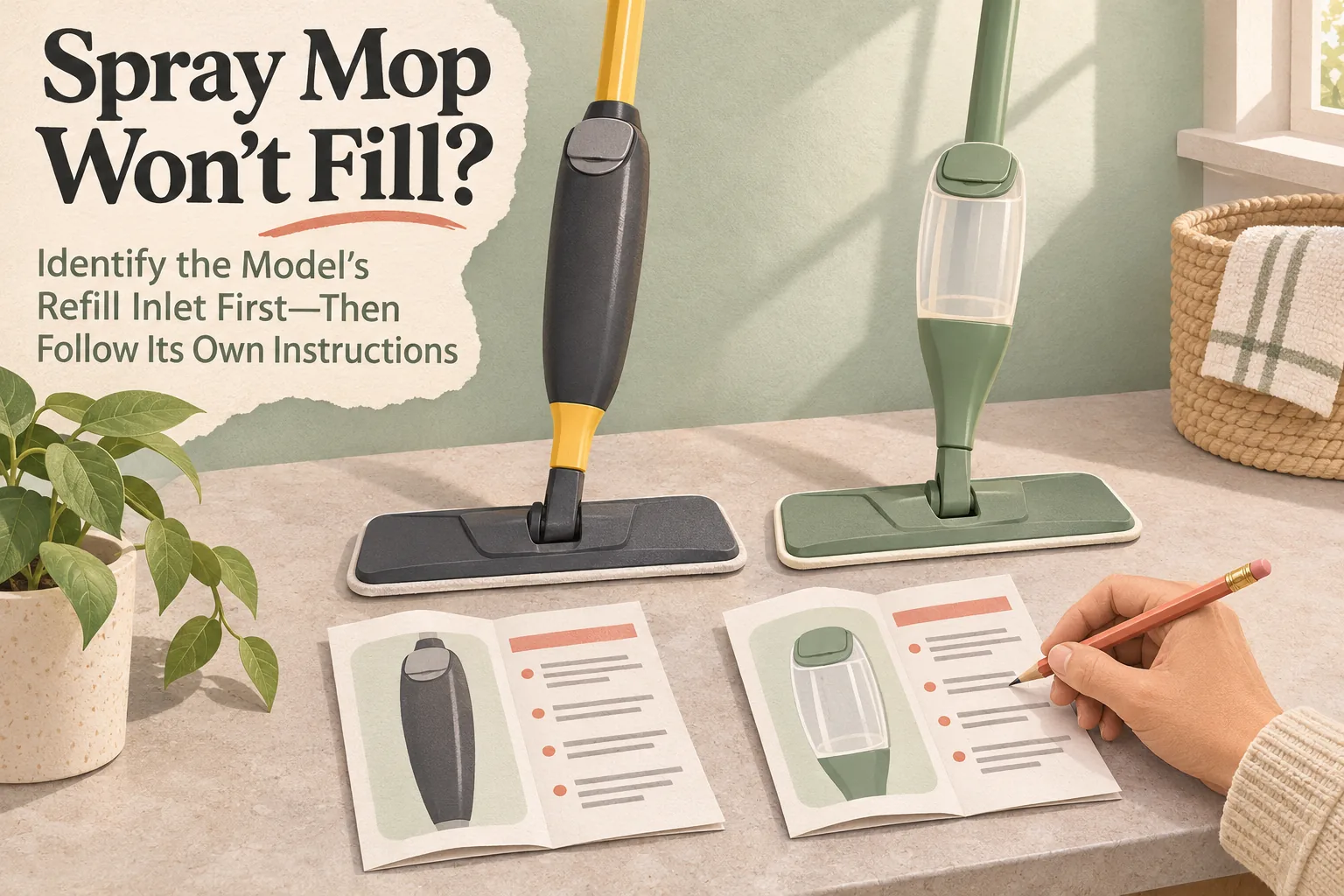
Name the stage that stopped
Spray mop reservoir will not fill names a specific problem: liquid has not entered the tank. Keep that observation separate from a trigger that produces no spray after the tank is filled. Write down where the liquid is now and the opening or connection you expected it to pass through. That gives the instruction search a specific purpose. A page about clearing a spray nozzle may answer a different problem. Before changing anything, establish whether you are trying to replenish the reservoir, attach a removable tank, or dispense liquid already inside it. This guide concerns the first question and the evidence needed to identify the intended filling method.
The captured Rubbermaid Commercial PULSE-named offer describes a yellow manual spray mop with an onboard reservoir. The listing describes two systems in the order and says each system includes a trigger handle and reservoir, a Quick-Connect frame and two HYGEN damp mop pads. The sole gallery shows one assembled yellow mop. Treat the stated order count and pad supply as listing claims requiring confirmation; the photograph does not authenticate delivered inventory. The listing's model-number field is empty. Those limits matter when looking for instructions: a catalog description can supply a useful product-family lead while leaving the exact hardware in your hands to identify.
Make the refill inlet question concrete
For a refill inlet question, record the maker and full model information available on your own tool, its packaging or retained instructions. Keep a photograph of the reservoir and the part you expected to connect. If a model label is absent or unreadable, say so in the enquiry. A seller title and a familiar color are leads to investigate. Neither should become an invented model number in your notes. This distinction is especially useful when a product family contains several reservoir arrangements, or when the instructions you found show an accessory you do not own.
Describe the attempted action without assigning a cause. For example, an original support note might read: "I tried to refill through the connection shown in my guide. Liquid did not enter the reservoir. I have stopped at that step." Add which guide you used and the hardware identity you have established. This sample reports an observation; it does not claim an internal blockage, a failed seal or a defective pump. Leave those conclusions open for the applicable instructions or the maker to resolve. Keep any photograph close to the note so the intended connection is clear.
Read the PULSE filling note within its limits
Rubbermaid Commercial Products' HYGEN product-use manual describes a PULSE caddy filling route: the caddy's Clean Connect hose plugs into the cap fitting, and filling stops when the reservoir is full. In that filling step, the manual says that if air in the PULSE reservoir impedes liquid flow, loosen the cap and perform a manual fill. The following alternative opens the red cap at the top of the PULSE reservoir, fills it and replaces the cap. Read this with the complete instructions for identified, matching PULSE hardware, including the manual's protective-equipment and established-procedure requirements. It is a specific fill-flow note, not a diagnosis of every dry spray mop. It supplies no general instruction to dismantle a pump or clear a nozzle. A separate caddy and cart appear in the manual; their presence there does not establish that either accompanies the captured retail order.
Notice what the note can resolve and what remains open. A reader with the matching equipment can locate the manufacturer's stated alternative to the caddy filling step. Someone whose tool has a different tank or cap still needs the correct instructions. The note does not authenticate an online offer, prove the cause of a particular failed attempt, or show that liquid will later dispense normally. Keep those questions separate in the record. Otherwise, an instruction about getting liquid into the reservoir can quietly become an unsupported explanation for everything that happens after it leaves.
Manual filling belongs to the identified tool
Read the whole applicable manual filling step, including what must be replaced or disconnected when it is finished. If the guide and your tool disagree, preserve the disagreement and ask about it. Do not choose a cap, latch or hose connection merely because it resembles an illustration. A useful support question identifies the mismatch directly: "This is the reservoir on my tool; this is the filling step I found. Does that step apply to this model?" An answer to that question is more useful than a collection of unrelated repair suggestions.
Keep the filling instructions beside the cleaner's own directions and the requirements for the intended surface. This article does not select a chemical, dilution or floor treatment. A refill-path question is not a reason to mix products or experiment with an unidentified liquid. If the proposed procedure depends on information you do not have, name that missing information before proceeding. The same applies to a leaking or visibly damaged part: record its condition and obtain the appropriate instructions rather than trying to make an uncertain connection work by force. These are limits on the enquiry, not a claim that a particular component has failed.
Keep the Libman tank account separate
The captured Libman Freedom Wide Spray Mop offer describes a refillable tank and precompression spray mechanism. Its model field names 4002 and its color field says Green; the sole gallery shows one complete green manual mop with a translucent tank and attached rectangular pad. Libman's official Freedom Spray Mop page identifies product 4002 and calls its tank removable and refillable. The matching number gives you a manufacturer reference to check. It does not establish factory authentication or every delivered detail of the retail offer. Neither captured account supplies a tank-release procedure to reproduce here. Use the instructions for your identified Libman tool, or ask Libman how its tank is removed and refilled. The PULSE caddy connection and red-cap alternative should stay with their PULSE context.
Make two separate instruction records if you are comparing tools. Put the hardware identity at the top of each, followed by the guide title and the specific filling question. Keep unresolved points in the same record as the tool they concern. For the Libman example, a question about its removable tank should not inherit an answer about a PULSE hose fitting. For the PULSE example, a photograph of another mop's translucent tank should not supply a release method missing from the PULSE guide. That keeps the unresolved connection beside the tool it belongs to.
Keep other mop decisions out of the diagnosis
The published manual mop pad attachment guide explains the relationship between a cleaning textile and its carrier. Use it when the uncertainty concerns the pad connection. Changing a pad or recognizing its fastening type does not establish which opening fills an onboard reservoir. Keep the two relationships named separately when asking for help.
The spin mop refill or full kit guide addresses a replacement decision across a bucket, handle, plate and textile. That decision needs its own component evidence. Here, leave the shopping conclusion open while identifying the fill path. An uncertain filling method is not proof that the complete mop needs replacement or that another pad would solve the problem.
End with a question someone can answer
A concise final enquiry can contain four things: the identity you have established, the instruction you consulted, the exact stage that stopped, and the missing answer. For example: "My label identifies this model. I used this edition of its guide. Liquid did not enter through the specified filling connection. Please confirm whether the manual-fill alternative applies, and which instructions I should follow." This is an original example, not a report of an actual service case. If the identity remains unknown, replace the first sentence with that uncertainty and provide the photographs requested through the maker's support process.
Retain the response with the original question. A reply that identifies the correct guide resolves an instruction question; a reply requesting another photograph leaves that question open. Neither should be recorded as a completed repair. If later use presents a different symptom, describe that new stage separately instead of rewriting the earlier observation. The useful outcome is a clear account of the refill method applicable to your own hardware and a truthful record of what remains unresolved. Once that is established, follow the complete instructions rather than extending a short filling note into an improvised maintenance routine.
Leave room for a specific answer in the enquiry. "Which opening should receive the liquid on this model?" asks about the inlet. "Which guide covers this reservoir?" asks about applicability. "The tank is full but the trigger produces nothing" reports a later output problem. Choose the sentence that matches your observation. Combining all three into "the mop does not work" conceals the stage you need help with. Keep a question about an unidentified connection open until the maker identifies it; a description of a different tool does not complete that answer.
Keep a conditional payment record
Both saved product pages list cryptocurrency among their accepted payment methods. If a future order on republeq.com actually offers a crypto option, make that decision after the exact tool, included items and unresolved model questions are settled. If USDT is offered for that transaction, use the merchant's current instructions rather than a payment note saved for another order. Record the order reference, displayed amount, named asset, network and destination exactly as presented. If any instruction is ambiguous, leave payment unfinished while the merchant resolves it. Keep this payment record separate from the equipment enquiry so an answer about a reservoir is never mistaken for confirmation that funds arrived. Before submitting payment, compare the current order reference with the one attached to the instructions. Check whether the displayed amount and instructions still belong to that order. If the session expired or a payment field changed, obtain the current instructions through the merchant's authorized process. After an attempted payment, retain the confirmation or transaction reference and the merchant's actual status response. An unclear status calls for reconciliation of that attempt before another payment is authorized for the same order. If a refund becomes relevant, ask how the merchant would handle the payment method actually used and retain the terms supplied for that transaction. If you choose another method before sending funds, record the change so an abandoned instruction set is not mistaken for a completed payment. Keep private wallet credentials out of the shopping record. Apply these steps only to a payment option genuinely offered for the specific transaction, and confirm current network, exchange-rate, checkout and refund terms with the merchant.
Conceptual refill-path check; no tested fault, repair result or exact delivered model shown.