Office Supplies & Stationery
split figure bookends and separate figures on a shelf
Compare a divided elephant bookend pair with two separate cat figures to decide which visual arrangement suits a book row.
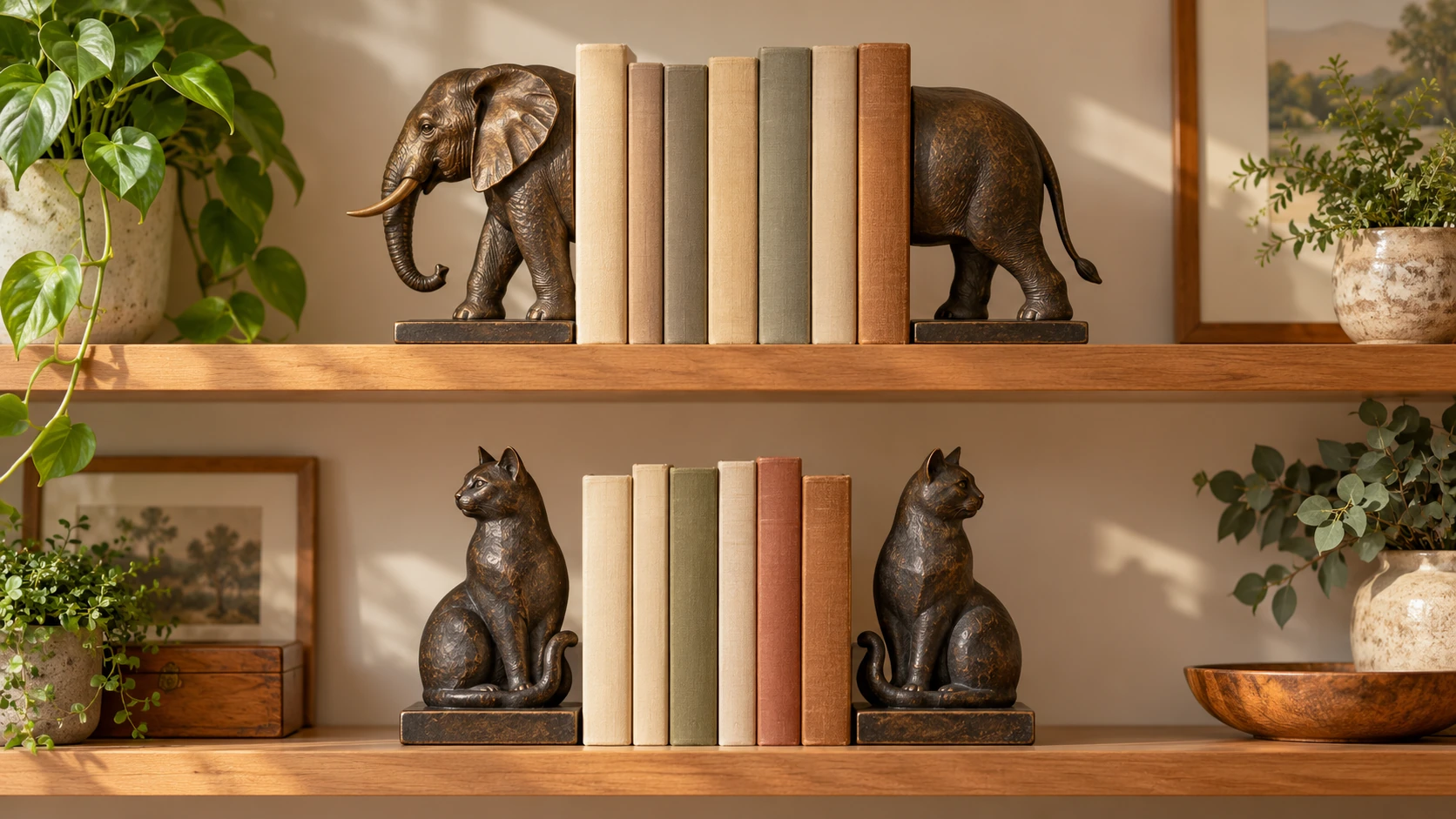
A pair of sculptural bookends can read as one picture interrupted by books, or as two separate objects standing on either side of them. That distinction is easy to miss in a product thumbnail. It changes the impression of a shelf even when the same row of books sits between the ends. If you are considering split figure bookends, start by looking at the two forms together, then look at each end on its own. The examples here are a divided elephant figure and a pair of seated cats. Their native pictures show the arrangements; they do not prove how either pair will perform on your particular shelf.
Look at the space between the ends
Imagine removing every book from the row for a moment. Does the pair still suggest one figure whose two portions belong together? Or do the ends look like independent figures that happen to face a common space? This is the main visual decision. In a split design, the books become an interruption in a single implied shape. A change in the row's width changes the gap in that shape. With two independent figures, the books occupy the center of a small scene; the figures need not appear to join across it.
This distinction is about what the listing and its image actually show. It is not a promise that one arrangement holds books more securely, takes less room, or suits a particular furniture style. Those practical questions require measurements and a gentle test with the real books and shelf. First decide which visual relationship you want to see when you walk past the shelf.
The elephant pair suggests one divided figure
The CC Home Furnishings elephant bookend pair is listed as a two-piece set. Its native description calls the design a split elephant and mentions a flat base. In the captured gallery, the front portion stands at one end of the pictured book row and the rear portion at the other. Seen together, they invite the eye to complete one elephant across the books. The books occupy the missing middle rather than merely sitting between two unrelated ornaments.
Notice how much of that effect depends on the arrangement. If the ends are far apart, the continuous figure becomes a loose suggestion. If a few books sit close between them, the two parts may read more immediately as a pair. The image does not give a rule for a correct gap. You can think of this as a composition to try with your own books, allowing the row to grow or shrink without claiming the product was engineered for any one width.
The native listing has conflicting size language: its title says 10 inches, while the description supplies a different height figure. Do not treat either as a measured dimension of the particular pair that will arrive. The image also cannot establish the exact base footprint, load tolerance, or how the ends will behave on a slick surface. If these details matter to your purchase, get current, offer-specific dimensions and care information from the seller before deciding.
The cats remain two independent figures
The Ebros Gift cat bookend pair presents a different visual idea. The captured gallery shows two separate seated cat forms with books between them. The native text describes a pair of cat figurines posed at rest. You can recognize each end as its own figure without mentally connecting it to the other across the book row. The pair still frames the books, but the center space does not complete a single animal.
That independence gives you a different way to read the shelf. A reader may notice the cat nearest the first book, then the row of spines, then the other cat. The figures act as two points of interest at the boundaries. This observation is visual, not a guarantee that the items can be placed in any orientation or separated by any distance. Keep the pair's intended support role and the seller's placement information in view while deciding where it belongs.
The page uses different finish language in its title and description. The photograph is useful for seeing form and pose, but lighting and screen color cannot settle the delivered finish. If a precise color or material match is essential, verify the current offer with the seller. Avoid assigning an appearance to the item solely from the product URL or a styled photograph.
Compare the pair as a whole, then each end
Open both product pages and put the gallery views side by side. Cover the books in each image with a finger or a sheet of paper. In the elephant view, the separated portions still seem to belong to a common figure. In the cat view, each seated form remains complete. Reveal the books again. The elephant pair asks the row to occupy a gap in the figure; the cats set a boundary around the row. This quick exercise is more useful for this decision than a generic label such as “decorative bookends.”
Now consider which end you expect to see most often. On a shelf viewed from one side, the near figure may draw the eye before its partner. A split figure may lose some of its intended effect when only one half is visible from the usual approach. A pair of complete figures may remain legible from either side. That is a way to plan the view, not an assertion about the construction or dimensions of either product. Try the sightline from the doorway, chair, or desk where you normally encounter the shelf.
Book spines also affect the composition. A tall, irregular row can interrupt the visual connection between two parts of a figure. A short, even row may make the relationship easier to read. That does not mean you should choose books only for a photograph. Keep the volumes you actually use accessible and let the end arrangement work around them. If the visual idea depends on a perfect, permanent gap, ask whether it still suits a living shelf whose books are taken out and returned.
One more question helps when the shelf changes often: can you recognize the arrangement after a book leaves the row? The split elephant still has two halves, though the space between them becomes less filled. The seated cats still remain two complete figures. Neither result is better by itself. A person who enjoys the playful interruption in one image may prefer the elephant. Someone who wants each end to read clearly even with a sparse row may prefer the cats. This is an interpretation of the captured forms, not a claim about their usefulness as supports.
Do not use the gallery's staged book count as a specification. Photographs commonly arrange props to show an item, and the captured native pages do not give a tested number or weight of books for either pair. The visual comparison works with the pictured row; a purchase decision should use the actual volumes you intend to place there. If the seller has an updated image or specification, read that current offer as well. Product names and pictures can change while an old screenshot stays in circulation.
Keep appearance and support as separate questions
The examples establish a useful visual distinction; they do not establish that either pair fits your shelf. Before ordering, measure the clear space where each base would stand and the width available for the book row. Check for a wall lip, cabinet door, adjacent object, or shelf edge that reduces usable space. The guide on bookend dimensions and shelf depth covers that measurement decision in detail. Its measurements should be taken from your actual shelf and the current seller specifications, not borrowed from a picture.
After placement, observe what happens when you remove and return a book. A photograph cannot reveal base contact or whether the pair will move on your surface. If an end shifts, the bookend shelf-contact test explains how to inspect and retest that behavior. Do not infer stability from the apparent weight of a sculpture, its material wording, or how firmly it looks posed in a styled gallery. The product page may describe an intended use, while your shelf and books determine the result in practice.
Also separate the design decision from a broad animal theme. Choosing an elephant or cat because it matches other objects in a room is a different task from deciding whether the two ends read as one split figure or two independent figures. Here, the animals make the contrast visible. The same visual question could apply to other paired forms, but the native evidence in this guide is limited to these two current offers.
Make the decision with the shelf in mind
Choose the split figure when you want a book row to interrupt a single implied shape and you can see both portions from the places where the shelf is normally viewed. Choose separate figures when you want two complete forms to mark the ends of the books. Neither preference settles footprint, support, exact finish, or size. Those details need a current listing check and the real placement.
Try describing the pair without naming the animal. For the elephant example, you might say that two parts of one figure face across a changing row of books. For the cats, you might say that two whole figures sit at opposite ends of the row. If that description matches what you want to notice every day, the visual decision has become clearer. If the animal itself is the only attraction, review the gallery once more with your own shelf in mind. A staged photograph can make a sculpture seem larger or more centered than it will look from the place where you usually sit. The native pictures establish the relationship between the figures and the pictured books; they cannot establish the final view in your room. A sketch of your shelf and book row can help you see where the two ends would be visible. It is a planning sketch, not a substitute for the actual fit check.
Before buying, write down the visual arrangement you prefer and the practical facts you still need. For the elephant pair, confirm the size discrepancy with the seller. For the cat pair, clarify any finish expectation. For both, check base dimensions against the shelf and inspect the actual result after setup. A pair can look convincing in a gallery and still be wrong for the available space or the way the books are used. Let the picture answer the composition question, then let measurements and ordinary use answer the rest.