Home & Living
A souvenir keychain you keep after a trip
Nora realizes an intended souvenir gift carries her own travel association, keeps it and leaves a different gift for Sam undecided.
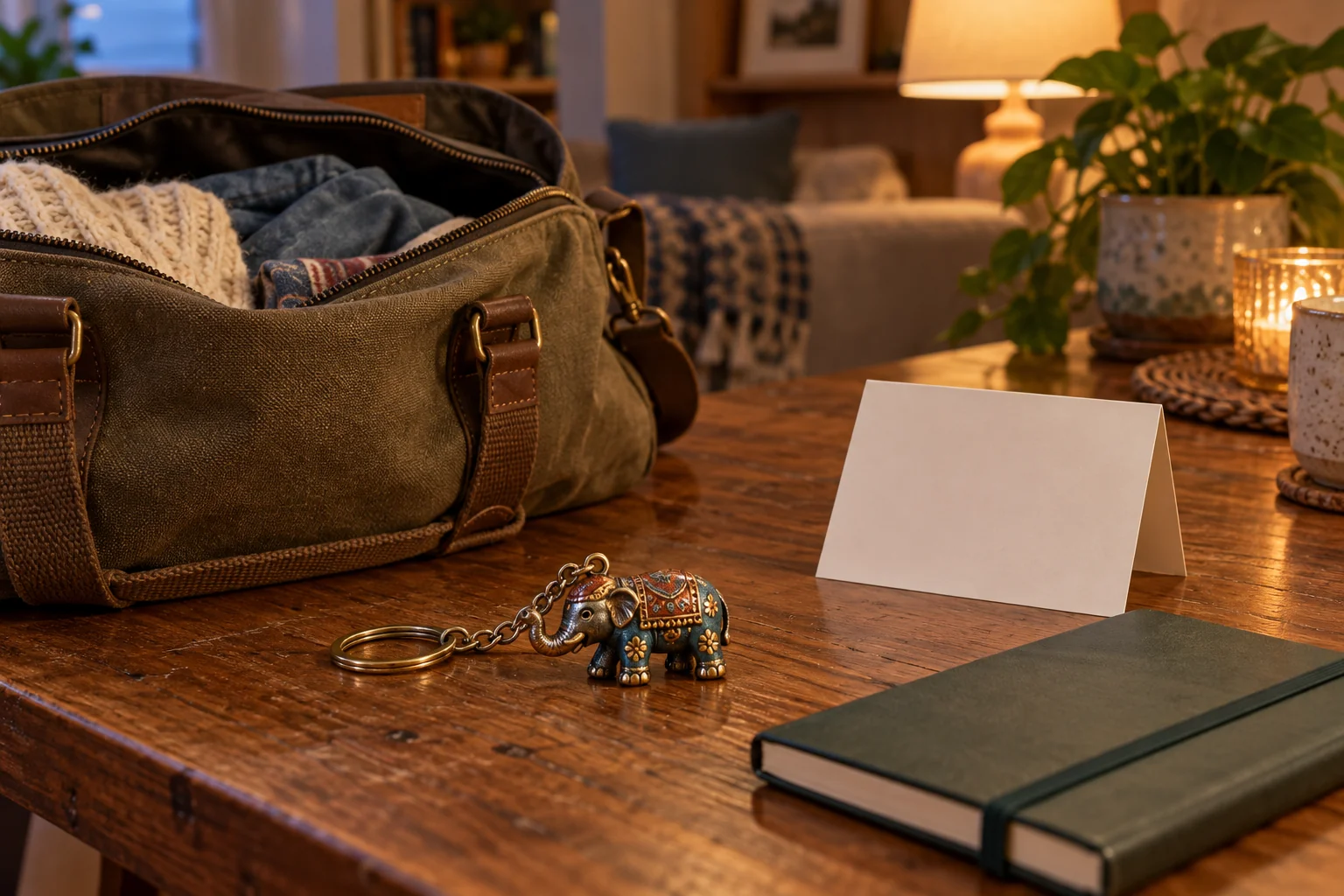
The small thing that came home with Nora
A souvenir keychain you keep may begin as something you thought you would give away. In this original fictional scene, Nora returns from a short trip with a small animal-themed keepsake she had loosely intended for her friend Sam. At home, she starts a gift note and realizes that the reason she chose it belongs to her own afternoon away. She leaves Sam's gift undecided and keeps the souvenir.
The scene concerns that particular change of mind. It makes no claim about a real traveler, a recipient's likely reaction or a general rule for choosing presents. Two actual keychain offers appear separately as decorative possibilities to identify, without becoming the object Nora bought or a product tested in her story. Their appearance supplies no evidence about what Sam would like. That question remains open throughout the scene.
An intended gift without an actual choice for Sam
Nora puts the small wrapped object beside her travel bag. She remembers noticing it after an afternoon spent wandering without a fixed destination. That memory has already become part of why she likes it. When she first called it an intended gift, she had not asked herself whether she was choosing something Sam wanted or simply giving a name to her own wish to bring it home.
She finds a blank card and begins with Sam's name. The next sentence comes quickly: she knew he would love this. She stops before writing it. In the fiction, Sam has said nothing about this object. Nora has enjoyed imagining the handover, but that imagined scene has supplied his enthusiasm as well as her own. She leaves the rest of the card blank while looking at the little package again.
Her memory belongs to the afternoon she had
The object recalls a narrow part of the trip to Nora: the unplanned stop and the pleasure of finding something she liked. Sam was not there. She could tell him about the afternoon without requiring the souvenir to become his version of it. She can also keep a reminder of a day that matters to her without first describing it as something selected for somebody else.
Nora had taken no photograph of the moment. For a second, she imagines explaining that as a reason the object must be especially important. She lets the explanation go. In this invented scene, she simply likes having it beside her. There is no missing evidence she needs to produce before deciding that she wants the souvenir. Its ordinary appeal can remain an account of her own choice.
Keep the actual cat offer separate from the fiction
The cat keychain listing identifies an unbranded decorative cat keychain. All six actual gallery images show cat figures integrated with clip-and-chain fittings. This guide adopts no exact supplied color selection, pack count or powered function. The source's battery and no-warning wording provides no accepted child-suitability or safety claim here. The offer is not identified as Nora's fictional souvenir.
A retail object can provide a subject to consider without inheriting a story written around another object. If you like an animal motif, that preference can be yours. It does not establish a recipient's taste or the contents of a particular delivery. Keep an actual product enquiry with the selected offer, while leaving Nora's trip and the reason she keeps her own souvenir within the fiction.
The cooking-themed offer has its own identity
The cooking key ring listing describes a cooking-themed key-ring set. Its six actual gallery images show complete rings with integrated miniature cooking charms, rather than working cookware or separately supplied full-size utensils. No exact delivery inventory, holding strength or lifespan is established here. The wording pictured on a charm is decoration, without becoming advice or a gift promise in this article.
The theme may interest somebody for reasons they can describe themselves. It does not make an interest in cooking a settled fact about an unidentified recipient. Nor would a decorative cooking subject assign that person a practical role. Keep the actual object distinct from the expectation a giver might attach to it. Nora's fictional decision concerns whose association she was relying on before she wrote the card.
The sentence she chooses not to finish
Nora looks again at the beginning of the note. She could replace the unwritten sentence with an account of her trip. That would be true to what she remembers, but she notices that she is still trying to explain why the object ought to become Sam's. The explanation is answering a question she has not settled: whether she wants to give this particular thing away.
She leaves the card unfinished. There is no message to retract because she has not sent it, and no promise to revise because she has not told Sam that a present is waiting. Her private description of the purchase can change without turning into a fictional conversation with him. She sets the card aside and keeps the choice at the scale it actually has.
A personal keepsake beside the unpacked bag
For Nora, calling it a personal keepsake feels more accurate than the gift description she used earlier. The phrase says whose trip she remembers and who wants the object now. It does not claim that Sam would reject it. He might like it, dislike it or have no particular interest. Nora does not need to invent any of those responses to recognize that she wants to keep it herself.
She considers putting it with other small things from earlier trips. Then she leaves that arrangement for another day. The present choice is already clear. A new display, a special storage project or a complete account of every holiday is not required by the scene. She has decided which object stays with her, without deciding how every future souvenir will be chosen.
Keep an apron gift's separate expectations in its own story
The apron gift expectations guide concerns a recipient who may want a garment without accepting an ongoing cooking role. Its fictional conversation separates a gift from a hoped-for practical commitment. Nora's scene contains no proposed cooking role or recurring invitation. Use that guide for its own expectation question, without supplying Sam with the response its different characters choose.
Nora is not rehearsing an argument in which Sam must reassure her about keeping something. She has not asked him to want it and then withdrawn an agreed present. In this fiction, the change happens while the intended gift exists only in her own description. She can tell him about the trip later without turning that conversation into a request to approve her private keepsake decision.
Let the friend's actual interests remain actual questions
She thinks of another object she nearly bought and then remembers that she is doing the same thing again: arranging a handover without knowing whether Sam wants the item. She closes the browsing page. The scene does not resolve his gift through a better recommendation. It leaves the question where it belongs, with a person whose preferences have not been established for this purchase.
Nora may ask him another time, choose a different kind of gesture or make no purchase. Those are possibilities beyond this scene, rather than promised next steps. There is no replacement present waiting in the final paragraph to prove that keeping the souvenir led to a better outcome. The small decision is allowed to stand without acquiring a successful shopping result afterward.
Keep a familiar tune within its listening occasion
The music box listening guide explores one familiar tune and the personal association somebody brings to hearing it. Its actual musical-object accounts supply no keychain identity or recipient preference. Read that guide if a listening occasion is what interests you. Nora's keepsake requires no tune, shared performance memory or invitation to hear another person's interpretation of music.
A remembered afternoon and a remembered melody can each matter to the person recalling them without becoming interchangeable stories. Nora does not need to borrow a history of musical keepsakes to explain her small object. She can describe the particular stop she remembers. The account stays modest because it stays with what this fictional person actually chooses to say about her own afternoon.
Another small reminder from the same day
While clearing the travel bag, Nora finds a folded scrap on which she had written the name of a place to visit. She never went there. It reminds her that the afternoon she enjoyed was different from the one she had planned. She leaves the scrap with her travel notes, without turning the missed stop into a regret that needs to be corrected on another trip.
The souvenir belongs to the afternoon that actually forms her fictional memory. Nora can keep both reminders without making them tell the same story. One records an intention; the other carries her association with an unplanned stop. Neither needs to become Sam's experience. She has something ordinary to remember, even though she has not finished a gift note or chosen a new present.
The note can remain unused
Before putting the card away, Nora turns it over and sees the blank back. She had been about to make it part of a gift. Now it is simply a card she has not used. She does not need to destroy it or write another message to complete the decision. She can keep it for an occasion when she knows what she wants to say.
The little package also stays as it is for the evening. This article gives no wrapping, attachment, care or storage method for an actual accessory. The story does not turn its decorative object into tested equipment or establish how it should be carried. Nora's change concerns the intended owner and her own association. Any real product still has its own practical requirements.
When she later tells Sam about the trip
In the final imagined conversation, Nora mentions the stop because Sam asks what she enjoyed while she was away. She describes wandering into a place she had not planned to visit. She does not announce that a present meant for him has been withheld. There was no agreed present. The story of her afternoon can be shared without making him responsible for the decision she made at home.
Sam's detailed response is deliberately left unwritten. This is Nora's small keepsake scene, rather than evidence that a certain kind of disclosure improves a friendship. The conversation can continue beyond what the article needs to supply. Nora has told the part she remembers, while keeping the object she wants and leaving a possible gift for another occasion undecided.
Keep an optional order separate from the souvenir story
If the decorative possibilities lead you to consider a keychain through republeq.com and you prefer crypto such as USDT, keep that purchase attached to its actual product account. Nora's invented afternoon does not establish a trip origin for either selected offer, a recipient's enthusiasm or the contents of a later delivery. Check the exact item, variant and supplied contents before deciding whether to proceed. Review the payment methods presented for that particular order. A general cryptocurrency reference supplies no promise that a specific asset, network or transfer route will be available at checkout. This article provides no receiving address or payment procedure. Use the actual instructions for the method you choose, and leave the transaction undecided while a necessary detail remains unclear. Read the delivery and return information applicable to the same purchase as well. An intended gift date does not establish an arrival date, and a preferred payment method creates no special refund or replacement arrangement. If another person is helping select the item, explain which preferences and product questions remain open rather than letting a decorative story stand in for an agreed choice. Should the proposed item change, read that offer's own account instead of transferring the first object's description to it. If you place an order, retain the confirmation and exact product reference for comparison with what arrives. The transaction record can identify the purchase without proving how another person will feel about receiving it. You may also decide to keep a possible purchase for yourself or to make no purchase at all. Those are actual choices for you to make, rather than conclusions supplied by a fictional travel memory.
The keepsake remains Nora's
A souvenir keychain you keep can remain part of your own account of a day, without being made into evidence about somebody else's taste. In Nora's fictional evening, the card stays unfinished and Sam's possible gift stays undecided. She keeps the small thing she wanted from her trip. The scene ends with that choice, without a promised reaction, a replacement purchase or an invented shared memory.