Headphones & Earbuds
sound in one headphone: wired or Bluetooth checks
Choose the applicable connection and left-right playback enquiry before treating one-sided sound as a confirmed headphone fault.
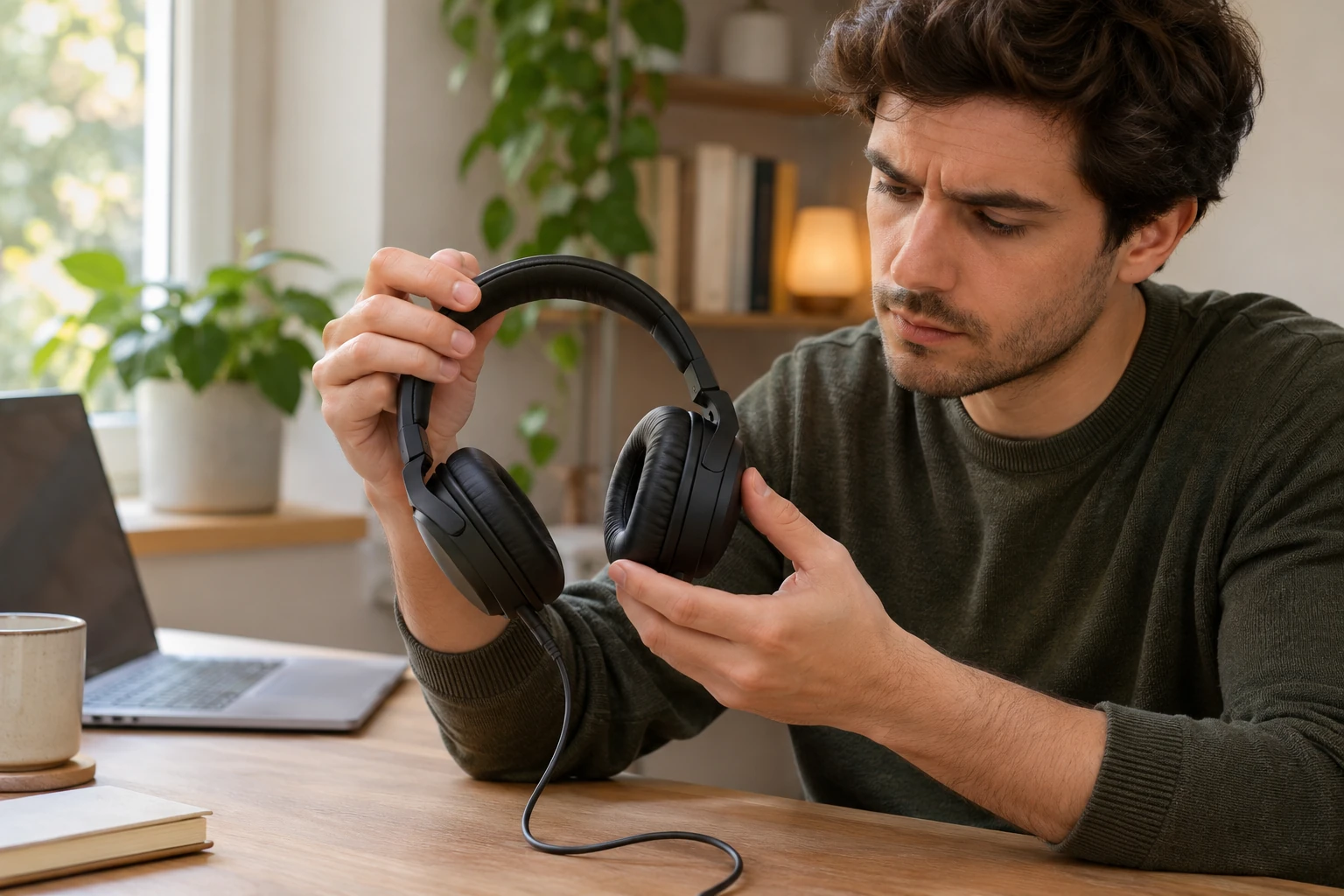
Sound in one headphone needs a more specific description before a repair decision. Do you mean that one ear is silent, one side seems quieter, or you are intentionally using one earbud? Identify the equipment and actual connection, then choose the applicable documented check. This guide reports no sound test.
Begin a wired headphone check with the actual connection
For a wired headphone check on iPhone or iPad, Apple describes inspecting the cable, connector and headphones for damage and firmly reconnecting the plug; a case may prevent a firm connection. Its second-pair comparison leads to an enquiry with the original headphone manufacturer if the second pair works, or Apple Support if it does not.
Consider an original fictional example. Devon tells Rae that the headphones have stopped working on one side. Rae asks what Devon actually heard and which equipment was being used. Devon distinguishes a silent ear from a general dislike of the sound. They have not established a broken component, and the conversation begins without a replacement order.
Devon names the source device and the connection actually in use. An available cable and a wireless product description are not interchangeable accounts of this particular attempt. Rae keeps the current arrangement with the complaint. The fictional example gives no assurance that a named adapter, port or headphone combination is compatible merely because the pieces are on the desk.
If Devon cannot identify the connection, that becomes the next question. Rae does not select a procedure from a familiar-looking product picture and present it as applicable. They need the actual equipment account. The enquiry can remain useful while that fact is found; it does not need an invented button press or a confident hardware diagnosis to move forward.
Use a cable account only for the arrangement it describes
Sony’s headphone-cable account says incomplete plug insertion can produce no sound, muffled sound or noise. Its illustrated I-shaped and L-shaped plug arrangement and dry-cloth advice belong to that applicable account. They are not a universal plug-orientation or cleaning recipe for every headphone, connector or either wireless JBL reference here.
Rae asks whether Devon’s equipment actually has the connection described in the instructions. A fixed lead and a separately connected lead should not be silently treated as the same visible arrangement. This example supplies no cable-removal instruction for an unidentified unit. If a connection is not meant to be detached, the guide provides no authority to force it free.
Suppose Devon reports visible wear while identifying the equipment. Rae keeps that observation with the support question instead of asking Devon to demonstrate it by twisting or bending the lead. This fictional enquiry provides no continuity test, soldering instruction or internal service procedure. An observation can be retained without turning an unfamiliar repair into a required next step.
In another version, Devon has the applicable instructions but cannot tell whether the current arrangement matches the diagram. Rae asks for clarification from an appropriate support contact. The guide does not resolve that uncertainty through a guessed connector name. A short unanswered question about the exact equipment is more useful than an unsupported claim that a connection has been checked successfully.
Keep Bluetooth channel balance in its Windows context
For Bluetooth channel balance, Microsoft’s Windows 11 account directs users to Settings, System, Sound, the actual Bluetooth output device, then Output settings and Volume to compare Left and Right. Keep that Bluetooth context with the instructions. This guide prescribes no universal listening level, change to an accessibility preference or transfer of the Windows route to wired iPhone headphones.
Now imagine a separate fictional listener, Imani, who reports the complaint through a Bluetooth connection on a Windows computer. Imani identifies the actual output device before seeking its applicable settings. Devon’s wired-phone account does not become Imani’s control map. The shared description of one-sided sound does not make the two setups identical.
If Imani sees a left-right setting under the applicable instructions, the observation belongs to that named device and attempt. Imani can record what was visible without declaring that it caused the complaint. This fictional example gives no numerical target for listening volume and no request to keep increasing the level until the quieter side becomes audible.
If the documented choice is absent, Imani leaves that availability question open. A similar control elsewhere is not automatically a substitute. The next enquiry can identify the Windows setup, the actual device and the missing choice. This article supplies no driver removal, firmware installation, factory reset or repeated pairing sequence for that unresolved state.
Keep a second-pair comparison attached to the attempt
Return to Devon, who is considering the second-pair enquiry described in the applicable Apple account. Devon first establishes which supported equipment can be used for that comparison. A retail reference in this guide is not an instruction to purchase or connect it for a test. The comparison needs the actual arrangement and its relevant documentation.
Devon describes the original complaint to the person helping rather than asking whether the replacement pair is generally better. The useful observation concerns the specific one-sided experience under discussion. This example supplies no controlled audio benchmark or hearing assessment. It does not establish that another listener will describe the same recording in the same way.
In one fictional outcome, Devon reports that the second pair works for the intended listening task. Rae keeps that report with the equipment and attempt it concerns and refers back to the applicable support route. The guide does not transform the observation into proof of a particular damaged wire, failed driver or replacement part needed inside the original pair.
In another outcome, Devon reports the same complaint with the second pair. That result remains part of the enquiry rather than a reason to discard both products automatically. Rae preserves which source and connection were involved. The example leaves the cause unresolved and supplies no guarantee that the source device is defective or that a software change would resolve it.
A third outcome is incomplete: Devon cannot establish whether the complaint changed. Rae records that uncertainty instead of choosing a favorable result. An unclear comparison should not be rewritten as a successful repair to justify a purchase. The actual report can support a more precise question for the responsible manufacturer or source-device support team.
Distinguish a deliberate one-ear arrangement from a complaint
Suppose Imani initially says only that one earbud is being used. Rae asks whether that is the intended arrangement or whether the other side was expected to play. This is a question about the listener’s intention, not a claim that every model supports independent use. The answer needs to be clear before a missing-side complaint can be described.
If the listener intentionally chose one side, keep that preference with the discussion and consult the actual model account for any capability question. This guide does not label the choice a fault or prescribe a change to it. If the listener expected both sides and heard only one, record that different observation without inventing a reason for it.
Keep the support request narrow when the result remains unclear
Devon prepares a short enquiry naming the actual headphones, source device, connection and one-sided observation. The note distinguishes what Devon personally heard from what another person reported. If an earlier detail is uncertain, it stays uncertain. The fictional account contains no recording of a private call and requires no personal conversation to be reproduced for the guide.
Rae asks which documented check was attempted and what happened afterward. The answer should describe the action actually taken, rather than the outcome Devon hoped it would produce. A report of reconnecting a permitted plug and a report of hearing both sides are separate observations. This example does not say that one automatically proves the other.
If somebody else takes over, Devon gives them the current result and the applicable instructions already consulted. They should be able to see whether the unresolved question concerns equipment identity, connection, a setting or the comparison outcome. The handover makes no promise about repair time, replacement eligibility, warranty coverage or what the support contact will recommend.
Read the JBL references within their limits
The JBL Live 770NC catalog reference shows one beige over-ear unit with JBL and LIVE markings. Its full model is not printed in view. The picture establishes no personally tested codec, noise-cancellation result, Bluetooth channel behavior or one-sided sound fault.
The JBL Vibe Flex 2 catalog reference shows two white earbuds with their dedicated case and VIBE FLEX2 lid marking. Its stock identifier remains a catalog label. The green indicator is illustration content, not a charging measurement. No playback, microphone, runtime or protection performance has been tested here.
Devon keeps a later purchase decision separate from the equipment already being investigated. These are two retail accounts, not a tested comparison or an instruction to use either as a diagnostic substitute. A listing’s wireless features do not establish a current device connection or transfer Apple’s wired-phone and Sony’s cable instructions to a different model.
Keep call participation and Mac quality changes separate
The holiday call headset guide concerns who is meant to hear a greeting and the arrangement participants agree to use. The Mac Bluetooth audio guide concerns playback-quality changes during microphone use. Neither question establishes the cause of one-sided playback in the specific connection being investigated here.
Devon closes the enquiry with the actual outcome. The relevant instructions may have been identified, a permitted check may have produced an observation, or the complaint may still need support. Each state can be described accurately. This fictional investigation reports no measured stereo performance, hearing diagnosis, successful internal repair or guaranteed result for another person’s equipment.
Review a separate headphone purchase before payment
If a headphone order through republeq.com meets your actual listening requirements, review the exact selection before choosing payment. A preference for crypto, including USDT, does not establish which options the current basket offers. Read the transaction information actually provided for the purchase you intend to authorize. This paragraph supplies no token network, receiving address, exchange rate, fee or transfer procedure. Keep the one-sided playback enquiry with the equipment it concerns; a payment option cannot establish a connection, identify a faulty component or prove that a replacement is needed. Ask the responsible seller about an unclear identity, supplied item or intended use before committing funds. Review the delivery, cancellation and return terms applicable to the exact offer. Another transaction does not establish those terms for this purchase. If someone orders on your behalf, give them the confirmed selection and explain which equipment questions remain open. Ask them to bring a changed offer back for consideration. Recheck the basket and current transaction instructions when the selected headphones change. An account for one product does not authorize an unreviewed substitute or transfer its connector and software guidance to another model. Retain the order reference and payment response after an authorized purchase. If the payment outcome is uncertain, reconcile that particular attempt before considering another payment; a missing confirmation does not prove nothing happened. Compare the delivered product and documentation with the order you authorized. A receipt establishes no successful listening check, confirmed cause or repaired headphone. Those questions require their own applicable instructions and actual observations on the equipment being investigated. Leave the order unmade if information needed for the actual purchase decision remains unavailable.
Conceptual one-sided playback enquiry; no exact retail model, sound measurement or successful repair is shown.