Problem-Solving Articles
Smoke alarm chirping: route the exact model's fault
Match an identified alarm's trouble signals to its own instructions, distinguish sealed-unit replacement, and stop repeating an unresolved fault action.
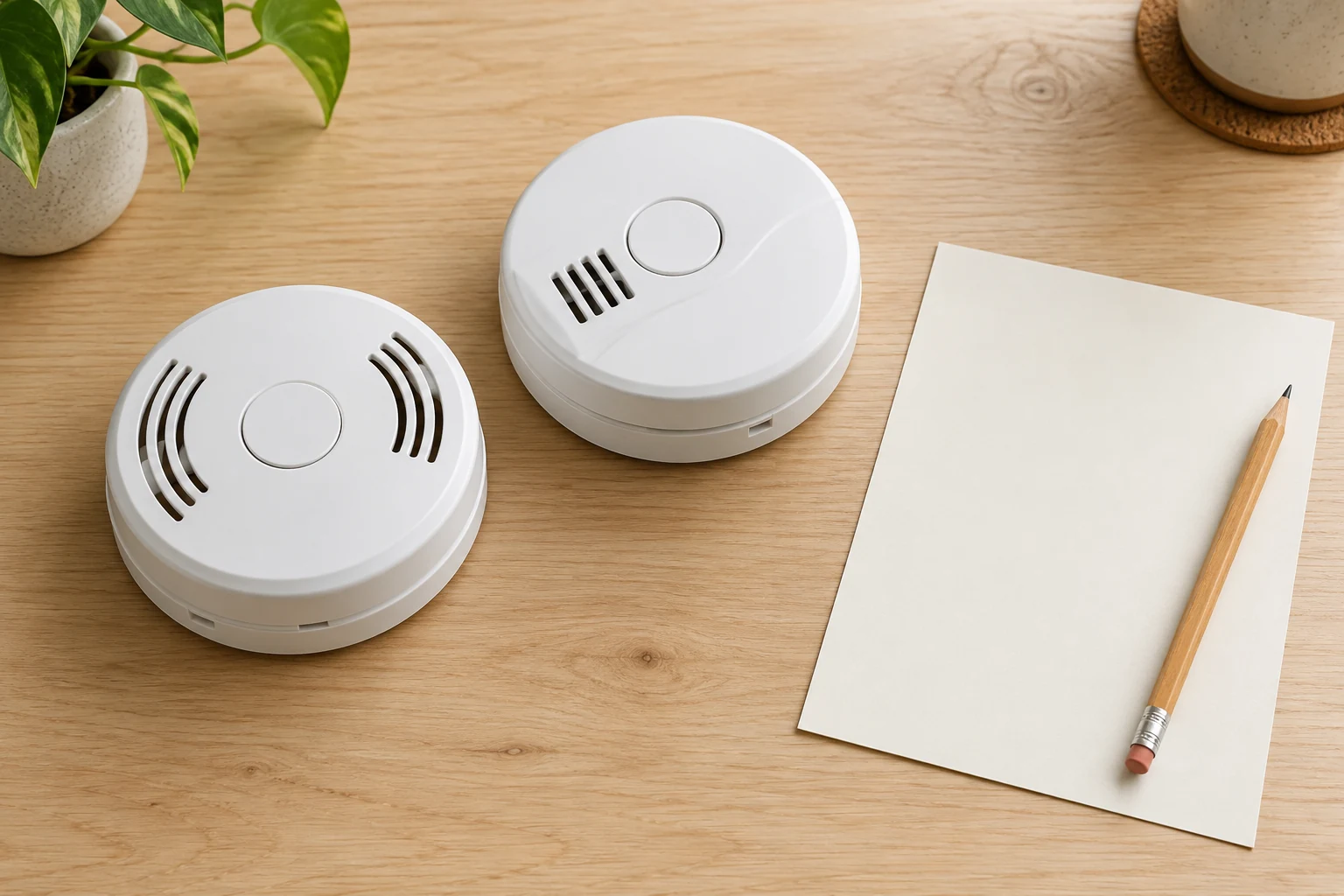
Smoke alarm chirping needs a different response from a smoke or carbon-monoxide alarm sounding in a possible emergency. If a hazard alarm sounds, follow the alarm's emergency instructions, get to safety and contact emergency services. Do not stay inside to decode lights, collect a recording or experiment with buttons. The fault-routing discussion below applies only after immediate danger has been addressed and the situation is safe.
An intermittent sound can leave a householder with several competing explanations. The useful question is which documented condition the exact installed unit is reporting. Choosing a remedy from the sound alone can send you down the wrong branch. Work from the complete signal, then take the action attached to that branch. A household alarm is not a suitable device for improvised repairs intended simply to make a noise disappear.
Keep smoke alarm fault signals behind the emergency boundary
The U.S. Fire Administration describes carbon monoxide as poisonous, invisible and odourless: human senses cannot detect it. An apparently ordinary room therefore cannot establish that a CO warning is false. USFA also warns against removing a smoke-alarm battery because cooking or shower steam has triggered an alarm. Preserve protection while following the applicable instructions. A hardwired installation belongs with a qualified electrician when installation work is required.
For smoke alarm fault signals, separate the question of danger from the later question of device trouble. A person who has just heard an unexplained alarm should not reinterpret it as a maintenance inconvenience because a replacement battery is already in a drawer. The immediate response follows the warning and the emergency plan. Only the later service decision concerns whether a particular component or the entire alarm needs attention.
This order matters when two people are involved. One may remember a chirp from yesterday while another is responding to a warning now. Establish which event is being discussed before carrying an earlier explanation forward. A previous maintenance concern does not settle the meaning of a new event. Do not delay evacuation to resolve disagreement about what somebody heard.
Read the exact 900-CUAR sound and light pair
The Kidde 900-CUAR combination alarm has a model-specific troubleshooting table. Three chirps every minute accompany several faults: one amber flash identifies photo fault, two CO fault, three memory fault and four a stuck button. The table calls for its prescribed reset for sensor or memory faults, with replacement if the fault persists; photo fault also refers to the cleaning instructions. A stuck button has its own dislodging instruction and replacement outcome if unresolved. Two chirps with two amber flashes mean end of unit life. One chirp with one amber flash appears in both low-battery and false-low-battery rows; the latter concerns AC connected before backup batteries were activated. Read the complete matching manual before acting.
The same manual specifies two replaceable AA backup cells and approved battery types, excluding lithium cells. Its red alarm-memory indicators describe a previous event; they are separate from the amber trouble table. These details apply to 900-CUAR, not every Kidde alarm or a similar-looking voice model. Replacement, cleaning and testing must follow that exact unit's instructions; do not disconnect its harness merely to stop a sound.
Resolve an incomplete observation before choosing a remedy
In an already-safe service situation, a description containing only the audible part leaves an important field empty. Treat that empty field as unknown. Writing a likely value beside it does not improve the observation. When a branch requires both a sound and a light pattern, the sound by itself may leave several branches possible. The next useful step is resolving that specific missing information through the applicable documentation and safe observation, rather than trying each possible remedy.
Consider a paper example with a fictional device whose service chart has rows A, B and C. All share the same audible signal, while their visible indicators differ. If you have recorded only the audible signal, all three rows still fit. Buying the part named in row A is premature. Once the visible indicator reliably selects row B, rows A and C cease to be the working explanation. This example explains the reasoning; its letters are not codes for a real alarm.
A partial view creates a similar problem. Someone may see the last part of an indicator sequence and mistake it for the whole sequence. Do not convert an interrupted observation into a confident count. If safe access or a clear view is unavailable, arrange suitable help with the unresolved distinction. Climbing on an unstable chair or detaching equipment simply to get a better look adds a different problem to the original one.
Apply the chart's conditions together. A row that agrees with one observation while disagreeing with another is not a match. If no row fits, stop the household diagnosis and obtain model-specific assistance. Do not combine the sound from one row with the remedy from another to create a procedure that the maker never supplied. The absence of a match is useful information about the limits of the current decision.
There is also a difference between an observation you could not make and an observation that excludes a branch. In the fictional chart, an obstructed indicator leaves the visible field unknown. A clearly observed indicator that differs from row A rules row A out. Treating both situations as “nothing useful to see” discards information in the second case while inventing reassurance in the first. Keep the distinction when deciding whether any row has genuinely been selected.
If two possible rows require incompatible actions, do not choose whichever action is easier. The remaining ambiguity is the reason to stop and resolve the identification. Conversely, finding a matching row should narrow the work: carry out only its applicable instructions, including their conditions. An unrelated procedure found elsewhere in the manual does not become part of this fault response merely because it uses the same button.
Use the persistent alarm fault stopping rule
A persistent alarm fault needs the stopping point attached to the documented action. Before starting a permitted service step, identify its endpoint: what action is allowed, what result must be checked and what follows if the problem remains. This keeps an unsuccessful intervention from turning into a sequence of increasingly speculative interventions. Use only the steps applicable to the condition you have identified.
For example, imagine an already-safe service case where a matching chart permits one bounded action before replacement. After that action, the same unresolved trouble returns. The branch has already supplied the next decision. Starting over with a fresh description of the same problem does not create another permitted stage. Arrange the specified replacement or qualified service instead of treating repetition as progress.
Keep the action and its result together. If another person takes over halfway through, they need to know that the prescribed step was completed and failed to resolve the condition. Otherwise the household can repeat it simply because the second person did not see the first attempt. A short handoff should state what was actually done and what the device did afterward, without diagnosing an internal component beyond the chart.
A quiet interval alone answers only whether a sound was heard during that interval. It cannot establish that an unresolved condition has been repaired. Check the result in the way the matching instructions require. Where those instructions direct replacement, make that the next practical task. Do not keep extending an observation period to avoid carrying out an unwelcome replacement decision.
Before declaring an action unsuccessful, distinguish a completed step from an interrupted one. If safe access prevented completion, report the step as incomplete and arrange help. If the step was completed but the expected check could not be made, its outcome remains unknown. Neither case licenses extra improvised work. This distinction gives the person taking over a precise task while avoiding a claim that a repair was tried and failed when it was never completed.
Route SA350B trouble to the whole sealed alarm
The official specification identifies the First Alert SA350B smoke alarm as model 0827. Its matching manual describes a sealed, nonreplaceable battery pack. A chirp about once a minute for more than thirty minutes is its end-of-life warning and requires replacing the alarm. Do not open the case, shop for loose cells as its remedy or use irreversible deactivation to obtain quiet while leaving the home unprotected. This instruction belongs to that documented model.
That decision changes what the household needs to arrange. A shopping list headed simply “battery” can preserve the original misunderstanding even after the documentation has been read. Name the item the instructions require. If the outcome is whole-unit replacement, take the actual model and existing installation requirements into that replacement task. Do not let a familiar consumable purchase stand in for the required work.
For a device that actually permits replacement cells, cell size still leaves other compatibility questions. The AA battery pack and charger-kit guide separates size, chemistry and package contents. Use the alarm maker's exact requirements to decide what is allowed in the alarm. A general battery purchase comparison cannot approve a rechargeable kit or a different chemistry for a safety device.
Keep the replacement task open until protection is restored
Describe the outcome as an action still to complete when replacement or installation remains outstanding. An order confirmation, a box on the table or an appointment booking each records a different stage. None establishes that the replacement is installed and its prescribed checks have been completed. Keeping these stages distinct prevents someone from assuming the work is finished because the purchasing portion is finished.
Where a person helping with the replacement will arrive later, tell them which unit prompted the task and which documented outcome led there. Separate that unit from another alarm in the same home. Similar covers and shared rooms can make a vague request such as “change the hallway one” ambiguous. Use a location that distinguishes the affected unit, and preserve its exact identity through the handoff.
Return to ordinary care after the acute problem has been dealt with. The smoke alarm maintenance guide covers age, testing and replacement planning. Keep that recurring work separate from today's unresolved fault. A future calendar reminder cannot complete a present replacement requirement, and completion of today's replacement does not establish that every other alarm in the home has been checked.
The practical endpoint is a resolved condition under the applicable instructions, or completed replacement with the required installation and checks. If access, identity or a continuing fault prevents that endpoint, retain the specific unresolved task and arrange appropriate assistance. Leave everyone involved with an accurate account of what remains to restore the intended protection.