Home & Living
Shopping bag won't fit its pouch. Check the folding stage
An empty folding tote can reach its storage pouch at the wrong stage. Use the instructions for the exact bag to identify the unfinished fold, keep a different pouch construction separate, and leave damage or unsupported repair questions open.
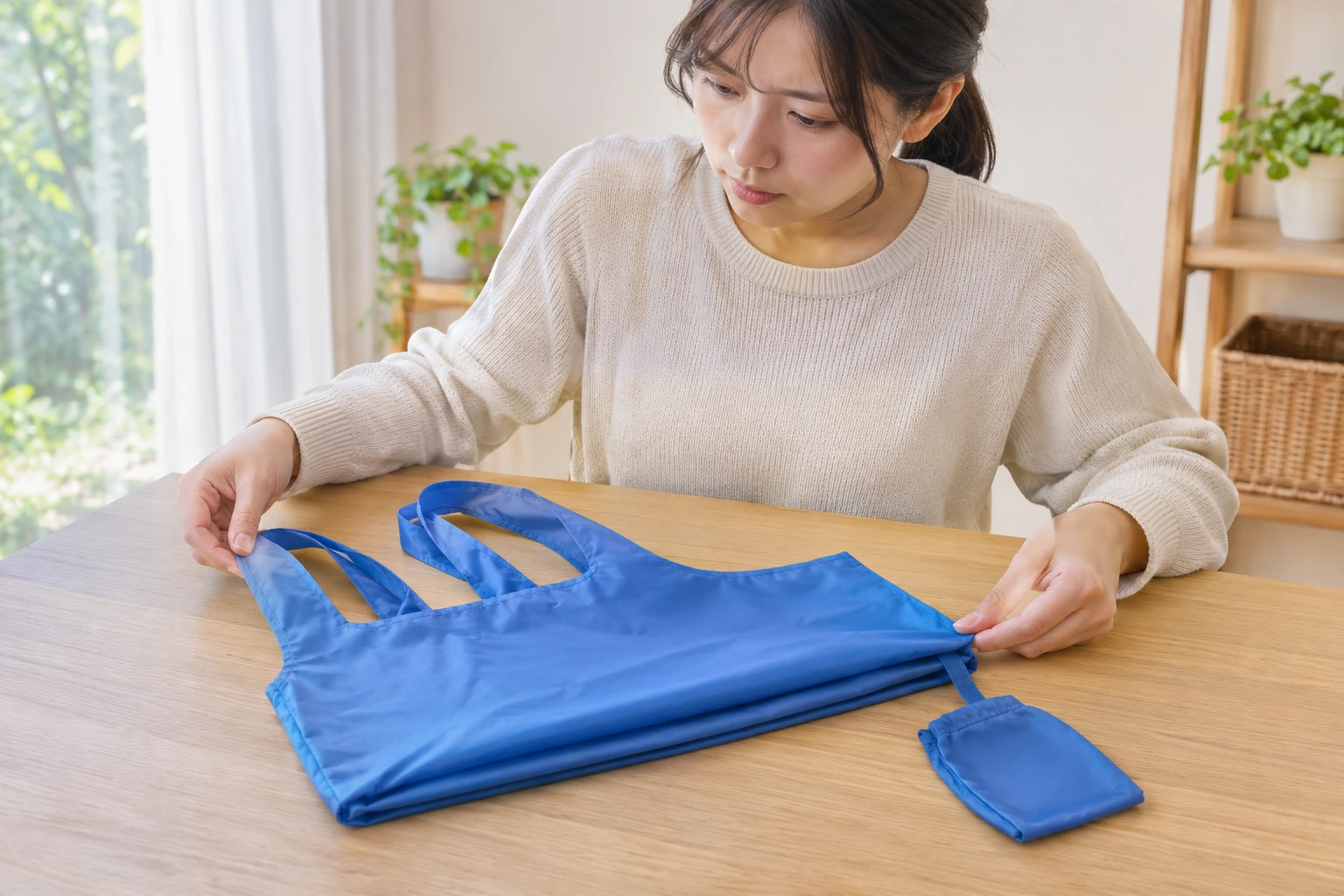
Pause where the bundle stops matching the plan
Shopping bag won't fit its pouch is a useful description of a storage problem, but it leaves the folding stage open. An empty tote can be sitting beside its storage pouch while its present shape still differs from the shape shown in its own directions. Begin with that comparison before treating the difficulty as a damaged closure or an undersized part. This guide follows a fictional exchange between Mira and Jalen at a household table. They are trying to understand the folding sequence for one actual construction, without presenting a real product trial or a completed repair.
Mira has made a loose bundle and is ready to put it away. The bundle does not resemble the compact final picture in the directions she has beside her. She asks Jalen whether the pouch must be the wrong size. He asks which picture comes immediately before the final one. That question changes their starting point. They have an unfinished comparison to make, and they have not yet established a fault. Their purpose is to locate the unanswered stage while the item and its own instructions are still together on the table.
Keep the particular bag with the directions being considered. A similar shape in another household's cupboard is not enough to identify the same construction. Neither is a remembered video about a different tote. Mira's fictional difficulty concerns the bundle in front of her and the information supplied for that item. Jalen can help her read that information without supplying a universal rule for every foldable bag. If the instructions do not match the actual construction, that mismatch should stay visible rather than being hidden by a confident guess about what every bag must do.
Read the whole diagram before choosing the next move
A diagram has a starting state as well as an end state. Look at both before deciding where the present bundle belongs. Identify which outline represents the bag, which small shape represents the pouch, and where the drawings place those parts relative to one another. This is a reading task, not a measurement exercise. There is no need to calculate fold widths from a photograph or decide that a drawing is to scale. Its labels and arrows should be interpreted within the actual instructions, with an unclear part left open for clarification.
Mira realizes she has been comparing only her bundle with the last picture. She has not checked the pictures between the start and finish. In the fictional exchange, Jalen suggests looking through the whole sequence once before trying to continue. They can then ask whether an earlier stage was left incomplete. The story supplies no outcome for an actual bag. It illustrates how an end-state picture can become an unhelpful demand when the intermediate information has been ignored. Reading backward from an expected result does not replace establishing the present stage.
Keep the two native constructions distinct
The Mato & Hash shopping-tote account has a MATO & HASH-labeled folding graphic in its gallery. The graphic starts with the bag flat, brings the side portions inward, then turns the handles down, brings the bottom upward, reduces the remaining length, and places the resulting bundle into the pouch. Use that sequence only for the construction it depicts. The account's thirty-bag option and its measurements are offer information, not a delivered-count or fit test. The other pictures show one blue bag in different states and a staged shopping scene.
The Debco F7237 tote account describes its own pouch with an elastic closure and plastic stopper. Its sole image shows an open black tote with a corner pouch and a compact folded representation. It supplies no equivalent step-by-step graphic. Do not transfer the Mato sequence to this different construction. The advertised twelve-pack does not become a verified delivered count from those pictured states.
Find the last stage you can actually identify
Back at the fictional table, Mira and Jalen agree to identify the last picture that Mira can confidently connect with her current work. If she cannot establish that connection, they do not choose a later step merely because it is closer to the finish. The useful question is where their understanding ends. A pause at an earlier point is more informative than repeating an action whose place in the sequence remains unclear. This approach leaves room to obtain the right instructions instead of turning a gap in understanding into a physical repair attempt.
It can help to distinguish a picture you recognize from a stage you know you completed. Mira recognizes several drawings because she has looked at them before. That familiarity does not tell her which one describes the bundle she has now. Jalen asks her to keep the present object in view while reading, rather than answering from memory. Their invented conversation concerns that comparison. It does not establish that a particular gesture has been performed correctly, and it gives no guarantee that completing a missed instruction would resolve every possible storage difficulty.
Keep a stopping point if the construction remains uncertain. A person can leave an empty bag in an appropriate temporary place without announcing that its pouch is faulty or that storage has been completed. Agree where it will remain and which information still needs to be found. This avoids making the next household user discover an unresolved bundle among items assumed ready to take out. The temporary arrangement is an ordinary coordination choice. It should not be described as a repair, a material treatment, or evidence that a different bag would work better.
Separate an unfinished stage from a damaged part
The folding sequence and the condition of the item answer different questions. Mira has noticed a difference between a bundle and a diagram. She has not established a torn part, a failed attachment, or a closure mechanism that needs work. If an actual item raises a condition concern, keep that concern with its applicable product guidance. This article supplies no sewing, cutting, trimming, heat treatment, or chemical method. The example can help locate missing instructional context without granting permission to alter material in order to reach a pictured result.
A comparison also has limits when the object has been partly rearranged between views. If someone changes the bundle while another person is still looking for the right diagram, the two may be discussing different states. In the fictional exchange, Mira pauses while Jalen reads. They do not need a special test setup or a timed trial. They need a stable enough shared view to understand the question. If the bundle changes, they can acknowledge that change before continuing, rather than treating an earlier description as though it still identifies the present state.
Do not let an uncertain part name decide the task. A small attached area might be called a pocket, sleeve, or pouch in casual conversation, while the actual directions use a particular term. Locate the named part on the item before assuming that any small compartment has the intended storage role. If the source does not establish that role for the actual item, keep the identification unresolved. Familiar vocabulary can make two different constructions sound interchangeable even when their instructions concern different parts. The bag's own information should settle the terminology being used.
Jalen also asks whether Mira has brought a different bag into the comparison. She remembers putting several totes in the same drawer, but she has no reason to assume their directions are shared. Their fictional task stays with the identified item. Any other bag needs its own information, even if it is sold for the same everyday errand. Grouping things together for household convenience does not create a common operating method. The comparison remains useful because it is narrow enough to explain, with the item and its instructions kept together.
Once the current stage is understood, continue only through the directions that actually apply. There is no advantage in making the bundle look like a final picture by an undocumented method. If the directions remain ambiguous, seek clarification for the exact item and leave the question open. Mira and Jalen do not reach a verified physical outcome in this story. Their exchange ends with a clearer account of what they still need to establish. That is a smaller result than a successful repair, and it is the result the invented example can support.
Leave stock and event planning in their own scopes
The paper shopping-bag stock guide concerns near-term handoffs, usable stock, and checking a boxed item's fit before a supply order. Those questions concern choosing bags for an event. They do not provide the missing stage for returning an empty fabric tote to its own pouch.
The Halloween treat-bag handoff guide addresses a packing station, finished bags, and the actual exchange with a recipient. Its loop-handle and die-cut-handle examples serve that distribution task. A successful event handoff does not establish a folding method or resolve a different tote's pouch problem.
These boundaries matter when a household has several bag-related jobs at once. Someone may be preparing for a gathering while another person is putting an ordinary shopping tote away. Decide which task is being considered before reaching for advice. A stock count, a cleaning question, a damaged handle, and an unfinished storage step can all deserve attention without becoming one combined fault. Keep each actual question with the item and information it requires. Finishing the event plan does not require pretending that the separate storage question has already been answered.
Keep the unresolved bag understandable for the next person
Shopping bag won't fit its pouch becomes a more manageable question when the exact construction and present stage stay together. The next person should be able to find the applicable instructions and understand where the comparison stopped. They should not have to reconstruct an unfamiliar routine from an unlabeled bundle or guess why the item was left apart. A short explanation in ordinary language is enough. State which information remains uncertain, without claiming that the material has been repaired or that a closure has passed a test that never occurred.
A new purchase remains a separate decision. Neither of the two native accounts proves that another tote would solve Mira's fictional difficulty, and neither identifies a real household's existing bag merely because it looks similar. Check the exact current offer if you consider ordering. Keep its selected option and quantity distinct from any visual demonstration of an open or folded item. An advertised compact form can help identify the product's intended storage arrangement, but it does not replace the instructions needed for the particular bag already in front of you.
If a separate shopping visit to republeq.com offers a cryptocurrency checkout option, review the actual current instructions before choosing USDT or another displayed asset. A payment method does not identify the right folding directions, verify a bag's material, or establish that a replacement will resolve the storage question. Keep the exact product and selected option visible while reading the proposed order. Confirm the quantity, delivery details, applicable return terms, and any conditions attached to that offer. When a token payment requires a network choice, use the network and recipient information supplied by the current checkout. A familiar token name does not establish a missing destination or amount. Instructions copied from an old order or an unrelated message should not be substituted for the transaction being considered. If an essential detail is unclear, leave the payment unsubmitted while seeking clarification through the appropriate support route. After an actual submission, retain its transaction reference together with the merchant's order information so that both parts can be reconciled. A pending screen does not establish dispatch, and a payment record alone does not describe the contents of a delivered package. This article has not tested a checkout, verified token settlement, calculated charges, or established that every buyer will see the same methods. USDT remains conditional purchasing context here. Keep the household question with its own evidence, and make any purchase decision from the product and payment information actually available at the time, rather than treating checkout as a substitute for understanding the item. Keep unresolved order details visible to the person responsible for the purchase. A familiar earlier purchase does not supply the conditions, selected variant, or transfer instructions missing from a new order.