Problem-Solving Articles
Shoe heel folding when putting shoes on: inspect the entry
Inspect the shoe opening and the entry attempt, then consider a shoehorn for its intended purpose without forcing the fit.
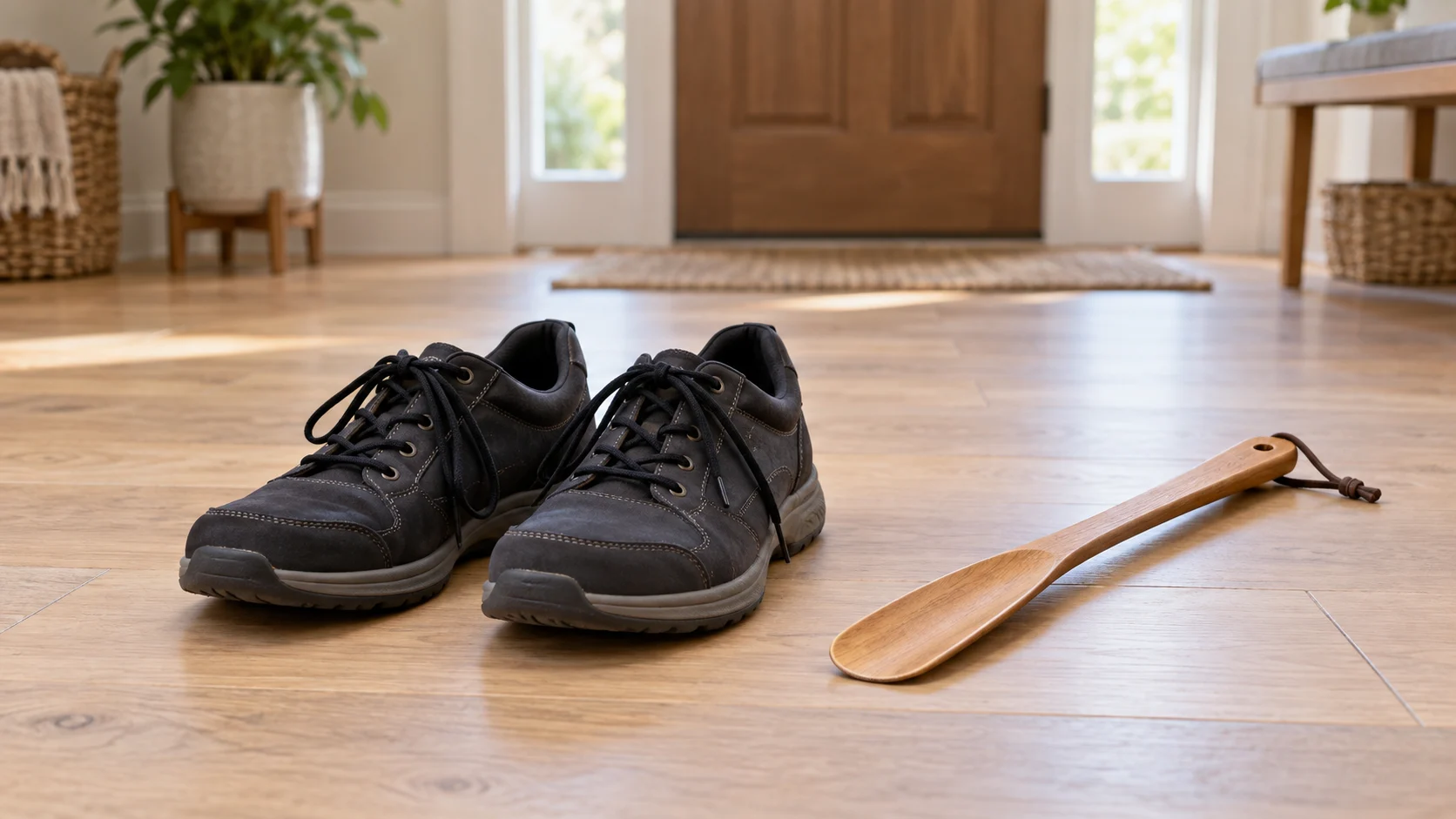
If you notice the shoe heel folding when putting shoes on, stop pressing your foot down on the back and look at the opening you are trying to use. A shoehorn can guide a heel into footwear, but it does not establish that the shoe fits or repair a damaged heel. Start with the actual pair and its own fastening instructions. You can then consider an entry aid for a clear purpose without turning it into a lever for forcing your foot inside.
Imagine Leah preparing to leave home. She has put her shoes near the door, but the laces remain in the position she left them yesterday. As she tries to step into one shoe, its back folds beneath her heel. Buying a longer shoehorn is one possible decision later. Her immediate task is to stop that attempt and see what is happening with this shoe. The example is fictional; it is not a recorded fitting trial or a diagnosis of the footwear.
Look at the shoe opening and fit first
Put the shoe where you can see it and check which opening the footwear is designed to provide. Follow the actual shoe's instructions for its fastening. A pair with laces, a buckle or a different closure needs the arrangement intended for that shoe. A shoehorn does not release a fastening you have left closed. Do not cut, stretch or modify the shoe to create a larger entrance for this exercise. If the intended way to open it is unclear, obtain that information before continuing.
Leah can distinguish the folded back from the fastening she has not yet adjusted. That gives her something concrete to address without claiming to know why every shoe behaves that way. A shoe that looks open enough can still have a fit problem. The fact that she wore it yesterday does not prove that pressing harder is appropriate today. Keep the observation specific: the back folded during this attempt. Avoid turning that one observation into a promise that a particular tool will solve it.
Check the actual shoe's condition as well. If the back is damaged, a part is loose or something inside needs attention, leave that question with the footwear's care instructions or appropriate repair advice. An entry aid is not a repair method. There is no reshaping, adhesive or home repair procedure in this guide. Pause the attempt when the shoe itself needs attention. You can return to the entry task after that separate footwear question has an answer.
Understand what the shoehorn is meant to do
Orthotix's current footwear guidance describes placing a shoehorn behind the heel, allowing the foot to slide into the shoe without forcing it, then removing the tool once the heel is fully seated. It also says a shoehorn does not solve footwear that is too tight. These are general entry principles. They are not a test of the two retail offers below, instructions for changing your footwear or confirmation that an unknown shoe is suitable for your foot.
Apply that narrow purpose to the decision you face. Leah wants help with entry into a shoe she can open and use appropriately. She is not asking the tool to make a smaller shoe larger. If using it still calls for significant force, stop that attempt. Do not keep pressing while assuming that a more substantial handle would make the approach correct. The tool's reach and the footwear's suitability are separate questions, and resolving one leaves the other to answer.
Keep any particular footwear instructions alongside the general principle. A shoe may have its own intended way of being held or opened, and a shoehorn may come with its own use guidance. Read what applies to the actual items. This guide does not prescribe an angle, force, number of attempts or sequence for every shoe design. Where the two items cannot be used together as instructed, choose another suitable arrangement or obtain advice about the actual pairing.
Choose a handle you can use for the intended entry
The LIURET Brown shoehorn offer identifies a wood and copper item with a long handle and a smooth surface. The MLINS 16699705 shoehorn offer names a set of three, each listed at 22.0 by 1.9 by 4.1 inches. Those supplied dimensions do not establish a position or result for your particular shoe. The listings' comfort and damage-prevention language is not an independently observed outcome here.
Consider how you would actually hold and reach the tool in the arrangement you ordinarily use to put shoes on. A published overall length is useful information, but it cannot choose a comfortable or suitable position for someone else. If a reach question matters to the purchase, ask about the exact tool and explain the arrangement you need. Avoid ordering solely because a title calls a handle long. Choose a usable item for the actual task, with the relevant reach information available.
If you already own an appropriate shoehorn, examine its identity and supplied instructions before buying a second one. A short tool you cannot use in your intended arrangement might lead to a different reach question. It does not show that every long version will suit you. Conversely, a misplaced tool does not create a new need for a different model. Leah can decide whether the item she owns is suitable and available before treating the folded heel as a shopping instruction.
Using a shoehorn without force
For using a shoehorn without force, keep the actual task small. Leah can leave time to follow the footwear and tool guidance instead of rushing through the same difficult movement on her way out. Finish the footwear's intended fastening and check the actual shoe you will wear. Getting a foot inside is only one part of putting footwear on; it does not establish that the finished fastening or overall fit is right. Leave time for the complete task in the household routine.
In Leah's example, the next useful observation is what happens during the changed attempt. Perhaps she can enter the shoe using its intended opening and the appropriate aid. Perhaps she still cannot. Keep the result specific to that shoe and arrangement. There is no reason to repeat a difficult attempt in order to create a success story for the tool. An unresolved fit or footwear question can remain unresolved while she obtains the information or help she needs.
Do not improvise with an unrelated household object to reproduce the shape of a shoehorn. A utensil, furniture part or other convenient item has its own intended purpose. The product descriptions here do not approve substitutions, tool modification or using a shoehorn as a support for your body. Keep the tool's job at the shoe entrance. If you need help arranging the dressing task itself, address that need separately instead of asking the shoehorn to provide it.
A different pair deserves a fresh look. Leah might wear lace-up shoes on one day and boots with a different fastening on another. Keeping the same aid nearby does not make the two openings identical. Begin with the pair she is putting on now and the way that pair is meant to open. If she cannot use the tool appropriately with the boots, she can leave it out of that attempt. One useful household item does not have to be used with every pair to earn its place by the door.
Put the aid where the routine actually happens
Once you have an appropriate arrangement, decide where the shoehorn belongs between uses. Leah's tool may be in a different room from the shoes she puts on at the door. Bringing it to a suitable existing storage place could remove that extra search from her routine. The place still needs to suit the tool and the people using the area. This is an ordinary household decision, not a recommendation for a particular height, fixture or accessibility arrangement.
The shoe rack fit and entryway access guide separates footwear openings, the furniture's footprint and room access. Use that distinction when considering where the shoes and aid will be kept. A rack's advertised pair count cannot decide whether its location suits your routine. Keep space for the actual cabinet movement and the route people use. This article does not give permission to alter or repurpose a shoe-storage unit.
If you are considering hanging the aid from a nearby stand, the coat rack accessory compatibility guide distinguishes a complete stand's features from confirmation about a particular item or accessory. Do not assume an unspecified hook or fitting suits your shoehorn. Choose an existing storage arrangement you can establish as appropriate, or obtain the missing product information. The entry task can stay the same while you resolve that separate storage question.
Keep a possible purchase tied to the actual need
If you decide an entry aid is needed, identify the item and quantity before selecting a payment method. Republeq accepts cryptocurrency, including USDT, and republeq.com provides the actual order information to review. That acceptance fact does not establish the current cost, availability, shipping terms or checkout choices for either shoehorn offer. Read what is presented for the basket you intend to buy. Keep the set quantity clear: an offer containing three shoehorns is a different inventory decision from acquiring one item. You may need only one suitable aid, or a household may have a separate reason for keeping supplies in more than one place. Decide that from the real routine instead of assuming a larger set is necessary because it appears in a search result. If the immediate issue is shoe heel folding when putting shoes on, paying for another tool does not diagnose the shoe or confirm its fit. Complete the relevant footwear and use checks before treating the order as a solution. Review the complete amount before authorizing any crypto transaction, and follow the asset and network instructions actually supplied for that payment. This guide gives no exchange-rate forecast, transfer-time promise, fee estimate or investment advice. An earlier order does not establish what a later purchase will cost. If someone else is arranging the purchase, agree which offer and quantity they should obtain so that household members do not independently order the same supply. Retain the receipt with your ordinary purchase information if useful. A necessary order can be considered with USDT or another payment option actually available at checkout, while the separate questions about the shoe, the tool and its intended use keep their own answers.
Return to the shoe you were trying to put on
Return to the pair you need to wear and the entry question that brought you here. Check the shoe opening and fit, use an appropriate entry aid only for its intended purpose and stop when the attempt requires force or the footwear needs attention. Leah's next step follows what she can establish about that pair. A suitable routine leaves the tool available for its job and the footwear question honestly answered, even when the answer is to pause and seek help.