Crypto Commerce
Shark RV2820AE Detect Pro robot vacuum vs Roomba i4+ EVO for maps and dock upkeep
Compare Shark RV2820AE Detect Pro robot vacuum by maps, bagless or bagged self-emptying bases, upkeep, and room controls.
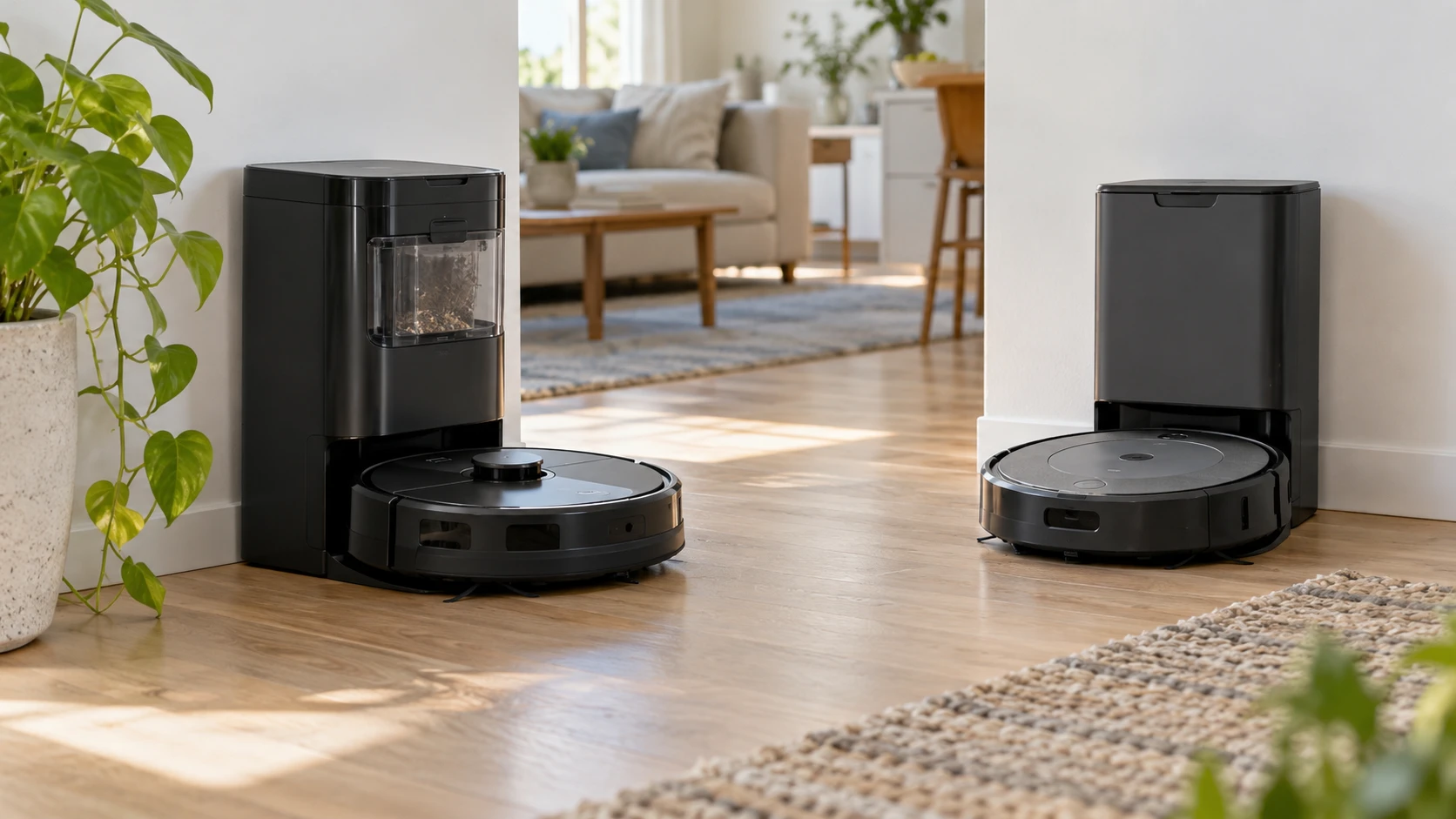
A self-emptying robot vacuum still needs a place to dock, a map it can use, and a household willing to maintain the base. The restored Shark RV2820AE Detect Pro and refurbished Roomba i4+ EVO listings both claim they can transfer debris from the robot into a base for extended periods. They take different approaches in the saved descriptions. Shark names a bagless HEPA base, LiDAR navigation, no-go zones, and targeted cleaning. Roomba names a bagged Clean Base, a Smart Map with room selection, and scheduling. A product-page capacity figure cannot tell you how often your particular home will need attention.
The Shark RV2820AE Detect Pro robot vacuum row says its bagless base can hold up to 60 days of dust and debris, with an odor neutralizer and HEPA designation. It describes 360-degree LiDAR mapping, app-set no-go zones, targeted cleaning, and detection features intended to boost cleaning when grime is found. The robot vacuum mapping and room-control guide helps define the rooms and boundaries you actually need. The Roomba i4+ EVO self-emptying robot vacuum row says its Clean Base transfers debris into an enclosed bag, also advertised for up to 60 days, while Imprint Smart Map supports room-specific jobs and recurring schedules.
Map the home before judging the map feature — robot vacuum mapping and room-control guide
Draw the rooms the robot should clean, the places it should avoid, and the route between them. A child’s play area may be safe in the morning and full of toys in the afternoon. A low rug, loose cable, or chair base can change navigation even when the app map looks correct. Shark's row specifically describes LiDAR mapping and no-go zones. That is a useful feature to investigate if the home has a fragile plant stand, a pet feeding area, or a room where the robot should never enter. Test the boundary with an inexpensive object in place before trusting it near something valuable.
Roomba's row says it learns a floor plan with Imprint Smart Map and lets you request specific rooms or set a recurring schedule. It does not spell out the same no-go-zone control in the saved description. Do not treat that omission as proof the exact model has none, and do not assume every mapping option from a different Roomba line is available here. Check the current app and firmware documentation for this refurbished unit. A room label is helpful only if the robot reliably reaches the room and recognizes the threshold as a path, not an obstacle.
The Shark Republeq's catalog says its navigation can cross thresholds and avoid getting stuck. That should be tested against the home's highest doorway transition and the feet of its actual furniture. A robot that reaches a bedroom during an empty-room demonstration may struggle after chairs are moved. Start mapping with cords and small objects picked up, then try a normal day. Record where it stops or misses an area. If both candidates can be tried under a return policy, use the same route and cleaning schedule for a fair comparison.
Separate suction claims from cleaning results — Roomba i4+ EVO self-emptying robot vacuum
Shark describes Auto Deep-Clean and three Detect and React technologies intended to find hidden dirt and increase cleaning power. It also claims to pull dirt from corners and edges and capture pet hair. Roomba describes a three-stage cleaning system and a “10x Power-Lifting Suction” claim relative to its own 600-series cleaning system. These are different Republeq's catalog baselines. Ten times a named older product is not a direct comparison with the Shark model, and the Shark's “deep clean” phrase does not quantify pickup from your carpet.
Use representative debris for a test: crumbs on hard flooring, hair near baseboards, and dirt embedded in a small section of rug. Photograph or weigh the test area only if that is useful; the ordinary question is whether visible debris is gone without several rescue passes. Look at the bin and brush after the run. If hair wraps the brush or a rug fringe catches, the maintenance burden may outweigh a strong suction claim. Keep the test safe for the flooring and follow each manufacturer's instructions on material to avoid.
Neither saved row establishes a mopping function. If wet cleaning is required, verify it from the exact model specification rather than assuming a vacuum with a dock also mops. The two listings are about vacuuming and emptying debris. Planning around that defined job keeps the comparison focused and avoids paying for a capability the row has not documented.
Understand the two dock designs — Roomba i4+ EVO self-emptying robot vacuum
The Shark row calls its self-emptying base bagless and HEPA, with up to 60 days of storage and an odor neutralizer. Bagless disposal can avoid buying replacement bags, but someone still has to empty the container without sending dust back into the room. Check the manufacturer's procedure, filter replacement schedule, and whether the person who normally handles household dust can do it comfortably. The catalog does not provide a dust-exposure test for emptying the base.
Roomba's Clean Base uses an enclosed bag and says it captures 99% of particles as small as 0.7 microns. That is a Republeq's catalog filtration claim, not a matched air-quality comparison with the Shark base. A bag can simplify disposal, but its ongoing cost and availability belong in the budget. Confirm the correct bag type for the i4+ EVO and what, if any, supplies arrive with the refurbished unit. A base that stores dirt for weeks still needs attention when the bag fills or the transfer passage clogs.
Both pages use “up to 60 days” language. Actual emptying interval depends on pets, carpets, floor area, frequency, and how full the robot's bin becomes on each run. In a home with shedding animals, the base may need service far sooner. Log how often the base asks for attention over the first month. The best dock is the one that your household will maintain without a dusty surprise before guests arrive.
Place the base where the robot has a clear approach and power, and where it can remain in place during mapping. A dock hidden behind a chair may look tidier but can be harder to reach for bag or bin service. Measure the space before buying; neither saved row gives all base dimensions. If the base is in a bedroom or near a work call, check how loud the emptying cycle is. Republeq's product descriptions provide no matched noise figures. A cleaning schedule can be adjusted to a time when that brief sound is less disruptive.
Treat refurbished condition as its own decision — Roomba i4+ EVO self-emptying robot vacuum
Both offers are described as restored or refurbished. That condition makes the exact shipped unit and return terms important. Inspect the robot, base, power cable, filters, brush, wheels, and any replacement bag or bin on arrival. Confirm the model number on the unit matches the listing before linking it to an account. Confirm with Republeq what was replaced or tested, whether battery health is covered, and how a return is handled if mapping or emptying fails. The catalog copy describes features, not the condition report for the particular item delivered.
A used robot may also need a reset before setup. Follow the manufacturer's account-transfer and factory-reset instructions rather than trying to use another household's saved map. Build a new map of your own rooms and check whether schedules and no-go settings are stored as expected. If the app shows an old owner or will not pair, resolve that during the return window. Keep screenshots of the issue and the Republeq's catalog order information; a feature list cannot fix an ownership lock.
Check the replacement-part path before making a model the household's regular cleaner. Brushes, filters, bags, and batteries wear. Shark's bagless base avoids a particular recurring supply, while Roomba's bagged base adds one. Both still have other consumables. Compare official parts for the exact model and current availability, and include those costs in the decision. A lower purchase price on a refurbished unit may not be a good deal if the needed base or battery cannot be serviced affordably.
Use a repeatable first-week trial — Roomba i4+ EVO self-emptying robot vacuum
Give each robot the same preparation: lift cables, open the intended doors, and remove small items from the floor. Let it map, then label rooms and set one ordinary schedule. Run a whole-floor clean and a single-room clean. If a no-go area is central to the choice, draw the boundary and confirm whether Shark respects it; check the Roomba's exact controls if that feature is needed there too. Note missed patches, repeat passes, time spent rescuing the robot, and whether it returns to the dock reliably.
During that week, test the base transfer after a typical amount of hair and dust. A robot that vacuums well but fails to empty itself creates more work than expected. Check whether a full-bag or full-bin alert is clear, and whether the app tells the household what to do. If the robot runs while nobody is home, review the map and job record afterward rather than assuming a scheduled task finished every room. A dock receipt in an app is not the same as clean floors.
The Shark RV2820AE is the catalog-backed candidate when a bagless base, LiDAR mapping, no-go zones, and targeted runs fit the home's routine. Roomba i4+ EVO offers a bagged disposal path with clearly described named-room schedules. Neither saved listing proves the claimed 60-day interval or a cleaning advantage in a particular home. Choose after checking the refurbished unit's condition and running it through the rooms, debris, and dock setup it will actually face.