Audio & Video
Shared-home guitar rehearsal: agree when playing is welcome
Ask whether audible acoustic playing is welcome, agree a usable interruption request and reset the equipment without assuming permanent permission.
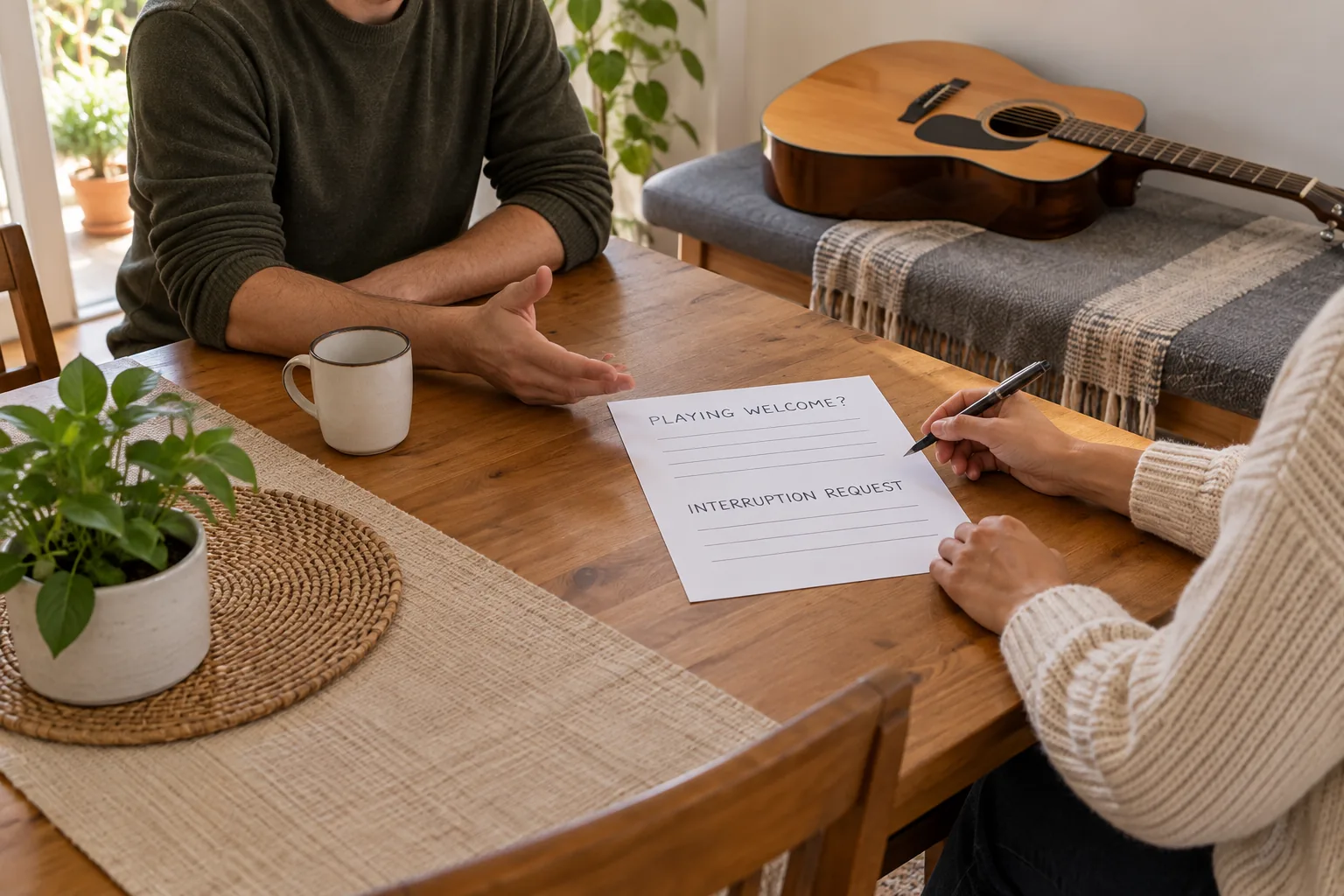
Ask about the audible rehearsal before beginning
Shared-home guitar rehearsal begins with a question for the people who will hear it: is acoustic playing welcome now? A free chair and a gap in your own calendar do not answer that question. Someone else may need to make a call, rest or use the same room for an activity that does not fit with playing. Ask about the actual sound-producing activity before settling into it. Keep an unanswered request open rather than treating silence as agreement.
The aim is to make an ordinary musical activity possible within a shared home. This is a suggested household conversation, with no promise about a guitar's loudness, sound transmission or anyone's reaction. It gives the people involved a way to say when audible rehearsal is welcome and how to interrupt it if circumstances change. Choosing music, learning a passage and establishing equipment fit remain separate decisions.
Name the activity people are agreeing to hear
Describe the rehearsal you actually want to do. You might intend to repeat a short passage on an acoustic guitar, try a sequence you are learning or play through something already familiar. These are possible activities to explain, not a lesson or a required practice method. Let the people sharing the space understand that they are being asked about hearing playing, including repetition if that is part of your plan.
A request to use the room can leave the sound question hidden. Someone may be happy for you to sit there while expecting a quiet activity. Put the acoustic playing into the request directly. Ask which existing plans it might affect and whether a different opportunity would suit the people involved. You do not need to turn that exchange into a judgement of their taste or your ability to play.
Keep the answer specific to the occasion. Agreement during an otherwise free afternoon is an answer about that afternoon. It need not become permission for every later session or for a different activity with more people. When the plan changes, check again. This keeps the conversation attached to what others are actually being asked to hear, rather than relying on an old general statement about enjoying music.
Audible rehearsal agreement keeps the sound question visible
For an audible rehearsal agreement, begin with the person whose current activity may conflict with yours. Ask in ordinary language whether acoustic playing would work alongside what they are doing. Give them room to say no or to name a different opportunity. Their answer can remain a practical statement about the moment; it does not need to become a review of the instrument or an argument about the value of practice.
If someone needs a call to finish first, keep that condition in the plan. A proposed opportunity after the call still needs to reflect the circumstances when it arrives. If the call runs over or another need appears, return to the question. An estimated ending is useful information, without creating an obligation for someone else to make the house available at that exact moment.
If nobody can give a clear answer, leave audible playing undecided. You can organize the music or make a note of the question you want to bring to a lesson without treating those alternatives as equivalent musical practice. The point is to avoid beginning the sound-producing activity on an assumption. Another person's uncertainty should not have to become a complaint before it is taken seriously.
An instrument description cannot give household permission
The Recording King RDS-9-TS listing identifies a Dirty 30s Series 9 dreadnought acoustic guitar with a solid Sitka spruce top and Cross Lap Bracing. Keep that description with the actual instrument offer. Its numerical scale wording is ambiguous, and the colour and size fields use different descriptions, so neither is resolved here. The account supplies no measured sound-output result or assurance that playing will suit a particular shared home. The household question remains open regardless of a finish preference.
A material or construction detail can help identify an offer while leaving the social decision untouched. Someone researching the guitar may still need exact specifications or clarification of its fields. Those enquiries do not answer whether playing is welcome beside another person's current activity. Keep a product question and a household request in separate parts of your notes so an answer to one does not appear to settle the other.
You can use an instrument you already own for the activity you have agreed, following its actual instructions and appropriate guidance. This planning idea creates no requirement to buy another guitar. A new purchase cannot supply another person's agreement, and the article makes no claim that either selected instrument is quieter, less intrusive or more suitable for a particular room than the other.
Choose an interruption signal before playing
A rehearsal interruption signal gives the other person a simple way to tell you that the current arrangement needs to stop or change. Agree something ordinary that both of you understand, such as a specific spoken request. Establish what you will do when it is used: pause the playing and listen to the new need. This is a suggested conversation rule, without an assertion that a particular signal will be heard in every room.
Ask whether the proposed signal is actually convenient for the person who may need it. Requiring them to come through an unsuitable space or wait for a particular musical moment could make the arrangement harder to use. Let them describe a workable way to reach you. If you have not agreed on one, leave that part unresolved rather than assuming a closed door or an unheard message will communicate the request.
Keep the signal separate from criticism of the playing. It can mean that a call has begun, the room is needed or the person no longer wants the sound alongside their activity. A request to stop need not contain a musical assessment. That distinction can help keep the exchange focused on the household arrangement instead of asking someone to prove that the rehearsal has become objectionable.
Let changed circumstances change the session
Suppose a fictional household has agreed that acoustic playing is welcome while another person finishes a quiet task elsewhere. Partway through, that person receives a call they need to take. They use the agreed request, and the player pauses. The arrangement can now be reconsidered. This example illustrates a change in plans; it supplies no rule about sound levels or a guarantee that separate rooms prevent disturbance.
The player can ask whether there is another welcome opportunity later. Keep that question separate from the decision to stop now. Someone should not have to agree to a replacement session before their current need is respected. If another opportunity is uncertain, record it as uncertain. The musical plan can remain unfinished without turning the earlier agreement into an entitlement to continue.
If interruption happens often, talk about the pattern when neither person is trying to resume an immediate task. Ask what part of the proposed arrangement repeatedly conflicts with household life. The answer may concern the actual activity, the opportunity chosen or the way the request is communicated. This article promises no universal solution. It suggests making the conflict explicit before treating repeated disagreement as another person's failure to cooperate.
Keep the musical choice with the music
The sheet music afternoon guide begins with choosing one familiar piece and arranging the actual pages for it. That is a musical starting point you can keep after audible playing has been welcomed. Here, the household agreement comes first because it concerns whether the sound-producing activity can begin. Neither a suitable score nor a satisfactory reading arrangement establishes agreement from someone else in the home.
Once playing is welcome, use the musical activity you actually intended. If that activity changes from an occasional read-through to repeated attempts at one passage, consider whether the original request still described what others expected. Ask again where it no longer does. The article provides no tempo, fingering, repetition count or improvement promise; those questions belong with appropriate instruction for the instrument and music.
A musical stopping point can be useful to the player while the household arrangement still permits interruption. Wanting to complete a passage is a personal preference, not a reason someone else must postpone an agreed request. Keep the two decisions visible. You can leave a note about where to return without demanding that the present session end at the place you originally imagined.
Keep another actual guitar offer distinct
The Washburn WD7SATB-A-U listing describes an acoustic dreadnought with a solid spruce top, mahogany back and sides, a satin mahogany neck and an Ovangkol fretboard. It names D'Addario EXP-16 strings and a tobacco sunburst gloss finish. These are specifications for that offer. The description's projection language supplies no measured result here, and its limited-warranty wording does not reproduce all coverage terms. No comparison of household audibility or permission to rehearse follows from these product details.
Someone can prefer the appearance of one instrument while leaving the household plan unchanged. A photograph shows a product's visible form and details; it does not demonstrate how sound travels through the reader's home. Keep any unanswered acoustic or product question attached to the exact equipment. Avoid using a buying decision as a substitute for the conversation with the people who share the space.
For a musician who already has an appropriate instrument, the useful change may be the request and response arrangement. It can be written on an ordinary note rather than attached to a new purchase. That note should say what was actually agreed for the occasion, including any condition that remains open, so a later recollection does not turn a limited answer into an unlimited one.
Reset the equipment as a separate responsibility
After the playing stops, attend to the equipment you brought into the shared arrangement. Follow the actual instrument and accessory instructions for handling and storage. This article gives no stand placement, peg installation, case-fit or packing sequence. The household conversation can identify who is responsible for restoring the agreed use of the space while leaving the physical method to confirmed equipment guidance.
The music stand instrument peg compatibility guide addresses the actual support question during a rehearsal break. It keeps the instrument, stand, optional peg and carrying bag within their documented roles. Its accessory discussion does not approve a support for either guitar here. If the reset depends on an uncertain support arrangement, resolve that actual fit question instead of improvising a resting place from the household plan.
Ask whether anything brought out for the session still affects the next person's intended use of the space. Record a specific unresolved item rather than declaring the room ready without checking the arrangement. The reset is part of keeping the shared agreement practical. It does not establish that an unidentified storage position is safe or that someone else has accepted responsibility for the instrument.
Keep an equipment order separate from the agreement
If you intend to buy a guitar through republeq.com using USDT or another crypto payment option, check the current checkout for the exact order before sending anything. A payment label in a listing does not establish which assets, networks or payment routes are available for your cart. Confirm the asset name and network shown by the active checkout, the full amount requested, any displayed fees and the destination details. Keep the order reference and the instructions you actually receive. Do not infer payment compatibility from a guitar's construction statement, a familiar wallet name or an earlier purchase. Technical suitability and payment availability need their own checks. Review the current shipping information, cancellation conditions and return policy for the order, including any instructions that explain how a payment issue or refund request is handled. This article promises no asset acceptance, transfer completion, recovery service or refund outcome. If a payment instruction changes, or if an address or network is unclear, stop and seek clarification through the site's current support channel before authorizing a transfer. A quotation or order summary should remain attached to the exact guitar variant and quantity you intended to purchase; neither an advertised instrument category nor a picture establishes the delivered contents. Record the product question you still need answered separately from the payment question, so resolving one does not make the other appear settled. Recheck the current order details at the point of purchase rather than relying on a saved screenshot, a copied address or a description that may have changed since you first read it.
Return to the question for the next occasion
Shared-home guitar rehearsal can begin with a clear welcome for audible playing, an interruption request people can actually use and responsibility for the equipment afterward. Keep any agreed timing attached to that specific sound-producing activity. Check again when the household situation changes, and leave a refusal or unanswered question intact. A later session can start from the current circumstances instead of treating an earlier agreement as permanent permission.