Office Supplies & Stationery
Seven-point pattern inspiration: cover every pair
An original seven-label paper design uses binary addition to build a minimal pair-covering triple system and prove its incidence structure.
Seven-point pattern inspiration begins with a small rule
Write seven labels on a blank page: 1, 2, 3, 4, 5, 6 and 7. The design challenge is to collect three-label groups so that every possible pair of labels appears in exactly one group. For example, the group 123 contains pairs 12, 13 and 23. We will call such a group a block. The order within a block does not matter, and a block never repeats one of its own labels.
This is an abstract paper pattern, suitable for exploring relationships without assigning the labels to real people or objects. Its appeal comes from a compact structure: seven blocks account for all twenty-one pairs, every label appears in three blocks, and any two blocks share exactly one label. Those statements need proof. A tidy page or a pleasing arrangement of colors would not establish them, and an attractive drawing should not hide an incomplete pair list.
Count the relationships before choosing the pattern
There are six pairs involving label 1, then five new pairs beginning with 2, four beginning with 3, and so on. Counting each pair once gives 6+5+4+3+2+1=21. Equivalently, seven labels each have six other labels, but this counts each unordered pair twice, so 7×6÷2=21. The two counts agree because both refer to the same complete set of relationships between different labels.
Each three-label block contributes three pairs. Six blocks therefore supply only eighteen pair occurrences and cannot cover all twenty-one distinct pairs. At least seven blocks are necessary, even if repeated pairs were allowed. If we can find seven blocks with no pair repeated, their twenty-one occurrences must cover the whole required set. The count supplies a lower bound and a target. It does not by itself construct a working design.
Keep this exact set of seven blocks
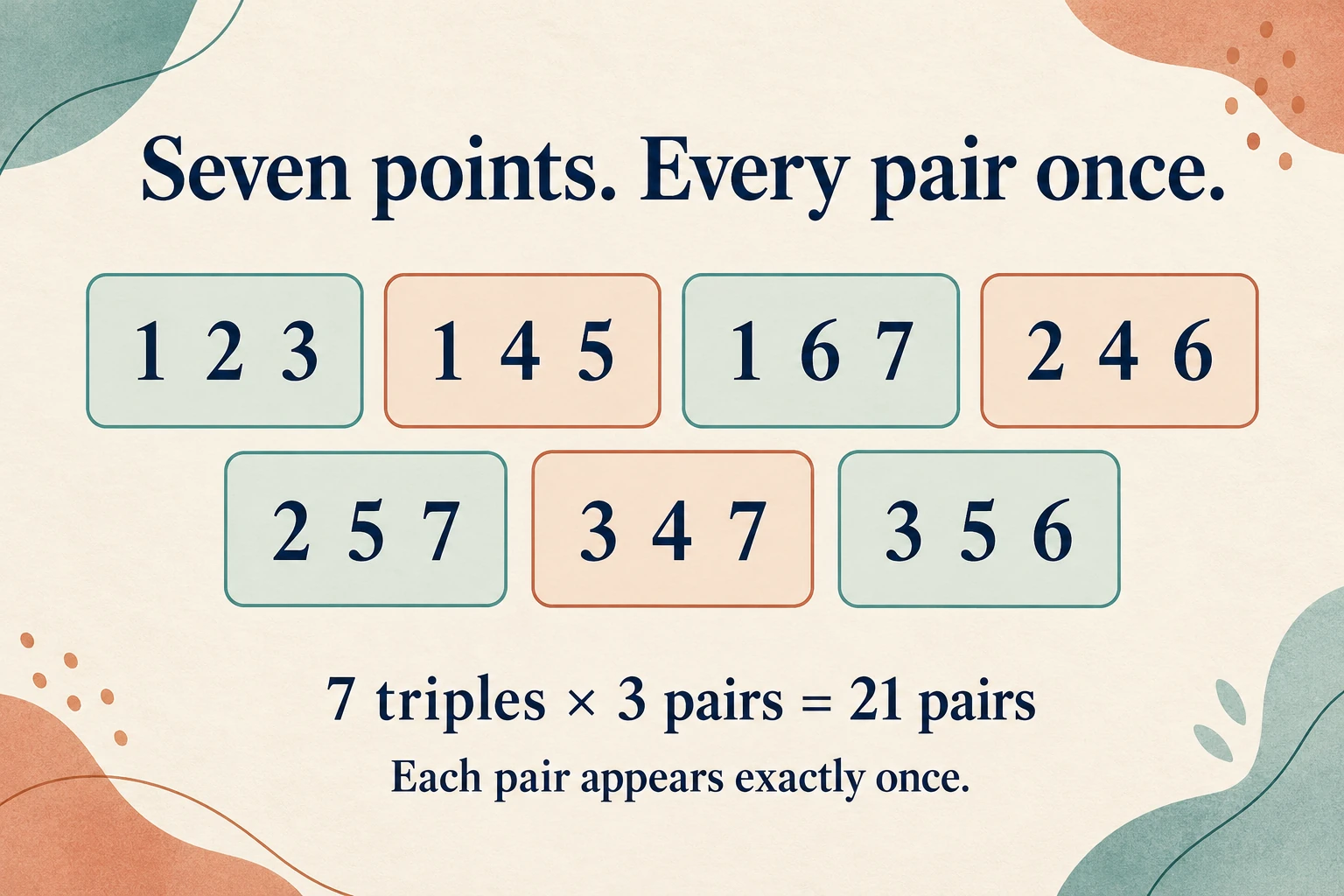
Use these blocks: 123, 145, 167, 246, 257, 347 and 356. Read each as a set of three labels, not as a three-digit number to be added or multiplied. Thus 145 means the block containing labels 1, 4 and 5. Keep spaces between the digits on your own worksheet if that makes the meaning clearer. The seven written blocks are the complete object being investigated here.
The blocks containing 1 are 123, 145 and 167. Their other labels divide its six partners into pairs: 2 with 3, 4 with 5, and 6 with 7. For label 2, the relevant blocks are 123, 246 and 257, giving partners 1, 3, 4, 6, 5 and 7. These readings make part of the structure visible, but we will derive a rule that explains every pair rather than trusting a few favorable samples.
Give each label a three-bit meaning
Represent the labels by binary triples: 1 is 001, 2 is 010, 3 is 011, 4 is 100, 5 is 101, 6 is 110 and 7 is 111. These are precisely the seven nonzero strings of three bits. Define addition coordinate by coordinate modulo two: equal bits add to zero, while different bits add to one. This is the exclusive-or operation, usually written XOR. In particular, every bit string added to itself gives 000.
For two distinct nonzero strings x and y, form z=x XOR y. This result cannot be zero, since a zero result would mean x and y agree in every position. It cannot equal x, since cancelling x from both sides would force y to be zero. Similarly, it cannot equal y. Thus x, y and z are three distinct labels from our original seven. They form an admissible block without introducing an eighth label.
As an example, 010 XOR 101 equals 111, so labels 2 and 5 complete to label 7. The corresponding block is 257. Another example is 011 XOR 100=111, giving block 347. These computations use binary addition without carries. Ordinary integer addition would give a different operation and would not generate the stated pattern. Keep the binary representation beside the decimal labels until the rule feels unambiguous.
Prove that each pair has exactly one completion
Define the permitted blocks as triples whose bit strings add to 000. Given a pair x and y, choosing z=x XOR y makes x XOR y XOR z equal zero, because each bit string cancels with itself. This proves existence of a permitted block for every pair. To prove uniqueness, suppose another string w completes the same pair. From x XOR y XOR w=000, cancelling x and y forces w=x XOR y=z.
The argument does two jobs. Every pair belongs to a block, and no pair belongs to two different blocks. It is therefore a universal construction proof, rather than a count of selected examples. The arithmetic count now tells us how many different blocks the rule creates: twenty-one pairs, with three distinct pairs in each block, gives seven blocks. The displayed list has seven different blocks, and each has XOR sum zero, so it is exactly the complete list.
You can check that last assertion directly without enumerating every possible pair. The blocks containing 1 give 001 XOR 010=011, 001 XOR 100=101 and 001 XOR 110=111. The remaining four use 010 XOR 100=110, 010 XOR 101=111, 011 XOR 100=111 and 011 XOR 101=110. These are precisely 246, 257, 347 and 356. The construction and the printed list therefore describe the same seven-block object.
See why every label belongs to three blocks
Fix any one label, such as 4. It has six possible partners. Each block containing 4 accounts for two of those partners, and no partner can appear twice because each pair has a unique block. Covering all six partners therefore requires exactly three blocks containing 4. The same reasoning works for every label. It depends on the pair property, not on where the label is drawn or which color you choose for its marker.
For a concrete check, label 4 appears in 145, 246 and 347. Its partners are 1, 5, 2, 6, 3 and 7, all different. Across the whole design there are seven labels with three block appearances each, giving twenty-one label appearances. The seven blocks also have three labels each, again giving twenty-one. This agreement is a useful arithmetic cross-check on the construction, though the universal pair proof remains the substantive reason it works.
Derive the shared-label pattern between blocks
Two different blocks cannot share two labels. If they did, the pair formed by those shared labels would belong to both blocks, contradicting unique completion. They may initially seem able to share either no label or one label. To settle that question, count pairs of blocks that meet at a fixed label. Three blocks pass through that label, creating three pairs of meeting blocks. There are seven labels, so this produces twenty-one meeting block pairs.
No block pair is counted twice, since that would mean the two blocks shared two labels. There are exactly twenty-one unordered pairs of blocks altogether, by the same seven-choose-two count used earlier. Thus the twenty-one meeting pairs already account for every possible block pair. Every two blocks meet in exactly one label. For example, 145 and 246 meet at 4, while 167 and 356 meet at 6.
This second relationship gives the design a useful visual rhythm. Labels connect to blocks and blocks connect back to labels in a balanced way. It does not require you to force seven straight lines onto a Euclidean drawing. Here “block” means a three-label set. A diagram may use curves, colors or separate tiles to display membership, but those visual choices are a representation of the incidence structure rather than a claim about physical lines or measured angles.
Use the structure as a paper design idea
One presentation is to place the seven blocks on separate tiles and give each label a consistent symbol. A reader can then trace the three tiles containing a chosen label, or select two tiles and find their shared symbol. Keep the number beside a decorative symbol so that identity remains clear. Color can help organize the page, but a color choice should not redefine which labels belong to a block or make two different labels indistinguishable.
You may rename the seven labels consistently. Replacing every 1 by A, every 2 by B and so on changes the notation while preserving which pairs and blocks are incident. A partial renaming can change the object instead, so apply a single one-to-one replacement everywhere. This observation does not claim that every conceivable valid seven-label design has been classified. It only explains why a consistent renaming of this proved construction preserves its properties.
Keep this activity distinct from scheduling. Its blocks overlap, and there is no requirement to divide a round into disjoint pairs or to place each participant once in a round. There are also no freely colored edges and no search for a guaranteed monochromatic triangle. The reader decision is to construct and understand a selected system of triples with exact pair coverage. The binary rule and the block-intersection proof belong to that decision.
Keep the supporting references separate
The BAZIC binder-clip listing shows a model-272 retail card with colored hinged clips and integral folding arms. It is optional paper-organization context. The image does not independently authenticate the delivered pack quantity, dimensions, metal composition, corrosion resistance or holding performance, and none of those claims supplies the construction proof.
The Raindrops bookbinding-fastener listing shows elongated silver-colored binding strips. These are a different physical construction from hinged binder clips, despite the catalog title. The image does not authenticate a maker, model, delivered quantity, material, fit or fastening result. The strips supply no mathematical evidence and no installation instructions are inferred here.
The six-participant pairing-plan guide arranges disjoint pairs into rounds. This design instead uses overlapping triples on seven labels and derives their unique binary completion and shared-label structure. Its seven blocks are not a round-robin schedule.
The six-point two-color triangle puzzle freely labels all edges and proves a uniform triangle must exist. Here we choose seven particular triples so that each pair belongs to exactly one of them. Edge-color guarantees answer a different question.
Keep an optional purchase separate from the pattern
If this paper project prompts a later supply purchase, keep the order evidence separate from the pattern. The binary construction does not establish a product quantity, a material, a page capacity or a fastening result. Before buying through republeq.com, inspect the exact current item and resolve any product question that affects the intended use. A retail-card photograph and a catalog pack description may concern different levels of packaging, so do not turn a visible count into a promised delivery quantity. If cryptocurrency is being considered, check the payment choices actually presented for the particular order. Mentioning USDT here does not establish that a token, network or wallet is supported. Where an appropriate cryptocurrency option is offered, compare its instructions with the order reference and confirm the requested asset, network, destination and amount before sending funds. Retain the displayed delivery and return terms together with any written clarification and the resulting confirmation. If an order or transfer remains uncertain, reconcile its status before considering another payment. This note does not report an actual transaction, guarantee acceptance, promise a discount or establish a refund right. It also makes no claim about transaction speed, fees or token price stability. Choose among available payment methods on the current terms you can verify, rather than assuming that cryptocurrency is necessary for a simple paper activity. The design itself needs only seven written labels and room to record the blocks. No purchase, account setup or token balance is needed to reproduce the binary addition, prove unique completion or inspect the shared labels between blocks.
Keep the proof with the finished page
Retain the seven blocks beside the binary label key. Their pair coverage follows from one unique XOR completion for each pair; their three appearances per label follow from six partners taken two at a time; their single shared label between every two blocks follows from the meeting-pair count. Those reasons remain valid when the page is redrawn or consistently renamed. The finished pattern has a structure another reader can reconstruct, rather than an appearance they must simply trust.