Crypto Commerce
Samsung Odyssey G55A gaming monitor vs LG 27GS75QX-B for 27-inch gaming
Compare Samsung Odyssey G55A gaming monitor: Samsung Odyssey G55A and LG 27GS75QX-B 27-inch QHD monitors on curve, refresh, adaptive sync, HDR, bundle…
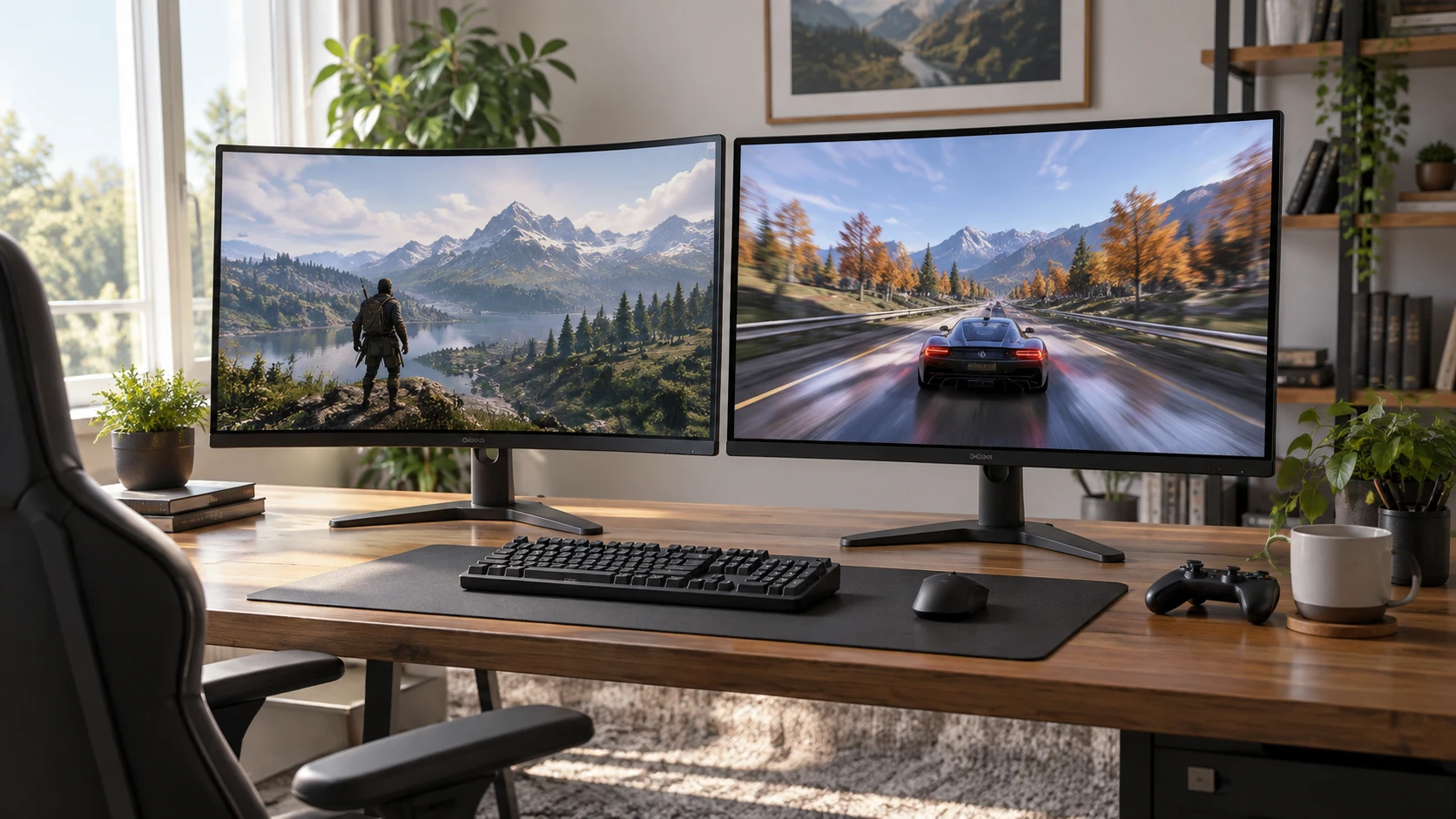
A monitor can advertise a very fast response time and still be a poor fit for a particular desk or computer. The Samsung Odyssey G55A and LG 27GS75QX-B listings both describe 27-inch QHD gaming screens, but their saved details point to different questions. Samsung identifies a curved WQHD panel, 165Hz refresh rate, HDR10, and AMD FreeSync Premium. LG identifies a QHD IPS panel, 180Hz refresh rate, G-Sync compatibility, and a bundle with cables and protection coverage. The two rows do not provide matched measurements of motion, color, brightness, or input delay.
The Samsung Odyssey G55A gaming monitor is listed under the exact model LS27AG552ENXZA. Its row calls the display curved and names a 1ms GTG response-time claim alongside the 165Hz refresh rate. The 27-inch WQHD gaming setup guide helps frame what a fast 27-inch screen demands from the rest of a gaming setup. The LG 27GS75QX-B UltraGear monitor row specifies 1440P IPS, 180Hz, a 1ms response-time claim, and G-Sync compatibility. It also names a particular bundle whose contents need checking at checkout.
Begin with resolution and graphics load — LG 27GS75QX-B UltraGear monitor
Both catalog rows place these monitors in the 27-inch QHD or WQHD class. LG's row explicitly says 1440P; Samsung's calls its panel WQHD and describes a pixel density 1.7 times that of Full HD. The terms indicate a sharper desktop than a typical 1080p screen at the same diagonal, but the exact display settings should still be confirmed from the model manuals. Your computer has to render games at the resolution and frame rate you choose. A monitor's refresh ceiling does not make a slow graphics card produce more frames.
Take a game you actually play and note its current frame rate and graphics settings. If it already struggles at 1440p, the difference between a 165Hz and 180Hz label may have little effect until you adjust the workload or upgrade the computer. If it regularly runs far above 100 frames per second, either refresh ceiling could be relevant. The published guide's questions about the complete signal path apply to both models: graphics output, cable, input setting, and game performance must line up.
QHD can also change ordinary desk work. Open a browser beside a document at the scaling you prefer and check whether text remains comfortable at your normal viewing distance. A display chosen for games will still show email, maps, and calls for many hours. Neither saved product description gives a stand adjustment range or details on text rendering. Those gaps are worth resolving if the monitor doubles as a work screen.
Read the refresh numbers in proportion — LG 27GS75QX-B UltraGear monitor
The Samsung row lists 165Hz and the LG row lists 180Hz. That is a 15Hz gap in their stated maximum refresh rates. It does not establish a 15-frame improvement in every game or a visible advantage in every scene. Input delay, pixel transitions, frame pacing, and the computer's output all affect how motion feels. The saved rows are product descriptions, not a controlled side-by-side test. Compare the monitors under the same game, cable, and settings if you have access to both.
Each product also has a 1ms response-time claim, but the wording differs. Samsung specifically says 1ms GTG, referring to a gray-to-gray pixel transition metric. LG's saved description says 1ms without identifying the measurement method or setting. Neither row supplies a full response-time distribution, overshoot result, or test mode. A single best-case number cannot tell you whether dark transitions smear or whether an aggressive overdrive setting creates bright halos. Look for independent measurements tied to the exact model and refresh setting if motion clarity is the deciding factor.
Fast modes sometimes require menu choices. On arrival, confirm the native resolution and highest available refresh rate in the operating system and monitor menu. Then watch a familiar moving scene at several response or overdrive settings. Choose the mode that looks clean to you. The most extreme setting may produce visible artifacts. If a game feels uneven, check whether its frame rate is fluctuating before concluding the panel is at fault.
Check adaptive sync with your computer — LG 27GS75QX-B UltraGear monitor
Samsung's listing names AMD FreeSync Premium; LG's names G-Sync compatibility. Those labels are relevant if the graphics card's frame rate varies below the maximum refresh rate. Adaptive sync can align display refresh with delivered frames and reduce tearing or stutter when the feature is supported and enabled. The saved rows do not specify every supported input, graphics card, operating-system combination, or variable-refresh range. A label on the product page is the beginning of a compatibility check.
Look up the exact model and firmware in the manufacturer documentation. Identify the port and cable that support your intended resolution, refresh rate, and sync mode. The LG bundle description says it includes two HDMI cables, but it does not state their version or that those cables unlock every advertised mode. Samsung's saved row gives no cable list. If the computer uses DisplayPort, find out whether a suitable cable is supplied or must be purchased separately. Keep the source device, cable, and monitor input in the same test when troubleshooting.
After setup, enable the feature in both the monitor menu and graphics driver where required, then use a game with a changing frame rate. Check the driver's status as well as the monitor menu. A tearing problem can come from an incompatible connection or an option that was disabled after a system update. A stable frame rate can also feel smoother without adaptive sync. Judge the actual game behavior; a certification name cannot rank every setup.
Decide whether the curve fits the desk — LG 27GS75QX-B UltraGear monitor
Samsung explicitly calls the G55A curved. The LG row identifies an IPS panel but does not state a curvature or flat-panel specification. Do not infer the LG's physical shape solely from the panel technology. Check current photographs and the official model sheet. If the monitors will sit next to another screen, the housing shape, bezel, and stand may matter more than a small refresh-rate difference.
A curved 27-inch panel can feel natural at one seating position, especially if the screen is directly in front of the player. At a shared desk, several people may view it from different angles. Test the viewing distance and where the edges fall in your field of view. For design work involving straight lines or multi-monitor alignment, see how the curve feels in the actual layout. The Samsung row gives no curve radius, so a precise fit assessment needs the manufacturer specification or an in-person view.
LG's saved description says IPS, which identifies the panel family but does not settle its measured color accuracy or viewing-angle performance. Samsung's row does not name a panel technology. If color-critical work shares the desk with gaming, find measured gamut, calibration, and uniformity results for the exact products. A general panel label or a promotional image is not enough. Also check the stand's height, tilt, and depth for each model; neither row provides a complete ergonomic specification.
Keep HDR and bundle claims separate — LG 27GS75QX-B UltraGear monitor
Samsung's row says HDR10 brings out detail in shadows and highlights. HDR10 support does not by itself establish peak brightness, local dimming, black-level performance, or a convincing HDR presentation in every game. Those hardware details are absent from the saved description. If HDR matters, seek independent measurements and confirm that the source, cable, game, and operating-system settings all use the intended mode. Test an HDR title you know, then compare it with the same screen's standard presentation.
The LG row does not mention HDR in its saved text. Silence is a reason to verify the current specification, not evidence that a feature is absent. Conversely, the Samsung HDR10 label is no basis for assuming its image will beat LG's in ordinary SDR games. Pick the display for the image modes you will use most often and check them with actual content.
LG's product row identifies a bundle including Elite Suite 18, two HDMI cables, and a Deco Gear CPS Exclusive 26 Month Protection Pack. Confirm the current cart includes the same items and read the protection terms before assigning value to them. A bundle title can differ from the package shipped by a Republeq's catalog or from a later listing revision. Samsung's saved row does not itemize accessories. Ask about the included stand, power supply, cables, and warranty for the exact Republeq's catalog offer. A cable included in one bundle only saves money if it supports your chosen connection.
Test the complete setup during the return period — 27-inch WQHD gaming setup guide
Place the monitor at the intended viewing distance and check for stability, reflections, and comfortable eye height. Connect the actual gaming computer, set QHD and the desired refresh rate, and verify the connection remains stable after sleep and restart. Run a fast game and a slower, dark scene. Inspect text on the desktop, smooth gradients, and any stuck or bright pixels. Keep the packaging until the result is clear.
The available evidence makes the Samsung a specific curved 165Hz FreeSync Premium candidate and the LG a specified 180Hz IPS G-Sync-compatible candidate with a named bundle. It does not decide which image you will prefer. The useful final comparison is the one you can reproduce with your graphics card, cable, desk, and games. Ask for missing stand and port details before purchase, then verify the exact settings while the Republeq's catalog return option is still available.