Problem-Solving Articles
Safety glasses fogging: keep visibility and protection
Keep an obscured view within the worksite process for safe stopping, hazard assessment, eyewear fit and applicable lens care.
Address safety glasses fogging without giving up the protection required for the task. If the lenses obscure your view, follow the workplace procedure for safely stopping the operation and moving away from the hazard before attending to the eyewear. Bring the problem to the supervisor responsible for the work and its protective equipment.
This guide concerns workplace selection and care questions. OSHA's general-industry eye-protection standard and its nonmandatory selection guidance provide the framework below. The actual hazard assessment and applicable instructions determine what a worker needs. Neither of the two selected retail offers is independently certified here for a particular job.
Describe the visibility problem before choosing a replacement
Record what you actually saw and when it happened. Did the view become cloudy after entering an area, while performing a particular task or after an equipment change? Keep that observation separate from a conclusion about the cause. A description of the circumstances gives the supervisor something more specific than a request for different glasses.
Identify the actual eyewear and the other protective equipment being used. Keep the manufacturer's identification, any available model and the applicable instructions with the account. A familiar frame shape does not establish that two pairs have the same lenses, coatings, markings or permitted use.
OSHA's Appendix B notes that atmospheric conditions and restricted ventilation of a protector can cause lens fogging. It also explains that dirty or fogged lenses can impair vision. Those statements identify relevant conditions to investigate; they do not establish that ventilation is the sole cause of every cloudy view.
A lens that appears dirty, scratched or fogged presents information worth describing accurately. Do not give it a convenient diagnosis from a distance. Let the applicable inspection and care instructions guide the response to the actual condition, and keep damaged or unresolved equipment within the workplace's process for replacement or further assessment.
Keep the hazard assessment attached to the eyewear
Under OSHA's general-industry standard, the employer must ensure that affected employees use appropriate eye or face protection when exposed to specified hazards, including flying particles, chemicals or potentially injurious light radiation. The standard also requires side protection where flying objects present a hazard. These are task-specific protection questions.
OSHA's nonmandatory Appendix B describes a workplace survey that considers sources of hazards, the seriousness of potential injury and the possibility of simultaneous exposures. Its selection process compares those hazards with what the protective equipment can do, then addresses fit and instructions for care and use.
Keep the fogging complaint within that assessment. A different style of eyewear may raise questions about coverage, ventilation or compatibility, but the choice still has to address the actual hazard. Clearing a view does not by itself establish that a replacement provides the required protection.
For example, a workplace with a splash hazard has a different protection question from a task concerned only with flying particles. The selection guidance treats those hazards separately. Do not substitute a more open-looking protector on the assumption that extra ventilation is the only requirement worth considering.
If equipment or the work process has changed, tell the responsible supervisor. Appendix B assigns the safety officer responsibility for reassessing hazards as necessary, including new equipment and processes and the suitability of previously selected PPE. An earlier selection should not silently become approval for a different task.
Workplace eye protection fit needs an individual check
For workplace eye protection fit, OSHA's guidance emphasizes comfort and proper sizing. Poorly fitting PPE will not provide the necessary protection. Adjustable features should be fitted to the individual so the protector remains in the proper position. Follow the manufacturer's available instructions carefully.
Describe a fit concern in terms someone can assess. If the eyewear shifts during an ordinary required movement, identify that movement and the equipment being worn. Avoid adding an improvised strap, changing a component or altering a frame to obtain a different fit. Seek the approved adjustment or alternative through the actual equipment instructions and workplace process.
Keep other required equipment in the account. A fit answer obtained with one item alone may leave the complete work arrangement unresolved. Ask the supervisor to assess the actual combination rather than assuming that separately acceptable items automatically work together in the way you need.
The relevant question is whether the selected protector fits the wearer while maintaining the protection required for the work. Comfort matters within that question. A description such as universal size in a catalog does not replace an individual fit assessment.
Include prescription lenses in the protection question
OSHA's standard addresses workers who use prescription lenses while performing work involving eye hazards. The employer must ensure either eye protection incorporating the prescription or protection that can be worn over prescription lenses without disturbing the proper position of the prescription or protective lenses.
Tell the supervisor if prescription eyewear is part of the arrangement. Keep that information beside the fogging or fit observation. A retail description that says safety glasses does not establish whether a particular pair is suitable over your prescription eyewear.
Appendix B also notes that contact-lens wearers need appropriate eye and face protection in a hazardous environment. Contact lenses should not be treated as the protective device. The worksite's hazard assessment and the actual protective equipment remain necessary.
Ask about the complete arrangement before ordering a replacement. If an answer applies only to a different frame or prescription setup, retain that limitation. A useful response identifies the equipment and fit circumstances it actually covers.
Appendix B also stresses making users aware of warning labels and equipment limitations. When replacement eyewear is issued, include that instruction with the fitting process so the wearer understands the particular protector being supplied.
Read the two selected offers without merging their details
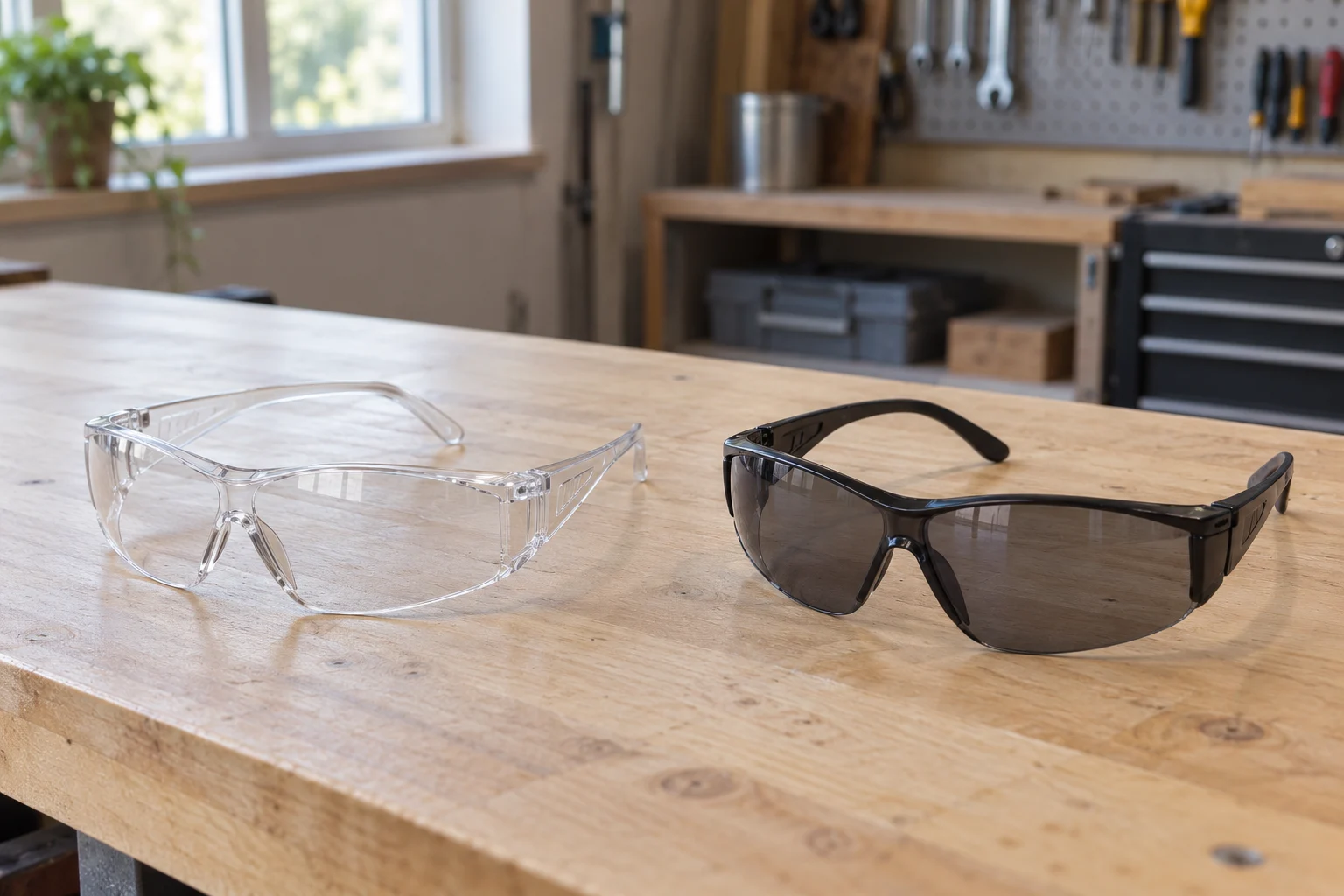
The KLEENGUARD KCC49311BX offer names V30 Maverick 49311, a lightweight black frame and smoke polycarbonate lenses. It states anti-fog and anti-scratch coatings, ANSI Z87.1+ optical and impact requirements and a quantity of 12. Its catalog color is Gray. Keep the actual lens and frame descriptions with the offer identity.
The 3M Virtua clear-lens offer is a 20-pack with clear frames, a wraparound design and an anti-fog coating. Its description makes high-impact claims referencing ANSI Z87.1-2020 and CSA Z94.3-2007 and specifies industrial or occupational use only. Those are the listing's statements, without an independent test or job-specific approval here.
Keep the package counts separate from the selection decision. A supply of several pairs does not establish an acceptable fit for every wearer or permission for every task. Confirm the exact model, applicable user information and worksite suitability before treating an order as resolved.
Read actual markings and supporting information
OSHA's standard requires eye and face PPE to be distinctly marked so its manufacturer can be identified. Read the actual product information when the eyewear is available, and retain any mismatch with the order description as an unresolved question. A web-page name and a mark on a delivered item are different pieces of evidence.
The standard's criteria reference ANSI/ISEA Z87.1-2010, ANSI Z87.1-2003 and ANSI Z87.1-1989, reaffirmed in 1998. It also permits devices an employer demonstrates are at least as effective as devices constructed to one of those standards. Do not turn a retail reference to another version into an independent finding of workplace compliance.
Ask the responsible employer representative for the documentation relevant to the actual selection. Keep a standard's version, the claimed type of protection and the product identity together. An impact statement does not supply a chemical-splash selection, and a coating description does not identify a protective filter shade.
Keep the relevant instructions accessible where the equipment is issued or maintained. If several models are supplied, identify which instructions belong to which model. This helps prevent a care method for one pair becoming the default for every coating in the shared supply.
Anti-fog safety glasses care must match the lens
For anti-fog safety glasses care, obtain the instructions applicable to the exact product. OSHA's Appendix B stresses keeping PPE clean and properly maintained and says frequent lens cleansing may be necessary when atmospheric conditions or restricted ventilation cause fogging. It does not prescribe one chemical or wiping method for every coating.
Use the permitted materials and method for the actual lens. A care instruction for a different product or coating should not become a general cleaning recipe. If the applicable directions are missing, ask the supplier or manufacturer for them while keeping the equipment question with the responsible supervisor.
Retain the distinction between a care task and a replacement decision. Completing cleaning does not establish that a scratch, damage or other unresolved condition has been corrected. Follow the actual inspection and replacement criteria rather than treating a completed routine as proof that the protector is suitable.
This guide supplies no detergent, spray, household remedy or coating application. The useful action is to establish the product-specific care requirements and the worksite response to an obscured view. Do not experiment with an unapproved treatment on equipment being relied on for protection.
Lens tint does not establish a protective filter shade
OSHA's standard requires the appropriate filter-lens shade for protection against injurious light radiation. Appendix B explains that tinted or shaded lenses are not filter lenses unless marked or identified as such. A smoke lens description therefore should not be converted into approval for welding or another radiation hazard.
Give the responsible supervisor the actual task and the product identification when asking about this requirement. The standard contains operation-specific shade information, but this article selects no shade or welding setup. An anti-fog claim and a dark-looking lens answer different questions from protection against a particular light source.
Use related guides for their own equipment questions
The caliper zero-check guide explains the limited scope of a single check. Here, an anti-fog statement or a completed care step also answers a limited question. Keep the full eye-protection selection and actual fit assessment separate from that one feature or observation.
The before-first-snow planning guide addresses the actual clearing job and supplies before choosing tools. Its weather planning supplies no workplace eye-protection selection. Keep cold-weather conditions in the account when relevant to the fogging observation, while retaining the actual hazard and equipment requirements.
Return with the unresolved issue stated clearly
A useful account includes the actual protector, the work being performed, other required equipment and the circumstances in which the view became obscured. Add the care instructions you matched and the response actually carried out. Leave unobserved conditions open rather than reconstructing a successful check.
For safety glasses fogging, retain both the visibility issue and the work's protection requirements through the supervisor's assessment. Continue only through the workplace's applicable process once those requirements are addressed. A replacement order, cleaning step or coating claim alone does not resolve the complete question.