Product Compatibility & Accessories
Saddle bottle mount compatibility: rails, cages and bottles
Check saddle attachment, rail-width limits, package contents and bottle space before choosing a rear cage mount. Keep version-specific fit details separate.
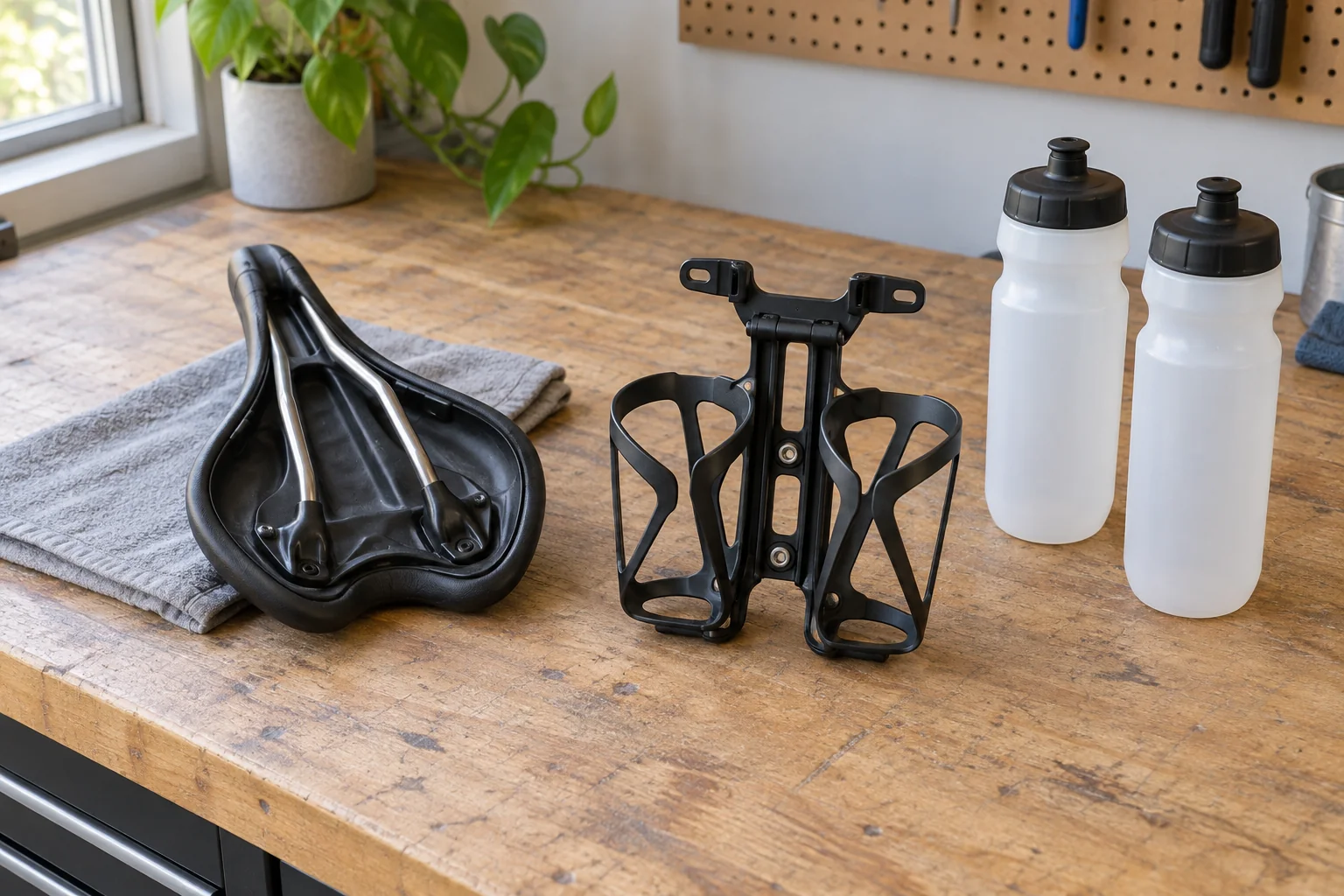
Saddle bottle mount compatibility involves several connections. The mount must suit the saddle attachment, its cages must suit the bottles, and the occupied space behind the saddle must work with the bicycle's existing equipment. Check those relationships separately before ordering a rear hydration setup. A package containing two cages still needs an appropriate place to attach.
The two accessories here differ in what they disclose. One is an Unbranded adjustable saddle adapter described as holding two bottle cages. The other is a VeloChampion 1176 arrangement whose description includes two cages, an alloy mount and explicit saddle exclusions. Neither has been fitted or ridden for this guide. The examples below are hypothetical buying exercises using the stated information.
Start with the saddle attachment system
Identify the actual saddle before considering width. The VeloChampion description excludes I-beam and Brooks saddles. Treat those as exclusions for that offer. If your saddle falls into either description, a favorable width figure does not remove the exclusion. Do not buy it on the assumption that an extra bolt, spacer or improvised clamp will turn an excluded arrangement into an approved one.
A conventional looking saddle also needs its exact attachment information. Use its applicable documentation and the mount's matching drawing to establish which part of the rails the mount uses. The rail spacing, rail profile and usable attachment area are separate details. This article supplies no clamp position or permission to attach hardware to an unspecified rail material or shape.
The VeloChampion 1176 double bottle mount is described for rails up to 7 cm, also written as 2.7 inches. Its description does not supply a lower limit or define the measurement reference points. Retain that qualification when checking the offered version. Ask for its applicable fit diagram before deciding where and how to measure your saddle.
Read the saddle rail width limit with its exclusions
Keep the centimetre and inch wording as the offer states it. The two figures are not an invitation to choose whichever gives you a more favorable result at the edge of a fit range. Establish the exact specification and measuring method for the supplied version. A saddle rail width result is useful only when it describes the same dimension as the applicable limit.
VeloChampion's current double cage mount page separately states a range of 5 to 8 cm and repeats the I-beam and Brooks exclusions. That current page has not been confirmed as the exact 1176 version offered here. Its wider upper figure cannot silently replace the retail offer's 7 cm statement. Resolve the version difference before using either account to approve an installation.
Consider an imaginary rail-width value of 7.5 cm, established using the appropriate diagram. It exceeds the selected offer's stated 7 cm maximum. The fact that 7.5 lies within a separately described current maker range does not settle which version will arrive. Identify the supplied version and its specification before placing the order.
Now consider a hypothetical 6.5 cm value. It is below 7 cm, but that arithmetic addresses only the upper limit. The selected offer gives no lower bound, and its excluded saddle types still matter. A different rail profile or unavailable attachment area would also remain a separate question. Treat that figure as one completed width check while the remaining fit conditions are still open.
Distinguish an adapter from a complete cage package
The Unbranded rear saddle bottle adapter is described as a black aluminum alloy mount for road bikes that holds two bottle cages. The description names adjustable angle and width settings, an included Allen key and bolts. It does not explicitly say that two cages are supplied. Plan the purchase around that missing package detail instead of treating holding capacity as a contents list.
Its adjustable width statement gives no numerical range. The VeloChampion's 7 cm figure therefore supplies no fit limit for this adapter. Before selecting it for an existing saddle, obtain the adapter's own attachment drawing and supported rail information. Adjustable describes a feature; it leaves the extent and conditions of that adjustment to be established.
For the VeloChampion bottle cage package, two lightweight bottle cages and one alloy mount are explicitly listed. Water bottles and a CO2 cartridge are excluded. This makes it a different shopping task from obtaining a bare adapter for cages you already own. Count each item by its role: mount, cages and bottles. A pair of empty cages does not provide the drinking containers.
If you want to reuse existing cages with the Unbranded adapter, confirm the cage-to-mount attachment as its own connection. The supplied bolts do not, by themselves, establish compatibility with every cage you own. Use the actual mounting pattern and fastener requirements specified for both components. No bolt size, thread, torque or replacement hardware is prescribed here.
Check the bottle cage package against your actual bottles
The VeloChampion description says its cages fit most bottles. It supplies no bottle diameter range or retention test for a particular container. Identify the bottles you intend to carry and establish their compatibility with the actual cages. A bottle sold for cycling still has its own shape, height and cap. A general statement about most bottles does not identify every acceptable container.
Separate the bottle's body fit from the room needed to remove it. A container might occupy a cage while its cap or shoulder needs a different path during withdrawal. Check the applicable cage instructions and the space around the proposed position. This is a planning question for the parked bicycle; the guide offers no instruction to reach behind the saddle while riding.
Imagine two bottles you already own, one taller than the other. Their equal labeled capacity would not establish equal external height or the same removal path. Compare the actual containers. If the taller cap would occupy space already used by a saddle bag, that conflict needs a specific solution before purchasing a rear carrier. Adding a second cage does not remove the bag.
Keep any bottle trial within the equipment's instructions after the correct assembly has been established. An empty bottle sitting in an unattached cage on a table is a limited observation. It does not demonstrate retention on a bicycle, behavior over bumps or compatibility with the saddle mount. Those broader claims need their own applicable evidence.
Plan the occupied space behind the saddle
Look at the equipment already using the rear area: for example, a saddle bag or a light attached in that location. Establish how the proposed mount and both bottles would occupy that space. The accessory descriptions do not give a complete mounted envelope for your bicycle. Use the matching dimensions or a qualified fitting assessment instead of taking the cover photograph as a scale drawing.
Include the bottle removal path in the space question. Measuring only the resting outline can miss room needed above or beside a cage. If you use a light behind the saddle, its placement and visibility also need their own check after any equipment change. This article provides no visibility certification or replacement mounting position for that light.
Both product descriptions mention adjustments, but those words do not establish unlimited travel. For the Unbranded adapter the stated adjustments concern angle and width. For VeloChampion the arms move up or down and cage angles can be adjusted. Obtain the actual permitted settings and instructions. Do not assume a photographed angle or a preferred bottle position is an allowed configuration for your saddle.
A simple size sketch can help expose a space conflict before you buy. Draw the existing saddle bag and the intended bottle positions using dimensions that actually belong to those objects. Mark any dimension you do not yet know instead of estimating it from a product photograph. Include the bottle's full height with its cap. The sketch can identify a question for a fitter; it cannot establish an attachment the maker has not permitted.
Consider the everyday task of taking the parked bicycle out of its storage place. If that route passes a narrow shelf, include the proposed occupied width of the bottles in your check. The saddle's own width is a different outline. A rear accessory can require a fresh assessment of the space available around the bicycle even when the original saddle already passes through it comfortably.
A two-bicycle buying exercise
Imagine that Idris wants extra bottle storage for two bicycles. On the first, the saddle is identified as I-beam. For the selected VeloChampion offer, that is already an explicit exclusion. Idris stops that particular match there. The bottle-height question can wait until he has found a mount permitted for that saddle arrangement.
On the second bicycle, suppose the saddle has a rail arrangement that remains a candidate, with a properly identified width of 6.5 cm. Idris still needs the supplied mount version and the rest of the applicable fit details. If he considers the Unbranded adapter instead, he starts with that adapter's own supported range. The measurement remains useful, while the acceptance limit changes with the accessory under consideration.
Suppose he already owns two cages and two bottles. The Unbranded adapter might be worth investigating as a mount for those cages, subject to confirming the interfaces and package. With the VeloChampion package, two cages are already listed. Idris can compare what each purchase would actually add without pretending that owned cages, supplied cages and separate bottles are interchangeable objects.
Finally, imagine a saddle bag on the second bicycle. Idris examines the proposed occupied space and bottle access while the bicycle is parked. If that combination remains unresolved, he has a concrete fit problem to investigate. He needs the space assessment as well as the attachment and package checks.
Use other compatibility examples for the right connection
The bicycle pump valve compatibility guide starts with the connection between the head and the actual valve. A pump that serves the wheel does not establish a rear mount's saddle fit. These are separate accessories on the same bicycle, and each needs its own interface check.
The paper towel refill compatibility guide distinguishes the hardware from the supply it accepts. For this purchase, distinguish the saddle connection, cage attachment and bottle fit. A package count answers how many objects are included. It does not supply the dimensions or permitted combinations for those connections.
Finish the choice of saddle bottle mount compatibility by resolving the actual attachment and the version-specific limits first. Then establish the cages and bottles you will use and the space they need. If the particular combination cannot be confirmed, leave that purchase undecided. A supported fit decision should cover the physical assembly you intend to use.