Crypto Commerce
Roborock Q10 X5+ robot vacuum and mop + vs Shark AV2800ZE: map the rooms, then inspect the dock
Compare Roborock Q10 X5+ robot vacuum and mop by home mapping, no-go controls, carpet handling, dock maintenance, water handling, and obstacle claims.
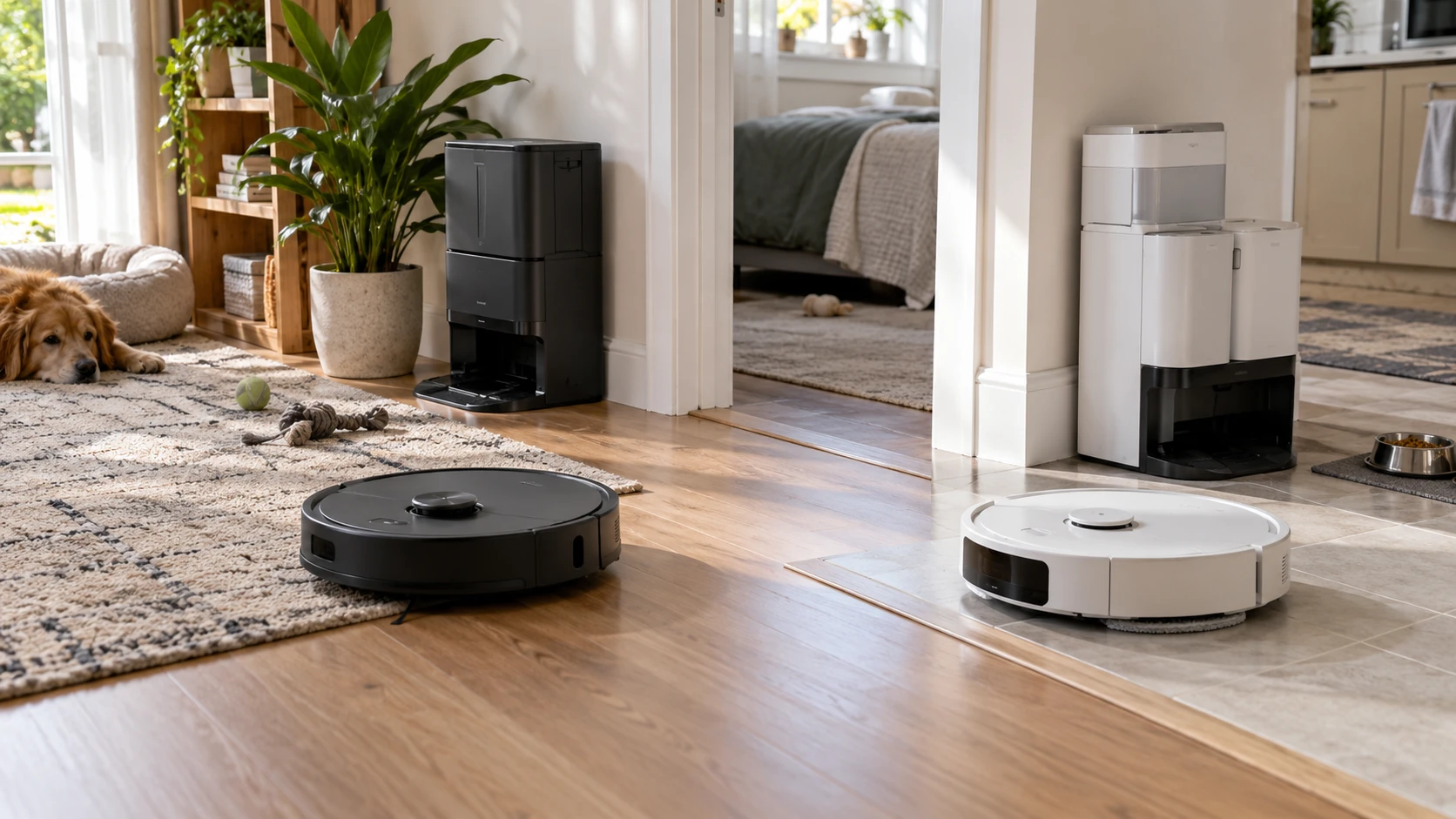
The Roborock Q10 X5+ robot vacuum and mop describes LiDAR mapping, no-go zones, an auto-empty dust dock, and a mop that lifts when carpet is detected. Shark's AV2800ZE combines mapping and no-go zones with a NeverTouch Pro base that also refills water and cleans and dries the mop pad. Both promise less day-to-day floor work. The difference to investigate is which chores move to the dock and how reliably the robot can follow a useful map of this particular home.
These are Republeq's product descriptions, not matched pickup, stain-removal, or navigation tests. They do not give a common battery runtime, dock footprint, or measured pass rate through cluttered rooms. Start with the home's thresholds, rugs, loose cables, pet bowls, and places where the robot should never go. A powerful dock cannot compensate for a map that sends the machine into the wrong room.
Map the places that matter — Shark AV2800ZE robot vacuum and mop
Roborock describes PreciSense LiDAR for mapping and path planning, with app controls for no-go zones and cleaning schedules. Its row also describes structured-light obstacle avoidance for items such as furniture, cables, and shoes. Those systems are useful leads, but the saved description does not establish that every object will be detected at every angle. Pick up items that could tangle, spill, or be damaged, and test the map before running the robot unattended.
Shark lists 360-degree LiDAR, a three-dimensional sensor for obstacle detection, home maps, targeted spots, schedules, and no-go zones. Those overlap with some of Roborock's controls, but the two rows do not show a common app screen or the same map-editing limits. Ask whether multiple maps can be saved, how room boundaries are adjusted, and what happens when furniture moves. The saved descriptions do not answer these questions for either model.
The published guide on robot-vacuum mapping and room controls offers a way to plan those checks. It is general guidance, not a performance receipt for either robot. Draw a simple floor plan with prohibited areas, high-traffic zones, rugs, and a charging location. Use it to compare each app's real controls with the home instead of choosing by the word “LiDAR” alone.
Some homes have more than one floor. Neither saved row provides a clear multilevel-map contract or a safe carry-and-resume procedure. If the robot would be moved upstairs, ask the manufacturer how it handles separate floors and where the dock must be. A single well-mapped living room is different from a house with stairs, closed doors, and seasonal furniture changes. Keep cliff and stair protections in mind even when a listing mentions obstacle sensors.
During initial setup, name the rooms in a way the household will understand months later. Mark an area around pet food, cords, and fragile floor decorations as needed, then run a supervised cleaning cycle. Notice whether either robot divides an open kitchen and living room as expected or treats them as one area. The saved rows do not describe the map editor in enough detail to predict that result. A useful map matches the household's actual cleaning requests.
Consider carpets and thresholds — robot-vacuum mapping and room controls
Roborock says the Q10 X5+ increases suction when it detects carpet and lifts the mop to keep carpet dry. Its row lists adjustable water flow while vacuuming and mopping in one pass. That can reduce the need to divide a mixed-floor room manually, but check the lift height and which carpet types the manual permits. A thick rug may still need a no-mop zone, and the saved row does not quantify how much water reaches its edge.
The Shark AV2800ZE robot vacuum and mop row says its mop pad stays above carpets. It also describes NeverStuck lifting the robot over obstacles and thresholds, with a Republeq's catalog comparison to another Shark model. That comparison does not tell us the maximum threshold height in this home. Measure the raised strips between rooms and ask for the official climbing specification. A robot that must be carried over a doorway cannot follow an automatic whole-floor schedule.
Roborock lists a dual anti-tangle system for hair. Shark emphasizes PowerDetect cleaning technologies for hidden debris, stains, and edges, including extra passes over detected stains. These are different claims in Republeq's catalog; the rows do not provide a matched test with the same pet hair or flooring. If shedding is the main problem, inspect how each brush and wheel can be cleared. If sticky kitchen marks are common, look at pad cleaning and stain coverage rather than assuming a dry vacuum pass will handle them.
Both robots may be able to target particular areas through their apps. That can help when crumbs collect beneath a table while the rest of the home is clean. Try to learn how many taps it takes to send each robot there and whether a room can be excluded temporarily. A no-go zone should be easy to adjust after moving a pet bowl or a child's play mat. The saved rows list the feature but not its daily usability.
Mixed flooring can also change the meaning of a single scheduled run. If a large rug lies across the path to a tiled kitchen, the robot must travel over one surface to reach another. Check whether the app can specify vacuum-only and mop-enabled areas and whether the robot can cross a carpet while carrying a damp pad. The saved Republeq catalog records mention carpet handling, but they do not settle every route through a furnished room. Test the path with rugs and doors in their normal positions.
Look closely at the dock's duties — Shark AV2800ZE robot vacuum and mop
Roborock says its auto-empty dock can hold up to seven weeks of dust. That is a capacity claim, not a promise that every household can leave it untouched for seven weeks. Pet hair, carpet debris, and the size of the cleaned area will change the interval. The saved row does not say that this dock refills water or washes the mop. Ask what the owner must do to prepare, refill, and clean the mopping components after each session.
Shark's NeverTouch Pro base is described as holding debris for up to 60 days, refilling the robot's water tank for up to 30 days, and cleaning and drying the mop pad after each use. Those are more dock tasks in the saved description, but they do not remove the need to empty dirty water, add fresh water, or clean the base itself. Confirm the tank capacities and required consumables for the exact AV2800ZE package. A larger dock may also need a more visible place in the room.
The seven-week and 60-day dust figures should not be compared as controlled endurance results. Neither row gives the same test home or debris load. Ask how the dock signals a full bin or an empty water tank and how messy replacement is. A household with several pets may service either dock more often than the headline interval. A compact apartment with little dust may find both intervals generous.
Plan for the dock's footprint, power outlet, and approach path. A robot should be able to leave and return without a chair leg blocking its ramp. The saved rows do not give dimensions or clearance drawings for either base. Measure the proposed position and inspect the official installation requirements. If the dock is in a hallway, consider whether a person can pass it safely while the robot is charging.
If the Shark dock handles water, think about the distance to a sink and a place to empty dirty liquid. If the Roborock's mop parts require manual attention, make that task equally visible in the plan. A dock hidden deep in a closet may be attractive but awkward to service. Compare the steps after a normal week, not only the hours spent while the robot is moving. The maintenance path may determine whether a scheduled cleaning habit lasts.
Keep the app and maintenance realistic — Shark AV2800ZE robot vacuum and mop
Roborock's saved row says it supports 2.4-gigahertz Wi-Fi only and requires 100 to 120 volts. Verify those specifications for the exact regional model. A home network that broadcasts only a different band could complicate setup. The Shark row does not state a Wi-Fi band or voltage in the saved description. Ask rather than applying Roborock's limits to it. Both app-based maps will need some attention when the home changes.
Pads, brushes, filters, bags, and sensors are recurring maintenance items. Neither saved row lists a complete replacement schedule or total parts cost. Ask for current part numbers and whether the base uses a disposable collection bag. An automatic pad wash can save a task but create another cleaning area that needs wiping. Inspect the dirty-water path before treating “hands free” as a literal description.
The Q10 X5+ is worth investigating when its mapping controls, carpet lift, anti-tangle approach, and auto-empty dust dock fit the home, and the owner is comfortable managing mop water separately. Shark AV2800ZE is worth investigating when automatic water refill and pad cleaning would reduce a frequent chore. Verify maps, thresholds, carpet treatment, dock dimensions, and consumable care with the exact models before believing either routine will run without intervention.