Crypto Commerce
Resenkos 3.2-cubic-foot mini fridge vs WhizMax 4.3 cubic-foot mini fridges for a small room
Compare Resenkos 3.2-cubic-foot mini fridge by listed capacity, door access, shelves, freezer details, temperature claims, energy figures, and saved price.
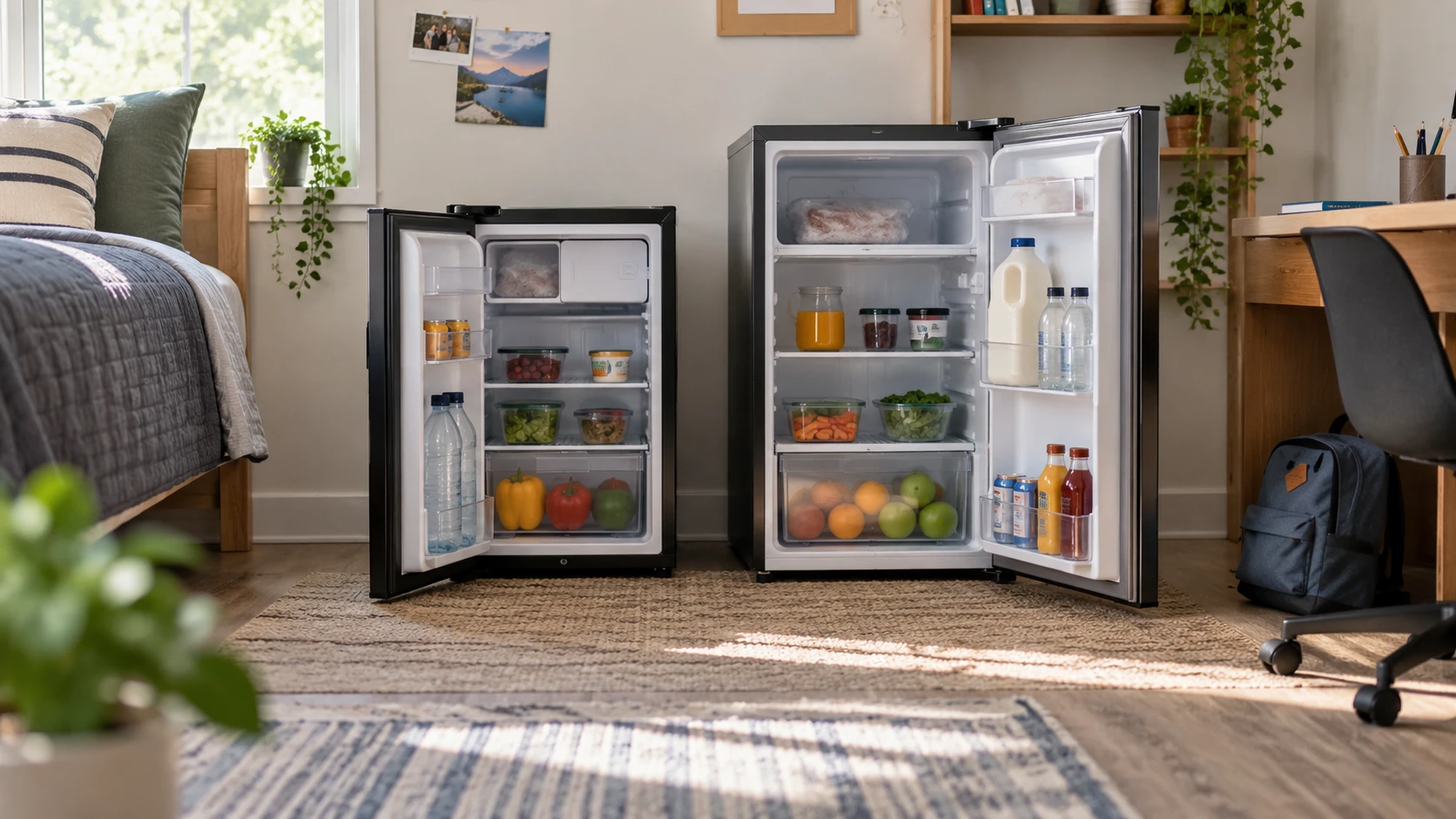
A mini fridge can fail a room before it ever fails to cool. The door opens toward a desk, the freezer gets in the way of a tall bottle, or the cabinet does not leave enough space for ventilation. These two listings make different promises about storage, noise, and temperature, but they do not provide all the measurements needed to settle placement from a product title alone. The Resenkos is listed at 3.2 cubic feet; the WhizMax is listed at 4.3 cubic feet. Both mention a freezer and a reversible door. Start with what must fit inside, then measure the place the fridge will occupy.
The saved September 30, 2026 catalog snapshot put the Resenkos 3.2-cubic-foot mini fridge at $245.10 and the WhizMax 4.3-cubic-foot model at $399.99. That is a $154.89 difference in the snapshot; the live offer may have changed. Extra nominal capacity can be useful, but it is worth paying for only if the shelves, freezer space, door clearance, and electrical requirements work for the buyer's real room.
Capacity is a starting point, not a floor plan — WhizMax 4.3-cubic-foot mini fridge
WhizMax advertises 4.3 cubic feet, a separate freezer compartment, a crisper drawer, and removable shelves. Resenkos advertises 3.2 cubic feet, multiple compartments, and adjustable shelves; its title mentions a freezer and a shelf. The saved Resenkos description does not specify the freezer's internal size or clearly show how its total capacity is divided. Neither listing gives usable shelf dimensions in the text available here. A 1.1-cubic-foot difference in headline volume cannot tell you whether a specific carton, meal container, or tray fits.
Make a short inventory before choosing: the tallest bottle, a typical lunch box, any freezer item, and any wide container that cannot be turned sideways. Compare their dimensions with a diagram or a listed by Republeq interior measurement, including space lost to shelves or a freezer enclosure. Removable and adjustable shelves may help, but they do not erase a fixed freezer unit or door-bin shape. If the refrigerator is for a shared office, test the mix of items that will actually arrive together rather than an empty-cabinet volume figure.
The WhizMax crisper drawer may make produce easier to separate from drinks and containers. The Resenkos listing describes adjustable storage but does not specify a drawer. Someone who rarely stores produce may prefer open shelf space; someone who keeps fruit or vegetables in the room may value the division. Ask whether either drawer or shelf can be removed for cleaning and whether its removal changes the practical usable space. This matters more than whether a product description calls the interior “spacious.”
Both listings mention a freezer. That word alone does not tell you how cold the compartment gets, whether it holds a specific package, or how much of the headline capacity it consumes. If frozen food is central to the purchase, request the freezer dimensions and temperature specification for the exact model. If it is only for occasional small items, check whether its location blocks the refrigerated shelf you need most. Do not treat a compact freezer mention as a promise of full-size freezer performance.
Door access can decide the room layout — guide to checking compact-refrigerator door access before choosing
Resenkos says its door is reversible and opens through 180 degrees. It also lists adjustable feet. WhizMax says its single door is reversible. A reversible hinge can help in a narrow room, but the saved descriptions do not tell us the clearance required behind, beside, and in front of each cabinet after a hinge change. The 180-degree claim is useful only if the intended wall and furniture allow the door to swing that far. Check the hinge orientation delivered and whether the Republeq's catalog permits or supports switching it.
Tape the intended footprint on the floor, then draw the door's swing in both possible directions. Include any handle, door bin, or nearby table that may obstruct access. Leave a route for cleaning and for taking out shelves. A fridge that fits between a bed and desk while closed may be unusable once a door opens. The guide to checking compact-refrigerator door access before choosing gives a related placement framework. It discusses door clearance generally and does not verify either model's dimensions, so get those measurements from the exact listings or Republeq's catalog.
Neither saved description supplies exterior width, depth, height, or required ventilation clearance. The WhizMax description calls the cabinet compact, but that is not a measurement. Confirm all exterior dimensions and the maker's placement instructions before ordering for a dorm alcove, closet-like niche, RV, or tight office corner. Add space for the power cord and an accessible outlet. Avoid using an enclosure that the instructions do not permit, even if a tape measure says the cabinet itself can slide in.
Temperature claims need a thermometer — WhizMax 4.3-cubic-foot mini fridge
WhizMax lists an adjustable thermostat with seven settings and a stated range of 32°F to 46.4°F. Resenkos lists an adjustable thermostat without a numeric range. A dial setting is not the same as a measured temperature at the food, and a published range may depend on ambient conditions and test setup. If the fridge will hold perishable food, use a refrigerator thermometer and follow current food-safety guidance for the stored items. Check the actual interior after the unit has stabilized, then revisit it when the room gets warmer or the cabinet is more full.
The upper end of WhizMax's stated range is a reason to pay attention to the chosen setting and the actual reading. It would be unwise to assume that all seven settings are suitable for every kind of food. The saved Resenkos description gives even less numeric guidance, so a thermometer is especially useful there. In either unit, keep airflow paths clear and avoid loading warm items so densely that cooling takes longer than expected. The maker's manual should define the controls and the steps to take after delivery.
Resenkos explicitly describes a manual defrost system. That means the buyer should understand how to shut down, empty, and clean the freezer area when frost accumulates, following the maker's procedure. WhizMax's short description does not state a defrost method. Ask before ordering if the maintenance schedule matters. A freezer that needs occasional hands-on care may be fine in a dorm, but not if the owner will be away for long stretches or cannot empty it easily. Keep the door seal and the drain or interior surfaces in the cleaning plan too.
Neither listing provides a measured recovery time after a power interruption or a detailed food-temperature chart. If power reliability is a concern, determine how the unit restarts and what happens to the thermostat setting after an outage. Place a thermometer where it can be read easily. Use the food-safety guidance appropriate to an outage rather than trusting that a closed door alone guarantees the contents stayed cold enough.
Noise and energy information are uneven — WhizMax 4.3-cubic-foot mini fridge
WhizMax claims operation at 40 dB and estimated consumption of 0.5 kWh per day. At that stated daily figure, thirty days would be about 15 kWh, before applying a local electricity rate. The listing does not give the test conditions for either number, and actual electricity use can change with room temperature, door openings, and thermostat setting. Resenkos calls its compressor low-noise and energy-efficient but supplies no numeric sound or energy figure in the saved description. Those adjectives cannot support a precise running-cost comparison.
If the cabinet will stand near a bed or work desk, listen for compressor starts and cabinet vibration, not only the steady sound level. A published decibel figure can help, yet the way the fridge sits on a floor or against furniture affects what a person hears. Resenkos lists adjustable feet, which may help level the unit according to instructions; it does not guarantee silence. Check the permitted leveling and ventilation steps for either model. A long trial in the actual room is better evidence of sleep or work comfort than a word like “quiet.”
WhizMax identifies R600a refrigerant. That information is useful for a service professional and for following the manufacturer's handling instructions. It is not a reason to improvise repairs or change the ventilation requirements. Resenkos does not name a refrigerant in the saved text. If that specification matters to a building policy or service plan, request the model label or manual. Avoid treating different levels of listing detail as proof that one cabinet is inherently more durable or efficient.
Compare the full cost of the space — WhizMax 4.3-cubic-foot mini fridge
The Resenkos saved price is lower by $154.89 and its 3.2-cubic-foot capacity may be enough for a few regular items. The WhizMax listing gives more nominal space, a separate freezer compartment, a crisper drawer, and explicit temperature, noise, and energy figures. These details can justify looking closer at the larger unit, but they do not prove its interior arrangement will solve a particular storage problem. Measure the opening, draw the door swing, and find the internal dimensions before turning the price difference into a recommendation.
Check delivery and return terms for either appliance. A fridge that arrives damaged or does not fit is awkward to move back out of a tight room. Inspect the door seal, shelves, and freezer area on arrival, then run the unit according to the manual and verify the temperature with a thermometer. Record any condition problem during the return window. If the room has building rules about appliances, confirm those before purchase as well.
Review the WhizMax 4.3-cubic-foot mini fridge listing for its current configuration and price. It offers more listed capacity, while the Resenkos offers a smaller, lower-priced alternative with an explicit manual-defrost description. The stronger choice is the one whose actual shelves, door swing, temperature, and maintenance routine fit the room and the food you plan to store.