Writing & Documents
Keeping a requested name beside an earlier letter
Lena asks Mira to use her current name. During their invented visit, an earlier letter remains signed Elena, without changing the person or rewriting the letter.
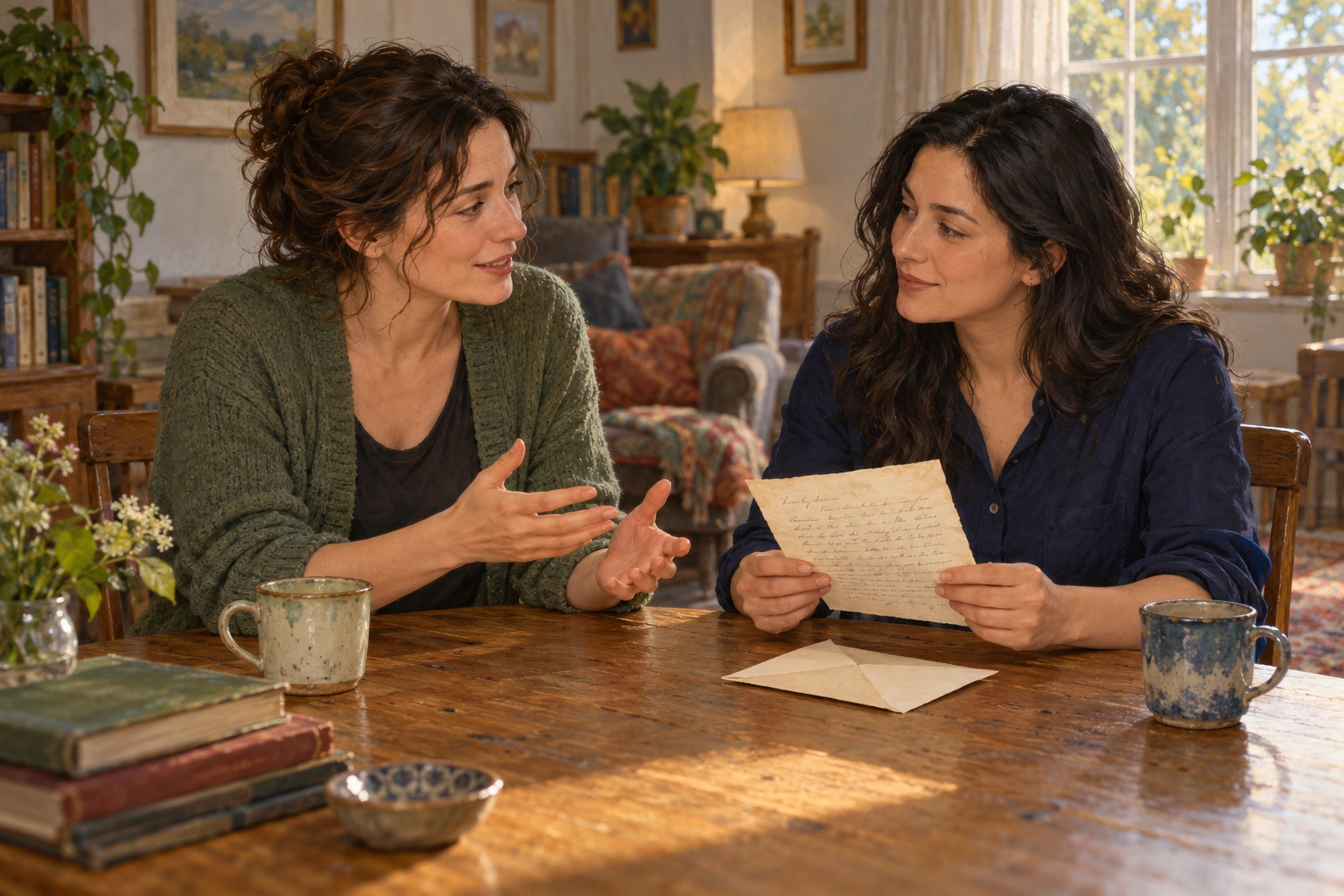
This original visit brings a requested name into a conversation between two invented adult friends. Lena, who previously used Elena, asks Mira to call her Lena now. They are the same person. An earlier letter in the room was actually written and signed Elena; its signature is not a drafting mistake.
The scene makes no claim about a real correspondent or a legal change of name. Lena’s request and Mira’s response belong to these particular characters. Their earlier letter remains an earlier letter, while the conversation continues with the name Lena has just requested.
The visitor at the door
Mira had left the door open while carrying a small chair from the passage. The chair caught against the corner of the rug, and she had to put it down before she could turn it. From the landing came a familiar voice asking whether she needed another pair of hands. Mira looked up and saw her friend holding the door clear of the chair’s back.
“Elena, come in,” she said. “I thought you would be later.” Her friend stepped inside and waited while Mira moved the chair against the wall. She put her coat over its back, then touched the edge of the rug with one shoe until it lay flat again. Mira stood beside the open door, still holding its handle although there was no longer anything to carry through it.
“Before we sit down,” her friend said, “could you call me Lena now?” She spoke quietly enough that Mira closed the door before answering. “Lena,” Mira said. “Yes.” There was no third person on the landing and no second visitor waiting to be introduced. The woman taking off her coat was the same friend Mira had greeted. She had asked for a different present form of address.
Mira pointed toward the room at the end of the passage. “There’s more space in there, Lena.” Lena lifted her bag from the floor and followed her. The room had a small wood table, two chairs and a low shelf beneath the window. A drawer stood open under the table. Mira had been sorting the things inside it before she heard the chair catch on the rug.
The letter beside the drawer
A folded cream sheet lay beside an empty envelope. Lena noticed the envelope first because its flap had been tucked inside rather than sealed. Mira had found it beneath a sheaf of old shopping lists. She had taken it out to read, then left it on the table when she went to move the chair. Now she drew the open drawer closed so Lena could sit without knocking her knee against it.
“Is that mine?” Lena asked. Mira turned the envelope toward her. There was no address on the outside, only Mira’s name in a slanting hand. “You brought it round,” Mira said. “I kept putting it back in the drawer.” Lena laid her bag beside the chair and bent closer. She had written the letter in this invented past, before she began asking Mira to use Lena.
“May I open it?” Mira asked, although the sheet was already folded beside the envelope. “Of course.” Lena drew her chair a little nearer the table. Mira picked up the letter and opened its two folds. The final line carried Elena. She did not rub at the name, cross it through or reach for a pen. The paper held the signature its writer had actually put there.
Lena looked at the bottom of the page. “That is how I signed it,” she said. Mira rested the lower edge of the sheet on the table. “I remember getting it.” She had not answered the present request by proposing to alter an old piece of handwriting. The two women were looking at a letter that already existed in their fictional history, with its actual words still on it.
The earlier words on the sheet
Dear Mira,
I have brought back the blue bowl. The little cloth inside it is yours too; I found it under the bag after I got home. Thank you for the afternoon. I was glad we stayed at the table after everyone else had gone. Next time I will bring the cake I told you about, if you still want to try it.
Elena
That is the complete original letter supplied for this scene. It reports no actual borrowed bowl and quotes no real private message. Its writer’s earlier signature remains Elena. The current visitor is Lena, explicitly the same invented person. Mira can read the earlier name as part of what was written without turning it into a new request about what to call her friend today.
“I never brought the cake,” Lena said. Mira glanced up from the page. “You brought pears instead.” Lena laughed and pulled the other chair slightly away from the window. Mira remembered the pears in a shallow dish and the awkward way she had tried to divide the last one. She did not remember what either of them had said while doing it. She let that part of the afternoon stay outside her account.
“The bowl was on that shelf for ages,” Mira said. She nodded toward the space under the window. A stack of plain dishes stood there now. Lena followed her glance, then looked back at the folded sheet. Neither woman went to search the shelf for proof. Their conversation had reached the old bowl through the letter, and for the moment they were content to leave the bowl in the afternoon they were remembering.
The name used in the room
Mira put the letter down beside its envelope. “Would you like the window open, Lena?” she asked. Lena shook her head. “Just the curtain back a little.” Mira moved the curtain clear of the chair and sat down again. The new address appeared in a small question about the room. She did not stop the visit to make her friend repeat the request or explain why the letter had another signature.
For a while they talked about the view from the window. A branch was close enough to the glass that one leaf kept touching it. Lena could see the touch from her chair; Mira could only see the branch moving. She leaned to one side until she caught the leaf against the pale sky. “There,” Lena said, pointing. Mira sat back before the movement happened again.
“Lena, can you pass me the envelope?” Mira asked. It was nearer her friend’s hand. Lena slid it across the table, keeping it clear of the open sheet. Mira flattened the tucked flap with one finger, then stopped. She wanted to put the letter away as she had found it. The envelope did not need a new address or a new inscription for that. She left the outside with the single word Mira.
Lena picked up the sheet while Mira held the envelope open. She followed the existing folds and handed it back. The final signature went inside with the rest of the letter. It had not become an instruction to speak the old name across the table. Nor had the current request made the earlier signature a word that Mira must pretend had never been written. She put the envelope down between them.
A place for the old letter
The drawer was full enough that Mira had to move a thick notebook before she could return the envelope. Lena watched her lift the notebook onto the table. A loose list slipped out, and Mira caught it against her sleeve. She put the list back between two pages without reading it aloud. Then she found a shallow space at the side of the drawer where the envelope could lie flat.
“You don’t have to keep it there,” Lena said. “I know,” Mira replied. “I want to.” She put it in the space she had found, with the flap facing up. The choice was Mira’s in this particular room. Lena did not ask for the letter back, and Mira did not turn keeping it into a promise about every old message she might find. This was the cream sheet they had just read together.
When the drawer closed, the table looked larger. Lena rested her hands where the envelope had been. Mira moved the notebook onto the low shelf and came back to her chair. “Now,” she said, “tell me about the journey here.” Lena began with the wrong turning she had taken after leaving the bus. The conversation moved into a new account, spoken by the visitor already sitting in the room.
Keep the retail accounts separate
The nonbranded round tablecloth account mentions morxilaw and BalsaCircle. Its eight gallery images show white cloths draped over tables and close views of hems and folds. Plates, tumblers, a vase and flowers are staging. These distinct labels are not authenticated or merged; no material, quantity, washing or performance result is verified here.
The YIDOADFEAP round cover account has six gallery images, including a printed pack band and event settings. Tableware, balloons, gifts and refreshments are not established supplied goods. Promotional safety, durability and fit claims are not adopted. Neither retail account identifies the table or objects in Mira and Lena’s invented visit.
Leave neighboring scenes with their own decisions
The different-tastes music scene lets Cora stop enjoying an invented song while Leon still enjoys it. Their earlier shared enjoyment remains true. Lena’s visit instead includes an explicit request about present address and an actual earlier signed artifact; neither friend is comparing current tastes.
The character-reference repair exercise corrects an accidentally written Etta to the intended Alina in an authored scene. Lena’s request repairs no mistaken manuscript name. The earlier Elena signature was intended when written, and the current visitor is explicitly that same person.
By the time Lena finished the story of the wrong turning, the leaf had stopped touching the window. Mira noticed its stillness while Lena looked for her bag. There was no new arrangement to make about the drawer. The old letter was inside its envelope, exactly as they had folded it. Mira brought the coat from the passage and held it while her friend slipped one arm into a sleeve.
At the door, Mira said, “Goodbye, Lena.” Lena turned back long enough to answer, then stepped onto the landing. Mira waited until she heard the outside door close before returning to the room. She pushed the chair nearer the table and left the curtain where Lena had asked her to put it. The letter stayed in the drawer with its earlier signature. The name she had just spoken belonged to the friend who had visited today.
If you plan to purchase an item on republeq.com, check the particular offer and current checkout before ordering. This guide does not establish that any cryptocurrency payment option is available. If USDT is offered for the intended order, verify the requested asset, network, amount, receiving destination and order reference with the responsible service before authorizing a transfer. Review the actual product identity, selected variant, quantity, delivery details, total charge and applicable terms. Use the confirmed order details when checking the payment instructions. Confirm any fee, conversion term or exchange rate from the current transaction information. Determine the applicable cancellation, return and refund process, including how a refund would be handled for the selected payment method. Keep the relevant instructions and transaction records, with dates and confirmed references. If essential instructions change, ask the responsible service to confirm the change against the exact order. An acknowledgement should identify the order and the agreed details; it does not replace checking whether the selected product is the one you intended to buy. If payment or order status remains uncertain, reconcile that status before considering another transfer. Do not treat an unresolved transaction as evidence that nothing happened. This article supplies no wallet address, transfer guarantee, recovery procedure or assessment of a counterparty. A product enquiry does not authorize a payment or resolve an uncertain order. If support provides an answer, retain the exact question and response so a later reviewer can understand what was confirmed. Decide whether to proceed only when the conditions of the particular transaction are clear, and retain the confirmed transaction information with the exact order.