Crypto Commerce
Read replacement part numbers before choosing an appliance part
A replacement listing can name a part, say which older numbers it replaces, and still leave unanswered whether it fits your appliance. Read replacement part numbers by separating those claims. Identify the number being offered, preserve the replacement references exactly, and look for evidence connecting that part to your appliance's complete model identity. A familiar component name or an OEM description does not supply that missing connection.
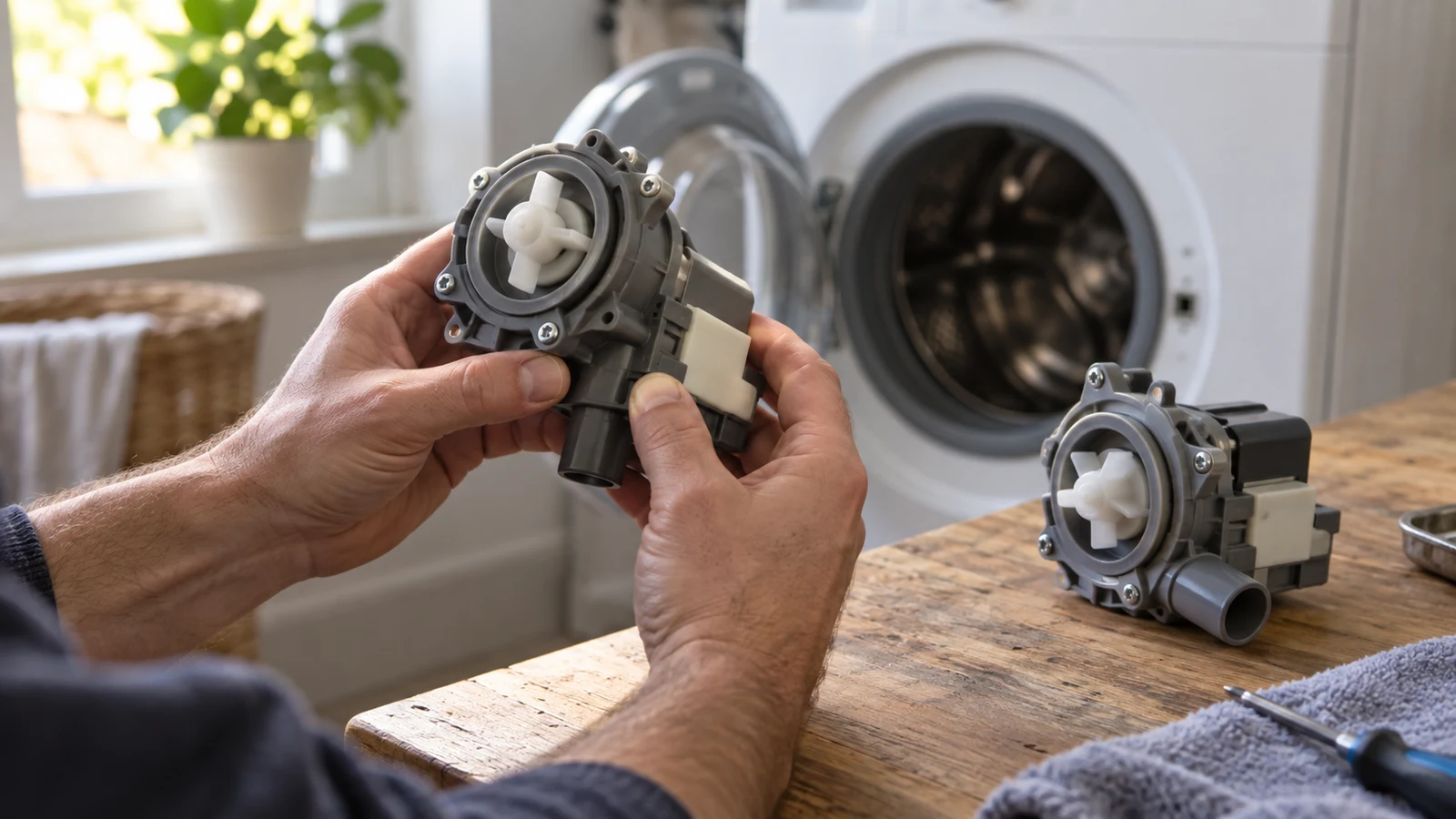
A replacement listing can name a part, say which older numbers it replaces, and still leave unanswered whether it fits your appliance. Read replacement part numbers by separating those claims. Identify the number being offered, preserve the replacement references exactly, and look for evidence connecting that part to your appliance's complete model identity. A familiar component name or an OEM description does not supply that missing connection.
The Frigidaire motor and GE damper listings below illustrate different amounts of information. One supplies an explicit replacement list; the other identifies a manufacturer and component without naming compatible appliance models. Neither description, by itself, answers a fit question for an appliance you have not identified. The useful outcome is a precise inquiry about the proposed part, rather than an order based on resemblance.
Record The Appliance Identity For Appliance Installation Readiness
Start with information you already have: the appliance's manufacturer and complete model identifier, plus any component number documented in paperwork or a previous professional assessment. Keep the appliance identity separate from the part identity. A model number tells the person reviewing your question which appliance you mean; the proposed ordering number tells them which component you are considering.
Use existing records or an accessible label that you can read without opening equipment. This is a listing-reading exercise, not a reason to remove a cover or reach into an appliance. If the necessary identity is unavailable, describe what is missing. A guessed model suffix makes the question look more complete while leaving the central uncertainty unresolved.
Record where each identifier came from. For example, distinguish a number copied from appliance paperwork from a number found in a product description. If a service document names a component, retain its wording alongside the number instead of replacing it with the listing's wording. Keeping both versions lets someone assess whether they refer to the same item without first untangling your notes.
A short record can use separate lines for the appliance manufacturer, complete appliance model, documented component description, documented part number, and proposed ordering number. Leave an unknown field explicitly unknown. You do not need a polished spreadsheet; you need enough separation that a number found in a search result does not accidentally become the number supposedly documented for your appliance.
For a concrete example of replacement part numbers, the Frigidaire Dryer Drum Drive Motor listing identifies 5304529782 as its part number. Its supplied description states that this number replaces 134693300, 134693301, 134693302, 5304510568, and 7137115900. Read 5304529782 as the ordering identity presented in this listing, with the other numbers recorded separately as its stated replacement references.
The distinction matters when explaining what you intend to buy. If your existing paperwork says 134693301, do not overwrite that entry with 5304529782 merely because you found it in this listing. Keep the documented number, then add that the proposed product description names it among the references being replaced. That preserves both the original evidence and the listing's claim.
Read the Frigidaire description as separate fields:
- Listed product name: Frigidaire Dryer Drum Drive Motor.
- Part number offered in the listing: 5304529782.
- Numbers the description says it replaces: 134693300, 134693301, 134693302, 5304510568, and 7137115900.
- Origin wording used by the description: Genuine OEM Part.
- Information absent from the supplied description: a list of compatible appliance models.
Those fields support different statements. The product name identifies the kind of component being advertised. The ordering number identifies the listed part. The replacement references describe a stated relationship with other numbers. The OEM wording is the listing's description of origin, not an independent authentication here and not a statement that the motor fits every appliance carrying a particular brand.
The word "replaces" also has a direction. Here, the description puts 5304529782 in the replacement role and names the other references after it. That does not establish the reverse claim that an older referenced part can replace 5304529782. Nor does it establish that any two numbers in the older list can substitute for each other in every appliance.
Suppose your paperwork names 134693300. The supplied description gives you a specific relationship to ask about: whether the listed 5304529782 is suitable for the exact appliance identified in that paperwork. It does not give you permission to select 134693302 instead because both numbers appear in the same sentence. Shared membership in this replacement list is not a separate compatibility statement between those references.
Keep the scope of a match equally narrow. Finding your documented number in the list establishes that the description mentions it. It does not resolve whether the paperwork belongs to your appliance, whether the component was correctly identified, or whether replacement is needed. Those are separate questions. This article does not diagnose a fault or recommend either component as a repair.
Read What The GE WR09X10173 Damper Assembly Description Establishes
The listing for the GE WR09X10173 damper assembly supplies a different set of details. Its description names the manufacturer as GE, General Electric; gives the part number WR09X10173; and calls the component an Assembly Cover Motor Damper. It also describes the item as a Genuine OEM Part. The supplied description does not name compatible appliance models or provide replacement references.
That shorter description is not evidence of incompatibility. It leaves compatibility unanswered. Equally, the absence of a replacement list does not authorize you to construct one from similar search results. Record WR09X10173 as the proposed part and retain the full component description. Then ask for the information connecting that exact identifier to the intended appliance.
The two listings are useful together because they show why a longer description and a shorter one require different follow-up questions. For the Frigidaire listing, you can point to an explicit replacement reference and ask whether that relationship applies to your appliance. For the GE listing, the supplied text provides no such reference to cite. Your inquiry must start with the listed part identity and the appliance model.
Do not treat the motor and damper as competing repair choices. Their purpose here is to illustrate how to read listing claims. A component description should remain attached to its own number throughout your notes. Moving a number under another component name, even accidentally, creates a question that no longer accurately represents either supplied listing.
The phrase "Genuine OEM Part" should remain attributed to each description. It is not an answer to "Does this fit my model?" A response that repeats the OEM wording without addressing the appliance identity still leaves your original question open. Ask for the basis of the fit statement, rather than treating a repeated product description as additional evidence.
Resolve The Fit Question Before Appliance Installation Readiness
Before preparing an inquiry, compare each identifier with its original source character by character. Preserve leading zeros, letters, suffixes, punctuation, and original spelling. Do not shorten WR09X10173 or silently change an uncertain character to make it resemble a search result. If the source is unclear, retain the uncertainty instead of converting a possible reading into an asserted match.
A close-looking identifier is a lead to investigate, not a confirmed alternative. Likewise, a matching component name does not fill a gap in the number. If your paperwork and a listing disagree, put both exact versions in the inquiry and state where each came from. That lets the recipient address the discrepancy directly rather than answer a simplified question that conceals it.
Ask a manufacturer, seller, or qualified service professional who can address the fit question for the identified appliance. This is a suggested inquiry, not a claim that a particular support service is available or will provide confirmation. Include only information relevant to the part relationship. There is no need to introduce payment details when the unresolved issue is which component belongs in the appliance.
For the Frigidaire example, adapt the following wording only if the documented number actually matches your records:
My appliance manufacturer and complete model are [manufacturer and model]. My existing [document or record] identifies the component as [exact description] with part number 134693301. The Frigidaire Dryer Drum Drive Motor listing identifies 5304529782 and says it replaces 134693301. Does that replacement relationship apply to this exact appliance model? Please identify the compatibility reference supporting the answer and any additional appliance information needed to determine fit.
For the GE example, replace the middle of that inquiry with the proposed number WR09X10173 and the description Assembly Cover Motor Damper. State that the product description you are using does not name compatible appliance models. Ask whether this exact part fits your complete appliance model and what reference supports that conclusion. Do not insert an older number unless you have a source for it.
Evaluate the reply against the question you sent. Does it address your complete model identifier and the exact proposed part, or does it merely repeat the brand and component name? If it supplies another number, preserve that number separately and ask how it relates to the proposed order. A changed identifier deserves an explanation before it becomes the item you purchase.
A bounded answer can also leave a decision pending. If the respondent needs information you do not have, retain that request rather than treating the exchange as confirmation. If the response addresses only the product's identity, the appliance-fit question remains open. You can pause that candidate without deciding that the listing is wrong or that the part cannot fit.
Once suitability is established for your intended appliance, purchase planning and repair planning still deserve separate attention. The related guide to appliance installation readiness addresses broader arrangements for making an appliance usable. It is not a compatibility reference for either component and should not be treated as a repair manual. A confirmed ordering number does not establish who should carry out any necessary work.
If cryptocurrency payment is offered for the intended purchase, consider it only after settling product identity and fit. Acceptance of a payment method does not establish suitability, and completing payment supplies no missing compatibility evidence. Nothing in these examples establishes checkout availability, price, stock, warranty eligibility, or return rights for a future order.
Before choosing the part, keep the complete appliance model beside the documented component number, the exact proposed ordering number, and the answer supporting fit. Use replacement part numbers to formulate that specific question, preserving what each listing actually says. Proceed with the candidate only when the answer connects the intended appliance to the intended part; otherwise, keep the unresolved identifier in the inquiry rather than turning it into an order.