Educational & Explainer Articles
Refractor and reflector telescopes: where the light goes
Understand the main lens or mirror, aperture, focal length and eyepiece figures using the actual SVBONY SV503 80ED and Gskyer reflector offers.
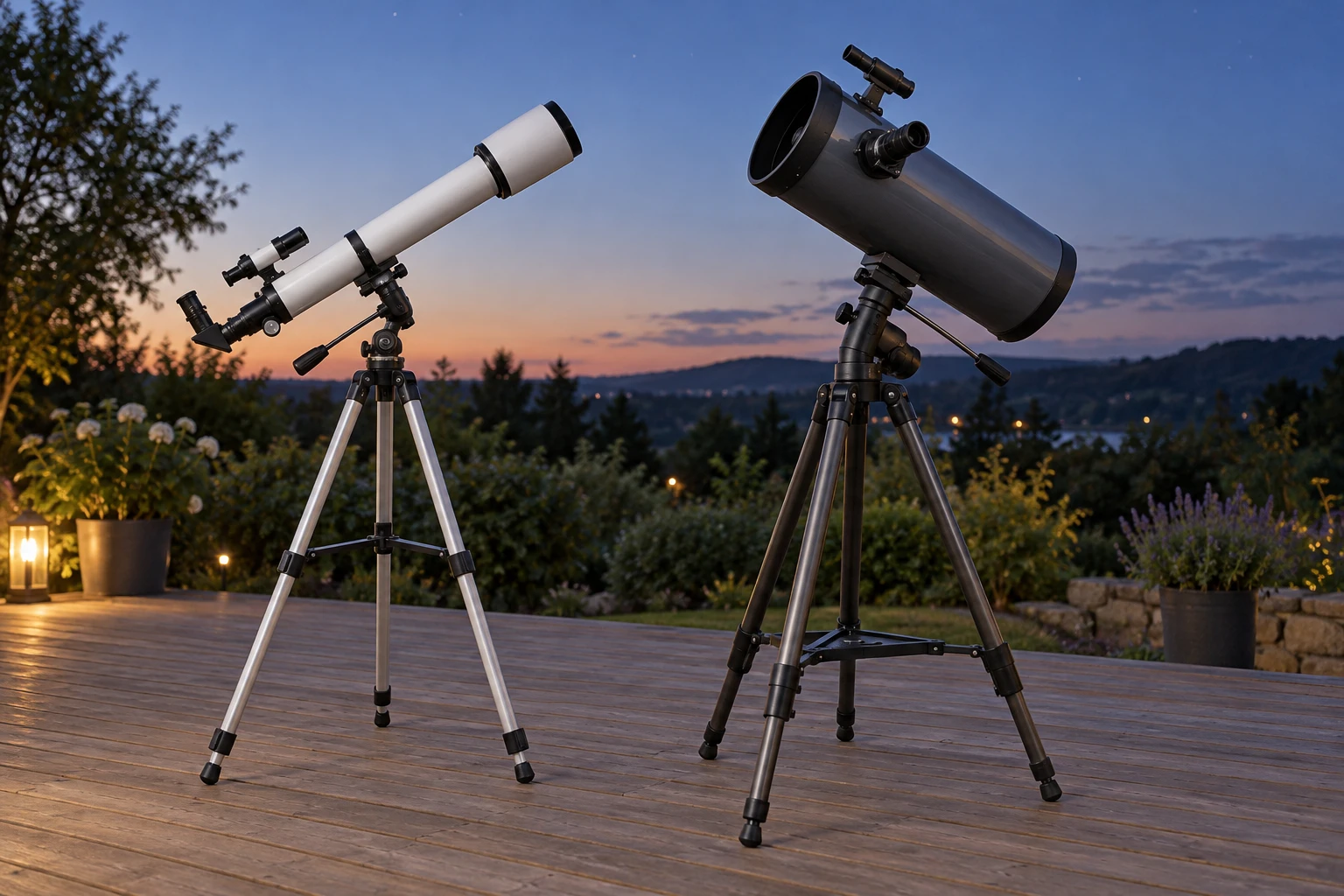
Refractor and reflector telescopes collect light with different main optical elements. A refractor uses a lens; a reflector uses a mirror. Begin with that distinction when reading the optical design, then consider the support equipment and magnification figures. Follow the light-collecting element first, then read the aperture, focal length and eyepiece figures as separate parts of the description.
The examples here are an SVBONY SV503 80ED optical tube and a Gskyer 130 mm reflector offer. Their descriptions show how the optical terms appear in actual offers. Use the explanation to understand those product terms. Assembly, alignment, pointing and observing procedures belong to the applicable equipment instructions.
The main lens or mirror gathers the light
NASA's telescope overview explains that astronomical telescopes gather and focus light with lenses and mirrors. In a refractor, light passes through the main lens and changes direction through refraction. The lens helps bring the incoming light together. The main light-collecting lens is therefore central to the instrument's identity as a refractor.
In a reflector, the main optical element sends light back by reflection. Its curved surface brings the light toward a focus. A reflecting telescope can include other optical parts as well. Calling the instrument a reflector identifies its principal collecting element; it does not say that every component inside it is a mirror.
The same distinction helps with photographs in an offer. A long tube is an enclosure, while the main lens or mirror performs the light-collecting work. A tripod supports equipment. These objects have different jobs even when a product photograph presents them as one complete arrangement. Read the optical design and the support description separately.
Telescope aperture and focal length describe different things
The phrase telescope aperture and focal length brings together two measurements that answer different questions. Aperture concerns the size of the main collecting optic. Focal length concerns the optical system's focus. NASA explains that a larger main lens or mirror collects more light. An eyepiece's magnification number describes another relationship further along the viewing system.
Keep the unit next to the quantity when reading specifications. An aperture expressed in millimetres is not a count of magnification. A focal length expressed in millimetres is not necessarily the outside length of the tube. A product's assembled height describes its physical arrangement rather than either optical measurement.
For a useful first reading, put each figure under its own name. Write aperture, telescope focal length, eyepiece focal length and physical dimensions on separate lines. Without the labels, it is easy to compare numbers that describe different things. With the labels attached, a shorter eyepiece focal length and a shorter tube length remain visibly different statements.
The SV503 80ED is a refractor optical tube
Think of the main optic and the eyepiece as doing successive jobs. The objective gathers light and forms the image that the viewing system presents; the eyepiece magnifies that image for the observer. An eyepiece is therefore more than a convenient place to put an eye, but it also cannot replace the objective's collecting area. Keeping the two roles separate explains why their specifications have different consequences.
This is useful when a product description devotes several lines to eyepieces. Three supplied eyepieces mean three listed viewing options, while the main collecting optic still has one stated aperture. A tube sold as an OTA may need other items for the intended arrangement. Read its supplied-contents statement alongside the optics description so you understand both the instrument and the equipment being offered.
The selected SVBONY SV503 80ED offer describes an optical tube assembly, or OTA, with extra-low-dispersion glass and a focal length of 560 mm. Its native account also names a dual-speed two-inch rack-and-pinion focuser with a one-to-ten gear ratio. Those are descriptions of the offered tube and its focusing mechanism.
SVBONY's own 80ED product page identifies an 80 mm f/7 doublet refractor. Doublet describes a two-element objective arrangement. The page names an extra-low-dispersion element and promotes its colour correction. Treat the advertised image quality as the manufacturer's claim. The useful design fact here is that this model gathers incoming light through an objective lens.
The merchant's short native account also carries small dimensions under its Telescope Accessories presentation. Those figures should not be substituted for the manufacturer's 80 mm optical designation or treated as an explanation of the entire tube's size. If overall dimensions matter for storage or mounting, obtain the actual item dimensions for this offer before ordering.
The Gskyer offer describes a reflector and eyepieces
The selected Gskyer 130 mm reflector offer describes a 5.1-inch aperture, an f/5 focal ratio and a short optical tube. Its native account lists three eyepieces: 25 mm at 26 times magnification, 10 mm at 65 times and 5 mm at 130 times. These are three configurations of one telescope, rather than three aperture sizes.
The description also mentions a tripod and remote control. Those supplied-item statements belong to this Gskyer offer. They do not become part of the SVBONY optical-tube package merely because both products are telescopes. A reader comparing a tube assembly with an offer containing support equipment needs to keep the optical design and the supplied components in separate columns.
The reflector label tells you to look for the mirror-based collecting system when reading the applicable optical diagram. It does not identify a particular space telescope's arrangement. NASA's Hubble explanation, for example, concerns Hubble's own primary and secondary mirrors. Its detailed route through the instrument should not be copied onto an unrelated consumer telescope without that model's diagram.
Focal ratio connects two optical measurements
A focal ratio expresses telescope focal length divided by aperture, with both measurements in the same unit. Celestron's explanation of f-numbers gives that relationship explicitly. The f-number therefore connects two optical measurements; it is neither the overall product height nor a second name for eyepiece magnification.
The manufacturer's SV503 80ED designation gives an example: 560 mm divided by 80 mm is seven, corresponding to f/7. This arithmetic explains the stated ratio. It does not add a new accessory, change the offered package or measure the quality of a particular delivered instrument. The numerator and denominator must come from the same optical configuration.
Likewise, the Gskyer offer's f/5 describes a ratio. Reading f/5 beside f/7 does not by itself select the more suitable telescope for a person. Aperture, focal length, equipment supplied and the intended use still describe different parts of the choice. Start by understanding which quantities produced each label before considering what equipment a task requires.
The eyepiece helps set magnification
Celestron explains visual magnification as telescope focal length divided by eyepiece focal length. A telescope can therefore have several magnifications when used with different eyepieces. The main collecting optic has not become wider just because the eyepiece changes. This is why the eyepiece's millimetre figure needs its own line in a specification.
The Gskyer account illustrates that relationship with its listed 25 mm, 10 mm and 5 mm eyepieces. The shorter listed eyepiece focal lengths correspond to larger stated magnifications. Keep the supplied magnification pairs together when reading that offer. They describe the advertised combinations, while the telescope's aperture remains the same across those three entries.
Higher magnification also requires a useful image to enlarge. Celestron's eyepiece guidance explains that excessive power can enlarge an image without adding detail, and that observing conditions affect the result. A larger printed magnification number should therefore lead to a question about useful performance in the actual situation, rather than an assumption that every object will reveal more structure.
Focusing changes sharpness rather than the name of the design
A quick consistency check can make the eyepiece table easier to read. In the Gskyer account, 25 multiplied by 26, 10 multiplied by 65 and 5 multiplied by 130 all give 650. Reversing the stated magnification relationship therefore yields the same implied telescope focal length from all three advertised pairs. This is an arithmetic check on the account, rather than a measurement of a delivered telescope.
The calculation also explains why changing one field affects another. If telescope focal length stays fixed, dividing by a smaller eyepiece focal length produces a larger magnification. It does not produce a larger aperture. A person reading the table can understand that connection without inserting an eyepiece, pointing the instrument or changing an adjustment. Keep any later equipment choice within the actual model's instructions.
The focuser on the SV503 account provides coarse and fine adjustment through its stated dual-speed mechanism. That control is associated with bringing the view into focus. Its one-to-ten gear ratio is a control description. It should not be read as ten times magnification or as ten separate optical elements inside the objective.
Keep refraction, reflection, focusing and magnification distinct in your notes. Refraction and reflection explain what the main optics do to light. Focusing concerns obtaining a sharp view with the actual arrangement. Magnification describes the scale produced by the telescope and eyepiece combination. Naming these jobs separately makes the specification easier to understand without turning it into an operating procedure.
Connect the terms to other optical reading
The related magnifying-glass explanation considers a familiar lens used to enlarge print. It offers another setting in which light passing through a lens affects the view. A telescope's objective and eyepiece arrangement needs its own explanation; the reading-distance instructions for a handheld magnifier should not be transferred to telescope use.
The lens-filter compatibility guide addresses a separate question about matching an accessory to an actual lens. Understanding a collecting optic does not establish an accessory's fit. Keep the filter guide's thread-diameter and lens-identity checks with the camera products it examines instead of assuming that every circular optical opening accepts the same threaded item.
Keep the telescope configuration clear before payment
If you are considering a telescope order paid with USDT, preserve the exact configuration before opening a wallet. The SVBONY offer describes an optical tube, while the Gskyer account lists eyepieces and support equipment as part of its description. Keep those supplied-item statements with the particular order at republeq.com. A title containing telescope does not make the two baskets equivalent. Confirm the goods and delivery destination before reviewing the payment instructions actually presented for that transaction. A product page's broad cryptocurrency payment category does not identify a particular token network or receiving address. Check the expected asset, transfer network and destination information against the current checkout instructions, and resolve any discrepancy through the merchant's published support route before approving a transfer. Retain the product reference and the written answer if the supplied configuration needed clarification. Save the order confirmation and payment reference alongside them so that a later shipment enquiry can identify both the equipment and the transaction. Read the merchant's current cryptocurrency conditions before deciding to pay. Cryptocurrency refund returns are excluded; an exchange depends on the published eligibility terms and available goods. A manufacturer's separate warranty has its own scope and should be checked for the exact model rather than treated as a replacement for those merchant conditions. When the parcel arrives, compare its identifying information and supplied contents with the retained order before following the equipment's use instructions. Report a mismatch through the applicable process using the relevant references. USDT payment does not establish optical alignment, accessory compatibility or what will be visible from a particular location. Those remain questions about the actual equipment and observing circumstances.