Musical Instruments & Listening
Write a rainstick object label with clear attribution
An original label-writing exercise separates a stipulated photograph from an attributed story and missing origin evidence.
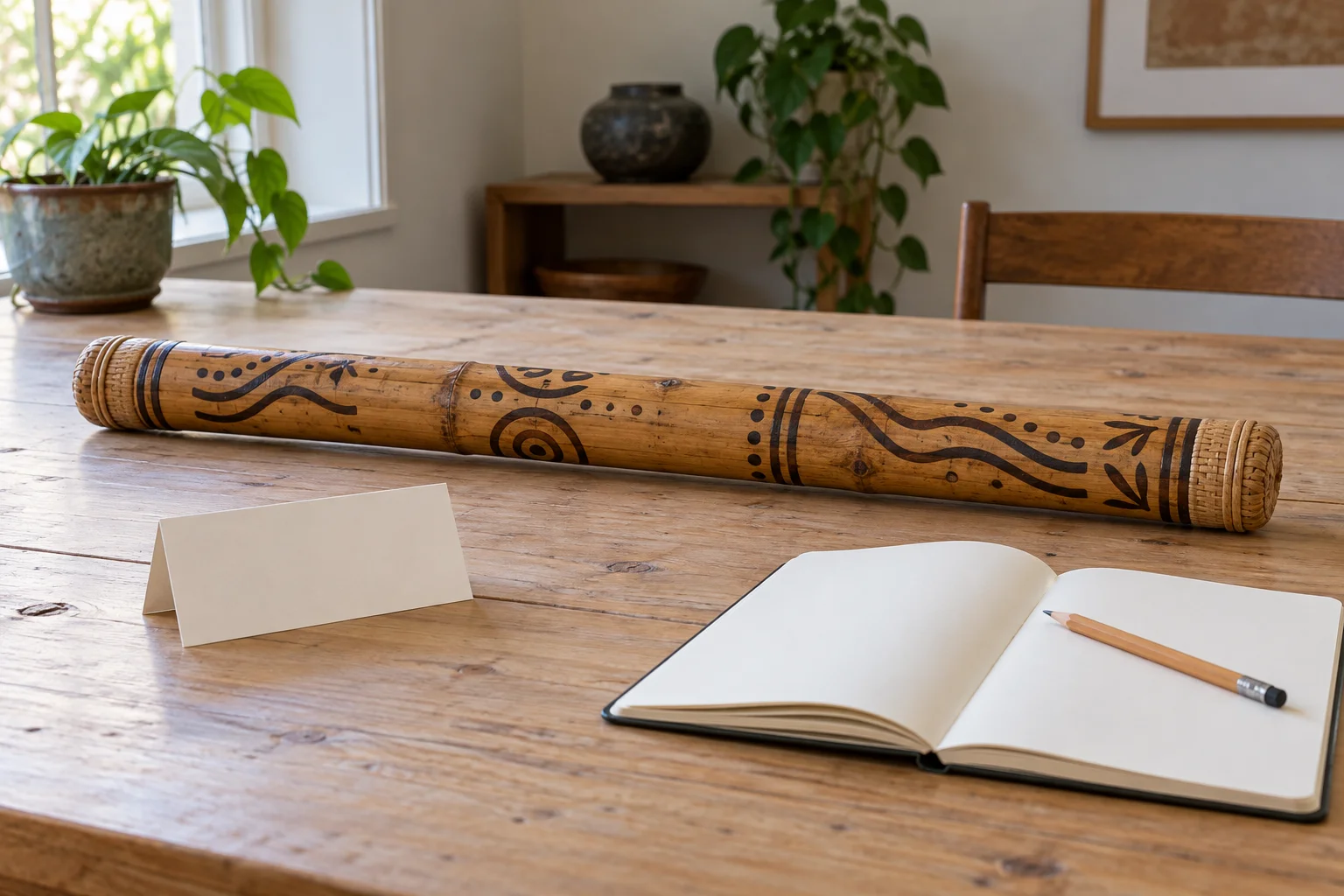
A rainstick object label can say what its writer actually has grounds to say while leaving an attractive story out. This guide proposes a small home writing exercise, with an invented record that separates a visible detail, an attributed description and an unanswered origin question. It is not a museum catalogue or a claim of professional collection authority. The task is to prepare a short reader-facing label and keep the supporting notes beside its draft, rather than turning every note into an unqualified statement about an object.
Begin with three headings on a working page: observed, reported and unanswered. These are the categories chosen for this exercise. Under observed, put what the stated observation actually establishes. Under reported, keep the exact account and who supplied it. Under unanswered, retain the question you cannot yet settle. A reported statement may later acquire additional support, but that has not happened merely because you have copied it neatly. The following invented example gives you the information needed to decide which sentence belongs in which part of this proposed page.
Start with a visible detail that has been stipulated
For our fictional object Q, the exercise supplies a photograph showing four dark bands across a pale tube. That is the only visual observation supplied about Q. Write “Four dark bands are visible in the supplied photograph” in the observed part of the page. This sentence concerns the stipulated picture and its visible detail. It does not establish what produced the bands, which material forms the tube or where someone made it. Q is invented; its four bands are not a description of either actual product linked later.
Now add this invented seller note: “The bands represent the four winds of Moon Harbour.” Moon Harbour is a fictional place in this exercise, and the note has no supporting account attached. Put the sentence under reported, identifying it as the supplied seller note. Do not move its explanation into the observation category simply because the photograph has four bands. The picture and note share a number, but the exercise supplies no evidence connecting that visible number with the note's proposed meaning or origin.
Keep attributed wording attached to its speaker
An attributed wording option for the draft is: “The accompanying seller note describes the bands as four winds of Moon Harbour.” That sentence tells a reader whose explanation is being reported. It does not say the explanation has been established. Another option is to leave the explanation off the short label and keep it in the working notes. Choose between those versions according to what you want this proposed label to communicate, without presenting the longer version as an obligatory catalogue convention or an institution's approved practice.
Compare that with “Made in Moon Harbour to represent its four winds.” The latter sentence adds a manufacturing origin that the invented seller note did not even state. It also removes the attribution. In our example, two different changes have happened: the claim grew and its speaker disappeared. Restoring the words “seller note” would address the missing attribution but would not supply the missing origin evidence. Check the whole proposed sentence, including the connection it makes between its parts, before deciding that a small wording edit has settled it.
Record the unanswered question without guessing its answer
Under unanswered, write “Where was Q made?” The example supplies no answer. You can also write “What supports the seller note's interpretation of the bands?” That is a question about a different part of the account. A later response could address one question and leave the other open. Keep both until you actually have relevant information to assess. The fact that a brief label has little room is a reason to choose its contents carefully, rather than a reason to fill its unanswered fields with a plausible story.
Suppose an invented later message says only, “I bought Q at a stall in Cedar Square.” That adds a claimed purchase location, with the message's speaker as its source. It does not state where Q was made or explain the bands. A draft that replaced the unanswered origin with Cedar Square would change the meaning of the new message. Keep the speaker's actual statement with the record you are considering. If it matters to your label, ask the more specific unanswered question instead of treating any place name as the answer.
Draft a modest label before adding the story
One proposed short label for the fictional case is: “Object Q. Four dark bands are visible in the supplied photograph. Maker and place of manufacture have not been established in these notes.” Each part stays within this exercise's provided information. The object identifier is our own label, the band sentence repeats the stipulated observation, and the final sentence describes the limits of the notes. It is a worked writing option, not an actual description, acquisition record, authenticity judgement or professional assessment of an instrument in a collection.
A second version could add the attributed seller explanation while retaining those limits. Keep the two drafts separate so you can compare the exact difference. The longer draft gives the reader another person's account; the shorter one declines to include it. Neither choice changes the evidence held in the exercise. If the explanation is later supported or contradicted, assess that new information before deciding how to revise the reader-facing words. A preference for an interesting paragraph does not itself establish the explanation's content.
Leave sound claims outside an unplayed example
Now imagine a draft sentence saying, “Q produces a long, soft sound that fills a room.” Our fictional record supplies neither an actual listening observation nor a named account making that claim. Leave the sentence out of this draft. This choice does not establish that Q is silent or that it would produce a different sound. It records only that the exercise supplies no basis for this particular sentence. No one needs to open, modify or play an unfamiliar instrument to complete the writing comparison proposed here.
If another invented note later says, “The previous owner described its sound as soft,” that is an attributed account to consider. It still does not supply the words long or fills a room. Copying only part of that distinction into a revision could leave the rest of the unsupported sentence in place. Compare each claim in the proposed line with the record actually available. The point is to retain the scope of the account you have, rather than making either a more flattering or a more critical sound claim from its absence.
Keep the actual product references distinct from Q
The Pearl PBRSB24694 listing identifies a rainstick with burned-finish wording in its title. Its photograph shows a capped decorated tube. The Tycoon TRS-100 listing identifies a separate rainstick; its two photographs show another complete capped tube. These are actual item references, while Q and Moon Harbour are invented. No visible pattern here establishes an origin, cultural interpretation, maker history or sound result. The article provides no permission to attach a label to an object, install a display support or transfer Q's four-band description to either offer.
For a different kind of object discussion, the handbell story guide proposes inventing a shared scene with friends. Its fiction belongs to an expressly imagined gathering. A descriptive label written as an account of an actual object needs its statements assessed as that kind of account. The familiar sheet music afternoon guide keeps actual stand descriptions separate from a player's chosen session. That context also differs from this proposed label exercise: neither a story contribution nor a plan for an afternoon supplies an object's missing manufacturing origin.
Keep the working notes when shortening the label
If you shorten the fictional label to fit a small card, keep the fuller working page with its draft. You might choose only the identifier and the observation sentence for the card. Do not shorten “The seller note says” into words that silently present the seller's interpretation as your own established finding. This is a proposed editing check for our example, without a required card size, software tool or promised reading outcome. The label can remain short while the notes retain the questions that the short version leaves off.
A reader may ask why an appealing origin story is absent. You can point to the unanswered question in the exercise instead of inventing an answer on the spot. If you intend to share an actual person's account, decide with them what attribution and sharing they agree to. The made-up seller message grants no authority over real words, names or private correspondence. This article sends no enquiry or publishes anyone's collection record; it supplies a writing exercise and the explicit boundaries of its invented information.
Keep any purchase question outside the label draft
If preparing a real label leaves you interested in an instrument order, create a separate note with the exact listing reference. A clear label draft establishes no item specification, availability or package content. Someone considering asking republeq.com about crypto such as USDT can include that preference in the enquiry. Ask which payment methods are actually available for the proposed order, and examine the instructions for the chosen method before deciding whether to proceed. This article confirms no particular token or network and provides no transfer instructions. Keep unresolved product questions beside the payment question so an answer about one does not silently settle the other. Check the delivery information and return terms that apply to the particular item under consideration. A date chosen for your display creates no arrival commitment here. If another person will place the order, give them the original product reference and the seller's actual responses. They can then identify what was confirmed and which questions still need answers. A shortened account of the correspondence should not conceal a remaining question about the object. You can leave the purchase undecided while continuing to edit the fictional label; none of Q's stated premises requires an instrument order. If an order is later confirmed, retain its acknowledgement and related buying correspondence together. Keep those records separate from the invented Moon Harbour account. Neither a payment record nor a neatly written label supplies the missing origin evidence, establishes a sound result or changes what the seller actually stated. The transaction and the descriptive writing each need the information appropriate to their own questions.
Read the last version against the information you kept
Finish by comparing the proposed label with the working page. In Q's case, the photograph stipulates four bands, the seller note supplies an attributed interpretation, and manufacture remains unanswered. A chosen short version can leave the interpretation out without pretending the question was resolved. Keep that boundary when the card is copied, shortened or discussed later. The useful result of this exercise is a particular set of words whose claims remain attached to the information actually supplied, with the unanswered questions still available for further research.