Networking
QUIC anti-amplification: why a server reply can wait
QUIC anti-amplification limits unvalidated server replies. Follow byte credit, address validation, congestion permission and client probe-timeout recovery.
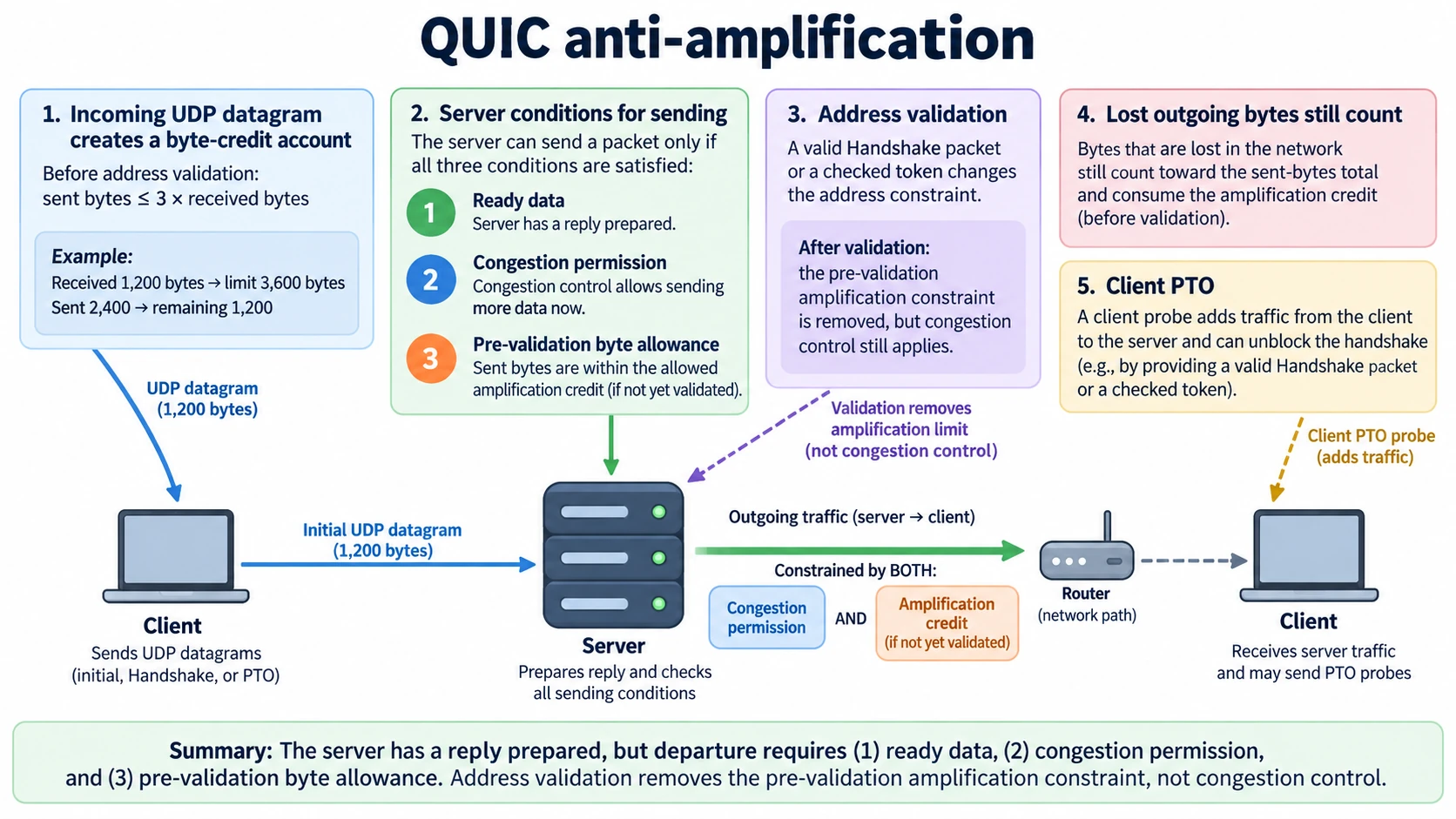
A server can have a response ready and still be unable to send all of it. Before a QUIC peer's network address is validated, the server must respect a transmission limit designed to constrain reflection amplification. Preparing the response does not provide the missing permission.
QUIC anti-amplification connects the pre-validation sending allowance to received traffic. Its purpose is different from congestion control: it limits how much traffic an unvalidated exchange can cause the server to direct toward a claimed address. Track readiness, network congestion permission, and amplification permission in separate accounts.
RFC 9000 specifies a three-to-one limit before the server validates the client address. The byte totals below are hypothetical, but the rule and the validation mechanisms come from that specification. A connection trace must supply the received datagram sizes, emitted bytes and validation events needed to apply it.
Why a claimed source address needs evidence
Imagine a request that reaches a server carrying another party's address as its apparent source. If the server immediately sends a much larger reply to that address, the unrelated party can receive traffic it did not request. A small input could have induced a larger outgoing response directed elsewhere.
The server initially sees the address carried by the incoming traffic. That observation alone does not establish that the apparent peer can receive responses at the address. The reflection risk arises from relying on that claim before a suitable return-path check has completed.
An anti-amplification rule reduces the size of the server's possible contribution during that uncertainty. It does not require the server to prove that the arriving traffic was malicious. The constraint applies because the validation condition has not yet been established.
The limit constrains outgoing traffic during connection establishment. It does not promise that the server spends no memory or processing time on incoming packets. Those costs and the amount sent back to a claimed address need separate defenses; a bounded reply is only one part of handling an untrusted initial exchange.
Track a receive-dependent transmission allowance
Before validating the client address, a QUIC server must not send more than three times the bytes it has received. RFC 9000 requires it to count every UDP payload byte in datagrams uniquely attributable to the connection. That includes datagrams whose packets the server successfully processes and datagrams whose packets it discards. Counting only application bytes would omit traffic that belongs in this allowance.
If the initial accepted input contributes twelve hundred bytes, the cumulative outgoing allowance is thirty-six hundred. Suppose the server has already sent twenty-four hundred bytes of handshake material. It then has twelve hundred bytes of unused amplification allowance.
Now let another eighteen hundred bytes be ready for transmission. The server cannot send that entire amount under the current account. It could send a permitted portion if the other rules allow it, but readiness of the remaining six hundred bytes does not increase the allowance.
Suppose further relevant incoming traffic contributes four hundred bytes before the address is validated. The cumulative received total becomes sixteen hundred, so the example's outgoing limit becomes forty-eight hundred. If the server had sent thirty-six hundred by then, it would have twelve hundred available for later transmissions.
The arithmetic follows cumulative totals. Newly received bytes add to the allowance according to the stated rule. Previously sent bytes continue to count against it. The server must not repeatedly spend the same unused allowance as if each prepared response started a fresh account.
What address validation establishes
address validation supplies the protocol's required evidence that the peer can receive traffic at the address being used. A successful validation event changes the status of that permission boundary. An exchange with independently established validation can be treated differently from one in which the server only has the source-address claim.
Successfully processing a packet protected with Handshake keys lets an endpoint consider the peer address validated. A server can also validate an address using a suitable token returned in a client Initial packet. Token integrity and address checks matter: copying an arbitrary value into the token field does not establish that it came from this server or applies to the current address.
Reachability and client identity establish different facts. A return-path check concerns reachability at a network address under its contract. An authenticated application account or another claim about who a user is addresses a different question. One should not be substituted for the other without a protocol rule that justifies the relationship.
Connection feedback also matters after the handshake, though it answers different questions. The TCP acknowledgment-clocking guide shows how returning reports release sending allowance and how a return-path queue can bunch those reports. That is useful background when separating ordinary feedback from address validation. Its TCP sending account does not establish QUIC token validity or replace a Handshake-packet check.
Removing the particular pre-validation amplification constraint does not remove every sending constraint. After validation, the endpoint still needs to satisfy the other protocol conditions and applicable network-control rules before its prepared bytes can depart.
Separate a handshake transmission budget from congestion permission
The server's application or handshake machinery determines what data is ready. Its congestion-control state can constrain how much traffic it may put into the network. The amplification account independently constrains how much it may send toward an unvalidated peer. A transmission needs permission from every applicable boundary.
In the byte example, assume the congestion allowance is sufficient for the entire eighteen-hundred-byte prepared amount. The remaining amplification allowance is only twelve hundred. The larger congestion allowance does not authorize the extra six hundred bytes because it answers a different question.
Likewise, suppose amplification credit is available but congestion permission is not. The server cannot treat the unused amplification allowance as an instruction to send immediately. An available budget at one boundary does not override a limit at another.
Comparing a handshake transmission budget with a congestion allowance helps preserve that distinction. The related TCP explanation follows an endpoint's feedback-driven adaptation of outstanding-data permission. The pre-validation QUIC budget here depends on received-byte credit and validation status, rather than being evidence that the path has learned a larger safe traffic load.
Several active constraints can produce an observed pause. A sender can wait because it lacks data, because network control restricts departure, or because its unvalidated exchange has exhausted the allowed outgoing account. An observed pause by itself does not identify the active boundary.
Compare validated and unvalidated exchanges
Hold the prepared response and congestion conditions fixed in two hypothetical exchanges. In the first, the server has not established address validation and has only the twelve hundred bytes of remaining amplification allowance described earlier. In the second, a qualifying validation event has independently established the address condition.
The first exchange remains limited by its receive-dependent pre-validation budget. The second need not apply that particular unvalidated-address constraint under the stated model. Its larger ability to transmit follows from the changed validation status, not from the response suddenly becoming more correct or more ready.
A Retry exchange provides one route to this change. The server sends a token, and the client repeats it in subsequent Initial packets for that connection. Checking the returned token can establish that the client received the earlier response. A Retry token is for that connection attempt; it must not be saved for a future connection.
For later connections, a server can instead supply a token in a NEW_TOKEN frame. A client returns an applicable token in its Initial packets. The server checks it before treating the address as validated. RFC 9000 requires these tokens to contain information for checking that the client IP address has not changed; if it has changed, the server must still apply the amplification limit.
Lost messages can affect progress without refunding credit
A server may send permitted bytes that fail to reach the apparent client. Their loss can prevent a response that would otherwise advance the handshake or provide further evidence. The server's outgoing account still records that it transmitted them under the example's cumulative rule.
If it sends another copy, that transmission consumes outgoing allowance too. A lost message should not be treated as though it never used the server's pre-validation budget. Otherwise the limit would cease to constrain the total traffic the server emitted.
A recovery timer can change when the endpoint is willing to try again. Waiting longer does not itself add received bytes or establish the validation condition. If the account is exhausted, the timer's expiry does not automatically create new amplification permission.
RFC 9000 identifies a possible handshake deadlock: the server has exhausted its allowance, while the client has received acknowledgments for everything it sent and has no immediate reason to send again. The client must send a packet when its probe timeout expires. Without Handshake keys, that is an Initial packet in a UDP datagram of at least 1,200 payload bytes; with those keys, it sends a Handshake packet.
Response size changes which boundary becomes visible
A small response can fit within a current allowance and leave the constraint unnoticed. A larger set of handshake material can exhaust the same allowance before all prepared data is sent. The difference can expose the rule even when the initial received amount and network conditions are identical.
Clients must pad UDP datagrams carrying Initial packets to at least 1,200 payload bytes. This gives the unvalidated server room for a larger response under the three-to-one rule. Padding contributes to received-byte credit even though it adds no application request data. The available allowance still depends on how much the server has already sent and whether validation has completed.
To identify the limiting boundary, record counted incoming and outgoing bytes alongside validation state and the other active sending constraints. Reading only a response's prepared size cannot settle whether the server was permitted to transmit it.
A flow can cross the MSI RADIXAXE6600 tri-band Wi-Fi 6E gaming router, whose listing describes its wireless networking role. That places the product in the path carrying the exchange. The router description supplies no endpoint token record or counted-byte history, so a QUIC sending pause still needs connection-level evidence.
The Nighthawk RS200 dual-band Wi-Fi 7 router is listed as a router without a built-in cable modem. It is another relevant network-path component for a client reaching a server. Those hardware details cannot establish whether an Initial datagram reached the endpoint or whether the server has already spent its available credit.
QUIC anti-amplification explains why a valid response can wait behind a permission boundary. Before validation, received traffic constrains the server's possible outgoing contribution under the applicable rule. Following that account separately from readiness and congestion state reveals which event would actually allow the remaining reply to proceed.