Crypto Commerce
Pyle PDIC81RD ceiling speaker set or Lithe Audio 06600 for sound in the ceiling
Compare Pyle PDIC81RD ceiling speaker set by amplifier needs, wiring, room planning, control, cutouts, and source-listing gaps.
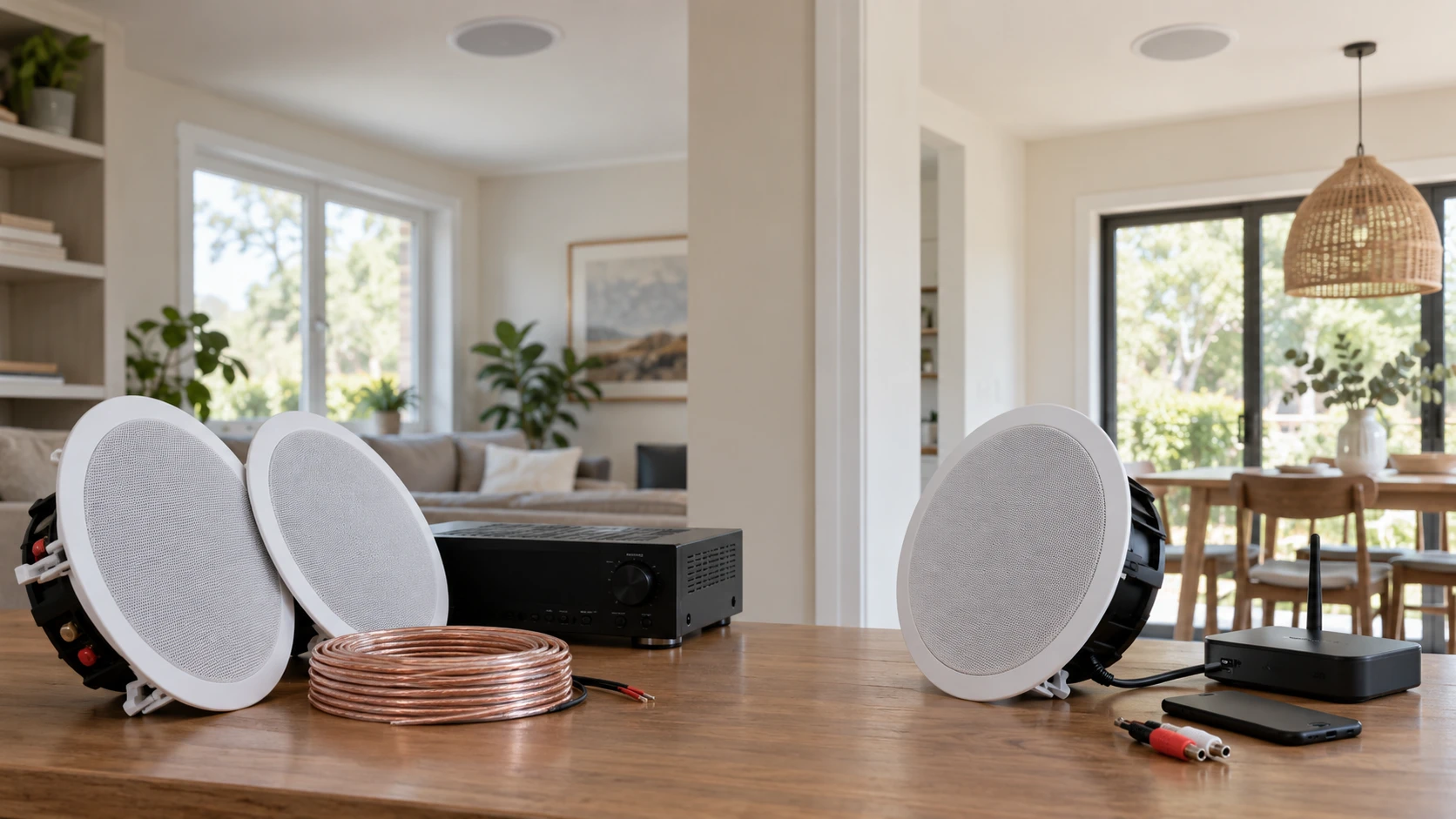
The Pyle PDIC81RD ceiling speaker set consists of passive, flush-mount speakers with wire terminals. They need an appropriate external amplifier and speaker wiring. The alternative is an active ceiling speaker with its own amplifier, Wi-Fi receiver, Bluetooth, and RCA input. Both approaches put sound above the floor, but they make the source equipment, wiring route, and control point quite different.
A ceiling cutout is a lasting change to a room, so settle the listening plan before choosing hardware. Where will music originate? Will one room play by itself or share audio with several rooms? Can a cable reach the location safely, and is there a suitable route for the equipment that drives the speaker? The published guide to installed or shelf speaker planning provides context for deciding whether an installed speaker is worth the construction work. Its bathroom example should not be treated as a moisture rating for the products compared here.
The Lithe Audio 06600 Wi-Fi ceiling speaker is listed as a single master unit. Its saved row gives a 60-watt RMS Class D amplifier and says it streams over Wi-Fi or Bluetooth, with an RCA input for a wired source. It does not give the cutout size, power-supply method, wet-location rating, or details of adding another speaker. A one-speaker purchase cannot be assumed to form the same room coverage as a multi-speaker Pyle set.
Start with the source and amplifier — installed or shelf speaker planning
Pyle's PDIC81RD units are speakers, not a complete playback system. Their listing names speaker terminals and an impedance figure, but no built-in amplifier or wireless receiver. The buyer needs a compatible amplifier or receiver and a plan for getting speaker cable from it to each installed position. That may be straightforward in an unfinished ceiling and expensive or disruptive in a finished room. Draw the route before ordering, including the return path to a serviceable amplifier location.
The Pyle saved row says "4 x PDIC81RD" in its title, while the description says the set contains eight speakers and the URL calls it an eight-pack. It also presents several inconsistent power statements, including a 250-watt figure and a much larger total output claim. Neither the exact delivered quantity nor a safe amplifier match can be established from this listing alone. Obtain a current box contents list and the PDIC81RD specification sheet from the Republeq's catalog or manufacturer. Confirm nominal impedance, continuous power handling, and wiring diagram before connecting an amplifier.
Lithe's 06600 puts amplification in the ceiling speaker itself. The source row specifies 60 watts RMS for its Class D amplifier, a different kind of number from Pyle's conflicting speaker power claims. The figures cannot be used to predict which installation will sound louder at a seat. Amplifier output, speaker sensitivity, number of speakers, room acoustics, and placement all affect that result. Ask for the 06600's current installation guide, including how it receives power, before assuming it is an easier retrofit simply because no separate amplifier is listed.
The active model's RCA input may help if a PC, turntable system, or older player already has an appropriate line-level output. The saved description mentions those examples but does not describe every required adapter or cable run. A turntable may still need the correct phono stage; confirm the complete signal chain of the specific source. For Pyle, the question is which amplifier will accept that source and drive the selected number of ceiling speakers within its supported load.
Match the controls to the way the room is used — Lithe Audio 06600 Wi-Fi ceiling speaker
The 06600 listing says setup and control use a Lithe Audio app on Android or iOS. Wi-Fi and Bluetooth are listed as playback paths. Ask which services, network bands, and grouping functions the current 06600 firmware supports; the saved row does not name them. Check whether a guest can play audio without an app account, whether the speaker resumes after a power cut, and how a household member stops playback without finding a phone. Those answers matter in a kitchen, workshop, or shared office where several people may use the room.
Pyle's passive speakers take their controls from the external amplifier and source. That can be useful when a household already has a receiver with familiar buttons or a central music system, although the Pyle listing itself promises none of those features. Decide where volume will be changed and how a user will select a source. A ceiling full of speakers can still be awkward if the only control sits in a distant equipment closet. Plan the control path alongside the cable route.
Multiple rooms need a separate decision. A pack of passive speakers does not by itself create independently adjustable zones; that depends on the amplifier, switching, and wiring design. A single Lithe master also does not establish a multiroom system from the saved excerpt alone. If different rooms must play different sources, ask for a documented system diagram and a demonstration using the current products. Count usable zones and controllers, not merely the number of speaker grilles or Wi-Fi labels.
Bluetooth can be convenient for a nearby phone, while Wi-Fi can avoid keeping that phone close to the ceiling speaker during playback. Exact range and interruption behavior depend on the home and network. Test the intended route from the regular listening positions before closing the ceiling. A router in a distant room or a crowded radio environment can change the experience. The saved listing does not give a measured coverage map for the 06600.
Lay out the ceiling before cutting it — Lithe Audio 06600 Wi-Fi ceiling speaker
Pyle's saved row gives a 9.38-by-3.5-inch cutout measurement and a 10.5-by-3.5-inch overall dimension for each speaker. Those appear to combine diameter and depth, but the listing does not label every axis clearly. Confirm the cutout template and mounting depth against the current manual, then locate joists, lights, ducts, plumbing, and cables before choosing positions. A nominal 8-inch driver is not the hole diameter. The flange must also fit without hitting trim or a recessed fixture.
The Pyle set is described as round and flush mounted for a home or office. Its drivers include an 8-inch midbass unit and a directable half-inch polymer-dome tweeter. A movable tweeter may help aim higher frequencies toward a listening area, but the row provides no tested coverage angle. Use the proposed seat positions and room dimensions to choose locations. Installing several speakers too close together can waste coverage, while placing one speaker far from listeners may make speech or music uneven across the room.
The Lithe row gives no cutout or overall dimensions. Get its current template and confirm the ceiling cavity depth, fixing method, and access needed for its power and RCA connection. Do not reuse the Pyle measurements because both happen to be ceiling speakers. A powered unit may require a different service route from a passive speaker cable. Have the required electrical work reviewed against the local installation rules before the ceiling is opened.
Neither saved row establishes a bathroom, shower, outdoor, or other wet-location approval for these exact products. The related guide discusses a bathroom speaker, but a guide about a different model is not a certification. Use only a model with the required rating for the intended damp or wet area, and check its installation zone and electrical requirements with a qualified installer. A ceiling above a sink or shower introduces considerations absent from an ordinary dry living room.
Understand the package before comparing price — Lithe Audio 06600 Wi-Fi ceiling speaker
The Pyle listing's quantity conflict affects the project budget directly. If the shipment contains four speakers, the amplifier channel count, cable length, cutouts, and labor differ from an eight-speaker installation. Check Republeq's product page for a written confirmation of the delivered count and exact model markings. Confirm whether grilles and mounting hardware are included. The saved row names a one-year warranty and a set weight of 31.3 pounds, but does not resolve how that weight is distributed across the shipped units.
Lithe is listed as one master speaker. Its integrated amplifier avoids a separate amplifier purchase for that one device, but the total installed cost still includes power delivery, any wired input, and labor to prepare and finish the ceiling. If stereo or broader coverage is needed, ask what compatible companion products and wiring are required. The saved 06600 row does not include a companion speaker, a stereo claim, or a price for expanding the system. Comparing its single-unit price with an ambiguous Pyle pack price would hide those differences.
Maintenance also follows the system design. An external amplifier can be serviced without reaching into the ceiling, assuming it was placed accessibly; a failed passive speaker still requires work at its opening. A powered ceiling speaker consolidates more electronics overhead, so ask how the 06600 is removed and serviced without damaging the finish. Keep the model, wiring plan, and cutout template with household records. Future owners or technicians should be able to tell what was installed before opening the ceiling again.
Make the choice after resolving the missing specifications — Lithe Audio 06600 Wi-Fi ceiling speaker
Pyle fits a project that already has, or intentionally plans, an amplifier and speaker wiring for several ceiling positions. The PDIC81RD drivers and terminals are described in the source row, but the pack count and power figures need written correction before purchase. Choose the amplifier only after the actual speaker impedance and wiring configuration are confirmed.
Lithe 06600 fits a project that wants one powered ceiling source with app control and the listed Wi-Fi, Bluetooth, or RCA input paths. Confirm the cutout, power method, network features, and any companion-speaker plan before starting the retrofit. With either option, mark the positions on the ceiling and test the intended controls. That preparation is far cheaper than moving a cutout after installation.