Product Compatibility & Accessories
Punch needle cloth compatibility: match yarn and tool
Compare punch needle cloth compatibility through needle size, fiber, foundation weave and threading system before choosing tools and accessories.
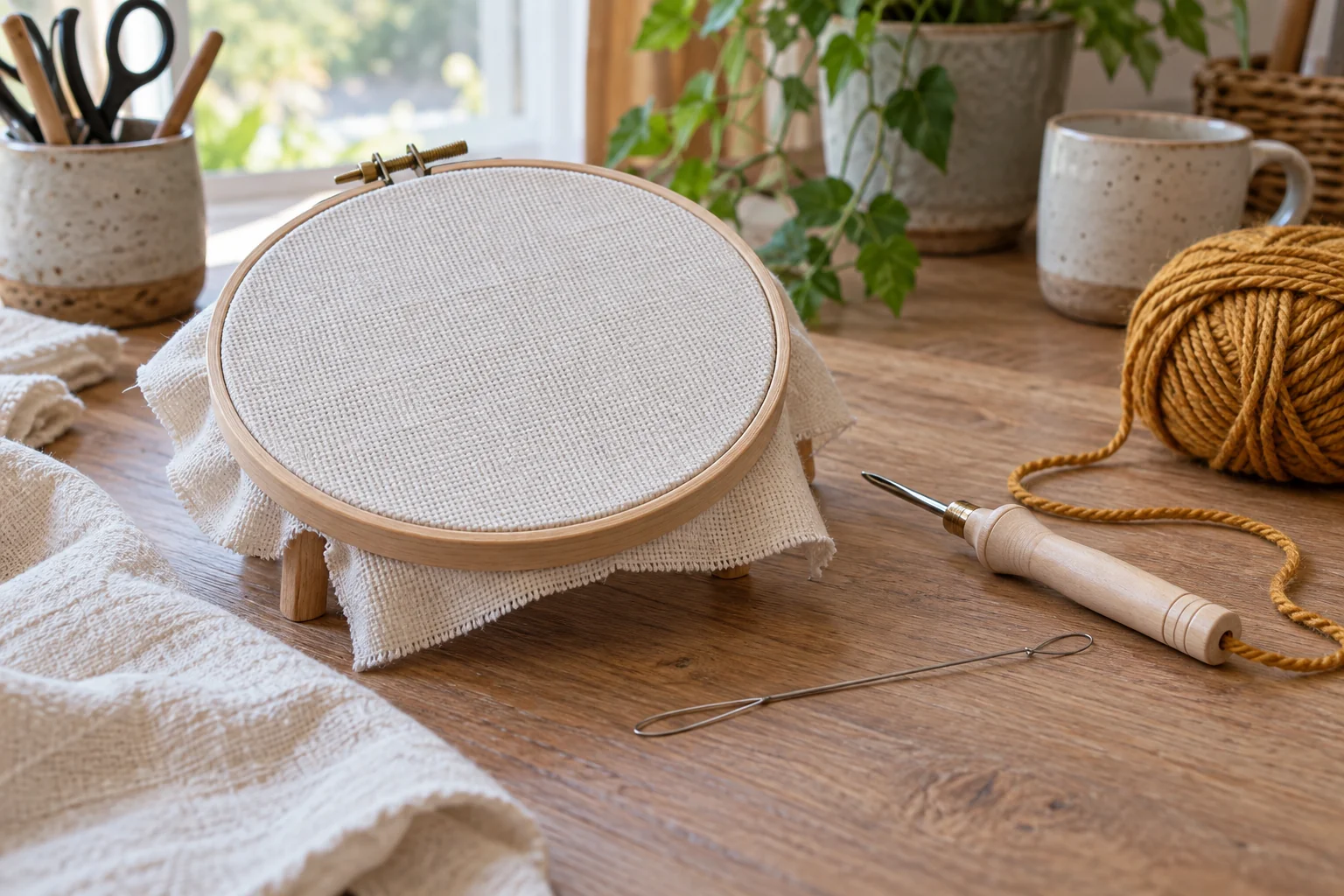
Punch needle cloth compatibility begins with the working combination
Punch needle cloth compatibility depends on the working combination: the needle, the fiber passing through it and the fabric holding the stitches. DMC's fabric guide explains that the weave and the density of the stitches retain the loops. A cloth name alone cannot answer whether a particular yarn and tool will work together. Begin with the kind of punching you intend to do, then choose the materials that belong to that technique. Fine thread and larger yarn need different considerations.
The JubileeYarn adjustable punch-needle 30-pack is listed under the brand BambooMN. Its contents are thirty adjustable punch needles, thirty sets of three needle sizes and sixty yarn threaders. The three-size wording gives a selection without naming numerical diameters. It also supplies no yarn-weight chart or tested pairing with the cloth discussed here. Preserve those limits when comparing the pack with a project that specifies a particular tool.
BambooMN gives the punch needle a length of 4.5 inches, the needles 2.4 inches and the threaders 7.6 inches. Those component lengths answer different questions from needle diameter. Twelve adjustable needle-length options describe another feature, without a table converting the settings into loop heights. The stated hard plastic, stainless steel and rubber grip identify construction. They do not establish how a selected yarn passes through a particular tip or how tightly a foundation holds its loops.
The other offer, Whoasyst cotton punch-needle cloth, is described as material for needlework and rug tufting. The text also uses monk's cloth and gives 185-by-250-centimeter and 185-by-400-centimeter wording, followed by one tufting cloth. That is not a promise of two pieces. The description supplies no hole count, yarn pairing or tested match to the BambooMN kit. Its cotton identity and broad craft uses leave those questions open.
Keep the listed cloth dimensions separate from a usable stitched area. The source does not identify a frame opening, the amount available after mounting or which size the selected offer supplies. A large piece could contain room for several smaller projects, but the actual cutting plan and selected size would have to establish that. The product name alone also cannot distinguish the weave needed for a fine-thread picture from the foundation needed for a yarn-based piece.
Read needle diameter separately from loop height
Oxford's punch-needle FAQ separates needle width from the height of the loop. Its Regular Point and Fine Point describe different widths and intended fibers; the numbered sizes describe loop heights within Oxford's own system. For example, its number ten produces a quarter-inch loop in that system. That number is not a ten-millimeter needle diameter. Read a maker's number together with its explanation rather than lining up numbers from unrelated kits as though they measured the same thing. A size reference becomes useful when you know exactly what its maker measures.
The same FAQ recommends monk's cloth with twelve to fourteen holes per inch for its method and warns against a much more open version with six to seven. This illustrates why the cloth name needs further identification. It does not assign either count to Whoasyst's fabric. Oxford also distinguishes its Fine Point yarn work from embroidery floss. A tool called fine in one system therefore should not be treated as a universal fine-thread punch needle merely because another maker uses a similar word.
Use monk's cloth with the right needle and fiber
DMC's fabric article makes the practical contrast clearer. Larger punch needles carrying yarn need a reasonably open weave, while fine punch work with thread needs a tighter fabric. Its examples include punch-needle Aida and monk's cloth for yarn work, and closely woven cotton percale for fine thread. These are technique-specific examples, rather than an approval of every fabric sold under those names. Keep the needle, chosen fiber and foundation together when reading the instructions for your intended piece.
Match the threader to the path through the tool
The threader is part of that combination too. DMC's illustrated guide shows a wire threader travelling through the tool's barrel, drawing the fiber through it and then handling the eye near the point. That is a particular path through a particular tool. It explains why a threader must reach the places the tool requires. Follow the threading directions supplied for the actual punch needle instead of assuming that a spare wire loop of any length serves every configuration.
DMC also describes changing the tips in its fine punch-needle tool to accommodate different thread or fine yarn. In that guide, the chosen fiber should move readily through the selected tip. A fiber that can be pulled in once is not automatically a suitable working match. Keep the movement through the tool in mind when choosing the tip and fiber together. The guide's screw, base and replacement sequence belong to DMC's design; the retail kit's description supplies no claim of matching parts. Use that example to identify the missing information in a different maker's description.
Keep replacement tips within their own system
Clover's Embroidery Stitching Tool article describes another hollow-needle system. Fiber passes through the handle and needle, then emerges at the eye near the point; the punching action leaves loops on the other side of the fabric. Its handle accepts different needle sizes for different fibers. This example helps distinguish a punch needle's feeding route from simply carrying thread in the eye of an ordinary hand-sewing needle. The working route through the tool matters alongside the visible size of its point.
Clover lists its own extended threader and identified needle refills for that system, including versions for different floss groupings and medium-fine yarn. Those are related accessories within the named product family. Their existence does not make a refill universal. Before treating two tips as substitutes, keep the actual tool identity and its specified accessory together. An accessory can look broadly similar while its product information still needs to identify the handle or tool it is intended to accompany. Keeping the refill's name with its intended tool avoids losing that relationship during shopping.
An open channel has its own threading route
Oxford's separate threading article shows an open-channel design. In its Regular Point example, the yarn passes through the eye and is then settled into the channel along the handle. Its Fine Point example adds a route through the screw-eye at the end of the handle. These descriptions show a different architecture from drawing yarn through an enclosed barrel with a wire threader. They belong to Oxford tools and should not be used as an assembly diagram for the selected kit.
The article also stresses that yarn should move smoothly through the tool, and warns against forcing a thick yarn through its Fine Point needle. Treat an obstructed feeding path as a reason to reconsider the actual yarn-and-tool choice. Simply owning more threaders does not solve a fiber that is unsuitable for that needle. Keep the threading architecture in view when comparing accessories, including whether the tool's directions call for a separate threader at all. A threader's pack quantity describes supply; the tool's threading route describes its use.
Leave working clearance under a taut holder
Clover's model 8816 manual makes the difference between needle extension and width visible. Spacer rings change the exposed length to produce different loop effects. Its four positions are settings for that model, rather than a standard conversion for other adjustable tools. A longer exposed needle also needs working clearance beneath the fabric. The manual illustrates its hoop arrangement and recommends a dedicated hoop to keep the longer needle from striking the surface below while working.
Its instructions call for tightly held fabric and yarn that feeds without being trapped. Its troubleshooting also asks whether the fabric and yarn are appropriate together. That combination matters before judging the result from the number of accessories purchased. Read the holder's intended use alongside the tool's directions. A display frame and a working holder answer different needs, and nominal frame width alone does not settle how the fabric is held or how much clearance remains under the needle. Allow the working needle's movement to determine the space you leave beneath the holder.
Allow cloth for holding and finishing
Plan the raw piece around its holder and finish before cutting from a larger supply. DMC's general embroidery-preparation article advises leaving fabric outside the design so the eventual finishing choice remains possible. A design's dimensions are therefore not automatically the dimensions to cut from your cloth. Use the requirements of the actual project and holding system. The article gives general embroidery guidance, rather than a fixed cutting margin for every punch needle, frame or finished object.
Preparation also belongs to the identified fabric. DMC advises following its washing and ironing directions and describes ways to protect raw edges while working. Those options do not establish a care recipe for an unidentified piece of cloth. Keep the fabric's own information and the chosen technique's instructions together before preparing it. The same article connects fabric and thread weight to the embroidery method, reinforcing the need to choose an actual combination rather than assembling supplies by their color alone. Preparation should preserve enough cloth for the way the piece will be held and finished.
Keep familiar supplies with their own projects
The friendship-bracelet guide separates the components in six-strand floss from the working lengths and groups used in a braid. That distinction is useful when reading thread descriptions for another craft. A strand count on a package does not identify a punch-needle tip or its feeding capacity. Keep that guide's cut lengths and closure with its bracelet pattern; here, the relevant decision is the fiber that the actual punching system is intended to carry. The guide's nine cut lengths become three working groups. Those counts describe the braid in progress; the package's six-strand construction describes the material before that project begins.
The small embroidery-corner guide makes room for one identified project and distinguishes a working idea from a later display choice. That suits this purchase decision: decide where the actual holder and materials will go before collecting extra frames. Its oval hoop and sunflower display offers are not verified punch-needle holders. Use their discussion as help with project space and storage, while leaving the technical mounting decision with the tool and holder you actually choose. Keeping one working project together also makes its chosen materials easier to identify. A decorative display purchase can wait until the finished work has a known shape and intended place.
Choose the complete combination before enlarging a project
For the cloth, retain the unresolved weave count and alternative size wording until the actual supply is identified. Punch needle cloth compatibility depends on the complete working combination. A familiar cloth name alone leaves the needle, fiber and holder requirements unsettled.