Educational & Explainer Articles
Pressure washer PSI and GPM: keep the operating pair together
Read pressure washer PSI and GPM as distinct quantities. Keep Greenworks flow-pressure pairs intact and the K5 flow discrepancy unresolved.
Pressure washer PSI and GPM describe different quantities. PSI is a pressure unit; GPM describes a volume of water per minute. A useful specification connects the pressure and flow that belong together. Two large numbers beside a product name do not necessarily describe one operating condition.
The selected Greenworks listing makes that distinction concrete. It states 1.1 GPM at 3,000 PSI and 2.0 GPM at 100 PSI. Those are two pressure-and-flow pairs. Reading only the headline's 3,000 PSI and 2.0 maximum GPM would lose the conditions that explain the relationship between them.
Pressure and flow answer different physical questions
NIST's Guide to the SI lists PSI as pound-force per square inch, a pressure unit convertible to pascals. It separately lists U.S. gallons per minute as a flow unit convertible to volume per second. The units distinguish pressure from a rate of water delivery.
The word per matters in both expressions, with different meanings. In PSI, the force is related to area. In GPM, the water volume is related to time. A pressure figure is therefore not a quantity of water in a container, while a flow figure is not another way of writing the pressure.
Keep that distinction when asking what a larger number tells you. A higher stated PSI compares pressure labels. A higher stated GPM compares volume-per-time labels under their stated conditions. Neither comparison alone supplies a measured time for cleaning a particular item, a permitted surface treatment or the complete operating requirements for the machine.
Read the actual Greenworks operating pairs
The Greenworks 3,000 PSI TruBrushless electric pressure washer offer names a 120V, 60Hz, 14-amp motor and PWMA certification. Its description explicitly gives 1.1 GPM flow at 3,000 PSI and 2.0 GPM at 100 PSI. Preserve the pressure attached to each flow figure.
At the first stated condition, the pair is 3,000 PSI with 1.1 GPM. At the second, it is 100 PSI with 2.0 GPM. The description does not state 2.0 GPM at 3,000 PSI. Joining the two headline maxima into that invented pair would change the product claim rather than merely shorten its wording.
Write the pairs on separate lines if that helps you read them. Label each line with both units so that the number 100 cannot be mistaken for a motor figure or an accessory quantity. Retain that relationship when copying the figures into a comparison or asking a supplier about the offer.
Pressure and flow at the same operating point belong together
For pressure and flow at the same operating point, an at statement is valuable information. It tells you the pressure associated with the quoted flow. In this Greenworks account, 1.1 and 2.0 are not two interchangeable descriptions of the water flow under the same stated pressure.
Imagine someone saying that the offer gives both three thousand and two, so those must describe the machine together. The complete sentence supplies the missing answer: the two-GPM figure has a one-hundred-PSI condition. Keep that condition when passing the specification to another person. Otherwise, an accurate pair of individual numbers becomes an inaccurate combined claim.
A comparison with another machine needs equally specific information. A flow label without its pressure condition cannot automatically be placed beside Greenworks' 1.1-GPM-at-3,000-PSI statement as a matched result. Identify the basis of each figure before deciding what numerical difference you have actually established.
Maximum pressure and maximum flow can describe different conditions
A short title can make maximum pressure and maximum flow look like one operating condition. The selected Greenworks description shows why the complete account matters. Its 2.0-GPM statement carries a different pressure from its 3,000-PSI statement. The maximum qualifier should remain with the quantity it describes.
This observation is specific enough to be useful without inventing a general performance curve. The two stated pairs do not tell you every flow between 100 and 3,000 PSI. They also do not establish a universal rule for how another pressure washer behaves. Keep a claim about the selected offer separate from a claim about all machines.
Do not sketch a straight line between the two labels and report its middle as measured performance. For example, the available statements do not give an observed flow at a hypothetical intermediate pressure. An estimate would need its own justified model and conditions. A product description containing two operating points does not supply that model by itself.
A flow rate retains its time basis
One U.S. gallon per minute is a volume rate, rather than one gallon stored somewhere in the washer. In a purely mathematical example, an unchanging rate of one gallon per minute over two minutes would total two gallons. That example defines the relationship between a rate and a duration; it is not an operating trial of either selected product.
Real job-water use would need the applicable actual flow and the periods during which it occurs. A headline maximum by itself does not establish that history. An interrupted task, a changed operating condition or a different flow basis would require different information before a total could be reported as the water used for a particular job.
The humidifier capacity and output guide illustrates that distinction with Vornado's 1.5-gallon tank and up-to-2.6-gallons-per-day output. Stored volume and output over time are different quantities. Its humidifier figures supply no pressure-washer water-use rate, but they help explain why a rate's time basis must stay visible.
Read the Kärcher flow statements without choosing a hidden answer
The Kärcher K5 Premium pressure-washer offer has 1.45 GPM and 2,000 PSI in its title, while its description uses 2,000 PSI and 1.2 GPM wording. Those different flow statements remain unresolved in this account. Do not silently replace one with the other or call them confirmed equivalent measurement conditions.
The title also names a 32-foot hose while the description says 25 feet. That is a separate package-detail discrepancy. Resolving it would not, by itself, resolve the flow figures. Ask a question about each actual statement rather than assuming that correcting one listing detail settles every other specification.
For a pressure-and-flow comparison, the useful missing answer is the applicable flow at the identified pressure for the actual K5 variant and its stated conditions. A reply repeating only K5 or the title's larger number would leave that question incomplete. Keep the exact offer reference available when requesting the relevant technical information.
Pressure units do not describe every part of the equipment
PSI expands to a force-per-area expression, without making a displayed PSI figure the total force on every possible object. A force question also involves the relevant area and the physical situation. This explanation provides no jet-force calculation or permission to use a particular pressure on an unidentified material.
Likewise, GPM does not tell you the shape of a spray pattern or establish which accessory fits the equipment. These are different specification questions. Retain a named component's own information when it matters, rather than using a pressure or flow number as a substitute for a missing connection or surface-use answer.
The bicycle pump valve-compatibility guide makes the interface question concrete through Lezyne's reversible Presta/Schrader hose and Topeak's named TwinHead DX. Those air-pump heads provide no pressure-washer connection approval. The relevant distinction is that a physical interface needs its own applicable account alongside any performance number.
Keep the location of a pressure or flow statement clear
A statement about the water supply and a statement about the machine's output concern different places in a system. Before comparing two values, identify what each one describes. An output headline alone is not a complete inlet-water requirement. This guide provides no water-connection, flow-testing or pressure-adjustment procedure.
If the supplier provides technical information with both inlet and outlet entries, keep their labels attached. A number copied without its location can appear to conflict with another number that answers a different question. Clarify the location and conditions before treating the apparent difference as a defective pump or an approved operating setup.
A unit conversion cannot restore a missing condition
NIST gives the U.S.-gallon-per-minute conversion as about 0.06309 litres per second. Multiplying by sixty gives about 3.785 litres per minute for one U.S. GPM. On that unit basis, the Greenworks label of 1.1 GPM corresponds arithmetically to about 4.16 litres per minute. Its 3,000-PSI condition still belongs with that converted flow. The calculation changes the unit used to express the rate, without supplying another product test.
If a different offer states 4.16 litres per minute without a pressure condition, the equal-looking flow numbers do not complete a matched comparison. You would still need the missing condition for that offer. Also retain whether a gallon is identified as U.S. or another gallon convention. A conversion has to begin with the correct unit; familiar abbreviation alone should not conceal an unresolved basis in the source being compared.
Read a supplier reply against the question you asked
Imagine asking for the flow associated with a particular pressure. A reply saying only that the maximum flow is two GPM does not yet answer the paired-rate question. It may be useful information about a maximum, but its missing pressure remains missing. Preserve the actual answer and ask for the condition rather than treating an unqualified maximum as the requested operating point.
Now imagine a reply specifying the flow and pressure together for the exact offered configuration. That addresses the relationship you asked about, subject to its stated conditions. Keep both values and those conditions when passing the answer to another buyer. If the answer instead concerns a different variant, it needs its own product reference before it can be used in the selected-offer comparison.
A numerical comparison needs a stated basis
Someone choosing equipment may want to know which washer finishes a particular cleaning task sooner. Pressure and flow information can inform that enquiry, but the selected descriptions provide no common timed cleaning trial. The observed task, tested configuration and relevant conditions would need to be known before a time advantage could be reported.
In the available Greenworks account, the strongest specific finding is its two named operating pairs. In the Kärcher account, the differing flow labels need clarification. Those are useful conclusions even though they do not name a performance winner. They identify what the figures establish and what additional information would change the comparison.
A supplier's answer should retain its qualifications when shared with another buyer. If it concerns one variant, condition or accessory arrangement, preserve that scope. A technically detailed reply about a different configuration is still a different account; do not attach its result to the selected offer merely because a familiar product-family name appears.
Finish with the operating pair you can actually support
Read pressure washer PSI and GPM together with their labels and conditions. For Greenworks, retain 1.1 GPM at 3,000 PSI and 2.0 GPM at 100 PSI as distinct statements. For the selected K5 offer, retain the unresolved 1.45-versus-1.2-GPM wording until the applicable account is confirmed. A clear explanation keeps those relationships intact.
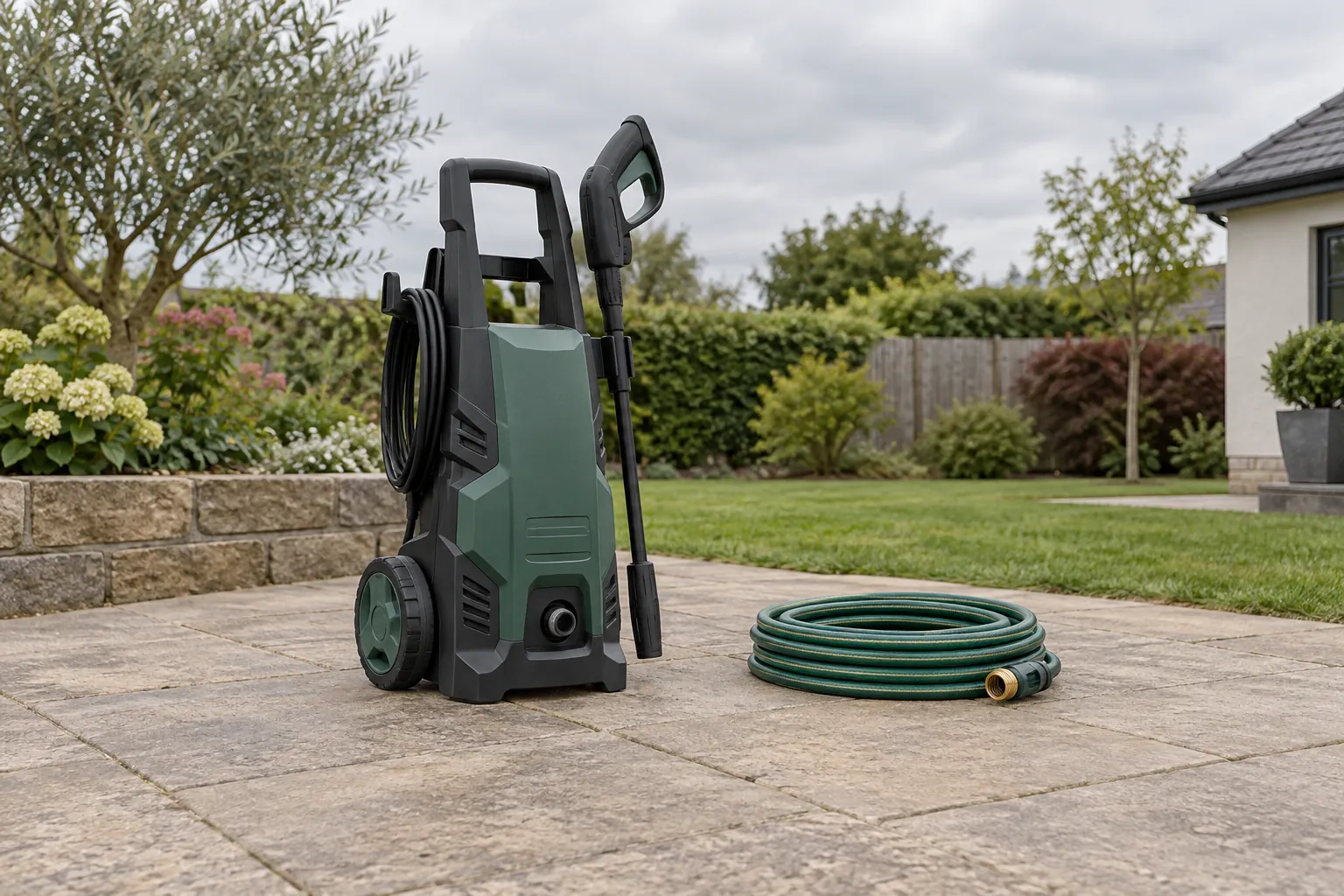
Pressure washer PSI and GPM are distinct measurements; conceptual cover shows a generic inactive electric pressure washer without a spray demonstration, exact-model claim or performance diagram.