Educational & Explainer Articles
Humidifier tank capacity, daily output and timer labels explained
Understand humidifier tank capacity, daily output, timers and automatic-stop conditions in the actual Vornado HU1-0076-06 and Danby DBHR13211BDD1 offers.
Humidifier tank capacity describes a quantity of water the equipment is stated to hold. Daily output and an hourly timer describe different things. Keep a refill question separate from a question about operating time or a selected humidity level. Keep the quantity's name and conditions beside its number.
The Vornado HU1-0076-06 and Danby DBHR13211BDD1 offers illustrate the distinction. Vornado names a 1.5-gallon tank and output up to 2.6 gallons per day. Danby names a five-litre capacity alongside one-, two-, four- and eight-hour timer settings. Those statements can coexist because a stored volume, output over time and a timer selection are different entries. Neither description supplies a measured overnight refill schedule for your household.
The tank figure answers a storage-volume question
When a listing states tank capacity, retain the volume unit. A gallon or litre figure attached to a water tank is different from a room-area figure in square feet. Copy the label with the number if you are comparing offers. A page containing several large numbers can otherwise leave you remembering a figure without the quantity it described.
Capacity also needs to stay with the named component. A tank label describes that tank, while a daily output statement describes a stated amount over time. The tank figure does not by itself establish how much water will be used in a particular hour or when a person will need to refill it. Those questions require applicable operating information beyond a volume label.
Keep the purchase question concrete. Someone may need to know the tank's stated volume; another person may need the actual refill requirements before deciding whether the routine suits them. The page may give tank volume while leaving the refill requirements unresolved. Writing down which answer you need prevents an available capacity number from becoming a substitute for a missing runtime account.
Humidifier daily output carries a time basis
A humidifier daily output figure attaches an amount to a stated period. The Vornado description's up-to-2.6-gallons-per-day wording is an output claim with both a maximum qualifier and a daily time basis. Retain up to and per day when writing it in an equipment comparison. Removing either changes what the statement says.
The same source gives a 1.5-gallon tank. The daily output number is larger than the tank-volume number, without those two entries being the same specification. One describes the tank and the other describes output across a day. Their difference does not establish how many refills your household will make, because the description supplies no complete refill account for a particular day's use.
Dividing a daily maximum into hours would produce a calculated average of that stated maximum. It would not establish a constant hourly output from this machine. Nor would dividing tank volume by that assumed average provide a tested time until empty. Such a result would depend on an operating pattern the selected description has not established.
If a continuous period matters, ask for the exact model's applicable runtime information and conditions. Keep the answer attached to the relevant mode and circumstances if those are supplied. A response repeating only the daily maximum has not answered how long a particular filled tank lasts during your intended use. The original output claim can remain accurate while that further question is still open.
A simplified example shows what a runtime calculation would assume
Imagine a mathematical model with one litre of usable water and a constant use rate of half a litre each hour. Assume the model has no other water loss, no reserve left unused and no interruption before the litre is consumed. One divided by one half gives two hours. The calculation is correct under those invented conditions. It describes neither selected humidifier.
Now keep the same one-litre quantity but change the invented constant rate to one quarter of a litre each hour. The model gives four hours. Nothing happened to the capacity figure; the assumed consumption rate changed. A tank-volume label alone cannot choose between those two calculations because it does not establish either rate.
Both examples assume the rate stays constant. If the modeled rate varies, a single unqualified hourly figure cannot describe every part of the period. A daily maximum also does not establish the constant assumption. Keep the model's assumptions beside its answer so the tidy arithmetic does not become a reported product runtime.
A refill question needs the actual equipment's applicable operating conditions. The Vornado page names fan modes and humidity regulation, while Danby names mist settings and automatic-shutoff conditions. This guide does not derive a consumption curve from those feature names. It shows the missing relationship a runtime account would need to establish before a tank number could support a time-until-empty answer.
Read the actual Vornado control account alongside the quantities
The Vornado HU1-0076-06 Black humidifier offer identifies SKU 427297636 and UPC 043765015285. It describes an evaporative system with vortex assistance for rooms up to 700 square feet. Keep that room-area statement apart from the water-volume and daily-output entries. It provides no measured humidity result for your particular room.
Vornado's description names an electronic humidistat that automatically regulates humidity between 35 and 60 percent, with a continuous mode also available. Low, High and Auto fan settings are named separately. These are stated control features. The text does not supply a complete account of how each setting changes water use or how the automatic regulation behaves over a night.
The description also names two antimicrobial-treated wicks and calls the design quiet. Those statements identify features and supplied components without establishing a health benefit or an independently measured sound level. A wick count cannot provide a refill interval. The material-treatment wording does not establish that the water or air in your household reaches a particular cleanliness result.
Humidifier timer settings describe another part of the offer
The Danby DBHR13211BDD1 Black top-fill humidifier offer states a five-litre capacity, also written as 1.3 gallons. Preserve those source labels as written. This article does not replace them with a new conversion or claim a more precise delivered tank volume than the description provides.
Its humidifier timer settings are one, two, four and eight hours. These are named settings, without a complete selection sequence or timer-behavior account here. An eight-hour option does not establish that the tank supplies eight hours under every mist or room condition. The description names the timer separately from the capacity.
Danby also names three cool-mist settings and a 360-degree vent. Its listed humidity-level options are 40, 45, 50, 55 and 60 percent. The description does not give a water-output figure for every combination of those controls. Do not fill that gap by assigning Vornado's daily output to Danby or by treating the selected percentage as a water-consumption rate.
A timer setting can therefore be relevant to one question while leaving another unanswered. A buyer wanting a listed time-selection feature can record its presence. A buyer wanting a supported period between refills needs applicable information for that question. The short description does not make those answers interchangeable.
Auto shutoff and a selected humidity level have their own scope
Danby's description states automatic shutoff when the unit runs out of water or reaches the set humidity level. Keep both stated conditions with that model. An automatic stop does not, by itself, identify which condition caused a particular stop in someone's home. This article has not observed your unit or established its diagnostic display meanings.
Likewise, selecting a stated percentage is a control choice described by the offer, without a verified room measurement here. The percentage does not become a promise of exactly that reading everywhere in a room or a health recommendation. This explanation supplies no preferred humidity setting, sensor placement, calibration or control-adjustment procedure.
Danby names a sleep mode that turns off lights and a blue night-light option. Keep that stated sleep-mode behavior separate from water use and sound. Turning off lights does not establish a measured reduction in output, a guaranteed refill interval or a particular sleep outcome. The listing's control names do not supply those results.
It also describes a washable reusable filter and a spare, and mentions an aroma-diffuser option. Those are separate feature and component entries. This article supplies no washing, filter-removal, oil-selection or aroma-use method. A component count or optional feature cannot complete an unanswered runtime question.
Keep room-area claims attached to their actual conditions
The selected Danby account gives coverage of 325 square feet, while Vornado states up to 700 square feet. Those numbers describe source claims with their own wording. The descriptions provide no shared room test that would support a performance ranking or prove either machine can establish a selected level in your intended space.
The actual Winix 5520 and Honeywell HPA030B room-rating guide keeps the purifier listings' area-and-time statements and stated air-change conditions together. That is useful when reading a humidifier's room-area label: preserve the quantity and its qualification. The purifiers' air-change counts and filtration statements provide no humidifier output, water-use condition or target-setting recommendation.
A room-area entry also cannot supply an absent hourly water rate. Keep area, tank volume and control information in separate parts of the comparison. The page may give useful information in each part without connecting them into a complete performance account for your room.
A daily figure cannot settle every shorter-period question
The actual ice-maker capacity and short serving-window guide distinguishes KFFKFF's up-to-37-pounds-per-day production claim from 4.8 pounds of ice storage and a 2.65-litre water reservoir. Its concrete serving example also keeps assumed replenishment distinguishable from measured production. Those are actual product decisions about different quantities.
That relationship helps explain why Vornado's tank volume and daily output should retain their own labels. A daily maximum cannot establish everything that happens during a shorter period. The ice guide's fictional serving withdrawals and storage assumptions do not become humidifier water-consumption figures or a refill method.
For a household refill question, identify the missing operating information directly. Ask which conditions support a runtime statement for the exact humidifier and whether the answer applies to the settings relevant to your intended use. Keep an unanswered condition visible. This is an information question, without a direction to run equipment in an improvised test.
Read the comparison back by quantity
A compact comparison can retain Vornado's 1.5-gallon tank, up-to-2.6-gallons-per-day output, named humidity regulation and fan modes in separate entries. Danby's entry can retain five litres or the source's 1.3-gallon label, its named hourly timer options and its stated automatic-shutoff conditions. An absent comparable output or runtime field should remain unestablished.
Use humidifier tank capacity for the volume question it answers. Keep daily output, timer options and set-level behavior beside their own conditions. Obtain the information your decision needs, such as a supported refill period or the documented behavior of a particular control.
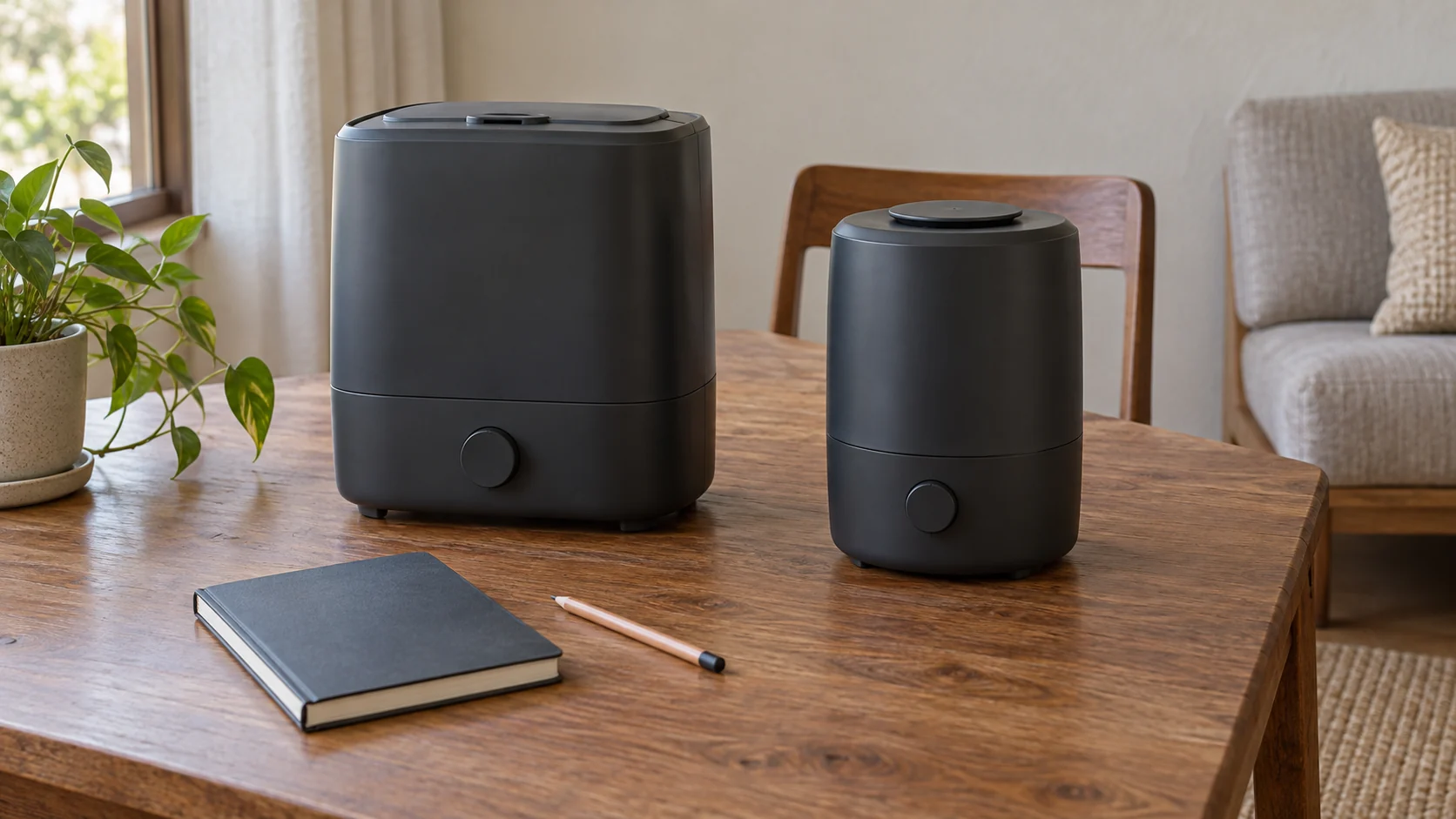
Humidifier tank capacity, output and timer labels describe different quantities; this conceptual cover shows generic inactive devices without a verified operating arrangement.