Crypto Commerce
Pre-owned Vivitar VTI Phoenix drone versus new GPS S159
The Pre-owned Vivitar VTI Phoenix drone is worth considering for flexible framing if its advertised camera movement suits your intended shots and the particular used unit is in acceptable condition. Its description specifies a 180-degree articulating camera, compared with the S159's stated 90-degree adjustable lens. That difference gives you a reason to investigate the Vivitar, but it does not establish better pictures or easier camera adjustment during flight. The purchase depends on how the mechanism works, its present condition, and the equipment supplied with it.
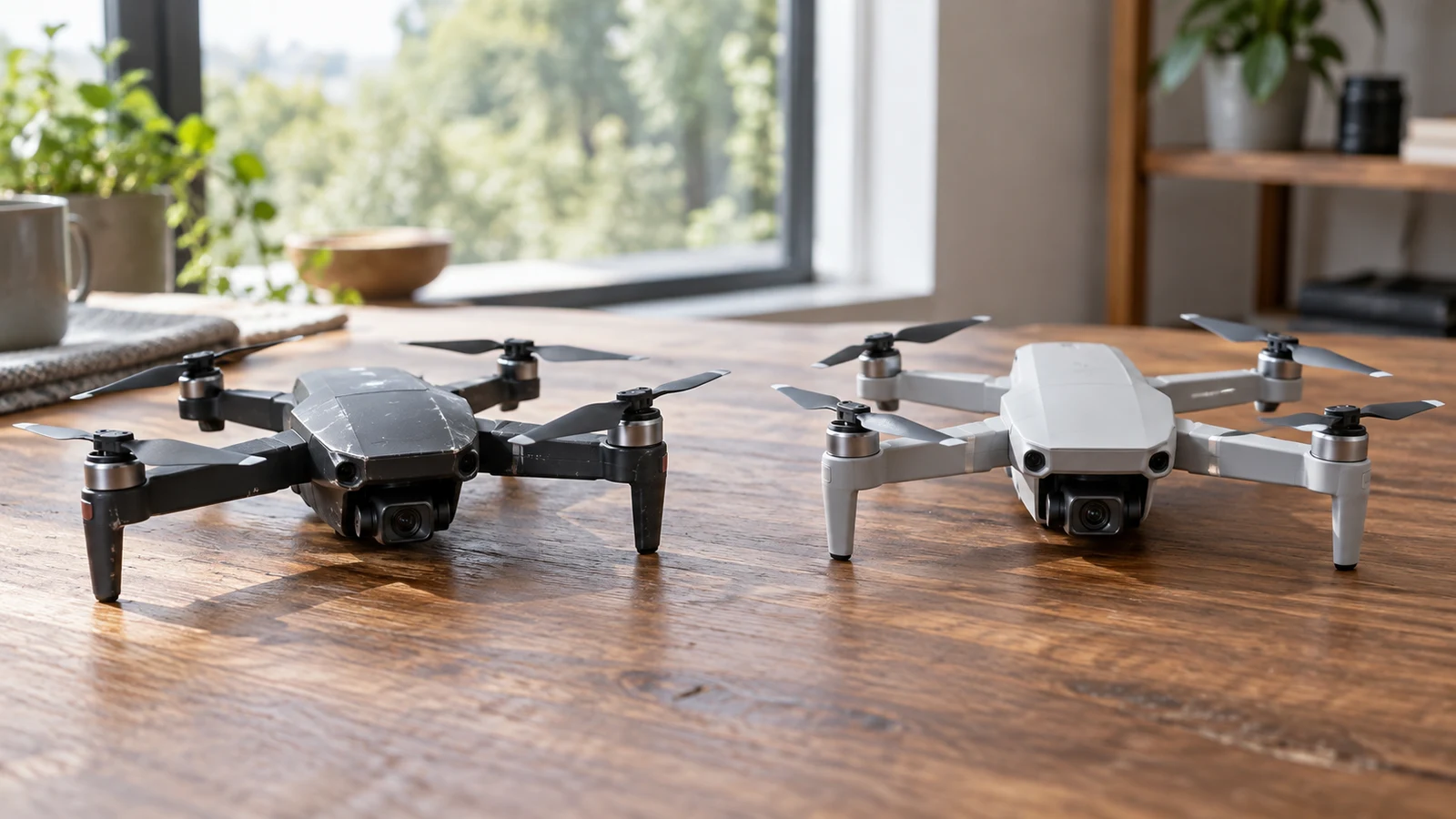
The Pre-owned Vivitar VTI Phoenix drone is worth considering for flexible framing if its advertised camera movement suits your intended shots and the particular used unit is in acceptable condition. Its description specifies a 180-degree articulating camera, compared with the S159's stated 90-degree adjustable lens. That difference gives you a reason to investigate the Vivitar, but it does not establish better pictures or easier camera adjustment during flight. The purchase depends on how the mechanism works, its present condition, and the equipment supplied with it.
The S159 brings a different documented package: a camera described as supporting 4K video recording, GPS and optical-flow positioning, and an included remote with a 5.9-inch display. Neither description provides enough evidence to declare an overall image-quality winner. For this comparison, the useful question is whether the Vivitar's camera articulation is valuable enough to justify accepting a pre-owned aircraft after checking its battery, controls, and support terms.
The comparison is framed as pre-owned versus new, but confirm the selected S159 unit's condition before buying. Its supplied description does not explicitly establish new condition. The feature comparisons below come from the product descriptions, not independent flight tests, and the condition questions apply to the actual units offered for sale.
Plan Distant Subject Photography Without Losing Context: Assess The Camera Movement
The Vivitar description pairs a 2048 x 1152p sensor with a 180-degree articulating camera. The S159 description pairs its 4K camera claim with a 90-degree adjustable lens. These are different kinds of specifications: one concerns stated image dimensions or recording resolution, while the other concerns camera adjustment. Decide how much each matters to your intended use before treating either model as the stronger purchase.
Start by asking the seller to explain the endpoints and direction of each camera's movement. Neither supplied description tells you enough to map the advertised angle onto an exact forward, downward, or upward view. Avoid assuming that the Vivitar can point in a particular direction simply because its stated adjustment range is larger. A photograph or demonstration of the actual mechanism would make the comparison more useful.
How you change the angle also matters. The descriptions establish articulation or adjustment, but they do not explain whether you can move either camera remotely during flight. If your intended sequence requires changing the camera angle while airborne, ask that question directly. If you are content to set the angle before takeoff, focus instead on whether the mechanism reaches and holds the position you need.
For example, imagine that you want to make separate recordings with the camera at different angles. Your buying question is whether each adjustment can be made predictably and whether the used camera joint remains secure. That is a narrower, more answerable question than whether 180 degrees is automatically better than 90 degrees. It also gives the seller something specific to demonstrate without requiring a broad performance promise.
Keep camera articulation separate from stabilization. Neither supplied description establishes a camera gimbal or a particular image-stabilization system. The S159's optical-flow positioning and the Vivitar's altitude-hover claim describe flight-related features; they do not, by themselves, establish how smooth the recorded footage will look. If smooth video is essential, request a representative original recording from the exact model and ask about the conditions under which it was captured.
Resolution labels leave further questions open. The descriptions do not supply a matched comparison of recording frame rates, compression, or low-light performance. Ask for sample files that you can inspect on the screen you normally use. A live-view screenshot alone does not establish saved recording quality. There is no need to assume that either model will produce your preferred result before seeing evidence relevant to that result.
For a separate discussion of composition, read Plan distant subject photography without losing context. Here, keep the equipment decision focused on whether the camera can achieve the angles you need, how you control those angles, and whether the offered unit still performs that adjustment properly.
S159 Drone Alternative: Weigh Used-Unit Condition Against The Listed Package
The S159 drone alternative lists two batteries and a remote with a 5.9-inch display. Its description identifies a 2200mAh battery specification but gives no numerical flight duration. The Vivitar description claims about 32 minutes per charge without stating the present capacity or history of the battery supplied with the pre-owned unit. Those descriptions cannot support a reliable endurance ranking.
For the Vivitar, ask whether the supplied battery is original or a replacement and whether the seller has information about its age or use. Request any available recent runtime observation, including the conditions of that observation. A general model specification and a measurement from the actual battery answer different questions. If no unit-specific information is available, leave actual runtime uncertain when deciding what the aircraft is worth to you.
The S159's two listed batteries give you a package detail to confirm, not a basis for calculating uninterrupted flight time. Ask whether both batteries are supplied with the selected variant, what charging equipment is included, and how the manufacturer instructs owners to charge and store them. Neither product description establishes charging duration or replacement-battery availability. Those details may affect how practical either purchase is for repeated outings.
Condition checks should also cover the feature that makes this Vivitar attractive. Request clear views of the camera housing and articulation joint, along with the folding arms and battery compartment. Ask whether any component has been repaired or replaced. Photographs can help you assess visible condition, while questions about operation address issues a photograph cannot settle. Treat an unanswered question as an unknown rather than assuming either damage or satisfactory condition.
A useful seller demonstration would show the camera moving through its available adjustment positions and remaining where it is set. Ask the seller to identify anything that feels loose, binds, or behaves inconsistently. This request is especially relevant to this comparison because the purchase case for the Vivitar depends partly on that mechanism. A clean exterior alone would not answer whether the camera adjustment is usable.
S159 Drone Alternative: Check What You Can Operate And Maintain
The Vivitar description expressly includes a hard-sided carrying case. It does not provide a complete itemized inventory of the controller, charging equipment, spare propellers, or recording media. Ask for a photograph and written list of everything included with the actual unit. The case is useful package information, but it cannot stand in for confirmation that you will receive everything needed for your intended setup.
The S159 description expressly includes its display remote and two batteries. It also names app control and Wi-Fi connectivity. That does not establish that every function works without a phone, that your phone is compatible, or that a particular accessory is included. Ask which functions use the remote, which require an app, and what device requirements apply. Make the same app-compatibility inquiry for the Vivitar, whose description also names app-based control.
Before choosing either drone, establish how you would obtain the instructions and identify replacement parts. Request the exact battery and propeller references if ongoing use matters to your purchase. Neither description confirms current parts availability or a repair service. You can still compare the models without those assurances, but avoid assigning value to maintenance support that has not been established.
Warranty and return terms belong in the used-versus-new comparison because they determine what recourse is offered if the delivered unit has a problem. Ask whether any warranty applies to the particular aircraft and battery, who provides it, and what exclusions apply. Separately, read the applicable return conditions. Neither supplied product description establishes coverage, return eligibility, or a deadline, and the S159's presumed new status should not substitute for written terms.
S159 Drone Alternative: Decide Which Controls And Purchase Terms Fit
The Vivitar description lists one-button automatic takeoff and landing, real-time Wi-Fi viewing, and an app-based Follow Me function. It also names GPS Auto Return Home, altitude hover, location lock, and three speed modes. These features offer several points to investigate during a demonstration. Ask how you select a mode, recognize its status, and return to ordinary control instead of assuming that the feature names explain the operating procedure.
The S159 description names GPS positioning, optical-flow sensors, a gravity sensor, and app or remote operation. It also advertises four-way obstacle avoidance and automatic return to home. Treat those as listed capabilities rather than independently demonstrated performance. Ask for the operating limitations and instructions before assigning them a decisive role in your choice. The description does not establish detection coverage under every condition or guarantee obstacle-free flight.
A comparison should connect those controls to your own tolerance for setup. If you prefer a display on the remote, the S159 documents that hardware. If Follow Me is important, the Vivitar description explicitly names it. The S159 description's silence about that function does not prove the aircraft lacks it; it means this comparison cannot credit it with the feature. Apply the same distinction to any capability that appears in only one description.
Ask how initial setup works on the selected unit, including pairing, app installation where needed, and any calibration described in the instructions. Neither supplied description establishes how long setup takes or how straightforward it will feel to you. For the used Vivitar, also ask whether the seller can demonstrate live viewing and the supplied controls together. That would address the working package you are considering, rather than just the aircraft in isolation.
Price should enter the decision after you know what each package contains. Compare the current selected variants and any confirmed costs for missing equipment. Do not presume that pre-owned means cheaper overall or that a higher purchase price includes better support. Current stock, condition, and final pricing need confirmation on the relevant product and checkout pages; the descriptions alone cannot settle those purchase details.
If you intend to pay with cryptocurrency, keep the payment check proportionate to this equipment decision. Read the currency and network offered for your selected checkout, the requested amount, and any displayed fees or timing conditions before authorizing payment. Also read the applicable cancellation and refund terms. A payment option cannot resolve uncertainty about the camera mechanism, battery condition, or included parts, so settle those product questions first.
The Pre-owned Vivitar VTI Phoenix drone has a credible place on your shortlist when its stated articulation addresses a real need and the offered unit's condition supports that use. The S159 merits consideration when its documented display remote, two-battery package, and listed recording capability better match your priorities. Neither choice has an established advantage in actual runtime or recorded image quality from these descriptions alone.
Open the Pre-owned Vivitar VTI Phoenix drone listing and ask for confirmation of the camera's adjustment method, the supplied battery's condition, and the complete package. Compare those answers with the selected S159 offer and its support terms. If the Vivitar's distinctive camera movement remains unconfirmed, leave that benefit out of your purchase decision until you know whether the actual unit delivers it.