Cooking & Food Prep
When potato tool instructions do not match the mechanism
Catalog names can blur the difference between a paired-handle potato press and a crank mill. Identify the mechanism before applying another model’s instructions.
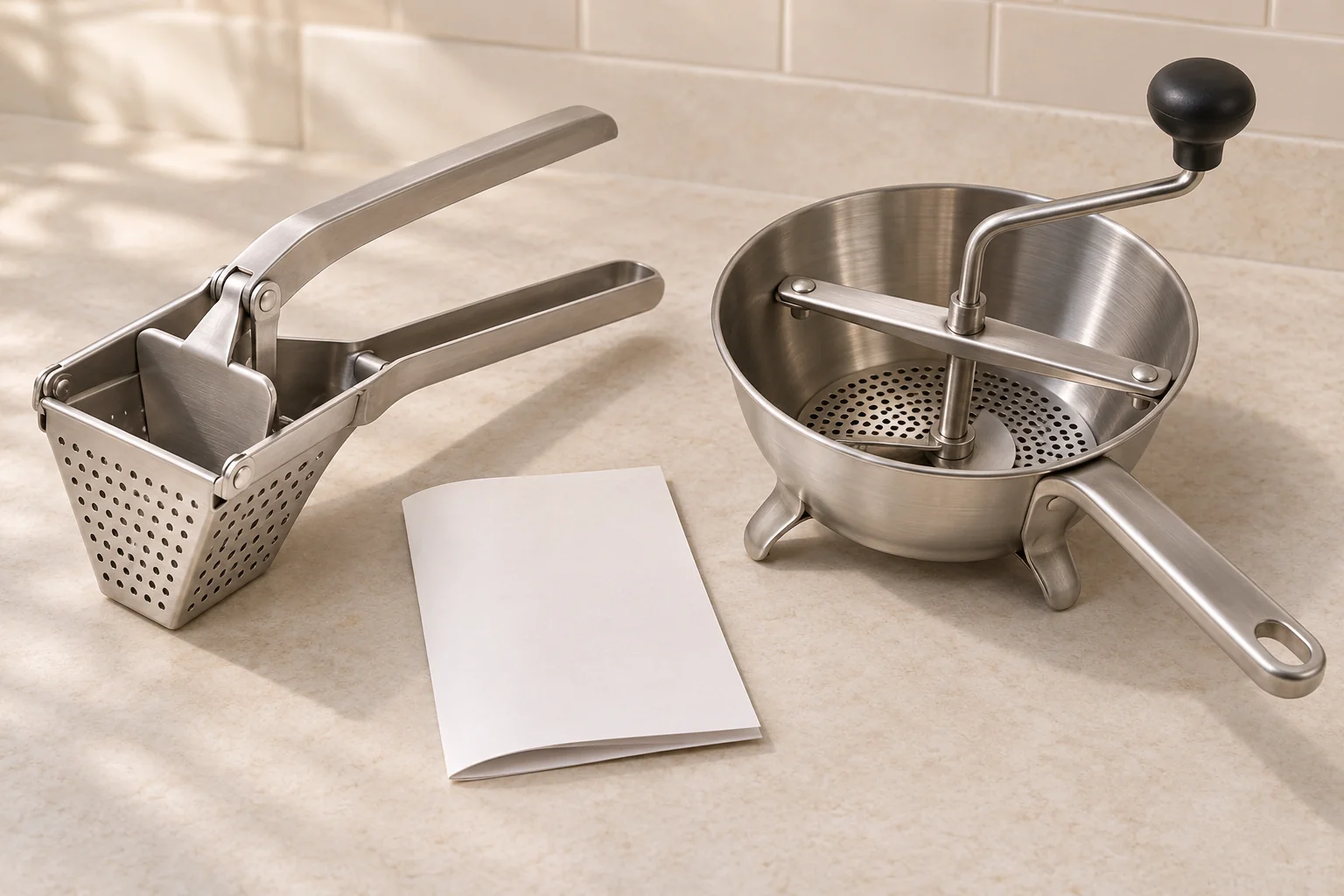
If potato tool instructions describe a part you cannot find, pause the method before assuming the tool is broken. A retail name can put different mechanisms under the same word. The useful question is whether the directions describe the device in front of you: its working chamber, moving parts and way of moving food. A photograph can help identify those features. It cannot supply the missing manufacturer's assembly or cleaning directions.
Start with the potato ricer mechanism
The TrueCraftware ricer listing illustrates a paired-handle press. Its gallery shows a perforated V-shaped basket, a pusher and an integral pan hook. Its description says to wash and boil potatoes before putting them in the basket and pressing the handles. Those are catalog directions for this offering, rather than a tested force limit. The title says 16 inches, the prose gives 10¾ by 4 by 4 inches, and the diagram shows 15 inches overall. Those figures do not agree, so none establishes a measured size here. Nor does the diagram's separate basket illustration establish that an extra strainer arrives with the press. The potato ricer mechanism is the relevant visible distinction: paired handles move a pusher toward a working basket. Material, delivered contents, pressing effort and the advertised texture or starch advantages remain unverified. That uncertainty should stay visible in a product enquiry, especially when the conflicting dimensions matter to storage or fit.
A catalog ricer can show a crank food mill
The Wellsay potato-tool listing also uses “ricer,” while its description calls the tool a masher, press and strainer. Its sole image shows an open bowl, a crossbar and spindle assembly, a turning lever with a knob, and three loose perforated working plates. That is the visible arrangement of a crank food mill, rather than two handles squeezing a pusher into a barrel. The plates are presented as parts of the milling mechanism, not as three independent strainers. The picture and the listing's “1 set” description do not certify the delivered inventory. There is no printed factory model in the image that authenticates another manufacturer's manual. A reader following squeeze-handle directions would be looking for a different mechanism. The naming mismatch calls for the correct instructions. It does not diagnose a defect or authorize improvised disassembly. Ask which model the supplied directions cover, rather than treating the familiar retail name as the answer.
Match the manual to the moving parts
OXO's official 3-in-1 Adjustable Potato Ricer booklet makes the model boundary clear. Its instructions use a rotating disc with notches and icons to select a consistency. They describe firm vegetables being boiled until tender and cut to fit, a barrel being loaded, and paired handles being squeezed. Its cleaning illustrations then identify particular disc positions and thumb placements. These details belong to that adjustable OXO ricer. A V-shaped basket on another press does not establish that it contains the same rotating disc or uses the same release sequence. Before following a diagram, check that the named part and its pictured location actually correspond to your model. If the manual's adjustment cannot be found, keep that mismatch open instead of translating the instruction into an unsupported movement. A different basket design can still be a press, while requiring its own assembly and care information. The booklet supplies a concrete example of why a mechanism match alone is only the beginning of a manual match. A missing illustrated feature is a reason to seek the right document, without trying to create that feature through force.
A turning direction can be model specific
OXO's separate Good Grips Food Mill instructions describe another arrangement. The illustrated mill has a disc, post, bar, hooks and a release button. The booklet specifies disc orientation, aligns named parts during assembly, and gives a turning direction for moving food through that mill. It also describes reversing the direction to reposition food. These instructions explain the OXO mechanism shown on that page. They do not establish the correct direction, locking sequence or release method for the Wellsay offering. Its catalog image does not authenticate the same release button, hook arrangement or disc orientation. The distinction matters when a search result seems to solve a sticking problem: an instruction can be accurate for the pictured model and still be the wrong instruction for yours. Find the actual product information before adopting the movement. Copying only the convenient turning tip while ignoring the assembly diagram would leave the underlying applicability question unanswered. Preserve the model identification alongside the saved page so that a later search does not strip away this qualification.
Similar food does not establish identical loading
The manufacturer's page for the Norpro 469 Deluxe Jumbo Potato Ricer describes pressing cooked potatoes, peeled or unpeeled. It also describes its own capacity and perforated construction and says that it disassembles for cleaning. Those statements concern the named Norpro product. They do not establish a capacity, skin-handling capability or disassembly procedure for either catalog offering above. In particular, “disassembles for cleaning” does not tell a reader which connection to release on a different device. This is another useful check on potato tool instructions: the food name may match while the permitted preparation, chamber and access details do not. Treat the model name as part of the instruction, rather than dropping it when saving a useful sentence. A claim about cooked potatoes in one manufacturer's press remains narrower than a claim that every potato tool accepts the same loading or separates the same material. The page offers no basis for prescribing extra pressure to overcome resistance in either of these two offerings. Requesting the actual instructions is more useful than asking whether every item sold under the same broad name works alike.
Keep a recipe's preparation attached to its method
BBC Good Food's Best ever creamy mashed potatoes starts the potatoes in cold water, cooks them until very tender, then drains and steam-dries them. Its method puts them through a ricer in batches before the butter and milk are incorporated. That sequence is useful context when checking what a particular recipe means by prepared potatoes. It is not a mechanical troubleshooting test. The recipe does not identify the TrueCraftware press or Wellsay mill, measure resistance, or explain either tool's disc access. A potato that has not reached the recipe's specified preparation is a different starting point from the one described. That observation does not diagnose why an unfamiliar tool feels difficult to operate. Keep the recipe and the device instructions available as separate references: one describes the dish's preparation, while the other must establish the device's permitted use. Neither reference becomes a substitute for the other merely because both mention potatoes. There is no need to turn a recipe's batch instruction into an invented basket capacity. The method specifies the condition of its own ingredients; it does not inspect the condition of an unfamiliar device.
Do not combine two recipes into one rule
Angela Nilsen's BBC Good Food Perfect mashed potatoes uses a different method: potatoes go into boiling water, are cooked until tender and dried, then milk and butter are added before the whisking or mashing stage. That differs from the ricer-before-dairy sequence in the preceding recipe. The difference is a reason to follow the chosen recipe's actual method, rather than assemble a universal sequence from isolated sentences. It does not demonstrate that one recipe repairs a jammed basket or that added dairy is an operating aid for a press. Even a recipe page that mentions a ricer elsewhere must be read closely enough to distinguish its main method from surrounding advice. For this problem, the narrow lesson is applicability: identify which preparation and which tool the instruction actually concerns. Once those details have been separated, there is less temptation to treat every mention of mash as interchangeable mechanical guidance. Keeping those distinctions visible avoids turning two different cooking methods into a mechanical recommendation neither recipe makes.
General technique advice has a boundary too
Lily Barclay's BBC Good Food ultimate mashed potato guide discusses drying potatoes after cooking and describes a ricer or sieve as part of its team's approach. Much of the guide concerns the finished dish and flavor choices. That is different work from identifying a press's release mechanism or a mill's assembly. It can help a cook understand a stated technique without authenticating any particular retail tool. Keep that boundary when a useful cooking guide appears in the same search as operating instructions. Advice about a finished mash does not establish a basket fault, a safe force limit or a transferable cleaning procedure. Use the relevant cooking context, then return to the actual device information for the unresolved mechanical question.
A review describes the units it actually tested
Elaine Lemm's BBC Good Food ricer review reports testing cooked vegetables and discusses several constructions, including conventional presses and a twisting model. Its observations about effort, retained food, loose parts or basket removal concern the particular units reviewed. Neither catalog offering here is authenticated as one of those tested units. A reviewer's difficulty removing a basket is therefore not a diagnosis of your basket. Nor does a favorable cleanup observation establish that every superficially similar tool can be cleaned the same way. The review is useful evidence that construction and access details vary within products sold as ricers. It supports reading the actual model account, rather than treating “ricer” as a complete operating specification. When checking a review, retain the product name beside the observation that interests you. If that identity cannot be matched, leave the finding with the tested product. A family resemblance can help explain the question to a seller, but it does not supply the missing answer about your mechanism. The reported difference can guide a question about the tested unit while leaving another model’s unresolved details untouched.
Separate the operating question from the finished supper
Andrea Rivera Wawrzyn's Serious Eats ricer tests likewise report differences in loading, effort and cleaning across the tested models. They distinguish twisting and geared mechanisms from traditional presses and note the cleanup burden of additional perforated surfaces. Those are observations from that test, not measurements of these native offerings. In particular, a discussion of dried potato residue does not establish a brush, dishwasher or disc-removal method for your tool. The remaining question is specific: which instructions correspond to the actual moving parts and model? Keep that question separate from a decision about the dish already on the table. The guide to gluey mashed potatoes at dinner concerns that immediate supper decision, while serving potato toppings separately concerns shared serving. Neither resolves missing operating information. With the device identified and its actual instructions located, the original mismatch can be addressed without inventing a fault or a force prescription. Neither review supplies a transferable force limit, so the practical next step remains locating information for the identified device.
A paired-handle press and a crank mill need instructions that match their own mechanisms.