Portable & Backup Power
Portable power station energy and output: FFpower and Jackery checks
Read FFpower P1000 Plus and Jackery HomePower 3000 capacity, output, port and solar-kit claims before matching a station to your named devices.
Write down the devices you want to support before comparing portable power station energy and output. A battery's stored energy, the permitted electrical output and the connection each device needs answer different questions. The FFpower P1000 Plus offer lists 1024Wh of capacity and 1800W rated power. Jackery's HomePower 3000 offer lists 3072Wh and 3600W output. Those labels do not establish how long your refrigerator will run, whether several appliances may share the outlets or whether a particular adapter is suitable. For each offer, record the unresolved output, connection and package details beside your devices.
The offers appear in different retail categories: FFpower in Storm & Flood Prep and Jackery in Camping Gear. This is an explanation of their stated equipment and unresolved buying questions, rather than a claim that the category labels establish an equivalent package. Both descriptions promote home and outdoor use. You may want power for lights and communications during an outage, or you may need supply for a particular cooler on a trip. Name that job and identify the actual device requirements before assigning value to the advertised power station features.
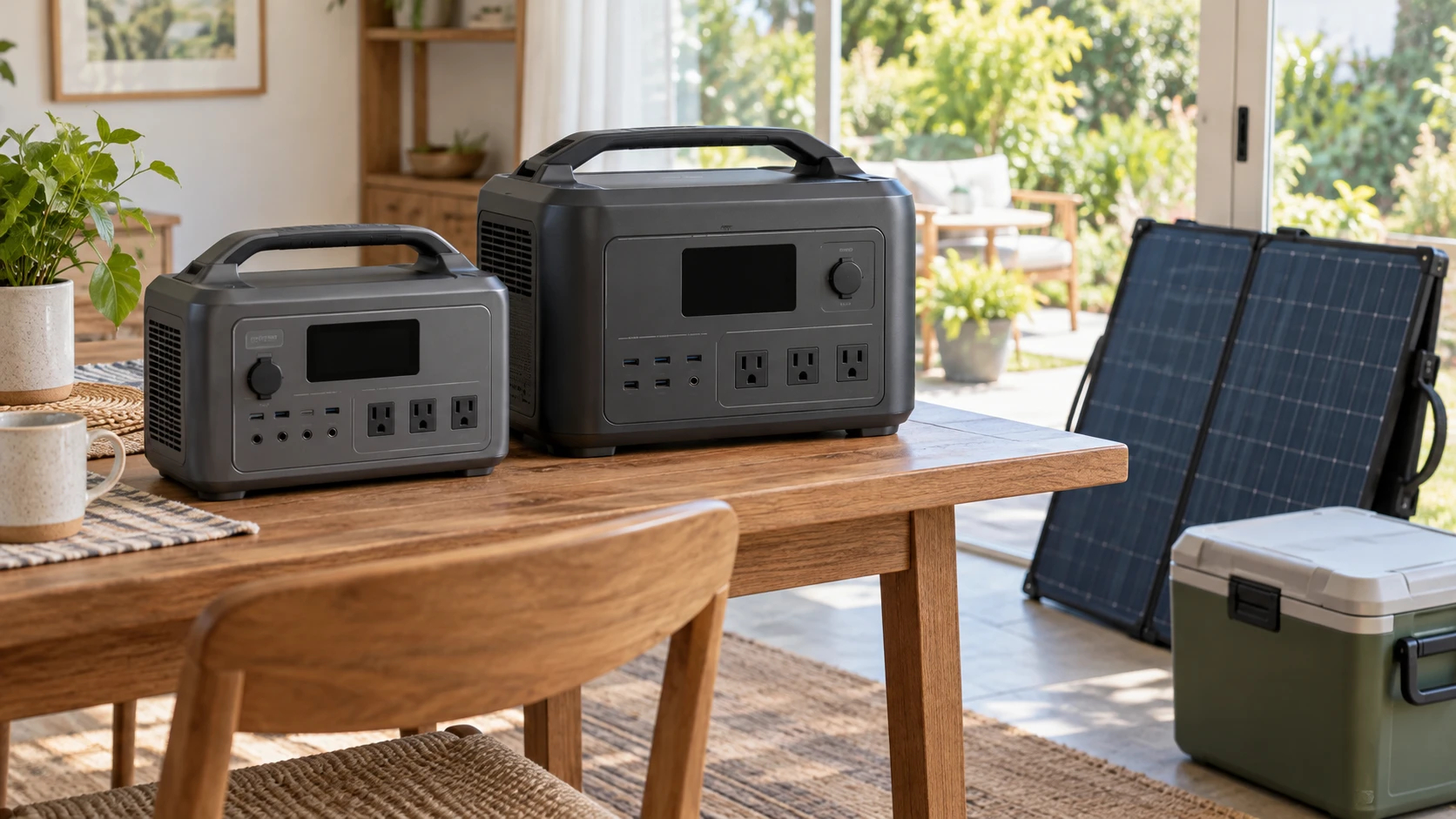
The conceptual editorial cover shows generic portable power stations, a separate solar panel and a cooler in a household setting. It does not show the actual FFpower or Jackery models, included package contents, a permitted electrical connection or tested backup performance.
Read the stated battery energy separately from rated output
The FFpower P1000 Plus offer names a LiFePO4 battery, 1024Wh capacity and 1800W rated power. Its title also names 320000mAh and a 3600W peak. Those entries do not form one interchangeable measure. Keep watt-hours beside the energy requirement of the proposed job and the rated watts beside the actual device's demand. This guide makes no conversion from the milliamp-hour figure because the selected wording does not provide the full conditions for that conversion. A peak label is not permission to supply that power continuously.
The Jackery HomePower 3000 offer names a 3072Wh LiFePO4 battery, 3600W output and 7200W surge. Its stated energy is three times FFpower's 1024Wh figure, but that arithmetic is not a threefold runtime result for your appliances. The usable arrangement also depends on the device, output path, operating conditions and permitted reserve. The selected descriptions do not provide a matched test with the same appliances. Do not turn the nominal capacities or surge numbers into hours of refrigeration, days at a campsite or a guaranteed response to a power interruption.
Record the device's relevant power information from its exact documentation, not merely its product type. A refrigerator, a light and a laptop adapter can need different connections and draw power differently during use. If more than one device is involved, identify which will need supply at the same time. Ask for the station's documented combined limits and the device maker's applicable requirements. Counting sockets cannot answer that question. These are purchase checks; the article does not provide wiring, load-testing or operating instructions for either power station.
FFpower promotes use with most appliances and mentions a 99% figure. Jackery promotes lengthy household and refrigerator backup intervals. Those statements should not decide whether the particular device in your plan is supported. Neither percentage coverage nor a household description identifies every load behind the claim. Ask which exact configuration and conditions support the statement relevant to your purchase. Keep a device whose requirements remain unknown out of a promised runtime calculation. Send the seller the exact device list and ask for the applicable output documentation.
Power station device connections need model-specific answers
For power station device connections, FFpower lists eleven outlets: four AC, two USB-A Quick Charge 3.0, two USB-C PD with stated 20W and 100W figures, two DC outlets and a cigarette-lighter socket. That is a documented inventory of port types, not evidence that every port reaches its printed maximum while all others are loaded. Ask for the exact combined-output rules and the supported profiles relevant to your devices. Also confirm the AC voltage and frequency of the delivered version. The selected description does not settle that regional electrical specification.
Jackery lists AC, USB-C, USB-A and DC connections, including dual 100W PD ports and a TT-30 RV port. Those features can matter if your named equipment needs them, but the description does not give a complete port-by-port specification or the permissions for every simultaneous combination. A TT-30 label is not a design for powering a vehicle or connecting a household. Have the exact equipment requirements assessed against the model's own instructions. This guide provides no hardwiring arrangement, adapter recommendation or assurance that a particular existing installation is ready for the station.
The guide comparing the restored Jackery Explorer 300 and refurbished BLUETTI AC50B develops actual power station purchase decisions around reserve, carrying weight, combined outlets and the devices needing power. Its smaller stations and refurbishment questions are different products and conditions. The directly relevant distinction is that battery energy, outlet output and the whole connection plan need separate evidence. Do not assign their port limits, battery health, supplied cables or charging features to the P1000 Plus or HomePower 3000.
Consider the shape and number of connections as well as their labels. Bulky adapters can affect access, and a device may need a specific power profile that is absent from a short retail description. Obtain the actual port layout and approved connection information for the selected station before counting a socket as usable for your equipment. If the plan depends on an accessory, name it and confirm its suitability separately. A nearby loose cable in an editorial image is not a supplied component or a compatibility decision.
Use an actual refrigeration question instead of a promised runtime
The guide to Norcold N15DCIMSS and the Dranite 16QT cooler shows why a refrigeration load needs its own identity. Norcold is described as a permanently mounted, direct-current refrigerator; Dranite is a portable compressor cooler with listed AC and DC adapter options. The buying questions include actual supply requirements, installation needs and missing load information. Those distinctions matter when a power station description broadly names refrigerators or RV use. They do not establish that either station here supports either refrigeration product.
Keep the appliance connection requirement separate from the energy needed over the intended period. The refrigeration guide explicitly leaves a complete operating profile and runtime unresolved. A stated current figure without its operating conditions cannot provide every detail of an outage plan. Ask for the information required by the exact appliance and station documentation, including any startup and simultaneous-load conditions. Avoid replacing that work with a promise that the larger station runs a refrigerator for a particular number of days. No such matched test is supplied for these offers.
If the cooler is intended only for occasional trips, its food load and travel position are different questions from supplying a permanently installed refrigerator. Explain which job you mean when asking about a station. That helps keep a seller's answer attached to the right device and arrangement. The P1000 Plus and HomePower 3000 descriptions contain broad home and outdoor examples; neither resolves the placement, restraint, ventilation or electrical requirements of your entire setup. Obtain the appropriate exact-model instructions instead of borrowing a connection method from the other refrigerator format.
Solar charging kit checks include the delivered parts
With solar charging kit checks, start by identifying what the selected offer actually supplies. FFpower's description lists the P1000 Plus, a 200W solar panel, AC charging cable and user manual. It also describes exclusive two-year customer service. That last phrase is not a complete manufacturer warranty or a promise that every repair is covered. Confirm the support issuer, applicable terms and the precise panel and cable inventory before treating the package as a complete charging arrangement. The description says the station and panels are delivered in separate packages.
Jackery's title identifies an offer with 200W solar panels, and its description says the station and panels ship separately and may arrive in different packages. The supplied wording does not give a complete panel-count and cable inventory. Ask which panel version, quantity and connection pieces belong to the selected order. Separate shipment matters if you need the whole setup for a particular trip: receipt of the station alone does not establish that every promised component has arrived. Verify the package record rather than judging completeness from the first carton.
FFpower's charging figures need clarification before a short charging stop becomes part of your plan. Its title names a 43-minute full charge, while the description names 41 minutes with stated AC and solar inputs and also says within one hour. These are different published claims. This guide does not reconcile them into one established charge time. Ask for the conditions and the exact model instructions behind the figure you intend to rely on. No charging power setting, combined-input procedure or solar connection sequence is supplied here.
Jackery names 1.7 hours for hybrid AC and DC charging, 2.2 hours for AC and up to 80% in nine hours with SolarSaga 200W panels. Different input methods and endpoints should remain attached to their respective statements. They are not common charging tests against FFpower's claims. The description also mentions car and generator charging; those words do not establish supplied adapters or appropriate use with your vehicle or generator. Confirm the exact input specifications and required components before assigning a replenishment interval to the trip.
Claims about interruption, lifespan and carrying need their own evidence
FFpower describes an EPS response below 0.01 second. Jackery describes a UL-certified UPS with switching within 20ms and promotes continuity for several example devices. Those retail statements do not certify your particular equipment's uninterrupted operation or establish that the two modes have identical permissions. Ask for the exact applicable documentation and the requirements of the device whose operation matters. This article endorses neither offer for a critical load and provides no test of transfer behavior. The named feature is a reason to investigate, not an independently observed backup result.
The descriptions also promote battery life in years or cycles and make size or weight comparisons. FFpower supplies a 12kg weight; Jackery's selected wording gives relative size and weight claims without a directly comparable complete weight and dimensions record. Keep the station, panels and necessary accessories in the carrying plan. A percentage against unspecified comparable models cannot tell you whether you can lift the delivered package or fit it in your storage space. Request the actual measurements and handling guidance for the exact items you will receive.
Current listed prices are $487.49 for the FFpower offer and $1873.75 for Jackery, a difference of $1386.26 before delivery or other applicable checkout additions. Those amounts belong to the selected offers. Resolve their package details before comparing delivered costs; neither amount supplies a tested cost per hour. Jackery's description includes tax-credit language referring to a possible 2025 end date. Do not count that old promotional wording as a current entitlement. Determine the actual delivered total and any independently verified eligibility before including an adjustment in your own budget.
Check cryptocurrency terms after the equipment decision
Consider cryptocurrency payment after you have confirmed the station, panels and connections needed for your equipment. A payment option cannot resolve a charging claim or a missing package item. Republeq.com advertises crypto purchasing, and its payment badges name USDT among the available choices. Check the order screen for the asset, network and instructions offered to you. Avoid sending from an earlier invoice or assuming the same network applies to every purchase. Keep the order identity and payment record together, particularly when the station and solar panels may arrive as separate consignments. The store's published policy makes cryptocurrency sales final. It states that purchases using these payments cannot receive a refund, and stablecoins are included within that restriction. Paying with USDT therefore does not remove the final-sale boundary. Resolve uncertain device compatibility and any necessary kit parts before accepting those terms rather than planning to obtain a refund afterward. An exchange has its own eligibility conditions. The request deadline is thirty days after the original purchase date; waiting for a later camping trip could use part of that period. The equipment needs to remain unused, unwashed and in its original condition. Keep the original packaging and the order's accessories, manuals and tags available for the request. Preserve proof showing the payment, such as its transaction reference and the purchase confirmation. The policy also makes exchanges dependent on available products, so a replacement model is not automatically reserved for you. Read the authorization process and the other exclusions applicable to your order before relying on exchange eligibility. Ask the store to clarify unresolved package or purchase conditions while you can still decide whether to proceed. Retain the terms with your named load and charging plan, so the payment decision follows the equipment evidence rather than distracting you from an unanswered requirement.
Keep the named equipment plan beside the order
Keep each device's requirements beside the selected station's documented output and connection specifications. Keep unresolved combined-port limits, regional electrical specifications and charging claims visible. For the P1000 Plus, ask about its different recharge statements and the exact panel package. For HomePower 3000, confirm the port map, package contents and the conditions behind its advertised backup intervals. Save the exact panel inventory, electrical version and relevant model instructions with those answers. If any necessary device connection remains unconfirmed, resolve it before ordering.