Office Supplies & Stationery
Check pop-up note refill fit beyond size
Compare what two same-size note listings say about accordion presentation and self-stick use, with exact dispenser fit and variant contents left unconfirmed.
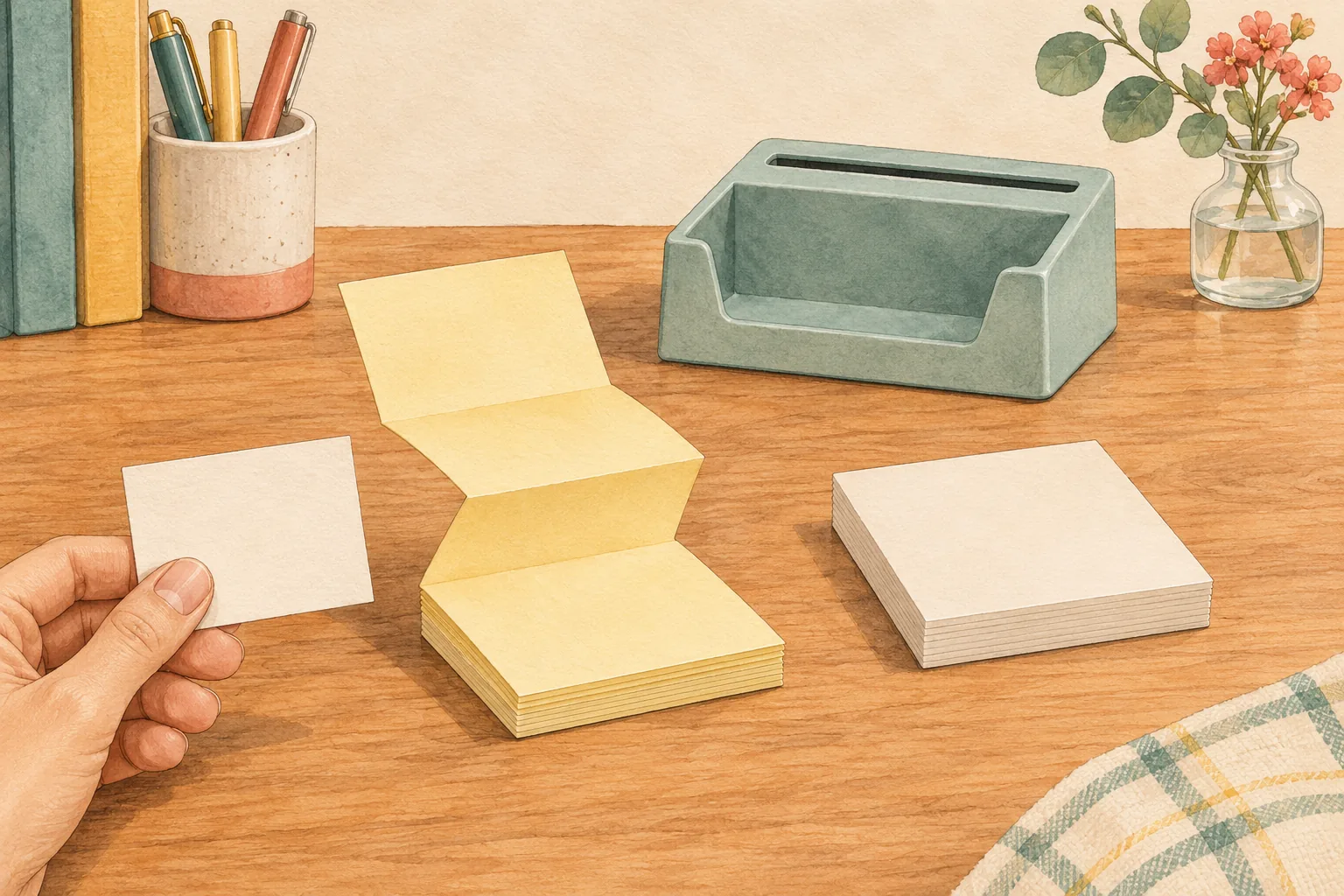
Check pop-up note refill fit against the dispenser you intend to keep using. A package can describe the size of its sheets, how they stick and how they are presented for removal. Those statements answer different questions. Decide which statement addresses the refill requirement before treating a familiar-looking pad as a suitable replacement.
The comparison here concerns the information supplied for two writing-pad offers. It reports no loading trial, adhesion test or successful pairing with a desktop dispenser. An actual equipment match still needs information that applies to that dispenser and the proposed supply. Keep that unanswered relationship visible while deciding what the wording of each offer does establish.
Read the accordion note format designation
The Post-it dispenser notes offer explicitly describes an accordion note format and pop-up refills. Its stated bundle is five packs of ten pads, with ninety notes per pad and three-by-three-inch sheets. The single original shows Post-it and 3M wording, a dispenser-notes label and an accordion icon. Its printed ten-pad, ninety-each and nine-hundred-total labels do not independently verify delivery of five packs. Neither the image nor the description demonstrates fit with your dispenser.
Keep self-stick pad claims with their own meaning
The HouseLabels note account gives self-stick pad claims and three-by-three-inch dimensions. Its yellow thirty-six-pack title sits alongside nine count-and-colour variants, with no explicit variant-to-image mapping. Two gallery images show six multicoloured pads and six yellow pads. Those pictures do not authenticate the aggregate order quantity or delivered colour. The native text describes lifting notes from a pad and posting them; it does not state an accordion refill designation or demonstrate a dispenser pairing.
In these accounts, the first offer supplies an explicit pop-up or accordion designation. The second supplies self-stick wording while leaving that designation unestablished. Both state the same sheet footprint. This is a difference in the information provided, not a tested finding that either product will work, or fail to work, in a particular dispenser.
Ask which property the next sentence describes
When reading a candidate offer, pause after a feature claim and name the question it answers. A description of sticking concerns one aspect of a note's intended use. A statement about a refill format concerns another. Keep those entries separate in your own reading rather than allowing an appealing adjective to fill a missing compatibility statement.
For example, an invented shopping note might contain “I want the next sheet ready to take” beside “I want a note I can post on my own working copy.” These are the reader's two requirements, not results reported for a retail product. Either could remain unmet after checking the other. Decide whether both matter for the task before selecting a supply.
Keep a claim's scope intact when comparing wording. If a source discusses one property, preserve that property with the claim. Do not add “therefore suitable for my holder” to the end of a sentence that never identifies the holder. That added conclusion would belong to your inference, leaving the actual pairing no better documented than it was before.
An unanswered format question also need not become a rejection of every other use. You may still have a separate reason to investigate a pad for writing outside a dispenser. Give that possible purchase its own purpose. Choosing ordinary writing supplies and finding a refill for existing equipment can be separate decisions, even when both begin with a request for more notes.
Identify the dispenser without opening a new problem
Use an accessible product reference or the documentation retained with the equipment to establish which dispenser is involved. Keep the full reference while consulting its applicable refill information. This guide gives no opening, loading or alteration instructions. A photograph resembling the holder on your desk is a starting point for an identity question, not an answer about its accepted supplies.
If another person supplied the desk equipment, ask what information they retained with it. They may have an order reference or instructions you have not seen. Say which item you mean rather than asking about the office's note holders collectively. The answer should stay attached to the particular dispenser being considered, especially where several similar-looking objects share a workspace.
Keep a missing identity visible. You can leave the refill purchase undecided while looking for the relevant information. Do not assign a model from a convenient search result simply to finish the shopping task. An honest description of what you own gives a supplier a clearer question than a confidently named different item.
Follow one fictional desk-supply decision
Imagine that Sam is responsible for ordering stationery for a shared desk. Jules asks for refills for a particular note dispenser. Sam has not yet identified that dispenser and initially writes only “more sticky notes.” This is an invented purchasing situation. No actual dispenser model, supplier reply or functioning combination is assigned to either person.
Jules explains that the request concerns retaining the existing dispenser, rather than placing a free-standing pad beside it. Sam changes the task description accordingly. They keep the separate request for loose desk notes on another line. The revised task no longer lets an answer to one need silently close the other.
Jules also changes the wording of the independent-pad request. It now says that the notes will be used beside the equipment, with no claim that they belong inside it. Sam can consider that request on its own terms. If the two requests eventually lead to the same candidate, they will still need separate reasons for that choice. If they lead to different candidates, the order can preserve that difference. Neither outcome has to be invented in advance to make the shopping conversation sound settled.
Sam then separates the questions still open: which dispenser Jules means, what refill information applies to it and which candidate is being considered. Sam can examine available descriptions without claiming to have completed the match. The desk's need for stationery does not make a missing equipment reference appear, and the example does not invent one to produce a neat ending.
Suppose Jules later supplies the retained equipment information. Sam would read the requirements actually stated there and compare the candidate against those requirements. This hypothetical next step supplies no acceptance result. If the information remains incomplete, Sam keeps the relevant question open instead of converting the arrival of a document into automatic approval of a purchase.
Use size for the question it can answer
Copy a stated measurement with the object and feature it describes. A sheet measurement belongs to the sheet. A holder's external measurement belongs to the holder. Keep any proposed comparison explicit so another reader can see which two quantities you mean. The presence of numbers in both descriptions does not establish that they describe matching parts.
If a package omits a measurement needed by the actual equipment information, ask about that missing property. Do not supply it from the photograph's apparent scale. Keep a personal observation separate from the seller's stated specification and from a maker's compatibility statement. Each can be useful without being described as the same kind of evidence.
The sketch-pad refill guide separates page removal from documented replenishment of a bound pad. That binding question remains with those pads. Here, the intended receiving object is a separate desktop dispenser. A removable sheet and a refill designation should each retain their own meaning; neither guide supplies an opening or modification method for the other's equipment.
Keep a changed candidate distinct
If the proposed supply changes during the enquiry, retain which item the earlier answer concerned. A reply naming one reference should not become approval of another item merely because its photograph has similar colours. Ask whether the new reference is covered. The earlier answer remains available, while the changed item has a question of its own.
For shared purchasing, agree what the buyer should do if the identified item is unavailable. They might return with the proposed alternative for discussion rather than making an unnoticed change. Keep that instruction short and specific. Give the buyer the selected reference and tell them which unanswered detail should bring the choice back to you.
On arrival, compare the supplied identity and the packaging with the order you agreed. If essential details disagree, retain the discrepancy and obtain clarification before treating the supply as the confirmed replacement. Use the actual equipment instructions for any later loading. Completion of an order is a transaction event, not a demonstration of correct dispensing.
Leave page markers in their own task
The temporary page-flag guide concerns returning to passages during a review, including wider writable cues and narrow edge markers. Its flag arrangements belong to that task. A brand shared with a writing-note offer does not make a page marker a refill for an unidentified desktop dispenser. This article supplies no flag placement or removal test.
Describe the outcome you need in ordinary words before asking someone else to buy it. A request to mark passages, a request for a pad used independently and a request to replenish an identified dispenser should remain distinguishable. They may be handled in the same stationery order, but each line needs to retain the purpose that made it relevant.
Review payment after the supply decision
When a proposed stationery order is ready, review its transaction instructions separately from the equipment decision. If republeq.com currently offers crypto for that order, read the available method in the actual checkout rather than relying on a remembered option. A preference for USDT does not identify the correct network or destination. Check the asset, network, amount and recipient details together against the wallet you intend to use, and include any displayed charges in your review. Confirm the selected item and the order unit before authorizing payment, particularly if the seller has clarified a variant or changed a proposed supply. Retain that clarification with the order reference. This guide has not opened a live checkout, obtained a wallet address, quoted an exchange rate or confirmed current token availability. It supplies no promised delivery date, cancellation outcome or refund value. Read the terms actually attached to the transaction and ask the responsible service about anything necessary that remains unclear. If a transfer has already been attempted and its status is uncertain, reconcile the merchant and wallet records before considering another payment. Keep the transaction reference and any actual acknowledgement so an enquiry concerns the same attempt. Paying twice would not answer an unresolved status screen or establish that the ordered notes suit the dispenser. In a shared workplace, use the purchasing responsibility and payment authority that actually apply to you; an informal request for stationery is not itself authorization to spend another person's funds. A completed checkout still leaves delivery identity and any later equipment result to be observed separately. Keep those later records truthful rather than treating payment confirmation as evidence of compatibility.
Before ordering, read the candidate reference against the actual dispenser information. Keep a statement about sticking with that property and a refill designation with the supply it names. If the equipment match is still unanswered, leave that purchase pending rather than describing a pad chosen for another purpose as its confirmed replacement.