Crypto Commerce
PlayNova X5 pool vacuum vs Seauto SAT25 for pool floors and walls
Compare PlayNova X5 pool vacuum by stated coverage, battery time, floor and wall modes, navigation, pool surfaces, retrieval, and charging.
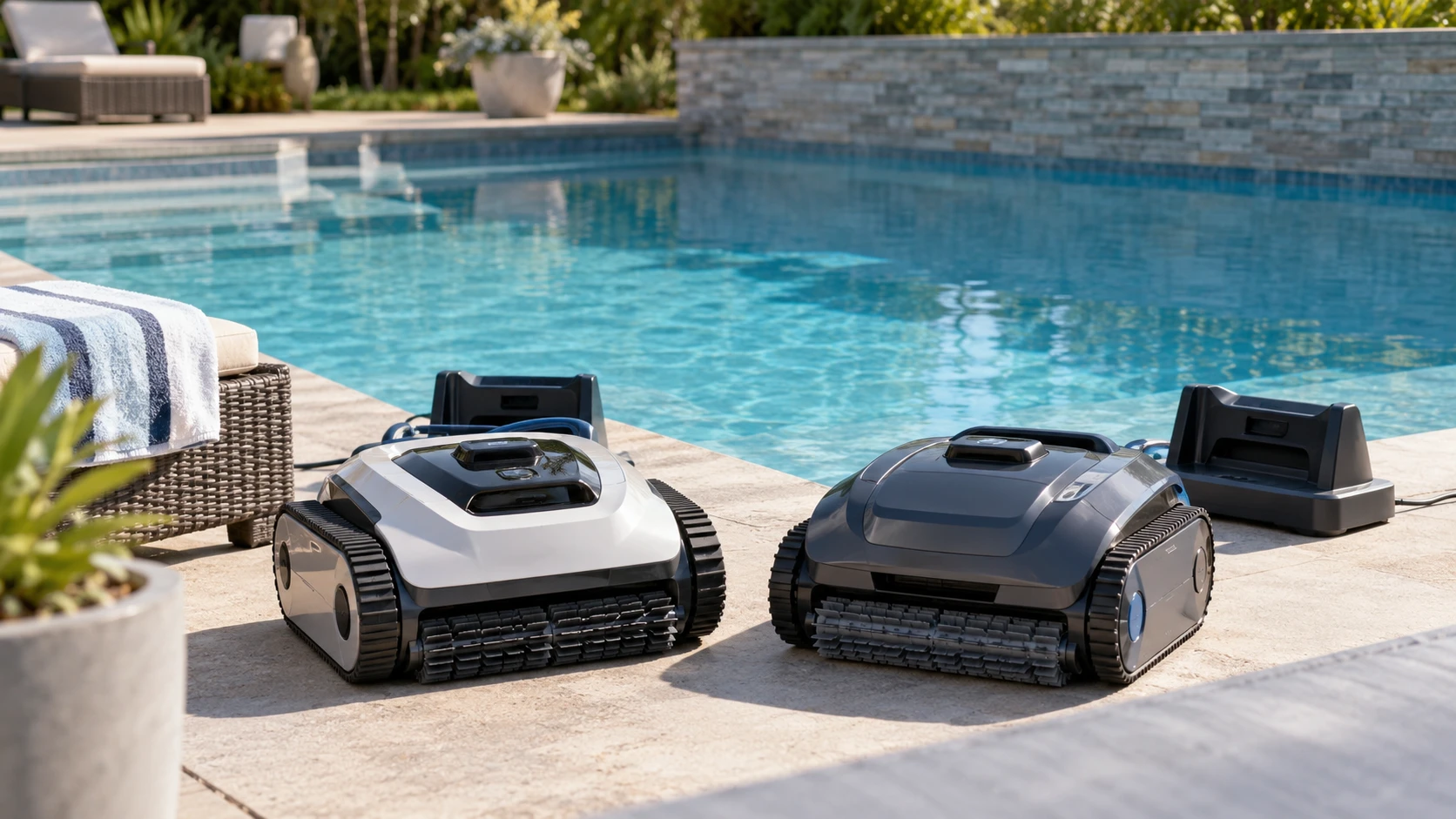
The PlayNova X5 pool vacuum and Seauto SAT25-Blue are cordless robots listed for pool floors and walls. PlayNova also names a waterline cleaning path, four modes, and up to 180 minutes of runtime. Seauto names sonar navigation, three app-selectable modes, and up to 150 minutes. The advertised pool-area limits differ: 3,229 square feet for PlayNova and 2,150 for Seauto. Those figures are starting points for checking your own pool, since steps, slopes, and corners can make the route harder than a flat-area calculation suggests.
The published guide on vacuum suction claim comparison is a useful reference when reading flow figures. A flow figure and a test of debris left behind answer different questions. PlayNova advertises 5,500 gallons per hour as suction, while Seauto calls 4,800 gallons per hour a filtration-system figure. The wording differs, and neither pinned listing gives an identical independent test. Those values alone cannot tell you how well either robot collects grit along a step, keeps leaves in its basket, or cleans the waterline. Evaluate the debris and surfaces that are actually in your pool.
The Seauto SAT25-Blue pool vacuum has a stated three-hour charging time, a 180-watt motor, and a one-click start. Its listing describes in-ground and above-ground use, wall climbing, and parking near a pool wall when the battery runs low. PlayNova describes a two-and-a-half-hour recharge, in-ground and above-ground use, and a directional return to a preset pickup spot. These retrieval claims deserve a practical check: a robot left at the far edge can be awkward to collect even after it has completed a useful cleaning run.
Match the claimed area to the actual pool — vacuum suction claim comparison
Measure the water surface and note the longest path between the places where the cleaner has to turn. PlayNova's 3,229-square-foot claim is paired with up to 180 minutes per charge. Seauto gives up to 2,150 square feet and 150 minutes. A larger advertised area may indicate room for a bigger pool, but it does not guarantee complete cleaning in one cycle. The listings do not explain the test shape, water conditions, or amount of debris behind those limits. If your pool is near either ceiling, confirm with Republeq what a full cycle covers in a shape like yours.
Both listings say the robots can be used in in-ground and above-ground pools. That phrase still leaves practical questions about a particular above-ground wall, a steep transition, or a tanning ledge. PlayNova names vinyl, mosaic tile, concrete, and fiberglass surfaces and lists caterpillar tracks, PVA cotton rollers, and reinforced brushes. Seauto says it is suitable for all pool types, but the pinned excerpt gives no comparable list of surface materials or traction parts. Check the manual for your pool finish and for any prohibited surfaces before relying on the broad claim.
Wall and waterline coverage should be considered separately. PlayNova specifically lists floor, walls, and waterline in its path planning, with a Wall Only mode. Seauto's listing names floors and walls, including an app mode for both, but does not promise a waterline-cleaning mode. If the waterline is where you see most residue, ask Seauto for a demonstration or written specification rather than inferring it from wall climbing. If the pool floor collects most debris, test whether either robot reaches the shallow and deep ends consistently before paying more attention to a specialized waterline feature.
Steps are another useful test. Neither saved description explains how its robot negotiates narrow treads, benches, ladders, or a tight corner behind a handrail. A pool robot may navigate a flat floor well and still leave a shelf untouched. Mark those locations before the first cycle and inspect them afterward. Ask whether the manual calls for a separate hand-cleaning step. Knowing where you will still need a brush makes the advertised coverage number more useful, because it ties the purchase to the work you want the robot to remove.
Compare routes and controls — Seauto SAT25-Blue pool vacuum
PlayNova calls its navigation Smart Path Planning and lists Auto, Wall Only, Floor Only, and Classic modes. Its single-click control starts cleaning or changes modes without an app. A person who wants a simple floor-only pass can test that button before setting up any phone. The listing does not explain what Classic changes, nor does it provide a map of the route used in each mode. Ask for the manual's mode descriptions and watch a complete cycle. A mode label is useful when you can predict which surfaces the robot will attempt to clean.
Seauto says sonar navigation plans the cleaning path. Its three modes, selected in an app, cover floors, walls, or both; the product also has one-click startup. The description does not state whether the one-click start chooses a particular mode or recalls the previous one. Confirm that before you count on phone-free operation. If several people maintain the pool, write down how the desired mode is selected and whether the app requires an account. The saved listing does not spell out setup, phone compatibility, or the behavior if the app is unavailable.
The navigation systems are named differently, but there is no comparable route-completion test in the pinned sources. Sonar, Smart Path Planning, and a larger advertised area are not substitutes for a full run in your pool. Start with a normal debris load, use the broadest suitable mode, and check the same spots after each cycle. If the robot stops before a wall section or revisits one patch repeatedly, note that exact condition. It will be more helpful in a Republeq's catalog support request than a general statement that the navigation failed.
PlayNova says three brushless motors provide its claimed suction and names brushes, rollers, and tracks. Seauto lists a 180-watt motor and 4,800 gallons per hour of filtration. These are different kinds of figures; a motor wattage or flow number does not establish scrubbing strength at a surface. Look for debris that remains stuck after a pass and debris that entered the intake but escaped during retrieval. Pool chemistry and brushing needs remain separate maintenance tasks. Neither listing supplies a test that would justify replacing every part of a pool-care routine with the robot.
Plan for charging and retrieval — Seauto SAT25-Blue pool vacuum
The maximum runtimes differ by 30 minutes on paper, and both are described as "up to" figures. The PlayNova listing says 180 minutes and a two-and-a-half-hour recharge. Seauto says a three-hour charge supplies up to 150 minutes. Neither excerpt specifies the cleaning mode or surface used for those battery claims. Wall climbing may demand a different amount of work from traveling across a level floor. Time a full run in the mode you expect to use, then allow for charging before the next scheduled cleaning. A weekend pool can tolerate a different turnaround from a pool cleaned every morning.
PlayNova's Smart Directional Return is said to park the unit at a preset pickup spot. The box lists a retrieval hook. Check how that spot is configured and whether the robot reaches it when a cycle ends early. Seauto says it parks near the pool wall at low battery and has an attached water hook for retrieval. The saved description does not say that Seauto returns to a spot you choose. Test the claim at a safe edge where you can use the hook without leaning too far over the water. A robot that is easy to retrieve is also easier to empty and charge regularly.
Both robots are described as cordless, so there is no power cord or hose trailing behind them during cleaning. That does not eliminate handling at the end of a run. Ask how heavy each unit is when lifted full of water, where to drain it, and whether the filter can be removed without spilling debris back into the pool. The pinned excerpts do not give basket capacity or wet lifting weight for either model. If reaching the pool edge is difficult, those missing details may matter more than a difference of several hundred gallons per hour in a Republeq's catalog flow claim.
Check charging instructions before the first run. Seauto's listing mentions an IP68 rating for the robot, but neither saved excerpt provides a complete charging-port care procedure. Keep charging equipment in the location and condition required by each manual. Inspect contacts and seals as instructed, and let the cleaner dry to the extent the maker requires. Record the elapsed charging time in ordinary use. The stated recharge figures are useful for planning, but they should be checked with the charger and outlet you will actually use.
Inspect the maintenance and support details — Seauto SAT25-Blue pool vacuum
PlayNova names leaves, sand, hair, gravel, and small twigs among the debris its three motors are intended to collect. Seauto names dirt, leaves, and fine sand. Neither excerpt specifies a filter-mesh size or a measured debris-retention rate. A coarse basket that gathers leaves may behave differently with fine sediment. Ask for filter options and cleaning instructions for the material that lands in your pool. If fine silt is the problem, request a relevant demonstration rather than assuming that a high flow claim proves filtration quality.
PlayNova lists a two-year warranty and around-the-clock customer support. Confirm the warranty terms, exclusions, and how a worn roller or track would be replaced. Seauto's pinned description calls the unit low maintenance but does not state a warranty term or replacement-part list. Request both before ordering if the robot will see frequent use. Its sonar sensors, wall-climbing parts, and battery remain physical components that may need care. Neither listing establishes a long-term cost for replacement filters, brushes, or batteries.
PlayNova X5 looks better specified for a buyer who needs an explicit waterline claim, named pool-surface compatibility, four modes, and a preset pickup location. Seauto SAT25-Blue offers a smaller stated area limit, a sonar-navigation claim, app selection for floor and wall passes, and low-battery parking near the wall. The available descriptions do not show which robot cleans a particular pool more thoroughly. Check the manual for your pool finish and obstacles, then judge a full cycle by what remains on the floor, walls, and waterline and by how easily you can retrieve and clean the unit.