Crypto Commerce
Plan dishwasher loading checks for stand mixer parts
A mixer listing may call a bowl or attachment dishwasher safe, yet that description alone cannot tell you where the part can go in a particular dishwasher. Before buying the Bosch SHV78CM3N dishwasher to use alongside parts from a SKYSHALO SM-1503HL stand mixer, answer two questions for each part: do its own care instructions allow machine washing, and can you place it as those instructions and the dishwasher guidance require? Keep an unanswered question open rather than treating an apparent fit as proof.
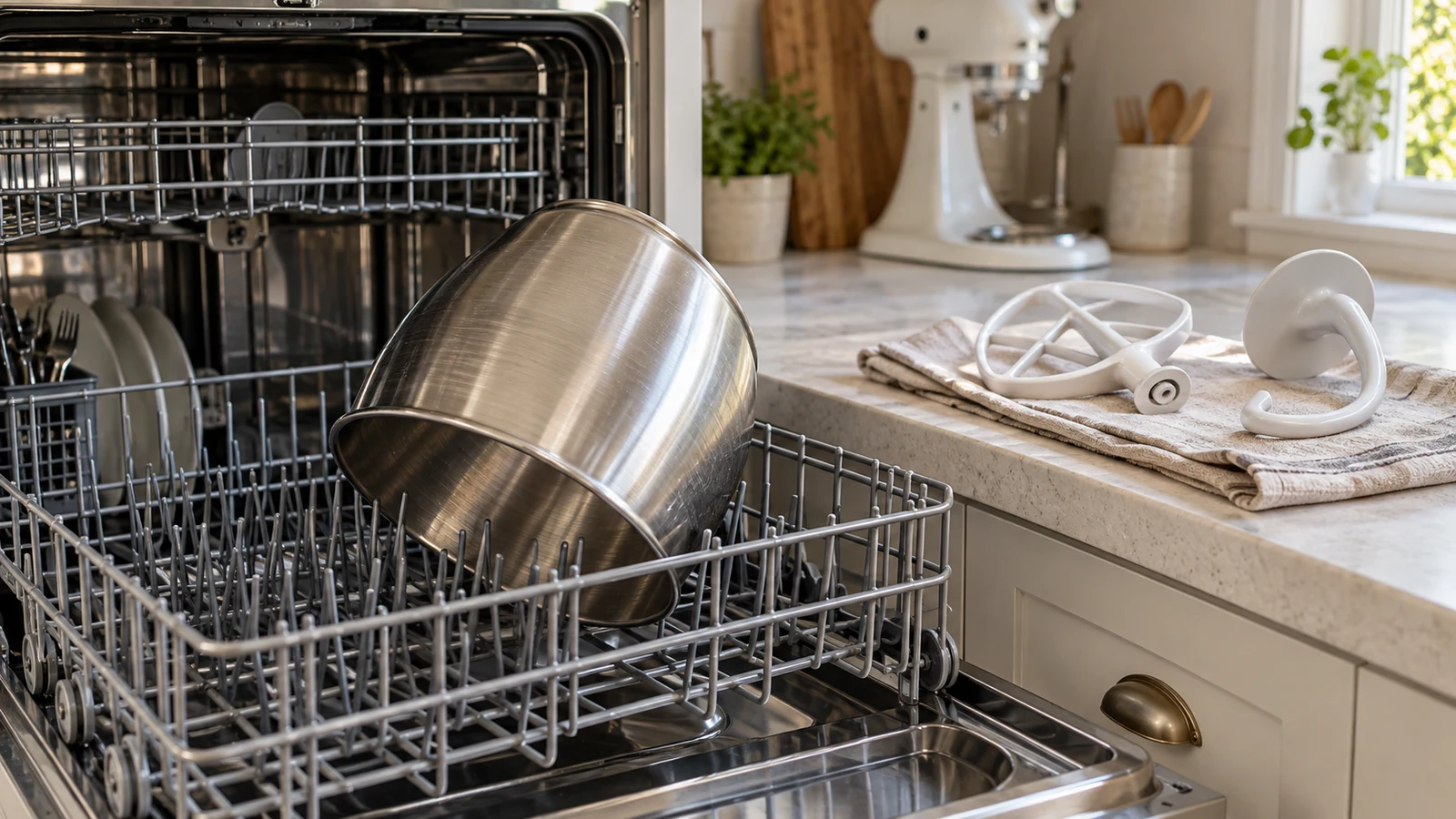
A mixer listing may call a bowl or attachment dishwasher safe, yet that description alone cannot tell you where the part can go in a particular dishwasher. Before buying the Bosch SHV78CM3N dishwasher to use alongside parts from a SKYSHALO SM-1503HL stand mixer, answer two questions for each part: do its own care instructions allow machine washing, and can you place it as those instructions and the dishwasher guidance require? Keep an unanswered question open rather than treating an apparent fit as proof.
The aim is a proposed load you can explain, not a promise that the two products have been tested together. A hook, beater and bowl may differ in shape, material or care directions. Even when a listing groups them under the same cleaning claim, check the precise item you expect to use. Then look at the position it would occupy in the actual dishwasher arrangement. Those are separate decisions, and either one can remain unresolved before purchase.
Identify The Parts Of A SKYSHALO Mixer
Write down the parts you actually intend to put in the dishwasher, rather than treating the whole mixer as a single washable object. The listing for the SKYSHALO mixer, model SM-1503HL, describes a stainless steel bowl, a dough hook, a flat beater and a whisk as dishwasher safe. It also names scrapers and splash caps. That description is useful for forming questions, but it does not supply a part-by-part loading position in the Bosch dishwasher or settle the care of every named accessory.
Make your proposed load specific. You might want to wash the bowl after mixing and the whisk on another occasion, or you might expect both to go in together. Record those as different proposed loads. A part's individual shape and the space taken by the other items can change the placement question. If a pictured or named piece is not part of the exact configuration you are considering, leave it off your assessment until the seller confirms what that configuration includes.
Keep accessory names distinct even when they sound interchangeable. A whisk is not necessarily covered by directions for a flat beater; a cap is not necessarily covered by directions for the bowl. Ask for a parts list matching the exact SM-1503HL package being sold, and identify which pieces are meant to be detached for cleaning. The catalog description supports its named dishwasher-safe claim for the bowl, hook, beater and whisk; it does not, by itself, establish the care status of the scrapers or splash caps.
Read The SKYSHALO Mixer Care Instructions By Part
Look for the maker's care wording for each exact bowl or attachment. Does it expressly allow a dishwasher, and does it limit where or how the part may be placed? A general claim on a product page is a starting point for this question, while the instructions may carry conditions the short listing omits. If you cannot obtain part-specific directions, describe the care permission as unconfirmed rather than extending a statement about one component to another.
Pay attention to which version of an attachment the wording names. A replacement piece or an accessory added later could have different instructions from a part pictured with the mixer. Ask whether the care document applies to the item and configuration in your cart. This is especially useful if a seller uses broad language such as “mixer accessories” without identifying individual pieces. Avoid deciding from appearance, material alone or the fact that a piece can be detached.
Capture the actual wording you rely on, including any conditions, and note the document or seller response that supplied it. You do not need a complicated record: the part name, the applicable care statement and any placement restrictions are enough to keep the questions straight. If the instructions direct hand washing for a particular piece, stop the machine-wash assessment for that piece. Its possible physical fit in a rack does not change its care permission.
Check Bosch Placement For SKYSHALO Mixer Parts
The Bosch SHV78CM3N listing identifies a built-in dishwasher, but its stated width and place-setting figure do not establish where an unfamiliar mixer part belongs. Use the product page as the starting identity for dishwasher loading checks, then seek the loading instructions for that exact model. The relevant question is whether the actual interior and permitted loading arrangements can accommodate your intended parts without conflicting with either product's directions.
Start with one part whose care permission you can substantiate. Read the dishwasher's guidance on supporting objects and keeping the washing mechanism unobstructed. Read the part's instructions for any required orientation or placement. Only after you have both sets of directions should you compare them with a proposed position. A large item that seems to fit into an empty compartment may leave too little room once the support, neighboring dishes and the dishwasher's moving components are considered.
The listing does not provide rack dimensions or a diagram of a bowl in this machine, so do not infer either from the dishwasher's outside width. If the position matters to your purchase, request an interior diagram, the exact-model manual or an authorized opportunity to examine the appliance. Ask the seller to identify which configuration the displayed interior represents. Photographs of a different model, or a general claim that a machine holds many place settings, cannot resolve the position of a particular attachment.
Imagine the bowl as a proposed object, without assigning it a rack. You would need to know whether its permitted orientation can be maintained while it is supported in the available space. You would also need to compare that position with whatever clearance the Bosch instructions require around its moving and washing elements. If any required detail is missing, the useful result is “placement not established.” That result is more informative than guessing a rack from the shape of a photograph.
Now imagine the hook and whisk as separate proposed objects. If their care directions allow machine washing, their shapes still raise different support questions from the bowl. Look for a position that follows the dishwasher's directions and does not depend on balancing a part precariously or forcing it among other items. Do not turn this thought exercise into a cleaning recipe: the manufacturer instructions, the actual parts and the available arrangement have to settle the proposed placement.
Dishwasher loading checks are easiest to use when they refer to the load you expect to run. A bowl alone is one assessment; the bowl beside the whisk is another. You can describe each arrangement to the seller or compare it with an exact-model manual without assuming that both will work. If you regularly wash other kitchenware at the same time, describe those objects in general terms when asking about space, but keep the mixer-part decision tied to the specific positions you can verify.
Keep SKYSHALO Mixer Permission Separate From Physical Fit
Think of care permission and placement as two columns. In the first, record whether the instructions for an individual part expressly permit a dishwasher and any conditions attached to that permission. In the second, record whether the Bosch instructions and actual arrangement support the position you propose. You can have a clear answer in one column and a question mark in the other. Calling a part dishwasher safe does not fill in the second column.
The reverse is also important. A part may rest neatly in a rack, but if its own instructions do not authorize dishwasher cleaning, apparent fit gives you no basis to machine-wash it. Do not substitute the dishwasher's ability to hold an object for permission from the part's maker. This simple separation keeps a product-page claim, a manual direction and an observed fit from being mistaken for the same kind of evidence.
For a planned purchase, you may be working from documents rather than an in-person inspection. Mark a proposed position as tentative when you have only a diagram, especially if the diagram does not show the exact items together. Ask what additional information would let you confirm it. The goal is to know which question remains before you rely on the arrangement, not to force a yes-or-no verdict from incomplete product descriptions.
Set A Care Boundary With Self-Cleaning Appliance Upkeep
Automatic operation does not remove the need to identify an item, read its care instructions and load it properly. The related discussion of self-cleaning appliance upkeep addresses the broader boundary between an advertised cleaning feature and the owner's remaining care decisions. Neither the Bosch nor the SKYSHALO listing here needs to advertise a self-cleaning feature for that boundary to matter. In this case, the concrete owner decision is whether each mixer part is allowed in the dishwasher and has a supported place there.
Keep the scope of a dishwasher-safe label modest. It concerns whether a stated part may be cleaned by that method under the applicable instructions; it is not a guarantee that a particular combined load will clean well or protect every surface. A successful loading plan also depends on the dishwasher's own directions and the arrangement you can actually use. If the part instructions contain preparation requirements, follow those directions rather than assuming that the machine's cycle replaces them.
This is a useful point to separate questions for the mixer seller from questions for the dishwasher seller. The first can clarify exactly which SM-1503HL pieces are included and what document covers each piece's care. The second can supply SHV78CM3N loading materials or an authorized way to inspect its interior. Neither party's answer should be stretched into a claim about the other product. If a seller cannot confirm the pairing, request the relevant documents and make your own assessment within their stated limits.
Resolve An Uncertain SKYSHALO Mixer Load
Suppose you are considering the listed bowl and whisk together. The mixer description calls both dishwasher safe, but you have not seen their individual care instructions. For the care column, record “listing says dishwasher safe; exact instructions and conditions still needed.” For the placement column, record “Bosch position not established; exact-model loading guidance and interior evidence still needed.” Those statements acknowledge the listing without claiming the pairing works. They also tell you what to ask for next.
Once the part instructions arrive, revise only the care column they address. If they confirm permission with conditions, transcribe the conditions before evaluating the Bosch arrangement. If the Bosch guidance arrives first, you can sketch a possible position, but keep the care column open. A seller's photograph, an empty-rack impression and a short product description each answer only part of the question. Do not combine partial clues into an unsupported compatibility verdict.
When you ask for help, describe the exact parts and proposed simultaneous load: “For the SM-1503HL bowl and whisk in the configuration listed, which care instructions apply to each, and do they specify dishwasher placement? Can you provide the SHV78CM3N loading guide or an interior view for checking an instruction-compliant position for both together?” If you intend to wash them separately, say so. A narrow inquiry is easier to answer than “Are these appliances compatible?” and less likely to produce a broad assurance that leaves your actual loading problem untouched.
Record the outcome for each part as permitted, not permitted or unresolved for care, and supported, unsupported or unresolved for placement. Use “supported” only when the documents and actual arrangement justify it; use “unresolved” when one of those is missing. If a proposed position conflicts with an instruction, look for another position allowed by both sets of directions or leave the part out of that load. There is no need to declare the entire mixer-dishwasher pairing suitable because one component has an answer.
Dishwasher loading checks should leave you with an actionable purchase question even when the answer is incomplete. Before relying on the Bosch dishwasher for the mixer parts you have in mind, get the exact part-care wording and the loading information needed to test your proposed positions. If you are evaluating equipment for a kitchen job, ask the prospective workplace which product-specific care and loading instructions govern the parts staff handle. That keeps the discussion about the actual work and the actual items, without assuming this product pair is used there.