Home Decor & Table Settings
Planning a placemat care budget before buying a replacement set
Consider the care route and household agreement behind a proposed placemat replacement before treating a new set as a saving.
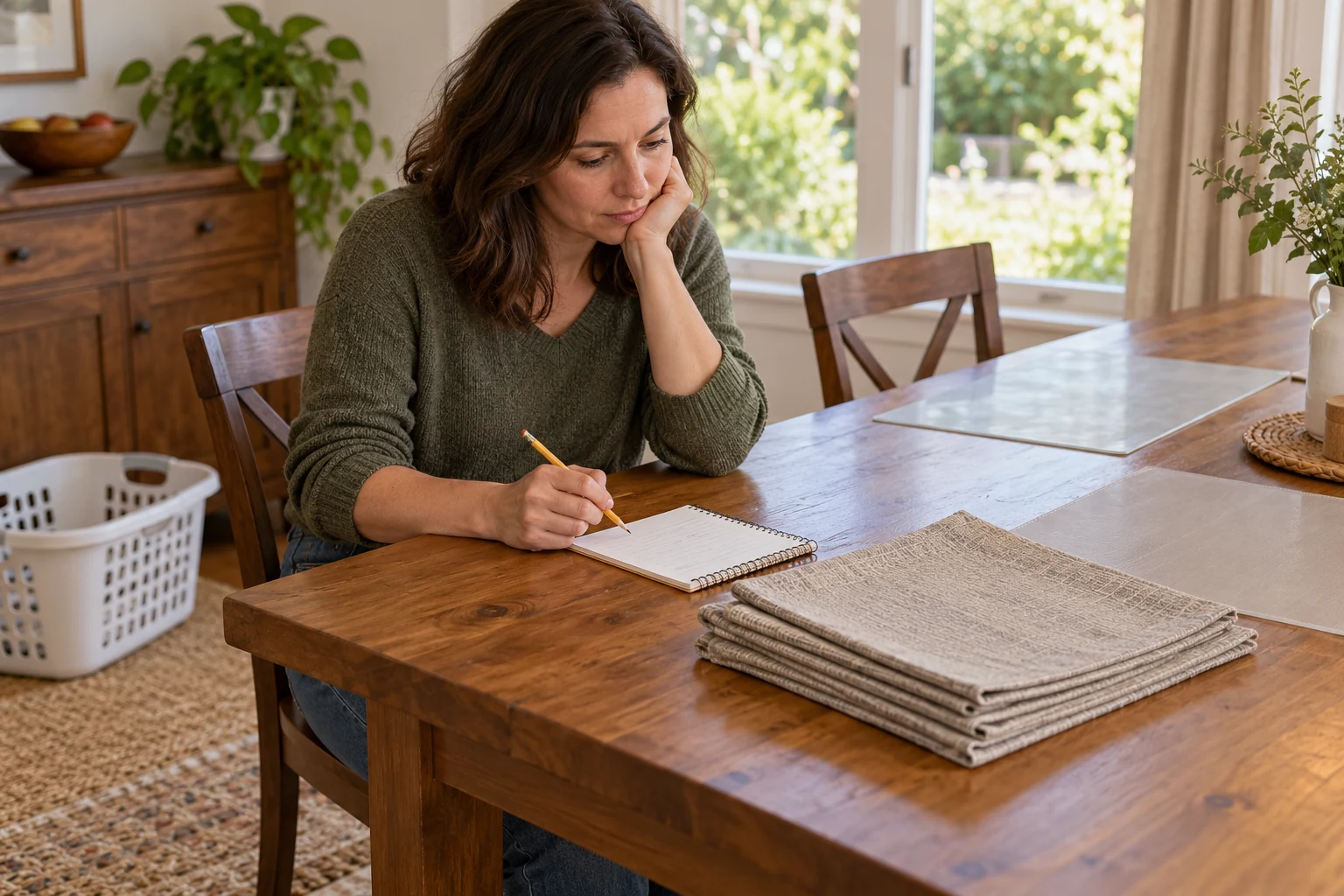
A placemat care budget can begin before you assign any money to a proposed saving. Name the set you are considering, the care information you actually have, and the work somebody has agreed to take on. Keep an unanswered care question visible beside the proposed purchase. This guide offers a conditional household planning note, without a cleaning procedure, a quoted price, an annual cost estimate, or a claim that either selected set will last longer or cost less to maintain.
Name what the replacement is meant to change
Start with your own reason for considering another set. You may want a different appearance for the table, a particular item may need replacing, or the existing arrangement may no longer suit the use you have chosen. Write the reason as your requirement. Do not silently turn a wish for another pattern into a claim that the present mats have failed. Likewise, leave an unresolved condition question unresolved. This article supplies no test for deciding whether an owned mat is suitable to retain.
Keep that requirement separate from the proposed care routine. A person can prefer a fabric pattern and still need an answer about the particular item’s care. Someone else may be willing to follow an established routine but have no reason to replace the table setting. Those are different purchasing situations. Your note should identify which one you are discussing before an attractive product photograph becomes the reason given for both the expense and the work that might follow it.
Read the clear-mat care account as a retail disclosure
The YIJI clear-placemat offer describes wiping with a soft damp cloth or cleaning with water and dish soap; it does not suggest dishwasher use. Its seven original images include staged settings and an EXACTMADE comparison chart. That chart is not independently authenticated as selected-product compatibility evidence here. No cleaning, protection, material-safety, or durability result is adopted.
Keep the fabric offer’s care wording with its own identity
The Fennco Styles 2115.M1320B_4PC offer describes four cotton placemats and lists cold machine wash, dry cleaning recommended, and cool iron. Its sole image shows a striped mat with staged objects. Its width statements differ, so no fit claim is used. These attributed retail words do not verify a care label, establish an exclusive care route, or price the household work.
Choose the care question that needs an answer
Use the proposed item’s exact identity when asking for the applicable current care information. If a description lists more than one care-related statement, ask how those statements apply to the selected product instead of choosing whichever gives your budget the easiest answer. Keep the reply with that item. A general answer about table linens does not identify what you have been told for the particular offer. Leave any essential unresolved point marked as pending before deciding to rely on a routine.
You can keep the question short. State the exact item and ask which current instructions the responsible supplier or maker provides for its intended use. If the answer refers to a label or document, retain that reference. This guide does not replace it with a procedure of its own. The useful result is an identified source for the care route you are considering, or a clear record that you still lack one. An unanswered question does not need an invented favourable assumption to complete the note.
Ask who accepts the proposed routine
Once you have the relevant information, discuss the proposed work with the person who would actually do it. Ask whether that person is willing to include it in the household arrangement. Do not count a purchase as convenient because somebody else might eventually deal with it. You can record an agreement, a refusal, or a point still being discussed. Those entries describe the decision you have made together; they are not a judgment about how any household ought to divide its work.
Keep the agreement specific enough to revisit. A note that somebody is willing to manage the selected set under the confirmed instructions is different from a vague promise to help with the house. If the arrangement depends on a service, obtain the actual service information you would need before treating it as available. This is not a recommendation to book one. You may instead decide that the proposed care arrangement is more than you want to undertake for the appearance change you were considering.
Keep work and spending as separate entries
Give the purchasing note a place for the complete current order amount if you later obtain it. Beside that, keep the care route, the relevant instructions or reply, and the household agreement. You do not have to translate every task into money. If you choose to assign a money value to someone’s time, make that an explicit agreed assumption. Do not present it as an observed expense or as a value that another person has accepted merely because you wrote it into the budget.
Likewise, leave an unknown service charge, supply requirement, or other proposed expense unknown. Do not fill the space with a figure from an unrelated item simply to produce a complete-looking total. This article supplies no measured use, expected replacement interval, or care frequency from which to build an annual amount. Keep the proposed purchase and unresolved questions together. The note can remain useful even when its current result is that you are not ready to compare a full commitment.
Try a household that has not agreed to the change
Imagine a household whose current mats still meet the requirement its members have chosen. One person would like a new fabric pattern. The person who normally handles the table setting has not agreed to the proposed care work, and the applicable current care information has not yet been obtained. These are invented planning conditions, not a report about a real home. Under those conditions, the note should not describe the replacement as an established saving. It still contains a preference and two unanswered questions.
The household can keep using its present arrangement while deciding whether to investigate the proposal further. It can also drop the proposal because the appearance change is not important enough to it. Neither outcome establishes that the offered product is poor quality. The decision concerns what these invented people have agreed to buy and manage. If they later obtain the missing information and change their agreement, preserve that later decision as a changed state rather than pretending the earlier questions were answered all along.
Consider a different household preference honestly
Now imagine another household that has obtained the relevant care information for its selected item and willingly agreed to the work it plans to undertake. Its members want the appearance change and choose to spend on it. That is an acknowledged purchase preference. They do not need to claim a future saving to justify a choice they have deliberately made. Keep the agreed routine and the complete order information with the decision, without adding an unmeasured promise about useful life or future bills.
This second example does not correct the first household or prove that one routine is better. Its starting conditions differ. It also does not establish that either actual retail offer meets those conditions. For a real purchase, the buyer still needs the applicable product information and current transaction terms. The examples show two ways to finish the planning note: retain an unanswered proposal, or record a chosen expense with an agreed care arrangement. Neither requires an invented financial advantage.
Avoid borrowing another task’s cost claim
If someone proposes that the new set will recover its price, ask what actual expense they expect it to replace. Keep the answer tied to this decision. A household preference for doing less of one task is not, by itself, a record of money returned. Nor does a statement about one part of the household’s work establish a change in the whole laundry bill. You can choose the preference without promoting it into a savings claim that the note has not supported.
Leave broader household costs with their own information. This guide gives no appliance settings, utility assumptions, detergent amounts, service frequency, or expected number of usable care cycles. It does not tell you to combine these mats with another load or alter a current routine. If the proposed purchase depends on a specific cost claim, obtain the information that actually supports that claim. Otherwise, describe the decision in the terms you do know: the selected item, your reason for wanting it, and the agreed work.
Revisit the conditions of a care agreement
If the person who accepted the proposed work changes their mind before the order, record that change. The earlier agreement can remain part of the history without standing in for current willingness. Ask whether the household still wants the purchase under the arrangement now available. You may defer it, choose to undertake the work yourself, or leave the existing setting in place. This is a planning choice, without a claim about legal responsibility or another person’s obligation to continue an earlier offer.
A changed care answer deserves the same attention. If new information makes the proposed route different from the one people discussed, take that information back to the decision. Do not keep the old agreement while silently replacing the work it described. Save the actual reply and identify the question that remains. A budget note can show a proposal being reconsidered; it does not have to turn every new fact into a reason to complete the purchase that was first imagined.
Return to the actual offer before committing
Check that the item now proposed is the same one covered by the care information you retained. If someone substitutes another set, keep that change visible and ask whether the earlier answer still applies. A familiar brand, similar pattern, or another photograph does not itself transfer the reply. The household agreement should also concern the selection actually being considered. Do not carry a convenient earlier conclusion into a changed order without noticing that the subject of the decision has changed.
Finish the note with the next action you actually choose. You might retain the current setting, ask one identified care question, or proceed with an acknowledged appearance purchase under an agreed arrangement. Keep any current order amount attached to the selected offer, and preserve essential unknowns. A placemat care budget has done its job when it records the commitment you understand and the decision you made, without calling an unresolved routine or an unmeasured future result a saving.
Keep the neighboring cost guides with their own questions
The laundry detergent cost-planning guide distinguishes supplied items from a supported wash count and separates detergent from appliance operating costs. This care-route decision supplies no dose, cost-per-wash calculation, or washer comparison.
The bath-towel reserve budget guide examines what is available for a particular occasion while other pieces are unavailable. This proposed placemat replacement does not count reserves, predict a laundry return, or prescribe a household allowance.
Review any separate order on its own terms
If you plan to purchase an item on republeq.com, check the particular offer and current checkout before ordering. This guide does not establish that any cryptocurrency payment option is available. If USDT is offered for the intended order, verify the requested asset, network, amount, receiving destination and order reference with the responsible service before authorizing a transfer. Review the actual product identity, selected variant, quantity, delivery details, total charge and applicable terms. Use the confirmed order details when checking the payment instructions. Confirm any fee, conversion term or exchange rate from the current transaction information. Determine the applicable cancellation, return and refund process, including how a refund would be handled for the selected payment method. Keep the relevant instructions and transaction records, with dates and confirmed references. If essential instructions change, ask the responsible service to confirm the change against the exact order. An acknowledgement should identify the order and the agreed details; it does not replace checking whether the selected product is the one you intended to buy. If payment or order status remains uncertain, reconcile that status before considering another transfer. Do not treat an unresolved transaction as evidence that nothing happened. This article supplies no wallet address, transfer guarantee, recovery procedure or assessment of a counterparty. A product enquiry does not authorize a payment or resolve an uncertain order. If support provides an answer, retain the exact question and response so a later reviewer can understand what was confirmed. Decide whether to proceed only when the conditions of the particular transaction are clear, and retain the confirmed transaction information with the exact order.