Product Compatibility & Accessories
Pipette bulb compatibility: separate fillers from complete droppers
A named manufacturer example and a fictional supplies request help separate an equipment question from the decision to order.
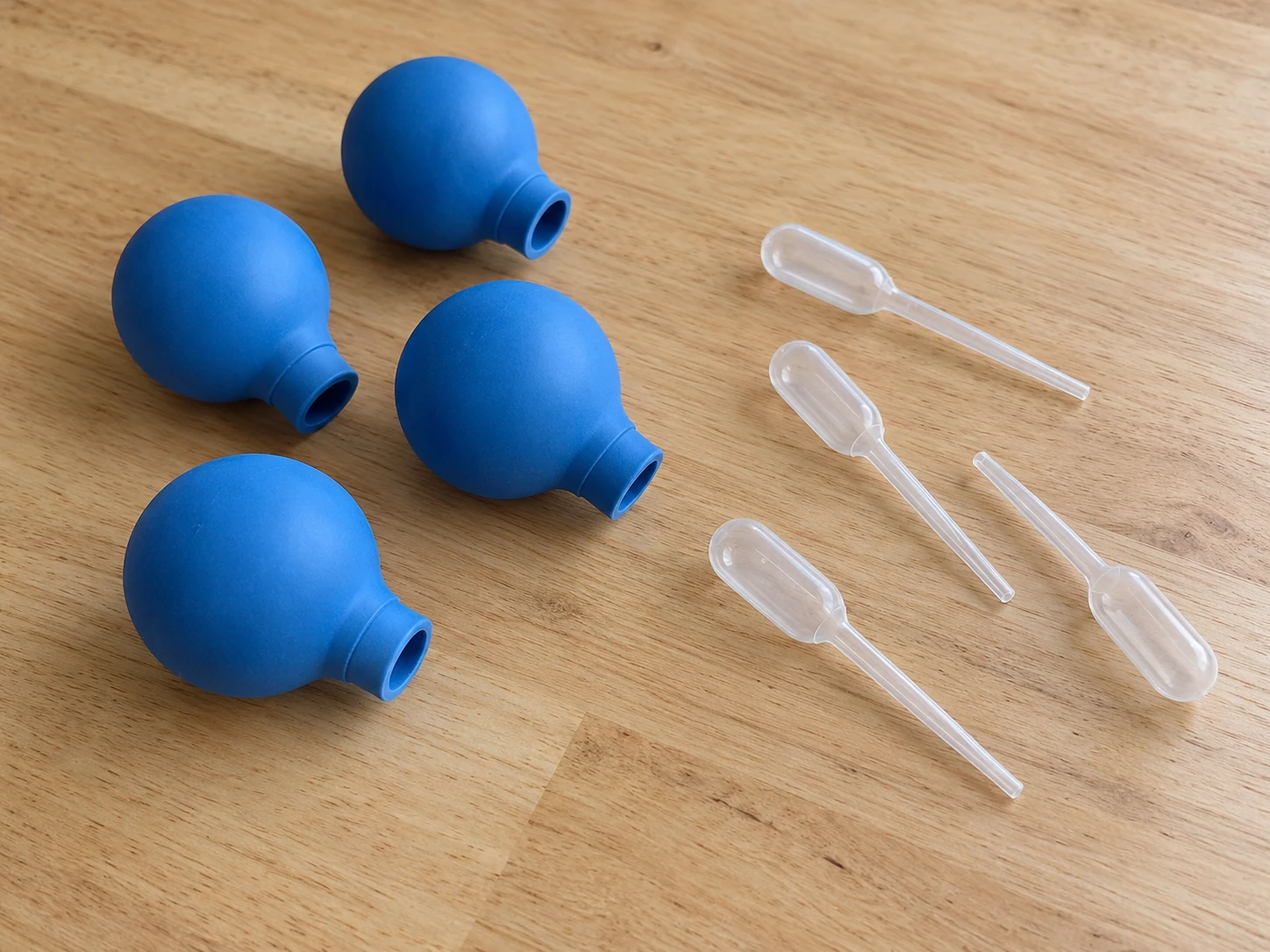
Start pipette bulb compatibility with the item you need to replace or obtain. A request for a separate filler and a request for a complete dropper concern different purchases. Identify the actual equipment and intended task before treating a shared product word as a fitting specification. The selected offers below make that distinction visible, while leaving their application limits and any unresolved connection information intact.
Identify the separate ELAYARD bulbs
The ELAYARD eight-piece blue pipette-bulb set identifies model 22158981 and SKU 18742567199. Its description calls the bulbs reusable silicone and says they fit various laboratory pipettes. That broad wording supplies no exact list of compatible instruments, connection bore or fitting range. Use the actual model when seeking the information for a particular proposed combination.
The eight gallery pictures show separate blue bulbs with open necks. Labels give an overall length of 55 mm and width of 35 mm; neither is labelled as the connection’s inside diameter. The description also mentions silicone tips and nozzle caps. Preserve that wording, but the photographs do not authenticate a separately supplied cap inventory. Ask for the actual contents and fitting information without deriving either from the overall dimensions.
Comfort wording describes an intended feature, without a user test or a confirmed instrument connection.
Recognize the complete disposable dropper
The unbranded 2,000-piece 4 ml plastic-pipette offer presents a different whole item. Its short description says “pipette pippets the food lab.” All four gallery images show short clear droppers with an integrated bulb and stem, including party and cupcake scenes. One image labels a six-centimetre overall length and a one-centimetre bulb width. Those labels do not describe a separate filler’s connection.
No graduation scale or detachable-bulb interface is shown in these pictures. Keep the 4 ml title label with the selected offer; it is not an independently measured dispensing result. A staged food photograph supplies no food-contact certification, sterility statement or precision specification. Neither the laboratory category nor the party setting establishes which intended applications the actual delivered item supports. Obtain the applicable product information when that requirement determines the purchase.
Read pipette filler fit for the actual mechanism
BRAND’s natural-rubber filler page describes pipetting aids for one-mark and graduated pipettes. It lists standard and universal models with three valves and a Flip model with two. Its control description concerns squeezing the appropriate valves. Those named mechanisms explain why the word filler can refer to a more specific assembly than an unlabelled squeeze bulb.
For pipette filler fit, retain both the instrument’s applicable requirement and the proposed accessory’s exact identity. BRAND’s valve-controlled models do not supply operating directions for the ELAYARD bulbs. Their model names also provide no permission to connect a different manufacturer’s part. A broad laboratory-pipette description leaves the selected combination to be established; it is not a connection measurement or a universal operating method.
BRAND’s catalogue references distinguish the three-valve standard 25300 from the three-valve universal 25315 and the two-valve Flip 25400. Retain the model reference when requesting information. A count of valves identifies one feature; it does not establish another maker’s connection specification.
Distinguish a bulb pipette from a pipette bulb
BRAND also sells BLAUBRAND class AS bulb pipettes with one mark. Here the product is a glass measuring instrument, rather than a separate rubber or silicone filler. Its manufacturer describes calibration to deliver, using TD and Ex wording, and supplies a batch certificate with the manufacturer’s packing unit. Keep that complete instrument separate from an accessory whose name happens to place the same words in another order.
The BLAUBRAND table includes a four-millilitre nominal-volume entry. That does not make the instrument equivalent to the selected plastic dropper carrying a 4 ml label. The measuring instrument’s declared class, calibration account and certificate belong to that manufacturer’s product. They establish none of those properties for the retailer’s unbranded droppers. Likewise, the glass instrument’s nominal volume does not specify the connection bore needed for a proposed separate bulb.
BRAND also distinguishes batch certificates from individually requested or DAkkS calibration certificates. Those are documentation options for its own glassware. Keep the exact product and certificate named together rather than treating any certificate word as approval for an unrelated accessory.
Keep transfer pipette capacity with its labelled field
Thermo Scientific’s Samco brochure distinguishes overall capacity from bulb draw in its transfer-pipette tables. For example, its General Purpose Standard catalogue number 202 lists 7.7 ml overall capacity and 3.0 ml bulb draw. These are two labelled figures for that specific catalogue item. A volume in a title therefore needs its meaning identified before it can answer a particular purchasing question.
For transfer pipette capacity, ask whether the stated figure describes the whole item, a draw or another specified quantity. The Samco brochure separately identifies graduated, fine-tip and other designs, with packaging and sterile variants in their own entries. Those distinctions do not add graduations or sterility to the selected unbranded offer. Its general-purpose single-piece design account is also not a detachable-bulb fitting instruction or a certificate for another maker’s material.
The same table uses separate catalogue references for sterile packaging options, including 202-1S for an individually wrapped version. A packaging designation belongs with its actual catalogue entry. It cannot be borrowed to describe the retailer’s bulk dropper package or an unidentified supplied bulb.
Ask which dimension describes the connection
The microscope eyepiece-fit guide separates magnifying power, mounting diameter and field-of-view wording. Its two AmScope examples show why a millimetre figure needs the name of the property it describes. Keep the same question precise when reading a bulb’s overall width beside an unidentified opening.
The eyepiece figures are optical-accessory information. They establish no fitting size, tolerance or installation method for a pipette filler. Use that guide’s distinction between labelled properties while obtaining the actual connection information for the instrument and bulb you are considering. A familiar number cannot substitute for identifying what was measured.
The guide also distinguishes one pointer eyepiece from a two-eyepiece package. That count answers an inventory question while leaving the actual mounting requirement to be established. Keep quantity and component identity as separate entries in the purchase request.
Match the kind of component before deciding fit
The microscope objective-compatibility guide keeps a finite objective and an infinity-corrected objective with their different optical-system requirements. Its actual AmScope examples distinguish a known system mismatch from an unanswered exact-component relationship. It does not approve a replacement merely because a familiar brand or magnification appears on it.
That is a useful laboratory-accessory question to carry into this purchase: is the proposed item the kind of component the requirement calls for? The objective guide supplies no pipette fitting matrix. Its optical descriptions remain with the microscope products. A separate bulb, a valve-controlled filler, a glass bulb pipette and a complete integrated dropper should each retain their own product identity.
That guide retains a cover-glass discrepancy between photographs and fields for its infinity offer. It leaves the supplied variant unresolved. Preserving a real discrepancy is more useful than selecting the picture that seems to answer the question most conveniently.
A fictional supply request split into two jobs
Imagine that Sol coordinates supplies for two sessions in a teaching room. A colleague sends a photograph of a bag and a message asking for more. Sol has the proposed activities on her calendar, but the message does not identify the contents or say which session needs them. She asks the person responsible for the room to identify each requirement before turning that photograph into an order.
In this invented situation, the conversation reveals two separate requests that had been combined in the message. Sol writes one entry for each session and assigns a person to answer its outstanding equipment question. The separation matters to her work: ordering one large bag would otherwise make it difficult to tell which requirement the delivery was meant to satisfy. She can organize the requests without offering a physical fitting opinion.
For the first session, the responsible person identifies an already available item that the room can borrow under its established arrangements. Sol removes the proposed purchase for that session and records who will return the borrowed item. The second request still needs its own purchasing decision. Having avoided one order does not turn the remaining proposal into an approved replacement or give it the first session’s permission to use equipment.
For the second session, imagine wholly invented references, Session Pack M and Supply Item D. The responsible person identifies D in the agreed pack list, and the proposed order names D. Sol passes that identified proposal to the purchaser for a decision. These fictional names describe no actual retail item and provide no confirmation for the products in this article. The example’s outcome is a split request: one borrowing arrangement and one specifically identified purchase proposal.
Sol gives the person receiving supplies the same references used in those decisions. If a different item is offered or delivered, the relevant request can be revisited without reopening the unrelated borrowing arrangement. She also keeps the return responsibility visible to the person who accepted it. Completing that handover makes the plan understandable to the next colleague without pretending that a purchase record is a test of equipment.
Keep the selected item clear through a crypto purchase
Treat the choice of a payment route as a separate decision once the proposed item is clear. For a purchase planned at republeq.com, give the person paying the final offer reference and the product answer on which the proposal depends. The payer may have a preference for USDT, but that preference still needs to meet the options actually shown for the current order. If a cryptocurrency route is offered, read its current instructions before deciding whether to proceed. This paragraph identifies no receiving address or network and asks for no transfer. A saved example from an earlier purchase cannot decide those details for another order. In a shared purchasing task, name who can approve the item, who will pay and who will receive the package. Those responsibilities may belong to different people. Someone should tell the payer if a product clarification changes the proposal, rather than leaving them to fund an obsolete selection. Leave enough time for that exchange before treating the order as settled. When an order is made, retain its actual reference alongside the confirmation generated by the chosen payment process. Give the recipient the product identity they should expect, together with the applicable delivery information. Read the return conditions for that transaction instead of making an assumption based on how another order was handled. A payment record can help identify a transaction; it cannot confirm an accessory relationship or an intended use. If the product question remains open, the purchasing decision can stay open too. Choosing to borrow existing equipment or to abandon an unnecessary order remains possible while the people responsible finish their review. Keep the final decision understandable to the person who takes over the records.
Keep the final decision attached to the actual item and requirement. A confirmed purchase proposal can be useful while a different combination remains unresolved. Retain what was answered, what still needs attention and who will handle that next question before the equipment is put into use.