Office Supplies & Stationery
Pencil cap won't stay: check which end and use failed
Identify which pencil end and cap role failed; keep a storage fit separate from short-pencil extension without forcing or modifying the pairing.
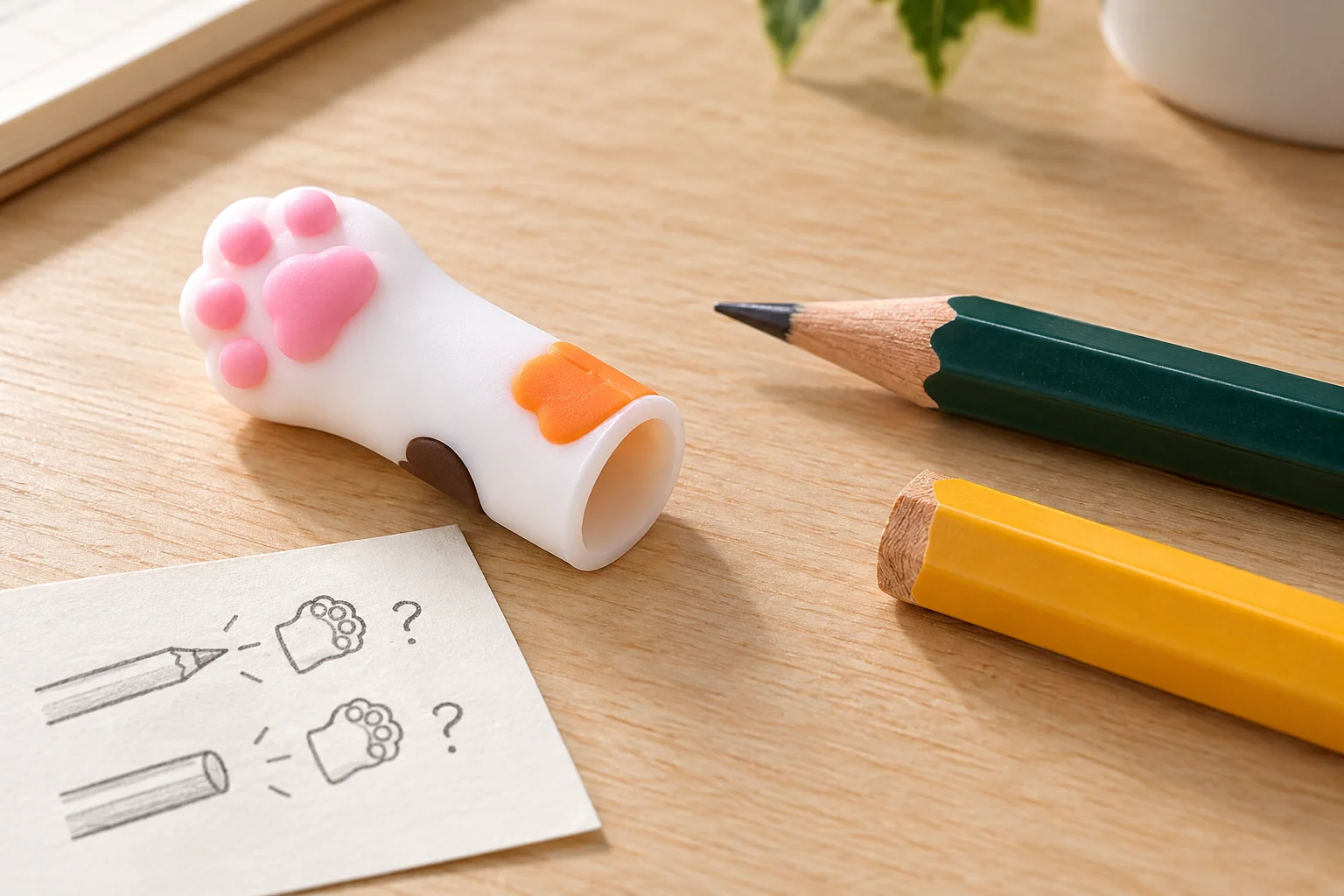
A pencil cap won't stay for a reason you need to describe at the right end of the pencil. Covering a sharpened point for storage is a different job from putting a cap on the back of a short pencil as an extension. A pairing that seems usable for one job does not prove the other. Keep the actual cap and pencil together, identify the intended state and make only a small reversible check under the applicable instructions. Do not force the fit or modify a pencil to make a broad product claim appear true.
Name the state before moving the cap
Begin with the pencil resting on a table. Identify its writing point and its other end, including any fitted eraser or metal ferrule. Decide which end the cap was meant to receive when the problem occurred. “It came off while stored over the point” and “it moved when used behind the pencil” are different observations. Avoid reducing both to a single statement that the cap does not fit. The end and the intended action belong in the note.
Set the cap aside while looking at the pencil. Record an obvious change that could matter to the pairing, such as a damaged casing or an additional end fitting. Do not diagnose an unseen cause from appearance alone. A short pencil may have a different back-end arrangement from a new one of the same color. Likewise, a cap recovered from a shared case may not be the one previously used with that pencil. Preserve the actual pair rather than silently replacing it with a more familiar combination.
Keep three states on the working note: point uncovered for writing, point covered for storage and cap used at the back as an extension. Not every pair will be appropriate for every state. A state can remain unverified without preventing you from using an ordinary uncapped pencil in a suitable writing arrangement. The cap fit note identifies the failed use; it does not certify protection, grip or comfort. Follow the exact item's directions wherever they specify its use.
Read the two cap offers as descriptions
The Ounona cat-paw caps listing describes soft rubber pencil caps and erasers, with roles covering tips and extending short pencils. Its gallery shows complete pastel paw-ended cap bodies. No matched erasing, retention or short-pencil handling test was made for this article. The stated roles do not establish that every pencil end fits, or that using the cap will recover a particular amount of pencil. Keep those results unpromised.
The silicone cat-claw caps listing describes complete caps and mentions short-pencil extension. Its galleries show loose caps, a cap around a pencil shaft and a cap over a point. Those images illustrate the offered form and pictured uses; they do not establish the fit of your pencil. Broad shape-fit, balanced-feel and puncture-protection marketing is not adopted as a universal result. Do not infer a supplied pencil or a separate mechanical extender from the photographs.
Both examples make it especially useful to name the role being checked. A cap can be offered for more than one purpose while your particular pair remains unresolved for one of them. Color and a similar paw outline do not identify the internal fit or prove an interchangeable model. Read the actual item identity and directions before transferring a conclusion from another cap. Do not turn a soft-looking exterior into an instruction to stretch, cut or otherwise alter it.
Check the point-cover state separately
If the intended job is storing the covered point, follow the cap's applicable fitting directions with the pencil supported on the table. Stop if it does not accept the pencil normally or if you cannot tell how it is intended to sit. Do not push until the sharp point reaches an unknown closed end. A visibly covered tip alone is not proof of resistance to puncture, drops or movement inside a case. Keep the claim as small as the observation.
Look at where the cap meets the pencil casing, without assuming the opening grips every shape or size. A round, triangular or hexagonal body can present a different actual pairing, even when a broad listing names several shapes. This guide provides no universal opening diameter or insertion depth. If the relevant dimensions or directions are missing, seek the specific answer before forcing a trial. An unconfirmed pairing can remain unconfirmed while you choose a suitable existing storage method.
If the cap comes away during ordinary intended handling, keep the pencil, cap and circumstances together in the note. Was the cap deliberately removed, left loose on the table or found detached after being carried? A recovered cap does not explain when or why it separated. Do not repeat a rough handling test to make the event happen again. Follow the actual product guidance and keep the original observation available for a product-specific enquiry or a different appropriate storage choice.
Treat the back-end extension as another use
A short pencil's back end may be plain wood, a fitted eraser or another construction. Identify it rather than assuming it matches the casing near the point. The role here is a cap used behind the pencil during writing, not a cover protecting the point while the pencil is put away. A result from the storage state does not establish support in this writing state. Keep any additional fitting on the pencil visible in the decision.
If the exact cap is described for that extension use, follow its applicable instructions for a modest check on expendable paper. Do not force it over an eraser or ferrule, cut the pencil end or add an improvised shim. If it shifts, rotates or comes away during the intended action, record that particular result and stop relying on it as an extension for that pair. The observation does not establish a defect in every cap of the same shape or prove that the pencil itself is faulty.
A cap's apparent fit while resting is different from its behavior during the writing task. Keep those observations separate without inventing a pressure or duration standard. You can decide that the combination is unsuitable for your use without making a general comfort, balance or service-life claim. If writing is the immediate aim, use a suitable known arrangement rather than continuing with a cap that moves unpredictably. Leave the uncertain extension pairing aside with its note.
An invented pair shows why the distinction matters
Imagine a fictional cap and pencil pair called A. The owner records that the cap accepts the point-cover state under the item's directions, but has not checked any other use. Later, a short-pencil extension question arises. The earlier note cannot answer it. It concerns the other end and another action. The owner keeps the storage observation and marks the extension role unverified, rather than treating the existing note as a universal fit approval.
Now imagine the owner checks the permitted extension arrangement and finds the cap moves during a small writing trial. The new note reads “back-end extension unsuitable for this pair in this trial.” It does not erase the earlier, narrower storage observation. It also does not turn the storage observation into a puncture-protection result. The two entries describe different things. Their usefulness comes from preserving which state was actually observed, not from producing one final pass or fail for every possible role.
If a different pencil is later considered, give that pair its own identity. Do not carry over the earlier result merely because both pencils have the same color or nominal type. Record only the comparison you actually make under the relevant directions. There is no need to test every pencil in a shared drawer. The next useful decision may simply be which cap and pencil are kept together for a specific verified use, while another combination stays unresolved.
Keep erasing and sharpening outside the cap fit finding
The word eraser in a cap listing does not establish a successful correction on your paper. The eraser smears pencil marks guide owns graphite removal, tool care and the limits of a changed paper surface. Use that different evidence when erasing is the real problem. Do not use a successful erasing result to certify point covering or extension fit, and do not treat an unstable extension as a reason to rub harder on a drawing. The functions require their own applicable evidence.
A broken point can introduce a different question again. The manual pencil sharpener problem guide separates pencil fit, a shavings chamber and the point's behavior during sharpening or writing. If the point is already damaged, keep that event distinct from whether a cap stays at the back. Finding a broken point after storage does not establish its cause. Preserve what you observed, then use the relevant tool guidance rather than assigning the whole event to the last accessory you handled.
Avoid making the finished page a place for repeated uncertain trials. A small expendable sheet can hold the writing observation while the original remains separate. If the cap moves and the pencil makes an unintended mark, that is another reason to stop that pairing for the task. The page does not need to become increasingly untidy before you are allowed to choose a suitable alternative. A decision to stop using the combination is a practical outcome, not an invented mechanical repair.
Keep a usable pairing identifiable
A reader who only uses capped pencils for storage need not test extension at all. Leave an unused role marked not needed, rather than treating every advertised use as required.
If you establish a particular permitted role for a cap and pencil, keep the note tied to that pair. State the end, intended use and actual observation. Do not label a cap “fits everything” because it worked once. If it returns to a shared supply, make sure the narrow meaning remains understandable to the next person. A simple note is enough; a complicated inventory would not add evidence about an untested end or pencil.
A visibly torn or changed cap should not inherit the earlier finding. Follow its actual care or replacement guidance instead of trying to restore its shape with heat, cutting or adhesive. Likewise, a pencil whose end fitting has changed is a changed pairing. Retain the earlier note as history and reconsider the actual current arrangement. The purpose is to preserve what you know, without treating an accessory's low price or cheerful appearance as a reason to improvise a repair.
Finish by reading the first symptom again. Have you identified whether the failed use was a point cover, a back-end extension or something else? Keep an unresolved fitting question explicit and direct it to the exact product information. A pencil cap won't stay becomes a clearer problem when the observation names the pair, the end and the action, while a different use remains a separate question.
Check a purchase separately
If you consider an order through republeq.com using crypto such as USDT, read the current exact product page and the current checkout before choosing a payment method. A product's appearance in this guide does not establish that a particular payment route is available for your order today. Confirm the listed seller, the exact item and package quantity, the delivery destination and the displayed total. If a crypto option is offered, verify the particular token and network named in its current instructions. Similar names do not make networks or assets interchangeable. Review any displayed fees, timing information and order conditions yourself. Do not infer a transfer destination from an earlier purchase, a product description or a message about a different order. If an amount, network, destination or instruction is unclear, stop and seek clarification from the responsible service before sending anything. This article does not promise acceptance, transfer success, a refund route or a particular delivery result. Keep the information relevant to your actual order through the arrangements appropriate to the purchase. A payment option cannot resolve whether a particular cap stays over a point or serves a short pencil as an extension. Those are separate product and trial questions. If the current checkout does not offer the method you intended to use, do not construct an alternative transfer route from old information. Use only the current verified process for the exact order. You can retain the particular fitting note and leave the purchase pending while the necessary product-specific questions remain unanswered, without turning an uncertain trial into a successful correction.