Sewing & Crafts
Paper grain direction: why a sheet responds differently
An explanation of paper grain direction considers predominant fiber alignment, drying history and page drape without identifying an unknown retail sheet.
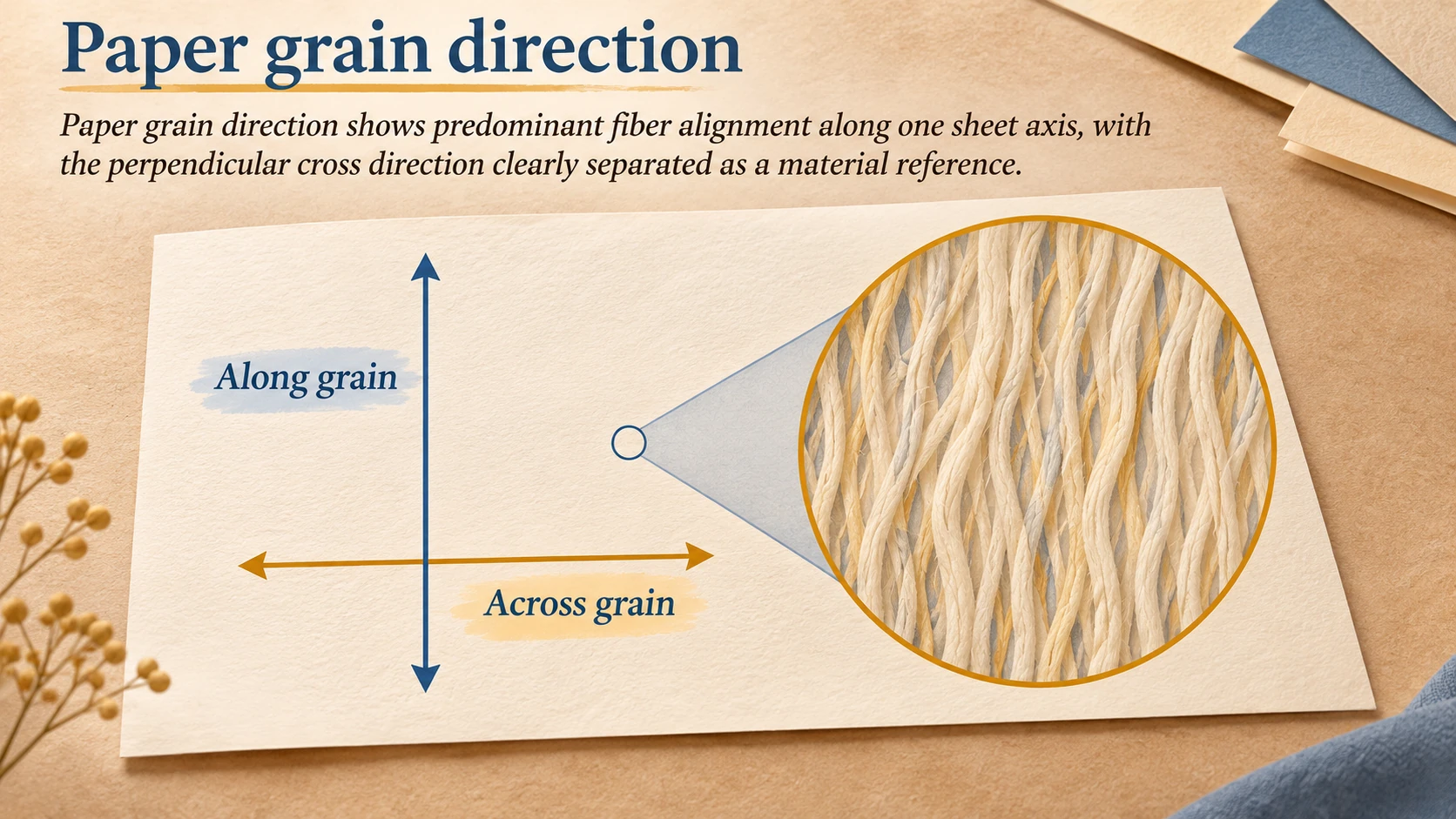
Paper grain direction describes a directional property of a sheet. Understanding it helps explain paper behavior, but it does not identify an unknown paper’s composition, certify permanence or supply instructions for a tool.
Begin with how the sheet is formed
Cornell University Library’s preservation tutorial describes paper as a felted mat of intertwined fibers formed from a liquid suspension. Its account distinguishes handmade sheet formation from the continuous process used for machine-made paper. The way the fibers are arranged matters to the resulting material; paper is not simply a uniform slab whose outline tells you everything about it.
In the tutorial’s comparison, handmade formation encourages fibers to intertwine more randomly, while machine production tends to align them in one direction. That is a description of the manufacturing process, not a claim that every fiber in a machine-made sheet lies in a perfectly straight row. Keep the tendency separate from an imagined microscopic diagram with no variation.
Cornell also notes that grain occurs in board and folder stock. A thicker-looking paper product does not make direction irrelevant. Equally, recognizing a likely directional structure does not establish the exact fibers or additives in an unidentified sheet. The tutorial treats accurate paper identification as a more complicated question involving chemical and fiber analysis. A familiar appearance alone does not answer it.
Understand machine and cross direction
Etherington and Roberts’ bookbinding dictionary defines machine direction through the predominant fiber orientation produced by the moving papermaking wire. It calls the perpendicular direction cross direction. These names describe directions within the material, rather than two different grades of paper. A single sheet has both axes.
The dictionary describes less humidity-related dimensional variation in machine direction. That comparison is important: “less” is not a statement that the sheet cannot change along that axis. It supplies no expansion allowance for a particular craft project and no measurement of paper sitting on your desk.
Keep machine and cross direction attached to the sheet’s manufacture. Turning a sheet on a table changes its position relative to you; it does not manufacture a new fiber arrangement. Cutting a new outline likewise does not, by itself, establish what the original orientation was. If you lack reliable grain information for the actual stock, keep that information unresolved. A cutting grid can describe where a line lies on a board while leaving the material-direction question unanswered.
Drying history is part of the explanation
The University of Utah’s Opening Artists’ Books terminology resource adds manufacturing history to the usual fiber-alignment explanation. Citing Richard P. Grant’s research, it describes grain as involving both predominant fiber direction and drying under constraint. Directional behavior is therefore more than a decorative pattern visible on the surface.
Its account describes shrinkage in an unconstrained direction during papermaking and very small wrinkles or ridges associated with that process. It relates these features to how the material later responds. That explanation concerns the history and structure of the sheet. It does not give the reader a way to reconstruct the conditions under which an unidentified retail paper was dried.
The resource also connects grain orientation with the drape of a book page. The direction is one material consideration.
A research example shows why restraint matters
A 2023 University of Rhode Island study in Micromachines examines paper-and-tape bilayer actuators. Its explanation notes that cellulose fibers take up water and expand more across their width than along their length. Fiber orientation consequently matters to the directional response of the paper.
The researchers bonded a paper strip to tape. The tape restricted the paper layer’s expansion, and the combined strip bent. Their work compared particular paper and tape combinations and considered how construction affected the response. The result illustrates why a free sheet and a bonded assembly need not behave in the same way.
Keep the example within those tested materials and arrangements. It does not predict how far your card, print or book cover will bend, and its measurements should not become a universal allowance for craft paper. This article gives no apparatus, wetting sequence, formula or numerical model. It also gives no instruction to laminate a valued object or moisten paper to discover its properties. The study explains a mechanism under specified research conditions.
Distinguish direction, surface finish and book structure
UC Berkeley’s Library Bindery glossary uses grain direction for the predominant alignment of fibers in paper or board and for warp direction in cloth. The shared word does not make cloth and paper the same structure. Identify which material a binding reference is describing before carrying its terminology into a project.
The glossary separately defines surface finish through qualities such as roughness, smoothness, absorbency and sheen. Those descriptions answer a different question from fiber direction. A smooth-looking sheet is not, on that basis, a sheet whose grain you have identified. Similarly, a visible texture does not supply the complete directional account.
Berkeley places grain direction within bookbinding by relating it to the spine. Its definitions of binding edge, spine and fore edge make that relationship specific to the assembled object. Use those names to understand a reference, rather than assuming the longest visible edge of every loose sheet is already a book spine. This article explains the relationship without teaching folding, sewing, gluing or rebinding. An existing book also should not become a practice sample for identifying material properties.
Keep paper grain and permanence as separate questions
The Library of Congress paper FAQ describes permanent paper by reference to requirements concerning alkaline reserve, lignin, tear resistance and pH. A grain-direction statement does not supply those records. Directional behavior and the chemical or durability requirements of a permanence specification are different pieces of material information.
Keep paper grain and permanence distinct when reading a supplier’s description. Knowing a sheet’s directional label does not establish that it meets a cited permanence standard. Conversely, a permanence claim does not identify the grain of an unmarked sheet. This article gives no numerical standard thresholds, current-edition certification or pass finding for either retail paper or a finished object.
The same FAQ treats damage and treatment as questions involving the actual object’s condition and value. A general explanation of moisture response is not permission to humidify, flatten or repair an original. Where an item is valuable, deteriorating or complicated, seek appropriate conservation advice. Keep the directional explanation as background knowledge, while leaving an intervention decision with the object-specific assessment it needs.
Read the two tool offers within their native limits
The multi-function craft paper-trimmer listing shows a flat board, transparent rail, sliding carriage, circular function selector and fold-out measuring arm. Its native account includes cutting and folding or scoring functions. The project insets are illustrations, without an independently observed result. A partly legible logo does not establish maker equivalence for the native Unbranded catalog field.
The KW-trio 13020 rotary-trimmer listing shows a rod-supported bridge-shaped head, a broad worktable and rounded end housings. Its native title says Silver while its listed color is Multicolor; retain that difference rather than treating either word as a material specification. The gallery shows one complete native tool and its worktable.
These listings illustrate equipment contexts, not the grain of any paper later placed on them. Neither a printed scale nor a straight guide identifies fiber orientation. No cutting, function-selection or pressure instruction is supplied here. The listings also establish no permanence result, tested accuracy or permission to use a particular paper. Obtain applicable tool guidance for an actual project; material knowledge does not replace it.
Use the related guides for their specific decisions
The paper-scoring guide distinguishes a line intended to preserve a connected fold from one intended to separate an offcut. Its question concerns the job you want a tool function to perform. Grain information cannot identify an unfamiliar carriage or turn an intended crease into a separating cut. Likewise, recognizing a tool function does not establish the grain of the stock.
The Photographic Activity Test explainer addresses chemical-interaction evidence for materials used near photographs. That evidence belongs to named samples and test scopes. It does not measure directional stiffness or identify grain. A sheet can raise both a directional question and a photographic-contact question, with different evidence needed for each.
Keep the reference that answers the actual question beside the project. Do not combine the titles into a general certificate for a tool, paper or photographic enclosure. The present explanation supplies material vocabulary; the neighboring guides retain their own practical boundaries. If the needed fact is missing, keep that fact open rather than transferring an answer from a different kind of evidence.
If you later choose a crypto-paid purchase
If you later choose a paper tool through republeq.com and want to use USDT for a crypto payment, first check whether the actual checkout offers that option for the exact order. This conditional example establishes no current asset, network, price, stock position or delivery promise. A preference for one payment method should not decide whether an unfamiliar tool suits the work you intend to do. If a usable option is offered, read the instructions for that transaction. Check the requested asset, network, amount, destination and any order reference against the transfer you are preparing. Review any displayed expiry, fees and final total before authorizing payment. Instructions from a previous order may belong to a different transaction, so retain each set with its own purchase record. If the information is unclear or does not match what your wallet can prepare, obtain clarification before sending funds. Do not guess which network or destination was intended. Keep the order acknowledgment and payment reference needed to identify the purchase, without disclosing a private key or seed phrase. An uncertain recorded payment state requires reconciliation through the actual order process before you consider another transfer. An unchanged screen does not, by itself, establish that a payment failed. Retain the exact selected item and option in the order record, especially if you change candidates while asking about the equipment. A reply concerning one model does not automatically apply to its replacement. After delivery, identify what actually arrived before relying on documents tied to the original selection. A transaction record identifies a payment, while the order record describes the merchant’s account of the purchase. Neither identifies the grain of an unmarked sheet, certifies paper permanence or supplies operating instructions. Completing a purchase leaves those material and equipment questions to be answered by their own evidence. If another person helps with the purchase, make sure the item and transaction references stay together. Ask them to distinguish a question they have sent from an answer they have received. A pending inquiry is not a completed order or a confirmed payment.