Crypto Commerce
Panda PAN725SF compact dryer — Small-load dryers need a realistic exhaust plan
Compare Panda PAN725SF compact dryer by load guidance, timed and sensor modes, exhaust planning, mounting, and space measurements.
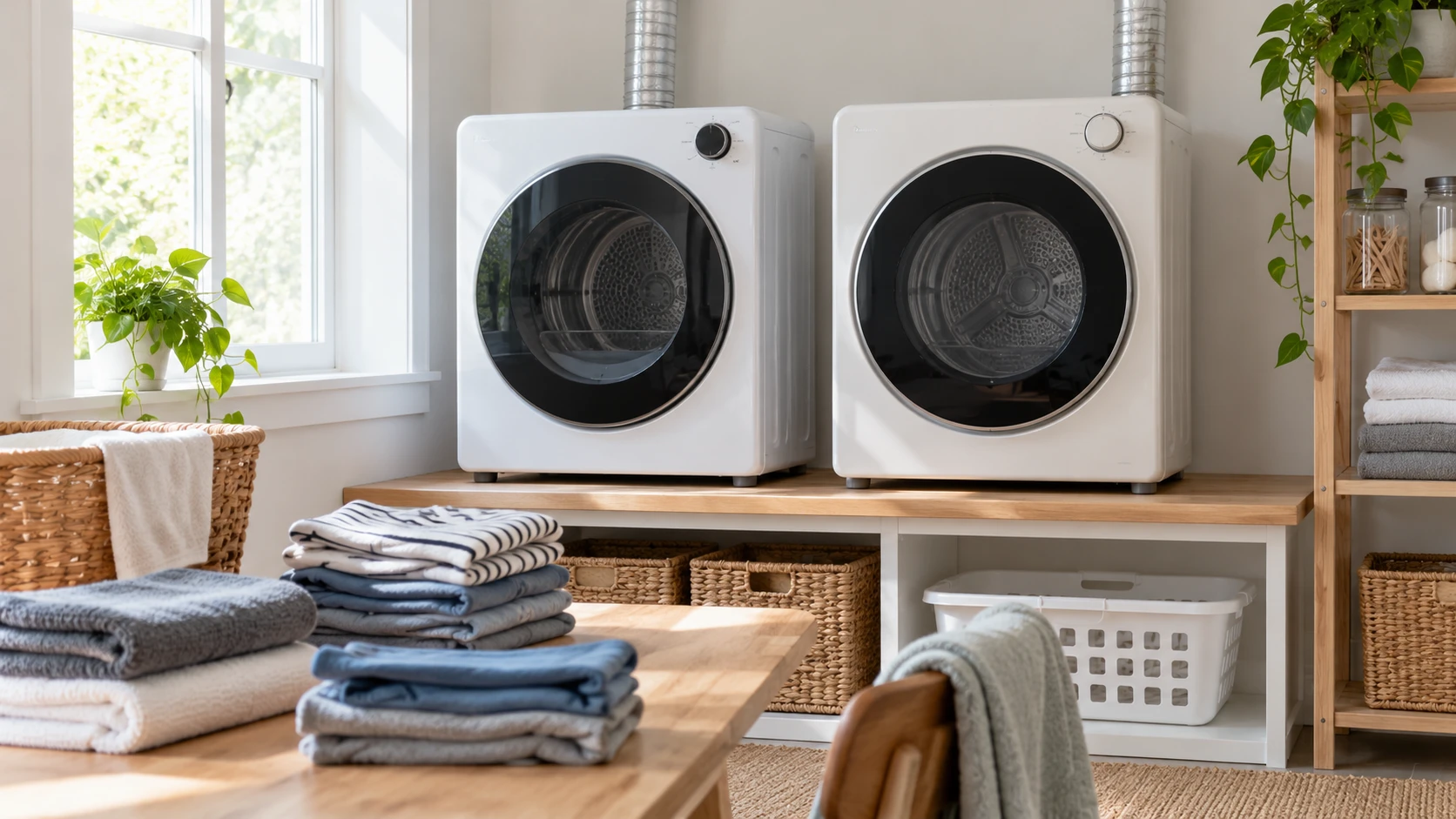
The Panda PAN725SF compact dryer lists a 1.5-cubic-foot drum, 850-watt rated input, timed heat choices, and a suggested load no heavier than 5.5 pounds for quicker drying. A published guide on compact dryer power and venting plan discusses another Panda model, PAN760SF, so its model-specific figures should not be copied to this PAN725SF. The Euhomy 1.8 cu ft portable clothes dryer lists a 1.8-cubic-foot drum, 1,020 watts, seven named modes, and an exhaust pipe. Both require more planning than their small footprints suggest.
Start with the weight of a real laundry load — Euhomy 1.8 cu ft portable clothes dryer
Panda's saved description recommends no more than 5.5 pounds when you want quicker drying. It names small clothing loads such as shirts, baby clothes, exercise wear, and towels. The 1.5-cubic-foot number describes drum volume; it does not tell you how many thick towels can tumble freely. Weigh a typical damp load from your washer and separate bulky pieces. A crowded drum can leave damp folds even if the total weight seems acceptable.
Euhomy lists 1.8 cubic feet and two different weight figures: up to 10.5 pounds of wet clothes or 6.5 pounds of dry clothes. Compare dry weight with dry weight, rather than setting Panda's suggested load beside Euhomy's wet-load ceiling. The saved row does not identify a common fabric mix or moisture level for those numbers. If your laundry includes jeans and bath towels, plan smaller loads than the most optimistic figure. A little free space helps fabric turn and exposes more of it to moving warm air.
Timed programs and moisture control — Euhomy 1.8 cu ft portable clothes dryer
Panda lists Cool for zero to 20 minutes, Warm for 20 to 120, Hot for 120 to 200, and Air Dry for zero to 80. It also describes low and high heat choices, a temperature-selecting timer, and automatic shut-off. Those ranges do not say which setting suits a particular garment label or how long a mixed load will take. Start with the appliance instructions and the clothing-care label, then adjust based on the actual result. A timer can be predictable after you learn your regular loads, but it cannot feel whether the thickest seam is still damp.
Euhomy names Cool Down, Warm, Hot, Anti-Wrinkle, Air Dry, Intelligent, and ECO. Its saved text says Intelligent adjusts heating time with humidity. That is a Republeq's product description of control behavior, not an independent measure of sensor accuracy. Euhomy's Warm and Hot ranges broadly resemble Panda's timed ranges, yet the machines have different ratings and capacities. Their labels alone cannot establish matched drying times. Test a familiar load, and check the thickest pieces before storing them.
Read the ECO description carefully — Euhomy 1.8 cu ft portable clothes dryer
Euhomy describes its ECO mode as 150 minutes of cold air followed by 120 minutes of hot air. That is a long sequence. The row calls it energy-saving but provides no measured energy use or comparison with its other settings. Do not infer a lower electricity bill merely from the word ECO. Ask whether the full sequence can be changed or stopped and whether it suits a normal weekday load. A mode that takes longer than your available laundry window may be less useful even if its energy claim proves true.
Panda's saved row does not name an ECO mode. Its lower 850-watt input does not automatically mean less energy per load than Euhomy's 1,020 watts, because run time matters too. If operating cost is a concern, compare actual watt-hours for a representative load and use the exact settings allowed by the manuals. Power ratings help plan an electrical circuit; they do not supply a complete cost or performance ranking.
Exhaust routing is part of installation — Euhomy 1.8 cu ft portable clothes dryer
Panda's description says an exhaust venting pipe is included for venting outdoors. It also mentions that indoor exhaust releases warm, humid air and that an indoor venting kit can collect some moisture. That is not a general recommendation to vent into a closed room. Follow the current manual and local building requirements for the intended location. An exhaust route that leaves lint or humidity in a small apartment can create a larger problem than the dryer solves.
Euhomy lists an exhaust fitting and pipe in its package. Its saved row does not give a complete duct-length limit or describe a safe indoor venting arrangement. Measure the route from the appliance to a permitted outlet, including bends and the space behind the dryer. Check the manual for duct size, material, cleaning access, and clearances. If the room has no practical exhaust path, settle that question before buying either model. Small does not mean vent-free.
Mounting needs structural and access checks — compact dryer power and venting plan
Panda says mounting brackets are included and that wall installation requires lumber mounted first. The row does not give a wall-load calculation or approve every wall type. Locate appropriate framing, follow the manual, and account for vibration and the loaded appliance. A wall-mounted dryer still needs safe access to its controls, lint filter, door, and exhaust connection. Place the bottom high enough for the washer if stacking the room, but not so high that a person must lift a wet laundry basket overhead.
Euhomy lists two hanging brackets, spacers, and screws in its package. Their presence does not prove that the exact wall and fasteners in your home are suitable. Confirm the permitted mounting method and the required clearances in its manual. Keep the route to the outlet and exhaust accessible. A portable dryer is often moved only until its duct and brackets are installed; plan the final setup as a fixed appliance, even if the product page calls it portable.
Compare dimensions with a tape measure — Euhomy 1.8 cu ft portable clothes dryer
Panda gives product dimensions of 19.5 by 16 by 23.8 inches and a weight of 37.5 pounds. Its row separately lists package measurements and a different rounded weight elsewhere, so use the product dimensions rather than carton size for the first fit sketch. Euhomy lists 19.3 by 17.7 by 27 inches. The saved rows do not label all three axes consistently, so do not assume the first number is always width. Confirm the orientation from the diagrams in the current manuals.
Leave space to open each door, pull out lint filters, and disconnect a vent for cleaning. The exhaust fitting may add depth beyond the bare cabinet measurement. If the appliance sits on a shelf, check the shelf's load rating with wet laundry included. If it sits in a closet, check airflow and access requirements. A dryer can fit its stated footprint and still be impractical when the door opens against a wall or the hose must bend sharply.
Lint maintenance and fabric care — Euhomy 1.8 cu ft portable clothes dryer
Panda lists a removable lint filter. Euhomy says it has a multiple-filtration system for lint and hair, but does not describe each filter's removal steps in the saved row. Follow each manual's cleaning schedule. Lint buildup can obstruct airflow, lengthen drying, and create a hazard. Plan a place to clean the filter after loads without scattering lint into the room. Check the duct as well; cleaning only the visible screen may leave a blocked exhaust path.
Both listings describe stainless steel drums. That material claim does not guarantee identical fabric handling or wrinkle results. Separate delicate items by care label, and avoid putting a heavy towel in with light shirts if you want them dry at the same time. Euhomy's Anti-Wrinkle mode may help some loads, but the row does not state a wrinkle-removal test. Remove clothes promptly and check whether your regular load can tumble without bunching. The right routine often improves results more than an extra mode name.
Warranty and electrical facts to confirm — Euhomy 1.8 cu ft portable clothes dryer
Panda's row explicitly gives 110V/60Hz and 850 watts. Euhomy's saved row gives 1,020 watts and claims overheat protection, but it does not clearly state a voltage in the extracted description. Obtain the current rating label and manual before assuming it uses the same receptacle requirements as Panda. Check the circuit and outlet location, then avoid an improvised extension lead. An installation drawing is more useful than a generic “apartment size” label.
Euhomy claims ETL and DOE certifications and a one-year warranty service in its Republeq's product-page text. The row does not supply the certificate scope or warranty document. Panda's row does not give comparable warranty terms. Verify both current offers and the exact coverage before comparing assurances. Those details matter after purchase, but they cannot compensate for an incompatible electrical supply or missing exhaust route.
A practical small-laundry decision — Euhomy 1.8 cu ft portable clothes dryer
Weigh one ordinary dry load, measure the space and permitted vent route, and decide whether wall mounting is genuinely useful. Panda's smaller drum and 5.5-pound quick-dry guidance may fit frequent small loads. Euhomy offers a somewhat larger listed drum, an Intelligent mode, and a different set of timed options. Neither product row includes a matched drying test with the same fabrics and starting moisture.
Use the manuals to confirm the voltage, placement, duct route, and care instructions for the exact models. Then run a familiar load within the maker's guidance and record how long the thickest item takes to dry. If an exhaust path is unavailable or the circuit is unsuitable, that installation fact should decide the purchase before any capacity or mode comparison. These compact dryers are most useful when their load size and room setup fit together.