Crypto Commerce
Panasonic NN-SN74PB inverter microwave vs Danby DDMW01440WG1: reheating on a crowded counter
Compare Panasonic NN-SN74PB inverter microwave by dish fit, sensor programs, power controls, defrosting, installation dimensions, and saved price.
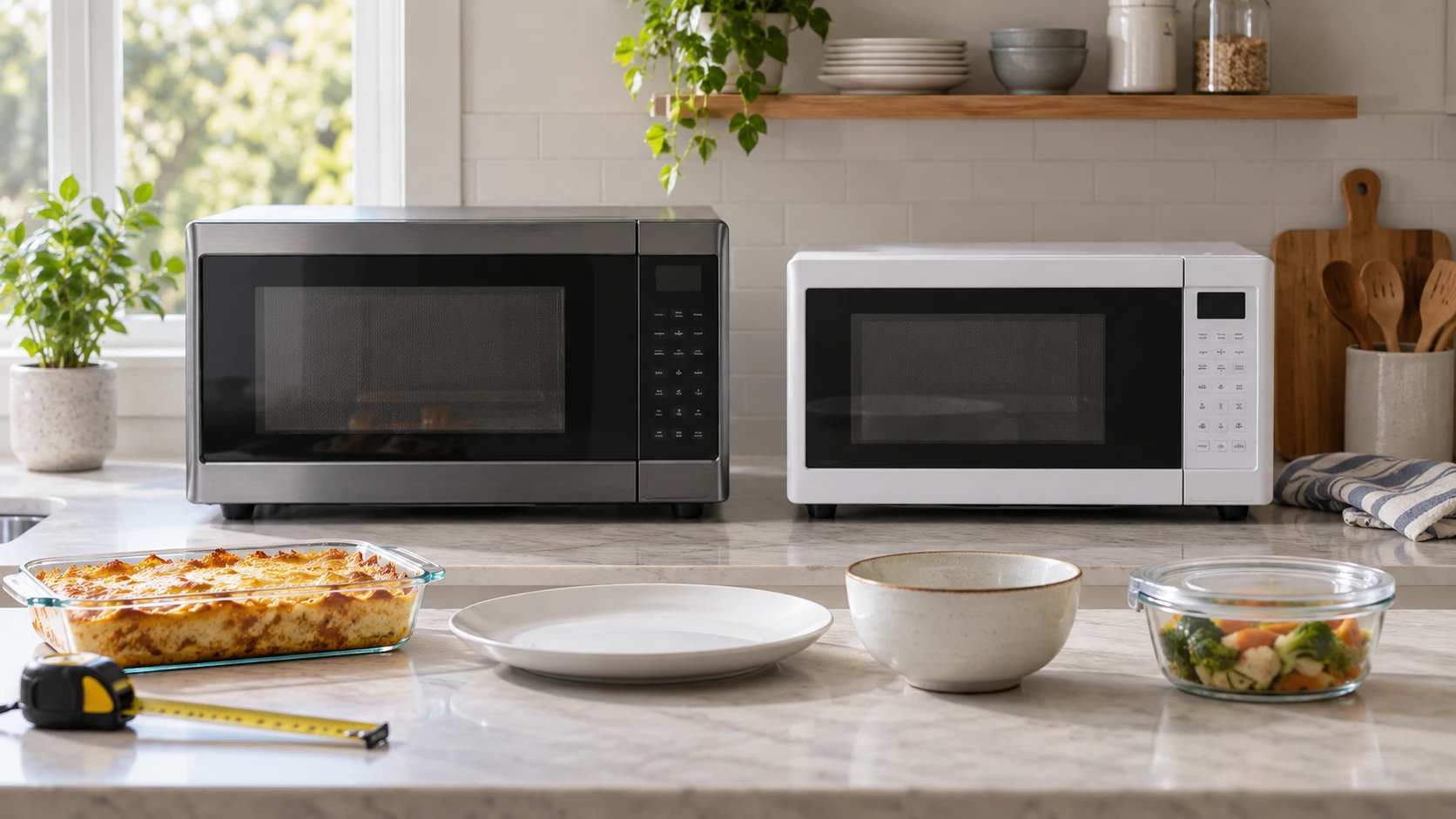
A countertop microwave has to fit the kitchen and heat the meals that actually pass through it. The Panasonic NN-SN74PB inverter microwave lists 1.6 cubic feet, 1,250 watts, a 15-inch turntable, sensor reheat, and inverter cooking. The related guide to Panasonic sensor-microwave controls covers a different Panasonic model and offers useful control questions; it does not establish how this NN-SN74PB performs. The Danby DDMW01440WG1 sensor microwave lists 1.4 cubic feet, 1,000 watts, a humidity sensor, and nine sensor-cooking options. The better match depends on dish size, counter clearance, and how much control the cook wants over reheating and defrosting.
Measure the dish before comparing cubic feet — Danby DDMW01440WG1 sensor microwave
The two listed interior volumes differ by 0.2 cubic feet. That number alone cannot tell whether a favorite casserole, wide dinner plate, or tall covered bowl will fit. Panasonic gives a 15-inch turntable diameter. Danby's saved excerpt does not give its turntable diameter or interior width and height. Measure the dishes used most often, including handles and a microwave-safe cover, then check the current interior dimensions for each exact model. A round turntable needs enough room to rotate a rectangular dish without hitting the wall.
Think about height as well as width. A covered leftovers container may clear the opening but sit too close to the cavity roof. A tall mug may fit at the door yet interfere with a lid or handle. The saved rows do not provide door-opening dimensions, so ask for a manual diagram or inspect the unit. If family meals often arrive in large serving bowls, the Panasonic's stated turntable is a useful clue, but it is still not a guarantee for a particular container. Test the dish in a floor model or use the manufacturer's measured cavity dimensions.
Counter space is a separate problem. Panasonic's listing calls its design compact relative to its cooking space, but it does not give exterior dimensions in the excerpt. Danby's row likewise omits clear overall dimensions. Do not use the cavity volume as an estimate of the footprint. Measure the available width, depth, and height, allowing room for the door swing, ventilation clearances, an accessible outlet, and safe placement away from a sink or heat source. Follow the exact manual's clearance and electrical instructions. An appliance that barely fits between cabinets may be difficult to use or service.
Understand the wattage claims — Danby DDMW01440WG1 sensor microwave
Panasonic lists 1,250 watts of cooking power and Danby lists 1,000 watts. Those figures suggest different rated outputs, but a 25% numeric gap does not translate into a reliable 25% change in every cooking time. Food shape, starting temperature, container, and the machine's control method all matter. Recipe directions often give a time for a particular power class; adjust according to the food and the manual rather than automatically using the higher setting for less time.
Panasonic's saved description says its inverter technology supplies continuous cooking power and is intended to heat from the edges toward the center more evenly. It also names inverter turbo defrost. These are manufacturer claims for the NN-SN74PB, not a measured side-by-side result against Danby. Inverter control can be relevant when a dish needs gentler heating, but the row does not show a test of a sauce, a frozen meal, or a thick piece of food. If even warming is the purchase priority, look for a demonstration with an ordinary household dish and check the temperature in several spots after the standing time recommended in food-safety guidance.
Danby lists ten power levels and defrost by weight or time. The saved excerpt does not describe whether it uses inverter control or how its lower levels are achieved. Avoid assuming the absence of a named feature in a short listing proves the machine lacks it. The current manual can identify its actual controls. Power levels and a weight-entry defrost mode may be enough for someone comfortable selecting time and strength manually. The useful question is whether the controls let the cook repeat a good result without multiple stops and stir attempts.
Compare what the sensors do — Danby DDMW01440WG1 sensor microwave
Panasonic lists sensor reheat, which it says warms food evenly. It also lists 14 preset auto-cook items. The row does not explain how the sensor determines when to stop or enumerate all of those presets. Verify whether it uses humidity, temperature, or another signal and which food types each program expects. A sensor program cannot know the contents of an opaque covered dish as a person does. Follow the manual's container and cover instructions, stir where directed, and check that the food is fully heated before serving.
Danby's saved description specifically says a humidity sensor turns the microwave off when cooking or reheating is done and lists nine sensor-cooking options. It also names melt, soften, and warm functions. The number of programs is not a measure of their accuracy. A family that mostly reheats leftovers may need one dependable sensor-reheat mode more than a long list of rarely used options. Ask which foods the Danby sensor choices cover and whether a manual time can still be added easily when a dish needs more heat.
Sensor cooking can reduce guesswork, but a covered bowl, a small portion, or food with uneven moisture may behave differently from the program's expected load. Test a familiar dish and observe the result before relying on automatic shutoff for every meal. The saved rows contain no independent sensor-accuracy tests. Both machines should be judged by the specific food and containers in the home, including the need to rotate, stir, and let food stand where the manufacturer's guidance calls for it.
Defrosting without drying the edges — Danby DDMW01440WG1 sensor microwave
Panasonic advertises inverter turbo defrost designed to thaw more evenly and quickly. The excerpt does not give the weight range, food types, or conditions behind that description. Danby offers defrost by weight or time. Either control still requires attention when thawing a thick package: the outer layer may soften while the center remains frozen. Consult the manual's directions for food preparation, turning, and standing time. Use safe food-handling practices, and cook perishable food promptly after microwave defrosting.
Compare the interface the household can actually operate. If a cook frequently thaws a small portion, a weight-entry mode may be convenient when its increments match the portion. A time-entry mode may be easier for an irregular piece after learning its behavior. Panasonic's inverter label is promising for controlled power, but it does not remove the need to check the food. Try the same common frozen item in the intended container and note how often the user must stop and separate pieces. The rows cannot establish which machine wins that task from feature names alone.
Controls for the daily kitchen routine — guide to Panasonic sensor-microwave controls
Panasonic lists Delay Start, a timer, More/Less Control, Quick Minute, a Popcorn key, and Keep Warm for foods such as vegetables, soup, sauces, and desserts. More/Less Control could help adjust a preset after experience with a particular dish. Quick Minute may be useful for small reheats. Confirm how the keys behave on the current panel and whether the display is legible from the user's normal position. A feature that requires several unlabeled key combinations may be less helpful than a simple manual time entry.
Danby's row names ten power levels, nine sensor choices, and melt, soften, and warm functions. It also appears to mention a child or control lock, but the saved text is incomplete at that point. Verify the lock feature and its operation in the exact DDMW01440WG1 manual before relying on it in a household with children. Ask whether the clock, beeps, and end-of-cycle reminder can be adjusted if those matter in the kitchen. Neither saved description supplies a complete control-panel walkthrough.
White and black finishes may influence an open kitchen's appearance, but they do not change cooking suitability. Panasonic is listed in black; Danby in white. Check the door handle or release mechanism in person if possible. A person with limited grip strength may notice a difference that does not appear in a specification table. Try placing a full plate, opening the door, and reading the display while standing at the actual counter height. That small routine will happen far more often than an occasional specialty preset.
Check the electricity and ventilation before ordering — Danby DDMW01440WG1 sensor microwave
The two products are countertop microwaves. Their saved rows do not give full input power, outlet requirements, cord length, or required clearance around the housing. Cooking-output wattage is not the same as the electrical input rating. Read the nameplate and current manual before deciding whether an existing outlet and circuit are suitable, and do not place a cord where it can be pinched by a cabinet or pulled across a wet work area. Use the manufacturer-recommended installation rather than an improvised enclosure.
Ventilation also affects where the microwave can sit. Cabinets and walls can block openings even when the appliance fits physically. Allow the specified clearances on the actual sides and rear identified by the manual. Check whether the door can swing fully open without hitting a wall or another appliance. If the kitchen has almost no counter depth, neither row gives enough evidence to approve the installation. Get exterior dimensions and a placement diagram before purchase, or consider a different form factor whose installation requirements fit the room.
Read the saved prices carefully — Danby DDMW01440WG1 sensor microwave
The catalog snapshot lists Panasonic at $418.69 and Danby at $361 in USD, a $57.69 difference. Those are minimum saved prices, not a current delivered quote. Panasonic lists a larger cavity, higher rated cooking output, inverter technology, and a 15-inch turntable. Danby lists a humidity sensor, nine sensor options, ten power levels, and a smaller stated cavity. The price gap has meaning only if the buyer verifies that the larger dishes and desired controls really fit the household's routine. Recheck availability, shipping, and return terms for the exact model numbers.
Choose Panasonic if its confirmed exterior dimensions fit the counter and the larger turntable and inverter-controlled functions address frequent large-dish reheating or defrosting. Choose Danby if its confirmed interior fits the usual containers and its humidity-sensor and manual power controls match the cook's preferred approach. Before ordering either, measure the widest dish, check the manual's cavity and clearance dimensions, inspect the panel, and test a normal leftovers portion when a demonstration is possible. That evidence can settle a kitchen decision more reliably than the cubic-foot and wattage figures alone.