Home & Living
Padlock shackle shapes: reading open and circular bodies
Read the body, shackle opening, key description and package count on two distinct padlock listings before checking a real hasp.
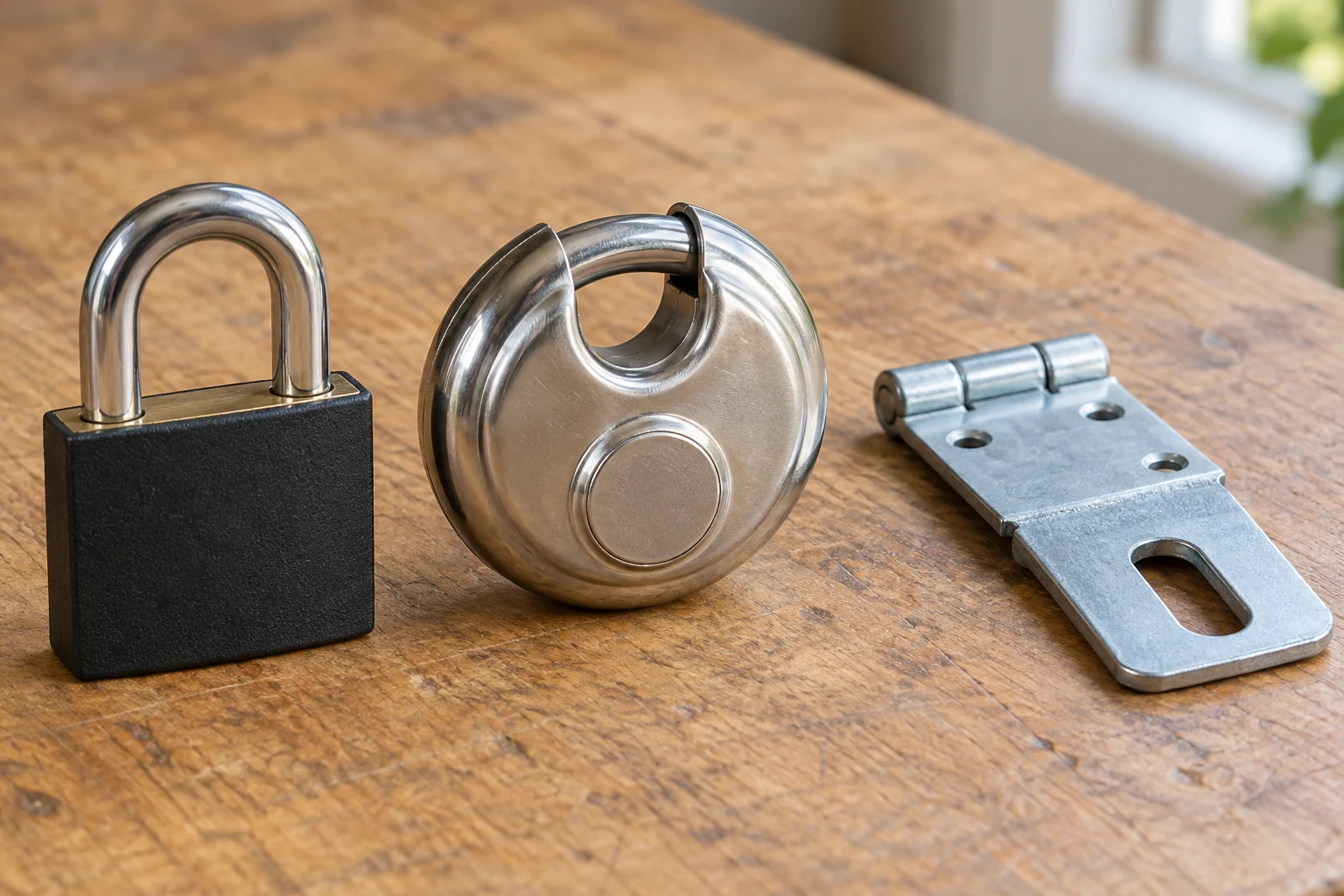
Padlock shackle shapes are easy to recognize in a photograph, but shape alone does not tell you whether a lock will fit your hasp. An exposed U-shaped shackle and a circular lock body leave different amounts of room around the hardware. Begin with the opening and the space around your own hasp. Then check the dimensions and key arrangement for the exact lock you might order.
Two current listings illustrate the difference. The Master Lock 131Q four-count listing describes brass bodies with black vinyl covers and steel shackles. The ABUS 26/70mm Diskus listing shows a circular body with a short visible opening near the top. Neither photograph proves that the lock will fit a particular gate, box, or latch.
Measure the hasp first
Look at the metal loop or holes that will receive the shackle. Note what must pass through the opening, how far the shackle must reach, and where the lock body will sit when closed. A hasp can have room for the shackle yet sit so close to a frame that a wide body cannot settle against it. Product photographs cannot show the clearance around your installation.
Keep three lock measurements separate: shackle diameter, usable width between its sides, and usable height between the body and the inside of the closed shackle. A seller may provide only some of them. Leave the others blank rather than estimating them from a photograph. If the hasp has an unusual shape, consult its maker's instructions or ask the lock seller for exact fit information.
A quick sketch can help. Draw the hasp and the nearby door, lid, or frame. Mark the direction from which the lock enters and the room needed to turn the key. Measure the opening you have, then compare it with the selected lock's documented dimensions. The sketch identifies the question; it does not replace a dimensioned specification.
Check the hardware in the position in which you will actually lock it. A box lid may lie flat while you measure it and stand at an angle when closed. A gate latch may shift slightly between open and shut positions. Record the position beside each measurement so that space visible with the hardware open is not mistaken for clearance when it is closed.
Do not force a candidate lock through a narrow opening as a fit test. If fitting it requires pressure or twisting the hasp, stop and check the dimensions and the hardware's intended use. The opening, surrounding frame, or body clearance may be the problem. A hardware maker or qualified installer can answer installation-specific questions that the listings cannot.
If the hasp has two holes, measure the path the shackle must take through both, not just the widest visible hole. Note any lip, hinge, or nearby trim that limits how you can angle a lock into place. You may have enough room to insert an open shackle but too little room for the body when you close it. Record those as separate observations. If a measurement changes when the door or lid moves, use the position in which the lock will actually secure it. A listing that gives only an outside body size cannot answer every one of these questions.
Read the open-shackle example
The Master Lock 131Q listing states a 1-3/16-inch brass body with a black vinyl cover and a 3/16-inch steel shackle. Its image shows four small locks with exposed U-shaped shackles and keys. The four-count package matters if you need several locks; it does not change the clearance needed by any one of them.
The body measurement and shackle diameter describe different parts. Do not treat the 1-3/16-inch body figure as the space inside the U. Shackle diameter alone also cannot tell you whether the loop reaches around your hasp. Look for the usable width and height in current model documentation. If those figures are missing, keep fit undecided.
The black cover is both pictured and described in the listing. It may affect the outside space the body needs, although the reviewed text does not give a separate covered-body dimension. Check where the body would rest when closed. The listing uses “weatherproof” in its title, but the exact model's exposure and care instructions still matter for your setting.
Before buying the four-count set, compare each place you intend to use a lock. Four similar-looking hasps can differ in opening, surrounding clearance, or the direction from which you must reach them. A package count tells you how many locks are offered; it does not establish that one model fits every location. Keep a separate measurement line for each hasp. If the listing offers a variant with a different shackle or body, verify the exact item in the cart rather than transferring the reviewed 131Q measurements to it.
Read the circular-body example
The ABUS listing names a 26/70mm Diskus padlock and labels it “keyed alike,” with the identifier EE0036. Its native description repeats the title without supplying separate usable shackle-opening dimensions in the text reviewed here. The image shows a circular body and an opening near its top. That is enough to identify the broad form, but not enough to settle hasp fit.
A circular body puts more of its outline close to the hasp than an exposed U-shaped loop may. Inspect the area around the opening and the surface behind it on your own hardware. This visual observation establishes no security advantage or universal clearance rule. You still need measurements for the exact ABUS model and any instructions that apply to your hardware.
Keep “70mm” as part of the listing's model name. The title alone does not say that 70mm is the usable shackle opening or the clearance between the hasp and body. Find a specification that names the measured part, or ask the seller a precise question about the dimension you need. A number without its part can make a poor fit look certain.
Photographs may be cropped or enlarged without a scale. The ABUS image makes the round body clear, and the Master Lock image shows four locks together, but neither image lets you measure an opening reliably from its pixels. Use pictures to identify parts and outlines. Use documented dimensions for fit, and keep the exact model name beside each figure you record.
Compare the circular lock with the hasp from the side as well as from the front. The round outline may have space when viewed straight on but meet a raised edge when you rotate the lock into its closed position. Sketch the body at the point where it would rest. If the seller or maker supplies a diagram, check which dimensions refer to the body and which refer to the shackle opening. Do not use the photographed gap as a scale. The missing measurement is a reason to ask a question, not a reason to guess that the circular model cannot fit.
Keep keying and package count separate
Both listings use “keyed alike” language. Confirm what that field means for the exact package and seller you choose, especially if you are ordering more than one lock. The Master Lock example is a four-count package; the ABUS example is a separate model listing. Do not infer that keys work across brands or that the ABUS purchase includes four locks.
If several people will use a lock, decide who needs a key and where a spare will be kept. Write down the exact model, number of locks supplied, stated keying arrangement, and number of keys listed. Ask the seller about any missing field. A “keyed alike” label does not answer every question about the contents of your cart.
Key handling is also a separate household habit. A first-week house-key story follows a person carrying a new key through ordinary trips home. It is a fictional account of keeping the right key available, not evidence about padlock dimensions or key codes. Keep your fit decision tied to the actual hasp and lock listing.
For a larger collection of shared keys, the labeled key-rack capacity guide covers counting sets and assigning each a clear place. That organization question comes after choosing a lock. It supplies no shackle dimensions and does not prove that two products share a key.
Make a short fit worksheet
Put the candidate model at the top of a page. List the measured hasp opening, available space for the lock body, shackle diameter, and usable shackle width and height. Beside each value, write where it came from: your measurement, the current listing, or a maker's model sheet. Leave a field blank when you lack evidence. This is more useful than calling two photographs “about the same size.”
For Master Lock 131Q, the reviewed listing lets you enter its stated body and shackle diameters and its four-count quantity. You still need a checked usable opening. For ABUS 26/70mm Diskus, you can enter the model name and circular body form; the reviewed native text does not supply the usable opening dimensions. Ask for the missing measurement before deciding that either lock fits.
Record how the lock must open and close in its setting. A keyway that is easy to reach on a table may face a wall or door edge on the real hasp. Check the motion without forcing the hardware. Follow any orientation or use limits in instructions for the exact model. This guide cannot assess the construction, condition, or access rules of a particular door, gate, or storage box.
Review the seller's current page before ordering. Package contents, variants, and displayed specifications can change. Confirm that the item in your cart has the same model identity as the one on your worksheet. If you select a different size or keying option, start a new line for that exact variant instead of carrying over the first model's measurements.
Keep the worksheet with the model identity or a dated link to the current listing. If a later page shows a revised package, different keying option, or additional size, you can see which information belongs to which version. Do the same when someone else in the household measures the hasp: label the location and closed position so the numbers are not mixed with another gate or box. These notes do not turn a listing into installation instructions. They make the remaining questions clear enough to take to the seller, maker, or installer.
Decide when the missing fields are filled
Compare the open U-shaped lock and the circular Diskus outline with your actual hasp, then verify the needed dimensions in current product or maker information. Keep package quantity and keying on separate lines. A four-count picture and a familiar model name answer different questions from the physical opening.
If fit data are unavailable, leave the choice open. Ask for the exact item's usable shackle width and height, body clearance, or key quantity, whichever field is missing. Once the measurements are tied to the hardware in front of you, the listing can support a fit decision. The photograph remains useful for recognizing the shape you are checking.