Office Supplies & Stationery
Let two plans remain in an original two-voice poem
The Courtyard Tomorrow gives two fictional speakers their own stanzas and keeps both plans present without adding an agreed ending.
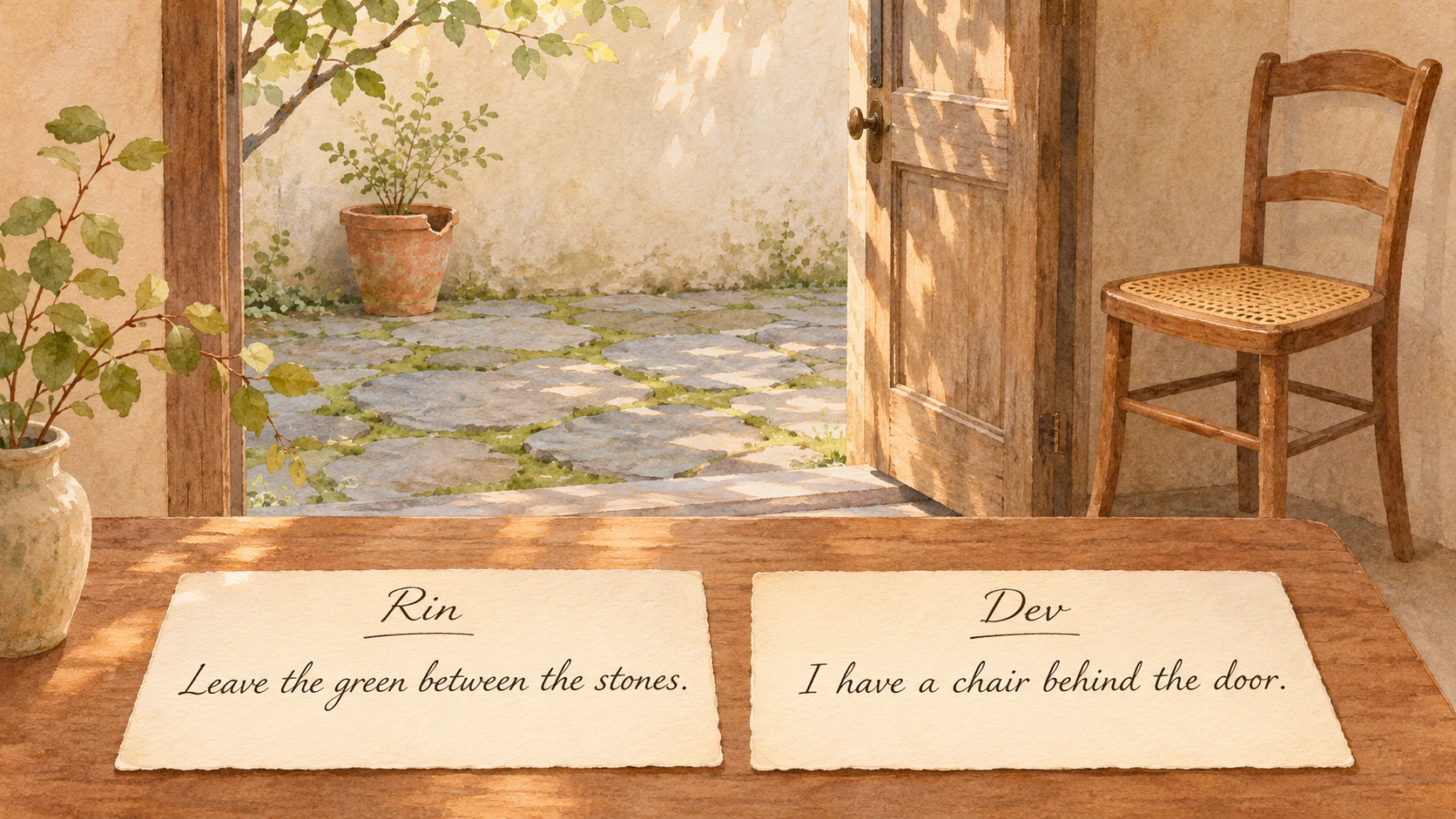
An original two-voice poem can leave its characters wanting different things at the end. In The Courtyard Tomorrow, Rin wants the green between the stones to remain, while Dev wants a clear place for a chair. I have written both voices into one complete piece. Its ending keeps their plans present without supplying an agreement neither character has made.
Rin, Dev and their courtyard are fictional. The moss, pot, chair and doorway belong to this invented poem. Their observations supply no gardening advice, furniture-placement specification or report of a real disagreement. The writing choice is how these particular voices accompany each other on the page, with each character allowed a wish that the other has not adopted.
Give each character something specific to want
Rin looks at the seams between the stones. A broken pot and the shade of a wall matter to this voice. Dev thinks about a cane chair that has been kept behind the door, with a coat on its seat. The poem gives each character an object and a place to notice before asking the ending to hold their different intentions.
I keep their wishes modest enough to state plainly. Rin is not defending every possible plant in the courtyard, and Dev is not proposing to empty it. Each voice eventually says so in its own words. Those limits belong to the characters I have written. They make the particular wants visible without turning either person into a position that has to stand for everyone.
Read the complete original poem
The Courtyard Tomorrow has the eight character stanzas printed below. Rin and Dev are the speakers within the fiction. Their names identify the voice of each stanza; they are not names assigned to actual readers at an event. The order and words here form the selected poem, including its ending at the doorway.
Rin:
Leave the green between the stones.
It remembers the shade of the wall.
I know the place where rain settles,
a soft seam beside the broken pot.
Dev:
I have a chair behind the door.
Its cane seat holds the morning light.
I want to bring it into the courtyard
and put both feet on a clear place.
Rin:
The pot has lost one piece of its rim.
I keep it turned toward the wall.
A leaf leans through the little opening;
I would leave that opening alone.
Dev:
My chair has waited through the winter.
A coat has occupied it in the hall.
I will lift the coat and carry it elsewhere.
I want the chair to have a morning outside.
Rin:
I am not asking the stones to vanish.
I like the hard edges under the green.
In the narrow place beside the drain
a little dark leaf has unfolded.
Dev:
I am not asking for an empty courtyard.
I would leave the pot where it stands.
But I have held the chair at the doorway,
and I want somewhere to set it down.
Rin:
Tomorrow I will look along the seams.
I will turn the broken pot toward the wall.
When the shade reaches the last stone,
I will look for the green that has returned.
Dev:
Tomorrow I will lift the coat from the chair.
I will carry the chair as far as the door.
I have not chosen the place for its feet.
I will stand there, looking into the courtyard.
separate wishes
The separate wishes remain recognizable after the last stanza. Rin still intends to look for the green; Dev still intends to bring the chair toward the doorway. I have not written a cleared patch, a seat in use or a promise to leave every seam untouched. The selected ending stops before either plan becomes a joint action.
Dev has the last stanza because I want the poem to end at a threshold. That placement does not announce that Dev wins. The final words keep the chair’s position undecided. Rin’s preceding stanza still has its own future, with the pot turned toward the wall and attention returning to the green. I would read both endings when describing what remains open.
The repeated word Tomorrow brings their plans close together without making the plans identical. Rin will look; Dev will lift and carry. The characters have a shared day in this fiction, but I have not supplied a timetable linking their movements. There is no hidden ordering question to solve, and no event needs to be reconstructed from competing accounts.
shared courtyard
The shared courtyard appears differently in the two voices. Rin’s early lines give attention to a soft seam and a missing part of the pot. Dev’s give attention to a seat and the place where feet might rest. Both voices have concrete surroundings. Neither is limited to saying yes or no to a proposition the other has already explained.
I keep the broken pot in Dev’s later stanza. The line about leaving it where it stands gives Dev an observation that reaches into Rin’s surroundings without claiming their wishes have merged. Likewise, Rin’s stones remain hard beneath the green. I want those details because the characters can notice a place while still wanting different things from it.
I would leave the courtyard’s overall shape undescribed beyond what the poem gives. It has stones, a wall, a drain and a doorway, but there is no measured plan. Adding a practical layout to settle where the chair fits would start another task. This piece ends with the character looking into the place, not with a diagram proving that a compromise is available.
Compare an ending that announces agreement
I wrote a short unused replacement for the final two stanzas: Rin says, “We will clear a place beside the wall.” Dev replies, “We will keep the green beside the pot.” Those lines would give the characters a joint arrangement. They belong to an actual alternative I am considering here, rather than to an agreement secretly present in the selected poem.
That alternative would also change what the earlier stanzas lead toward. Rin’s first request would become part of an agreed division of the courtyard, and Dev’s chair would have a chosen place. I might use that version if I wanted to write the making of an arrangement. For this piece, I prefer their stated intentions to remain alongside each other at the close.
I leave the unused lines in a separate note. They are not a correction to an error in the selected version. Keeping them allows me to point to the difference I am choosing: one ending supplies an agreement, while the other preserves the two futures the characters have spoken. I do not need to call either ending universally more honest or more satisfying.
Let each voice have more than a reply
Rin’s pot stanza does not answer the chair line by line. It turns toward the missing piece of the rim and the leaf at the opening. Dev’s following stanza turns toward the coat and the winter indoors. I want these passages because they give each voice something to say beyond defending the opening wish. The poem can alternate speakers without making every stanza a rebuttal.
The two later stanzas beginning I am not asking do respond more directly to the situation. I retain those character statements because each limits a possible reading of the request. They are spoken within the poem, beside the objects and observations that prompted them. I have not expanded them into advice about how real people should negotiate a shared space.
I also keep both names visible above their stanzas when saving the piece. Removing the labels would create another version whose speaker changes would need to be considered through the words alone. I have chosen a clearly identified pair of fictional voices for this poem. Their labels are part of that selected presentation, rather than marginal assignments for a group reading.
Read the optional pencil accounts carefully
The NOBRAND account describing Derwent Inktense pencils names a twelve-pencil metal tin. The pictured lid also says twelve, while the open row does not establish the complete supplied total. The printed pencil illustration and lower reflection are not extra contents. Watercolor, permanency, layering, origin and material language remains untested catalogue or package wording. No use of water, fabric or a particular paper is established here.
The BAZIC Electra pencil account says four per pack. Its image shows two differently colored blister cards, each printed three and holding three visible mechanical pencils. Supplied count and assortment remain unresolved. The grip close-ups are illustrations; a separate refill pack is not visible. Bangkit USA catalogue identity and pictured BAZIC labels do not establish a factory relationship or a writing test for this poem.
Keep neighboring writing occasions separate
The paired poem reading guide shares one fixed narrator’s poem between actual readers, retaining its passages and line endings. Rin and Dev are different speakers inside this newly authored piece. Their stanza labels identify fictional voices, without assigning a performance or changing another poem’s reader names.
The companion scenes around one shared knock links two complete room passages through a declared event. The Courtyard Tomorrow holds different wishes in alternating character stanzas. It does not revisit one knock, align two accounts of an event or infer what either character heard.
Ordering writing supplies through Republeq
You can write or keep this original poem without making a new purchase. If you choose to order through Republeq.com and cryptocurrency such as USDT is offered for that particular transaction, review the current order and payment details before authorizing anything. Confirm the selected product and option, intended quantity, delivery destination and complete amount presented for the order. For the Inktense account, keep the native and printed twelve count separate from verification of the actual supplied contents. For the Electra account, ask about the four-pack wording and pictured three-pencil cards if the discrepancy affects your choice. Retain any clarification with the exact order reference. Neither a writing project nor a familiar brand label resolves those questions. Use only the asset, network and receiving instructions presented by the applicable transaction flow. This article provides no wallet address, conversion amount, transfer deadline or recommended network. Ask the responsible service through a channel you have checked when an essential instruction remains unclear. If the selection or instructions change while you are reviewing them, return to the current details and establish what order you now intend to authorize. Consider any wallet or exchange charge through the service actually being used, alongside the merchant’s displayed total. Keep the order and payment records the involved services provide. A sent transaction and a confirmed merchant order describe different events; reconcile an uncertain result before considering another payment. Read the applicable delivery, cancellation, return and refund terms for the chosen order. Those records do not inspect delivered pencils, certify a complete tin or blister quantity, or establish writing and watercolor performance on a surface. Keep such supplied-content and material questions with the exact offer and its applicable instructions.
Keep the selected poem with its unused close
I would save the complete selected poem beside the short agreement alternative, naming each clearly. In the version I am keeping, Rin looks for the green and Dev brings the chair only as far as the door. Neither future disappears because the other is present. The Courtyard Tomorrow ends there, with both voices still belonging to the piece I have written.