Lifestyle & Inspiration
Open-door craft afternoon: make joining optional
A fictional shared-household afternoon leaves room for a brief visit, a separate drawing and an ordinary return to the rest of the day.
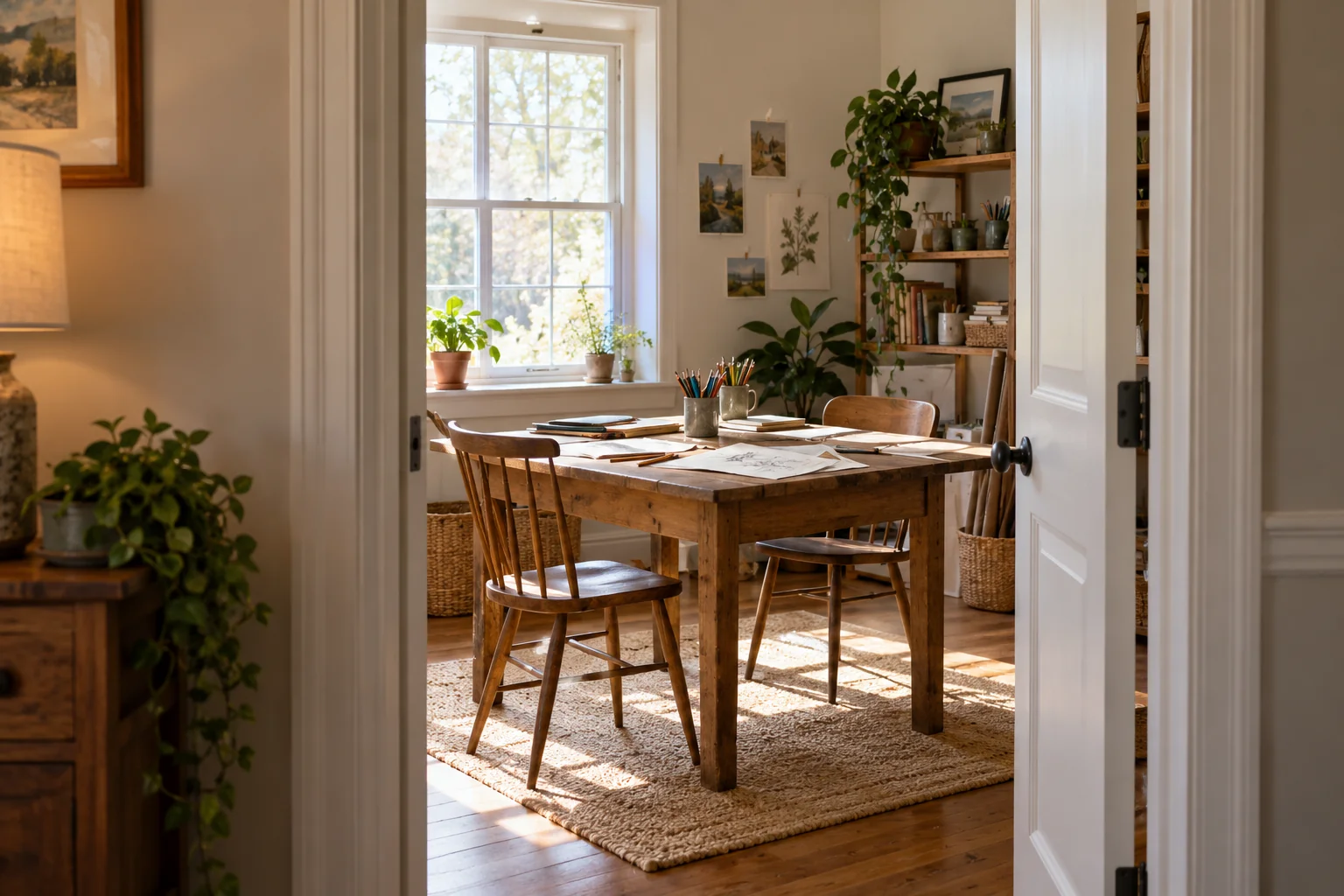
An open-door craft afternoon can begin with a modest invitation: I will be drawing here for a while, and you are welcome to stop by. The invitation leaves room for someone to look in, stay with a separate project or carry on with their day. Give the afternoon an ending as well as a beginning, so an ordinary period of company does not become an expectation that the room is always available.
The household scene below is invented. Mara wants to spend part of Saturday drawing in a room she normally uses alone. Eli, who shares the home, has other things to do. They choose a period when the room's door may appropriately remain open. Their arrangement concerns that particular afternoon; neither person has agreed to an ongoing household custom.
Begin with something you wanted to make anyway
Mara begins with a page she already wants to draw. She has sketched a small person holding an enormous umbrella and would like to see where the picture goes. There is an empty chair nearby, but no unfinished second copy waiting for Eli. The invitation does not depend on his completing a matching piece.
Before she starts, Mara tells him roughly what she has in mind. She will be in the room until she pauses to make tea. He can come and see the drawing if he feels like it. Eli says he may stop in after sending a message. That answer leaves a possibility open; Mara does not turn it into a promised arrival.
She can now begin without waiting at the doorway. If Eli never joins, the page still receives the time she intended to give it. If he does arrive, she has something underway to show him. The afternoon already has a purpose that belongs to its host.
Give a shared room invitation its own meaning
For their shared room invitation, Mara and Eli agree that an open door means a brief visit is welcome. Eli will still ask before settling into the spare chair. Mara can finish a line before answering. Those small details give this particular invitation a meaning both people have actually discussed.
Eli mentions that he may need to pass through the room to collect a book. Mara says that is fine, too. A trip to fetch something need not become a visit. They can share the doorway without having to make every movement through it part of the craft afternoon.
The imagined room has an ordinary household door whose permitted use suits their plan. In a real shared space, keep the room's own door requirements and the applicable equipment instructions in force. If that door needs to close or the proposed arrangement is unsuitable, choose another appropriate place for the visit. The social invitation can move with the people.
Keep the actual door-stop offers in their own scope
The Master Caster Big Foot doorstop offer describes a beige rubber wedge, with printed dimensions of 2.25w by 4.75d by 1.25h, without an explicit unit. It is a bundle of ten. Its image shows one individually packaged wedge. The supplied holding and surface claims are retail claims; this article supplies no result on a particular door or floor.
The yellow Gripper doorstop offer names a twelve-pack and describes an integral flexible hook for carrying and storage. Its photograph shows a yellow wedge with a black bottom. The Gripper offer is unbranded. No separate mounting kit is stated. Keep its general holding claims with that offer's applicable instructions rather than deriving a placement method from the picture.
Neither pack quantity determines how many people should join Mara's afternoon or how many rooms should remain open. The story does not require buying either offer. For their actual room, Mara and Eli would need suitable existing equipment and the applicable guidance. The craft invitation supplies no door-clearance measurement, force limit or installation procedure.
If a real door does not remain open as expected, the guide to a door that will not stay open separates observed movement from the documented purpose of the actual stop. Resolve that equipment question in its own terms. Moving the visit to an appropriate shared room remains an option while the hardware question is unanswered.
Let the first visit be brief
When Eli looks in, Mara is working on the umbrella handle. He asks whether she wants to show him the page. She holds it up and explains that the umbrella has become much larger than she planned. He points out the small shoes beneath it. They laugh about who might be hiding there.
That exchange is enough for a first visit. Eli can return to his message without being handed a pencil or asked when he will come back. Mara puts the page down and continues. She has had a moment of company, and the drawing still belongs to the afternoon she chose.
If you are hosting your own version, make the first invitation one you can accept an ordinary answer to. A guest may say that they are busy, that they only want to look, or that they would enjoy sitting down. Decide what you can actually offer before asking. Someone's brief visit need not be negotiated into a longer one.
Offer one small way to join
Later, Eli returns with a sheet of paper. He would like to draw something but has no subject in mind. Mara suggests making a little sequence about the person beneath the umbrella. He could also begin something entirely separate. She leaves the suggestion with him and goes back to her own page.
The wordless comic drawing session offers a creative activity built around a small visible change and simple invented characters. It also leaves makers a choice about which version they share. That makes it one possible invitation for this fictional visit, without turning the afternoon into a lesson everyone must follow.
Eli chooses a different character: a round figure carrying a ladder that is too short. He draws a first picture and then a second. Mara does not take over the page to make the ladder taller. He has joined the room with his own little problem to explore.
You can leave a suggestion available without repeatedly asking whether the other person has used it. In this scene, the spare paper gave Eli somewhere to begin. The subject and the moment of starting remained his choices. Mara can be interested in his page when he wants to show it.
Allow company with separate work
For a while, neither person says much. Mara redraws the umbrella's edge while Eli adds a third picture. The room is shared, though the two pages have different characters and different endings. They have no joint piece to finish before someone can leave.
Eli asks whether Mara minds a little music. She would rather keep the room quiet while she works on this part of the picture. He agrees and continues drawing. Their answer concerns the preference they have just discussed. It does not establish a permanent rule for every future use of the room.
If a visitor wants conversation while you need a quiet stretch, say what you can offer now. You might welcome a short chat after finishing the current part, or suggest meeting later in another room. Give the other person a clear choice. The open doorway does not require either person to guess the other's available attention.
There is also room for a guest who brings no craft at all. In another version of this afternoon, Eli might sit with a book for a short while. Mara could welcome that company or explain that she had pictured a different visit. The useful agreement is the one the people in that room actually make.
Leave a page in its maker's hands
Eli eventually shows Mara his ladder sequence. He has made the round character climb onto a box, then discover that the box is on wheels. Mara asks what happens after the final picture. Eli says he likes leaving that part unresolved.
She can enjoy that ending without adding another panel. If she has an idea, she can ask whether he wants to hear it. He can accept the suggestion, leave the page as it is or continue it another day. Sharing a table has not made the two drawings common property.
Mara shows her umbrella picture in return. Eli likes the shoes and asks whether they belong to one person or several. She decides she wants to keep that uncertainty. Their conversation gives each maker another reading of the page, while the decision about what to keep stays with the person drawing it.
Make leaving an ordinary part of the afternoon
Eli remembers something he wanted to do before dinner. He puts his sheet aside and says he is going to leave it there for now, if that is all right. Mara asks him to take it with him because she will need the table later. He carries it away without having to finish the sequence first.
The visit ends while both people still have unfinished ideas. That is an acceptable ending for the afternoon they chose. Mara has more drawing time ahead, and Eli has returned to another part of his day. Neither person needs to supply a final piece to prove that the visit happened.
If you want an unfinished page kept somewhere, ask rather than assuming the shared room has become its storage place. The host may be happy to leave it out or may need the surface for something else. Agree on where it goes before leaving. A small craft invitation can remain small even when the picture continues later.
Ending an open-door afternoon
For ending an open-door afternoon, Mara follows the point she named at the beginning: she pauses to make tea. She tells Eli she is putting the drawing away and returning the room to its usual use. She keeps the umbrella page because she wants to try another version, rather than because the afternoon needs a finished display.
They return the doorway and any suitable accessory to their ordinary permitted arrangements using the applicable guidance. This story gives no method for moving hardware, closing against a stop or changing a required door function. Its completed action is the end of the invitation: the room is no longer being offered for casual craft visits that afternoon.
At tea, Eli mentions that he might draw another ladder story sometime. Mara would enjoy seeing it if he wants to show her. They do not immediately choose a weekly date or promise to repeat the afternoon. Either person can suggest another visit when they actually want one.
An open-door craft afternoon can leave you with an unfinished page, a brief conversation and a little time spent alongside another person. In this invented household, the invitation worked because its terms were spoken and its ending was clear. Keep the shape that suits the people involved: something you wanted to make, a genuine choice about joining, and an ordinary return to the rest of the day.